


AEO & SEO for eCommerce, SaaS, Marketplaces & Communities

Anusha is a digital strategy expert with deep expertise in branding, UI/UX, and performance-focused content. She brings advanced insight into brands to scale intelligently, blending creativity with conversion-focused thinking.

Our authors are proven experts in their fields, writing on topics where they have demonstrated expertise. Every piece of content undergoes peer review and validation by industry professionals.
AI Summary
Key Highlights of AEO and SEO for eCommerce Sites
This post explores how to optimize websites beyond traditional Google SEO by integrating AEO (Answer Engine Optimization) tailored to eCommerce, SaaS, marketplaces, and communities. The key insight: AEO demands clear, concise answers with structured data, unlike broader SEO that supports browsing. It serves marketers and site owners seeking to boost visibility and reduce duplicate content risks. Practical methods include creating unique product descriptions, enhancing category pages with FAQs, applying correct structured data, and managing faceted navigation. The guide promises improved search presence, user experience, and efficient indexing by aligning with Google Search Central and platform-specific tools.
If you run a website today, you’re not just optimizing for “Google” anymore. You’re optimizing for multiple discovery surfaces at the same time.
Classic SEO: rankings and clicks from search results
AEO (Answer Engine Optimization): getting your content used in AI answers, featured snippets, “People also ask,” and other summary-style results
Platform search: internal search on marketplaces, app stores, community search, and even site search
The tricky part is that AEO and SEO are not one-size-fits-all. What works for a SaaS homepage can break an eCommerce category page. What helps a marketplace scale can create duplicate content. What makes communities grow can create index bloat.
This guide breaks down the key differences by website type, with practical fixes for product/category pages, SaaS landing pages, marketplace listings, and UGC-heavy communities. It also covers duplicate content, faceted navigation, and the structured data basics you should align with Google Search Central and schema.org, plus how to use your platform or CMS documentation to avoid technical mistakes.
AEO vs SEO (in one practical definition)
SEO is the system of earning visibility for queries where the user is willing to click and browse. It’s also crucial in lead generation, especially for small businesses looking to establish an online presence with effective online SEO strategies.
AEO is the system of earning extraction-ready visibility, where the engine can confidently answer:
- What is it?
- How much does it cost?
- Which one should I choose?
- How do I do X with it?
- Is it compatible with Y?
In practice, AEO rewards pages that have:
- Clear, unambiguous entity definitions (product, company, feature, category)
- Compact explanations near the top
- Structured data that matches the visible content
- Strong internal linking that gives context and hierarchy
- Text that resolves “comparison” and “decision” questions quickly
SEO still needs all that, but it can tolerate more browsing and discovery. AEO cannot.
For instance, if you’re running a Shopify Plus store, utilizing specific SEO tools designed for such platforms can significantly enhance your visibility. Additionally, understanding the nuances between SEO and AEO will help you tailor your strategy effectively.
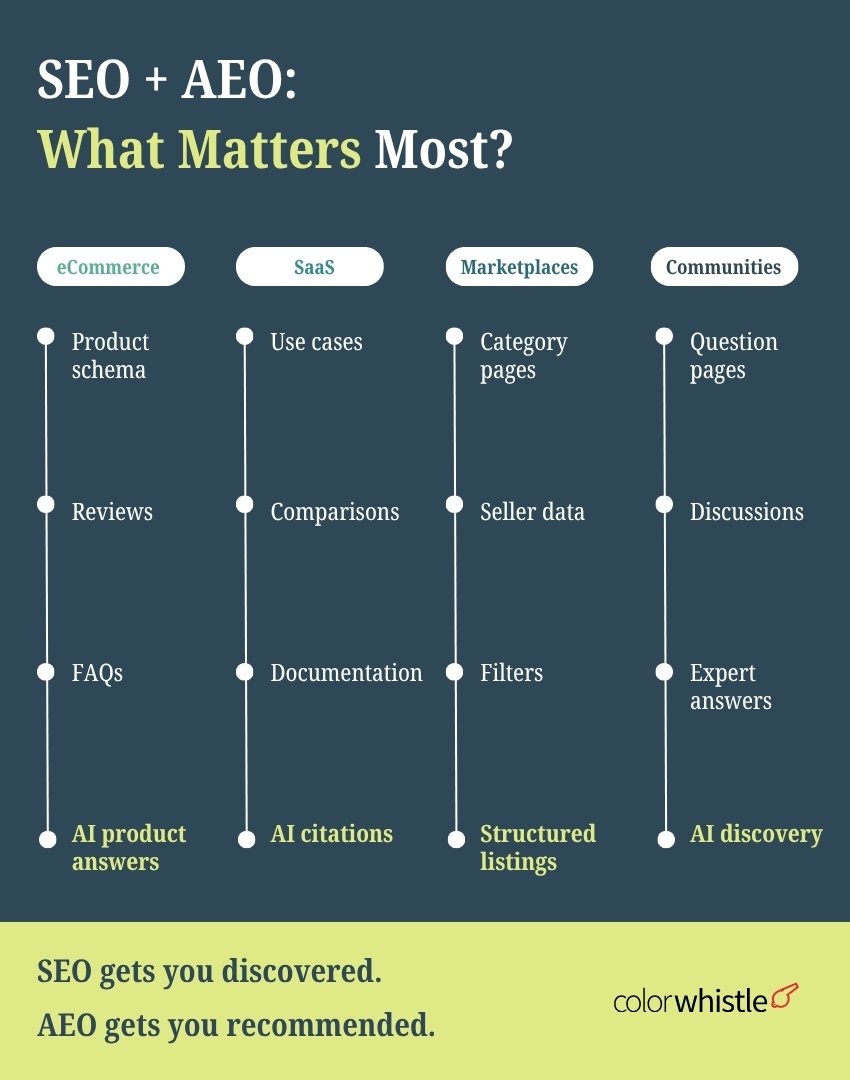
The biggest differences by website type (quick map)
Before we go page-by-page, here is the high-level truth:
eCommerce (stores with owned inventory)
- Primary SEO risk: faceted navigation, near-duplicate product variants, thin category pages
- Primary AEO opportunity: product specs, compatibility, shipping/returns, “best X for Y”
SaaS (pricing, demos, signups)
- Primary SEO risk: too many similar landing pages, jargon-heavy copy, weak informational coverage
- Primary AEO opportunity: clear definitions, pricing/plan answers, integrations, setup steps
Marketplaces (multi-seller or multi-provider)
- Primary SEO risk: duplicate listings, location/filter pages exploding, index bloat
- Primary AEO opportunity: “top providers in X,” trust signals, structured listing data
Communities (forums, Q&A, UGC)
- Primary SEO risk: low-quality threads indexed, crawl budget waste, duplicate discussions
- Primary AEO opportunity: high-quality Q&A that matches how people ask questions
eCommerce: product and category pages that win in SEO and AEO
Product pages: build an “answer block” above the fold
Most product pages are designed for humans to scroll. AEO needs a page that can answer quickly.
Add a tight section near the top (visible in HTML, not hidden in tabs):
What it is + who it’s for + key specs + trust signal.
Example structure:
- One-sentence product definition (no fluff)
- 3–5 bullet specs (size, material, compatibility, warranty)
- Shipping/returns summary
- Price range or “from $X”
- Review summary (if you have it)
This improves:
- Featured snippets and product-focused answers
- Conversion (people decide faster)
- Accessibility (clear scanning)
For eCommerce businesses looking to enhance their online presence through effective SEO strategies, it’s essential to address the primary risks while leveraging the available opportunities. Implementing a comprehensive SEO plan can significantly improve your website’s visibility.
Moreover, analyzing successful SEO case studies can provide valuable insights into effective practices. For those who need professional assistance in optimizing their website for better search engine performance, exploring SEO services offered by experts could be beneficial.
Additionally, if you’re an eCommerce business seeking to develop a robust online store with a focus on both SEO and user experience, consider investing in specialized eCommerce website development services.
Product descriptions: reduce duplicate templates
A common eCommerce failure is the reliance on a single template for every product, merely swapping adjectives. This leads to:
Thin differentiation across SKUs
Near-duplicate content across variants
Lower “reason to rank” for long-tail queries
Fix: write unique copy where it matters:
- First 80–120 words (unique positioning)
- Compatibility section (models, use cases)
- Care instructions, materials, sizing details
- “What’s in the box” (also great for AEO)
You do not need to write 800 words per product. You need unique decision info.
With the advent of AI tools for eCommerce, generating unique and relevant product descriptions has become easier and more efficient.
Category pages: stop treating them like filter lists
A category page that is only a grid is weak for both SEO and AEO.
Minimum improvements:
- 150–300 words of genuinely helpful copy (not “Shop the best…”)
- A short “how to choose” section
- A mini FAQ (3–6 questions) based on actual customer queries
- Internal links to subcategories and best-seller comparisons
AEO benefit: those “how to choose” paragraphs and FAQs often get extracted into answer results.
Category pages should not just serve as filter lists. Instead, they can be optimized using strategies similar to those employed in successful open-source SaaS auto parts eCommerce websites, which effectively manage product categorization and enhance user experience.
eCommerce structured data: only mark up what users can see
For eCommerce, structured data is a lever, but it is also easy to misuse.
Stick to:
Product(name, image, description, sku/gtin where applicable)Offer(price, currency, availability)AggregateRatingandReviewif shown to usersBreadcrumbListfor hierarchy
Use Google Search Central guidance as the rulebook and schema.org as the vocabulary. The practical rule is simple: structured data must match visible content.
Furthermore, leveraging eCommerce 3D product configurators can significantly enhance user engagement by allowing customers to visualize products better. This is particularly useful in multi-vendor platforms where a comprehensive multi-vendor website guide can provide valuable insights into managing such platforms effectively.
Finally, staying updated with global eCommerce insights can help businesses adapt their strategies according to market trends and consumer behavior.
Faceted navigation (filters): the #1 crawl and duplicate content trap
Filters create thousands of URL combinations:
/shoes?color=black&size=10&brand=nike/shoes?brand=nike&size=10&color=black(same page, different URL)
SEO risks associated with this faceted navigation include:
- Crawl budget waste
- Duplicate content
- Index bloat
- Category pages diluted by filter clones
Solution approach (practical):
- Decide which facets deserve indexation (usually only a small set).
- Keep most filter URLs crawlable for users but not indexable.
- Canonicalize and normalize URLs using deduplication and canonicalization strategies.
Common tactics:
noindex, followon most filtered combinations- Canonical from filtered pages back to the core category
- Parameter handling via consistent URL rules
- Internal links only to “approved” indexable facet pages
What you should not do:
Blanket blocking via robots.txt without thinking it through. That can prevent Google from seeing canonical signals and can trap crawl issues elsewhere.
Use your platform documentation here. Shopify, WooCommerce, Magento, BigCommerce, and headless frameworks all implement filters differently, so the right control points differ.
SaaS: landing pages, pricing, integrations, and “explainability” for AEO
SaaS SEO often fails because the site is all marketing and no answers.
SaaS landing pages: turn abstract claims into concrete answers
AEO rewards clarity over vibe.
If your hero says:
“One platform to unify your workflow.”
That does not answer anything.
Add a plain-English block immediately after:
- What the product does (specific outcome)
- Who it is for
- What it replaces (spreadsheets, 3 tools, manual process)
- Time-to-value (setup time, onboarding steps)
This block becomes a reliable extraction target for AI answers.
To gain insights into how successful SaaS companies have implemented exceptional marketing strategies, you can explore these exceptional marketing examples. Furthermore, understanding the AI transformation in SaaS companies can provide valuable context for leveraging artificial intelligence in your operations. If you’re interested in understanding the Total Addressable Market (TAM) for SaaS companies, this guide on understanding TAM for SaaS companies could be beneficial. Lastly, if you’re seeking inspiration for your website’s design or looking for effective SaaS website design ideas or designs, there are numerous resources available that can assist you in creating an optimized and user-friendly website.
Pricing pages: answer the questions people actually ask
Pricing is one of the most “answerable” SaaS page types.
Include:
- Plan comparison table (with real limits and units)
- What is included and what is not
- Add-ons
- Contract terms (monthly vs annual, cancellation)
- Minimum seat requirements (if any)
- Common billing FAQ (proration, invoices, taxes)
If you hide everything behind “Contact sales,” you force the answer engines to guess or use third-party sources.
To enhance your pricing page and make it more effective, consider incorporating some performance marketing strategies that can help drive more traffic and conversions.
Integration pages: prevent thin, repetitive “integration SEO”
SaaS teams often mass-produce integration pages that all look the same: “Connect X with Y to automate workflows.”
That becomes duplicate content.
Fix: Make integration pages operational:
- What the integration enables (3–5 real automations)
- Setup steps (numbered)
- Requirements (plans, permissions)
- Troubleshooting FAQ
- Links to docs
These pages rank better and get extracted more often because they contain concrete procedures.
SaaS structured data: focus on organization, software, and FAQs
Useful schema patterns:
Organization(logo, name, sameAs)SoftwareApplication(category, operatingSystem if relevant)FAQPagefor genuine FAQs (only if visible)BreadcrumbList
Avoid over-marking. Schema does not replace content. It clarifies it.
Marketplaces: scaling SEO without drowning in duplicates
Marketplaces are SEO machines when they are disciplined. They become SEO disasters when they index everything.
Listings: normalize titles and enforce required attributes
AEO and SEO both need consistent entities.
If sellers can create messy listing titles, your index becomes noisy and hard to trust. Require:
- Clear title format rules
- Mandatory attributes (brand, model, location, category)
- Standardized units and options
This improves:
- Internal search relevance
- Structured data quality
- Long-tail indexing
- Answer extraction accuracy
Additionally, these strategies can be beneficial not just for SaaS websites but also for building enterprise websites, where similar principles of structure and clarity apply.
Duplicate listings: pick a canonical strategy early
In the realm of multi-vendor marketplace websites, duplicate listings can pose a significant challenge. These duplicates often arise from:
- The same service being offered by multiple sellers
- The same product uploaded with minor differences
- Reposts across various locations
To tackle this issue, it’s crucial to decide on “the canonical page.” This could be defined as:
- The best listing (most reviews, verified seller)
- A clustered page (one canonical page with offers)
- A parent product page featuring seller offers underneath
Once the canonical page is determined, implement the following strategies:
- Use canonical tags
- Consolidate internal links
- Establish de-duplication rules at submission time
Location and filter pages: index only what has demand and inventory
Marketplaces generate infinite combinations of:
Category + city + price + rating + availability
However, indexing all of these combinations is rarely beneficial.
A practical rule to follow is:
- Only index location pages where there is meaningful supply and real search demand.
- Only index filters that yield a materially different set of results.
To achieve this, build a “curated index set” that includes:
- Top categories
- Top cities/regions
- Top combinations that convert
Everything else can exist for users but should remain out of the index.
Marketplace structured data: reflect what the page is
When it comes to structured data in marketplaces, common schema fits include:
Productwith multipleOfferentries (if applicable)LocalBusinessfor provider profiles (if relevant)BreadcrumbListAggregateRatingwhen reviews are visible
It’s essential to match the structured data with the visible content. For instance, if ratings are not shown on a particular page, they should not be marked up.
Communities and UGC: the fastest AEO wins with the highest SEO risk
Communities can dominate long-tail queries because they match how people speak. They also produce endless low-quality pages.
Your goal: index the “best answers,” not every thread
If you index everything, you accumulate:
- Thin pages
- Duplicate questions
- Old answers
- Low engagement pages that waste crawl budget
Practical approach:
- Index only threads that pass quality thresholds (length, engagement, accepted answer, moderator approval)
- Noindex low-quality or empty threads
- Use internal linking to elevate canonical “best” threads
Make Q&A extractable
To win AEO, format matters:
- Use question titles that match real queries
- Put the best answer near the top (or pin it)
- Summarize in 2–4 sentences before long discussion
- Add code blocks, steps, and examples where relevant
This increases the chance of being used for featured snippets and AI answers.
Handle “UGC duplicates” with consolidation
Communities often have repeated questions:
- “How do I reset my password?”
- “Is X compatible with Y?”
Fixes:
- Merge threads
- Redirect duplicates to the canonical thread
- Maintain an evergreen “official answer” page and link to it
This also reduces contradictory answers being extracted.
UGC structured data: use cautiously
If your pages are true Q&A, QAPage schema can help clarity. For generic discussion threads, it can be misleading.
Use:
QAPagefor question + answers formatDiscussionForumPostingfor forum threads (where appropriate)BreadcrumbList
Only apply markup where it accurately represents the content.
Duplicate content: the shared problem across all four site types
Duplicate content rarely “penalizes” you directly. It usually dilutes signals and wastes crawl.
Common sources by site type:
- eCommerce: variants, pagination, faceted URLs, manufacturer descriptions
- SaaS: near-identical landing pages by industry, city, or role
- Marketplaces: duplicate listings, parameterized search pages
- Communities: repeated questions and thin threads
Practical fixes:
- Canonical tags to the preferred URL
- Consolidate similar pages into one strong page
- Noindex pages that exist for UX but not for search
- Strong internal linking to reinforce the canonical version
If you only do one thing: pick a single preferred URL format and enforce it everywhere (internal links, sitemaps, canonicals).
Faceted navigation and pagination: what “good” looks like in practice
Facets and pagination are unavoidable for large inventories. The goal is controlled indexation.
A workable baseline:
- Index: core category pages and a limited set of high-demand facet pages
- Noindex: most filter combinations
- Canonical: filtered pages to the closest relevant index page
- Sitemap: include only indexable URLs
- Internal linking: link only to the URLs you want indexed
Pagination:
- Ensure paginated pages are crawlable
- Avoid creating thin paginated pages with little unique value
- Strengthen the first page (it is usually the ranking target)
The exact setup depends on your CMS/platform. This is where documentation for specific eCommerce CMS platforms matters more than generic SEO advice.
For an in-depth understanding of best practices in SEO, including how to effectively manage duplicate content, it’s beneficial to refer to Google’s comprehensive SEO starter guide.
Structured data: align with Google Search Central and schema.org (without overcomplicating it)
If you take away one rule, make it this:
Use schema.org types that match what the page actually is, and follow Google Search Central for eligibility and implementation details.
Practical workflow:
- Identify page type: Product, Category, SaaS landing, Listing, Profile, Q&A, Article
- Choose the correct schema.org type(s)
- Include only properties you can support with visible content
- Validate in Google’s tooling (and fix warnings that reflect real issues)
- Keep markup consistent across templates
Common “safe and useful” schema across most sites:
BreadcrumbListOrganization(site-wide)- Page-specific schema (Product, SoftwareApplication, QAPage, etc.)
Common mistakes:
- Marking up content that is hidden or not present
- Marking up reviews/ratings you do not display
- Mixing schema types incorrectly because a plugin auto-added them
If you rely on plugins, audit them. Many plugins add schema that conflicts with your own templates.
Using platform/CMS documentation to avoid invisible SEO bugs
Most SEO problems at scale are not content problems. They are implementation defaults.
Examples of what to check in your platform docs:
- How canonical tags are generated
- How filter URLs are formed (query params vs path)
- Whether the platform creates duplicate collection/category URLs
- How pagination works (and whether it generates crawlable URLs)
- How structured data is added (native vs plugin vs theme)
- How sitemaps are generated and what they include
- How to add noindex rules safely
This matters because the correct fix in Shopify is different from the correct fix in Magento, which is different from a headless Next.js storefront, which is different from a community platform like Discourse.
Do not fight the platform blindly. Find the control points the platform gives you, then implement your SEO rules there.
What to prioritize (a practical checklist by site type)
eCommerce (first 30 days)
- Fix faceted navigation indexation (index only what matters)
- Improve top category pages with buyer guidance + FAQs
- Add answer blocks and unique decision info to top products
- Implement clean Product + Offer + Breadcrumb schema
SaaS (first 30 days)
- Make landing pages definitional and concrete (what, who, how)
- Upgrade pricing and integration pages to answer real questions
- Build comparison pages for your real competitors
- Add Organization + SoftwareApplication + FAQ schema where appropriate
Marketplaces (first 30 days)
- Standardize listing data and required attributes
- Pick a canonical strategy for duplicates
- Curate indexable location/category combinations
- Mark up listings properly and keep filters under control
Communities (first 30 days)
- Stop indexing low-quality threads (quality gates + noindex)
- Pin or summarize best answers for extractability
- Consolidate duplicate questions
- Apply Q&A schema only to true Q&A pages
Wrap up: AEO and SEO are the same game, with different scoreboards
SEO is still about relevance, authority, and technical accessibility. AEO adds a harsher requirement: your site must be easy to summarize correctly.
That is why the best strategy is not “write more content.” It is:
- Create strong canonical pages per entity (product, category, feature, listing, question)
- Control duplication (filters, parameters, variants, UGC repeats)
- Use structured data as a mirror of visible truth, aligned with Google Search Central and schema.org
- Follow your platform’s documentation so your technical intent matches what the CMS actually outputs
If you want a simple north star: make your pages answerable in 10 seconds, and scalable in 10,000 pages.
FAQs (Frequently Asked Questions)
What is the difference between SEO and AEO in website optimization?
SEO (Search Engine Optimization) focuses on earning visibility for queries where users are willing to click and browse, supporting lead generation and discovery. AEO (Answer Engine Optimization) aims to make content extraction-ready so search engines can confidently answer specific questions quickly, rewarding pages with clear entity definitions, compact explanations, structured data, strong internal linking, and concise comparison or decision-making text.
How do SEO and AEO strategies differ across various website types?
SEO and AEO strategies vary by website type: eCommerce sites face risks like faceted navigation and thin category pages but have AEO opportunities in product specs and compatibility; SaaS sites risk jargon-heavy copy but benefit from clear definitions and pricing answers; Marketplaces must manage duplicate listings while leveraging trust signals; Communities should avoid low-quality threads but can optimize high-quality Q&A that matches user questions.
What are best practices for optimizing eCommerce product pages for both SEO and AEO?
To optimize eCommerce product pages for SEO and AEO, build an ‘answer block’ above the fold containing a one-sentence product definition, 3–5 key specs (size, material, compatibility), shipping/returns summary, price range, and review summary. This approach improves featured snippets, conversion rates, accessibility, and helps users decide faster while reducing duplicate content issues.
Why is managing duplicate content important in marketplace websites?
Duplicate content in marketplaces often arises from multiple listings of the same products or exploding location/filter pages, leading to index bloat that harms SEO. Managing this through unique listing data, structured markup, and controlling crawl budget is essential to maintain strong search visibility and prevent penalties from search engines.
How can SaaS websites balance SEO risks with AEO opportunities effectively?
SaaS websites can mitigate SEO risks like too many similar landing pages and jargon-heavy copy by providing clear entity definitions, straightforward pricing/plan information, integration details, and setup steps. This clarity supports AEO goals by enabling quick extraction of answers while maintaining sufficient informational depth for browsing users through well-structured landing pages.
What role does structured data play in enhancing both SEO and AEO performance?
Structured data aligned with Google Search Central guidelines and schema.org helps search engines understand page content clearly, enabling better indexing for SEO and making content extraction-ready for AEO. It supports rich results like featured snippets and answer boxes by matching visible content with precise markup, improving discoverability across multiple search surfaces including classic search results and AI-powered answers.
 AI Website Agents with WhatsApp & Telegra...