


AEO Setup for AI Search Visibility

Anusha is a digital strategy expert with deep expertise in branding, UI/UX, and performance-focused content. She brings advanced insight into brands to scale intelligently, blending creativity with conversion-focused thinking.

Our authors are proven experts in their fields, writing on topics where they have demonstrated expertise. Every piece of content undergoes peer review and validation by industry professionals.
SEO is no longer just about ranking a page for a keyword. Now, you are also competing to become the answer inside AI search experiences like Google AI Overviews, ChatGPT browsing, Perplexity, and other answer engines.
This shift is why AEO (Answer Engine Optimization) matters. AEO is the practice of structuring, writing, and publishing content so AI systems can confidently extract, attribute, and recommend your brand as a source.
In this guide, will walk you through a practical, forward-looking AEO setup that improves your odds of showing up in various AI search results. This includes appearing in Google AI Overviews and featured answer blocks, getting cited in ChatGPT and other LLM “browsing” responses, landing in Perplexity citations and “Sources” panels, and being featured in knowledge-style responses driven by entity understanding.
You will gain insights into how AI crawlers work, how entity understanding changes content strategy, what structured content looks like in practice, how to use FAQs and schema correctly, and how to build authority with citations and content architecture.
What AEO Actually Means (And What It Is Not)
AEO = making your content easy to extract, verify, and cite.
It is not about stuffing more keywords or writing for robots. And it is definitely not about publishing generic AI content at scale.
Most AI answer engines tend to favor sources that are clear and structured, consistent about entities (people, companies, products, concepts), backed by evidence (citations, data, firsthand proof), written with direct answers and minimal fluff, and published on sites that demonstrate topical authority.
If SEO is about ranking, AEO is about being chosen as a source of truth.
The integration of AI into website design and development can significantly enhance your AEO efforts. Moreover, with the rise of AI-assisted website design, creating structured content that aligns with AEO principles has become more achievable.
Additionally, understanding the impact of AI on website performance can provide valuable insights into optimizing your site for better visibility in AI search results. For a comprehensive understanding of the evolving landscape of SEO towards AEO and GEO (Geographic Engine Optimization), you might find this resource on SEO-AEO-GEO helpful.
How AI Crawlers and Answer Engines Find and Use Your Content
To set up AEO properly, you need a mental model of how the pipeline usually works:
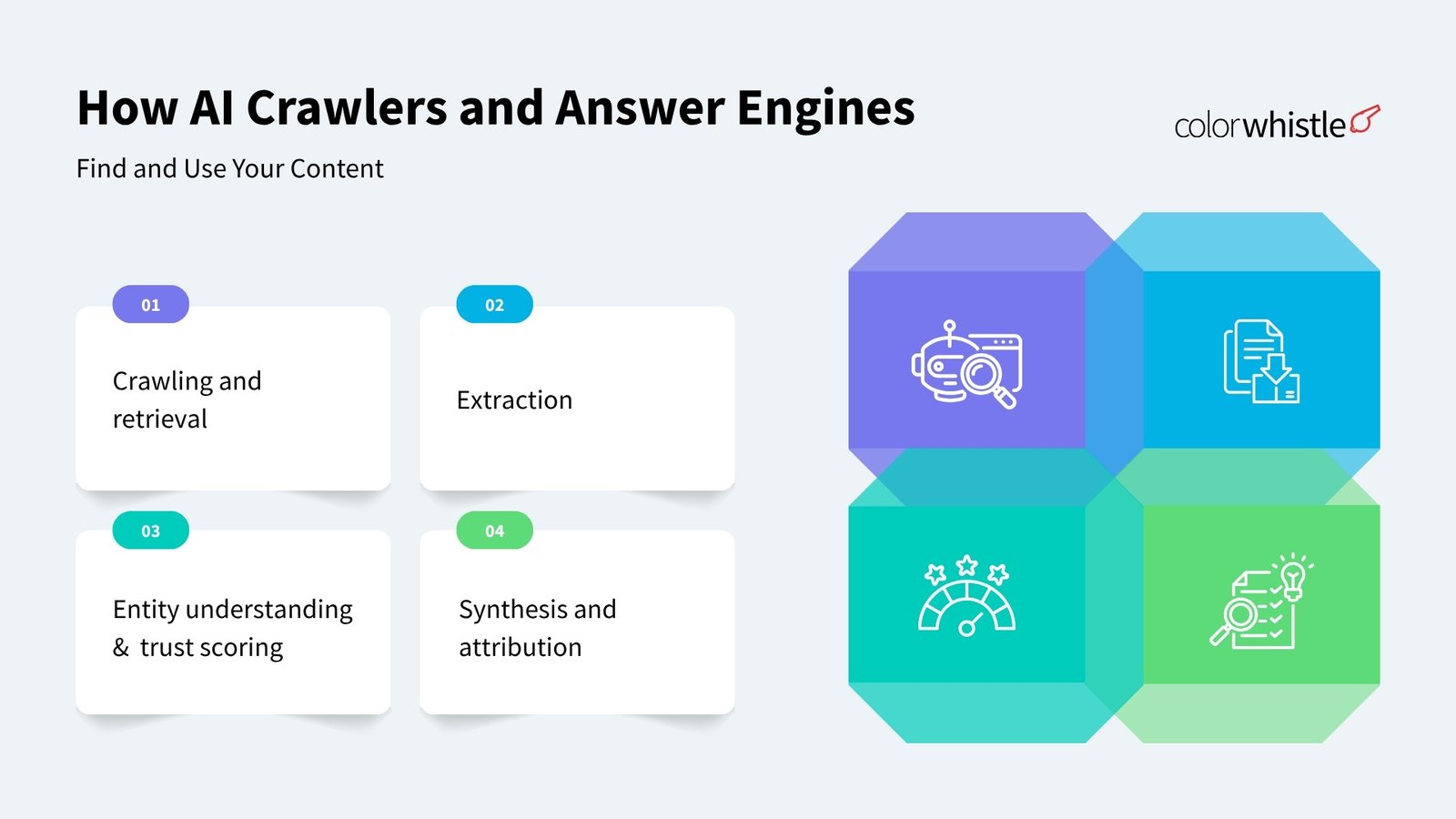
Crawling and retrieval
AI systems pull information from the web via:
- Search engine crawlers (classic indexing)
- Retrieval systems that query the index (RAG: retrieval augmented generation)
- Partnerships and licensed datasets (varies by platform)
- Feeds, APIs, and structured data where available
If your page is not crawlable, indexable, and internally discoverable, it is unlikely to be retrieved.
Baseline checklist
- Your important pages are indexable (no accidental noindex, canonical mistakes, blocked paths).
- Internal links exist from relevant hub pages.
- XML sitemap is clean and submitted.
- Page renders for bots (SSR or bot-friendly rendering if you rely heavily on JS).
- Fast enough that retrieval systems do not time out.
These factors highlight the importance of a well-planned website structure. This is something to keep in mind when considering a website redesign.
Extraction
Once retrieved, the system tries to extract:
- The direct answer
- Supporting details
- Definitions
- Lists, steps, comparisons
- Stats and claims (ideally with evidence)
This is where structured content wins.
Entity understanding and trust scoring
Modern systems do not only look at keywords. They attempt to understand:
- Who/what is being discussed (entities)
- Relationships between entities (brand to product, author to credentials, concept to definition)
- Consistency across the site (topic coverage and language stability)
- Corroboration (do other reputable sources say similar things?)
This is where content architecture, schema, and citations matter.
Synthesis and attribution
The final response is generated, often with:
- A short summary
- Key bullets
- A list of cited sources (common in Perplexity, sometimes in AI Overviews)
Your goal is simple: make your page the easiest high-confidence source to cite.
Step 1: Define Your Entity Strategy (This Is the Core of AEO)
If you want visibility in AI search, think in entities, not isolated keywords.
Build a simple entity map
Start by listing:
Primary entity
- Your brand or product (example: “Acme Analytics”)
Secondary entities
- Core offerings (features, services, use cases)
- For instance, you might offer AI app development services or AI consulting.
- Target industries
- Concepts you want to own (example: “data observability”)
Related entities
- Competitors (for comparisons)
- Tools you integrate with
- Standards and frameworks
- People (founders, authors, team experts)
- Locations (if relevant)
Then decide what you want AI systems to associate with you.
Example goal
“Acme Analytics” ↔ “data observability for fintech” ↔ “real-time anomaly detection” ↔ “SOC 2 reporting”
Lock in your naming consistency
AI retrieval gets messy when your entity naming is inconsistent.
Do this across your site:
- Use one official product name everywhere.
- Keep feature names stable (avoid swapping labels constantly).
- Standardize acronyms and spellings.
- Use consistent author names and bios.
This improves entity recognition and reduces ambiguity.
Enhance your online presence
To further improve your visibility and credibility online, consider leveraging professional SEO services that can help optimize your website for better search engine rankings.
Step 2: Create an AEO-Friendly Content Architecture (Hubs, Spokes, and Answer Pages)
AEO works best when your site clearly communicates topical authority. This is where a structured approach to content architecture becomes essential.
Use hub and spoke structure
Implement a hub and spoke structure for your content. Create hub pages for major topics and spoke pages for specific questions and subtopics.
Hub page: broad guide, category, or glossary topic
Spoke pages: detailed pages that answer one problem well
For instance, if you’re focusing on Travel SEO, the hub page could be a comprehensive guide on that topic while the spoke pages could tackle specific aspects like keyword strategies or local SEO tips.
Why this matters for AI Overviews and Perplexity Answer engines often retrieve multiple pages, then synthesize. If your site has a coherent cluster, it increases the odds that:
- multiple pages from your domain appear in retrieval
- your brand becomes associated with the topic entity
- the system finds both definition-level and detail-level content from you
Add “Answer Pages” intentionally
Not every page needs to be a long guide. Create pages that are designed to answer a question cleanly:
- What is X?
- How does X work?
- X vs Y
- Best practices for X
- Common mistakes in X
- Cost of X (with ranges and assumptions)
- Checklist for X
- Templates for X
These are extremely friendly to AI extraction.
Step 3: Write Structured Content That AI Can Reliably Extract
AI models love predictable structures. Humans do too. Here is a structure that consistently performs well for AEO:
Recommended on-page structure
- One-sentence direct answer near the top
- Short definition / context (2 to 4 sentences)
- Key takeaways (bullets)
- Step-by-step or framework (numbered)
- Examples (realistic, not hypothetical fluff)
- Edge cases / limitations (builds trust)
- FAQ (target retrieval queries)
- Sources / citations (where relevant)
In order to successfully implement this strategy, it’s crucial to understand the nuances of SEO and how it applies to different niches such as travel or e-commerce. You can also learn from best SEO case studies which provide valuable insights into successful strategies.
Moreover, comprehensive website planning is fundamental in creating an AEO-friendly content architecture that not only appeals to search engines but also provides value to users.
Write “extractable” sentences
If you want to be quoted, write in quotable units.
Bad (hard to extract):
- “There are many different ways to approach this depending on your goals…”
Better (extractable):
- “AEO improves AI search visibility by making your content easy to retrieve, verify, and cite.”
Use tight headings with question formats
Headings that mirror real queries perform well:
- “What is AEO?”
- “How does Google AI Overviews choose sources?”
- “Does schema help with ChatGPT visibility?”
This makes your page easier for retrieval systems to match to a question.
Step 4: Build a High-Intent FAQ Layer (Do Not Treat FAQs as Filler)
FAQs are not just for users skimming. They are a retrieval magnet.
How to build FAQs that drive AEO
- Use real queries from Search Console, support tickets, sales calls, Reddit, and community forums.
- Keep answers short, then link to dee
- Keep answers short, then link to deeper sections.
- Avoid repeating the same question with minor variations.
- Include “comparison” and “tool choice” questions.
FAQ examples for this topic
- What is the difference between SEO and AEO?
- How do I optimize for Google AI Overviews?
- How does Perplexity choose citations?
- Does schema increase AI visibility?
- What content gets cited most by ChatGPT?
If you add FAQ schema, keep it honest. Do not spam dozens of thin Q&As.
Additional Strategies for Success
To further enhance your content’s visibility and effectiveness, consider implementing some B2B SEO strategies. These strategies can help you target specific business audiences more effectively.
Moreover, if you’re in the travel industry, understanding and applying Google E-E-A-T principles can significantly improve your website’s credibility and ranking.
Lastly, optimizing your website’s structure and content can also increase Google crawl rate, allowing search engines to index your pages more effectively.
Step 5: Use Schema to Clarify Entities and Page Purpose (Without Overdoing It)
Schema is not a magic ranking button, but it helps machines understand what your page is about and who is behind it.
Schema types that matter for AEO setups
Use what fits your content, not everything at once.
- Organization: your brand entity, logo, social profiles
- WebSite + SearchAction: improves site-level understanding
- Article or BlogPosting: for editorial content
- FAQPage: when you have real FAQs
- HowTo: step-by-step guides (careful with eligibility rules in Google)
- Product: for product pages with pricing, reviews, and features
- Person: author entity (especially if relevant expertise)
- BreadcrumbList: helps content architecture clarity
Practical schema rules
- Keep schema consistent across templates.
- Make sure schema matches visible on-page content.
- Validate with Google’s Rich Results Test and Schema.org validator.
- Do not mark up content that is not actually present.
Schema supports AEO best when paired with:
- clear page structure
- strong internal links
- credible citations
- author and organization transparency
In the context of travel website design or development, incorporating relevant schemas can significantly enhance the site’s SEO performance. For instance, applying specific schemas tailored for a travel website can provide better clarity to search engines regarding the content and purpose of the site.
Moreover, if you’re running a multi-vendor marketplace or an enterprise website, understanding how to effectively use schema can be a game changer. Implementing the right schema types can improve the overall user experience by making the navigation more intuitive and the information more accessible.
Step 6: Add Citations Like a Publisher (Because AI Prefers Verifiable Claims)
AI engines tend to cite sources that look reliable. One of the biggest differences between “content that gets summarized” and “content that gets cited” is evidence.
What to cite
Cite claims that are:
- statistical (market size, adoption rates, benchmarks)
- medical or financial (especially)
- technical performance claims
- definitions that are disputed
- anything that could be challenged
When building a multi-vendor marketplace website, it’s crucial to back up your claims with solid evidence. This not only enhances your credibility but also aligns with AI’s preference for verifiable claims. Similarly, if you’re involved in building an enterprise website, incorporating credible citations will significantly improve your site’s authority and trustworthiness.
What counts as a strong citation
- Primary sources (studies, official docs, standards bodies)
- First-party data (your own benchmarks, with methodology)
- Reputable industry publications
How to implement citations on-page
- Link the specific claim to the source.
- Mention the source name in-text when it matters.
- Use a small “Sources” section when the page is data-heavy.
This is not just for Google. Perplexity-style products are designed to cite sources, and they favor pages that already behave like a cited document.
Step 7: Demonstrate Authority With Clear Authorship and Real Proof
AEO and authority are tightly connected. AI systems are cautious about who they trust, especially in sensitive topics.
Add authorship that actually helps
At minimum:
- author name
- short bio
- credentials relevant to the topic
- link to an author page with more background
- editorial policy or review process (optional but useful)
Add proof elements
Depending on your niche, include:
- original screenshots
- mini case studies
- specific examples of outcomes
- code snippets
- templates and checklists
- methodology notes for any tests you ran
This increases the chance your content is treated as “expert material,” not generic commentary.
Step 8: Optimize for AI Overviews Without Chasing Them
Google AI Overviews are still evolving. You cannot “force” inclusion, but you can increase eligibility.
Patterns that tend to help
- Answer-first formatting (direct response near the top)
- Clear subheadings that mirror questions
- Lists and steps that are easy to extract
- Definitions with clean language
- Balanced tone with limitations (not hype)
- Strong internal linking to supporting pages
- Up-to-date content (refresh dates matter)
Incorporating SEO strategies into your content can further enhance its visibility and authority online.
Avoid common mistakes
- Over-optimizing with repetitive keyword phrasing
- Thin “overview” pages that restate what everyone says
- Aggressive affiliate-style copy with no evidence
- Walls of text without structure
AEO content that wins usually reads like a helpful human wrote it for humans, but formatted in a way machines can parse cleanly.
Step 9: Make Your Content Easy for ChatGPT and Perplexity to Use
ChatGPT and Perplexity behave differently, but they share a preference for:
- clear factual statements
- scannable structure
- reputable sources
- coherent topical coverage
For ChatGPT-style answers
- Publish “definitive” pages that answer a question end-to-end.
- Keep intros short. Get to the point quickly.
- Add a “Key takeaways” section early.
For Perplexity-style citations
- Include citations and outbound references.
- Write in a way that allows line-by-line extraction.
- Avoid burying the main answer 20 paragraphs down.
One tactic that works across both
Add a short section like:
Quick answer
Best practice
Common mistake
Example
This format is very “retrieval friendly.”
Step 10: Create an AEO Audit Checklist (Use This on Every Important Page)
Here is a simple checklist you can apply today.
Crawl and index
- Page is indexable and canonicalized correctly
- Internal links point to it from a relevant hub
- Loads fast and renders content without relying on blocked scripts
Entity clarity
- Primary entity is named consistently
- Related entities are referenced naturally
- Author and organization are explicit
Structured writing
- Direct answer appears in the first screen
- Headings match query language
- Includes bullets, steps, or tables where relevant
- Includes examples and limitations
Trust and proof
- Citations for important claims
- Updated date if the topic changes quickly
- Author bio and/or editorial notes
Schema
- Article or BlogPosting schema (or the most relevant type)
- FAQPage schema if you have real FAQs
- Organization and BreadcrumbList schema applied site-wide where appropriate
- All schema validated and consistent with on-page content
A Practical 30-Day AEO Setup Plan (Actionable, No Guesswork)
If you want a realistic rollout, use this.
Week 1: Foundations
- Fix indexation, canonicals, and sitemap issues.
- Add Organization and WebSite schema.
- Create or clean up author pages and bios.
- Define your entity map and naming conventions.
Week 2: Architecture
- Build one hub page for a key topic.
- Map 6 to 12 spoke pages that answer specific questions.
- Add internal links from hub to spokes, spokes back to hub, and lateral links where relevant.
Week 3: Content Upgrades (AEO Formatting)
For your top 10 pages, add a direct answer block, key takeaways, FAQs, and citations for all major claims. Also add BreadcrumbList schema and validate it.
Week 4: Authority and Refresh
- Publish 2 to 4 “answer pages” that target high-intent questions.
- Add one original data point, benchmark, or mini case study.
- Update older posts with fresh sources and clearer structure.
Then monitor:
- Search Console queries that look like questions
- AI Overview appearances (where visible)
- Perplexity citations (manual checks)
- Referral traffic from AI surfaces (in analytics, if detectable)
FAQs: AEO Setup for AI Search Visibility
What is AEO in simple terms?
AEO (Answer Engine Optimization) is optimizing your content so AI search systems can retrieve it, extract clear answers, and cite it confidently.
Does schema guarantee inclusion in AI Overviews?
No. Schema helps machines understand your content and entities, but inclusion depends on relevance, trust, clarity, and corroboration.
What content gets cited most in Perplexity?
Pages with clear structure, direct answers, and verifiable claims with citations tend to get cited more often, especially if the site demonstrates topical authority.
Should I rewrite all my SEO content for AEO?
Not all of it. Start with pages that already get impressions and target queries that look like questions, comparisons, and “how-to” searches.
Is AEO only for informational content?
No. Product pages, category pages, and landing pages can also be optimized for AEO by clarifying entities, benefits, use cases, and adding structured sections like FAQs and comparisons.
The AEO Mindset That Wins
If you want AI search visibility, stop thinking like you are writing a blog post for a keyword. Instead, start thinking like you are publishing a source.
The winning setup is not complicated but it is disciplined:
- Build clear content architecture around entities
- Write structured, extractable answers
- Use FAQs to capture retrieval queries
- Add schema to clarify meaning, not to game the system
- Support claims with citations
- Demonstrate authority with authorship and real proof
By following these guidelines consistently, you will put your site in the best position to appear in AI Overviews, ChatGPT-style answers, and Perplexity citations as these platforms keep expanding.
Furthermore, embracing the AI revolution in website development can significantly enhance your site’s performance. This involves understanding the impact of AI in digital marketing which includes leveraging AI-generated content best practices.
Moreover, exploring the intersection of AI and responsive web design can lead to more user-friendly websites. Lastly, considering multimodal AI content creation strategies could provide a significant edge over competitors by allowing for more diverse and engaging content formats.
FAQs (Frequently Asked Questions)
What is Answer Engine Optimization (AEO) and why does it matter?
Answer Engine Optimization (AEO) is the practice of structuring, writing, and publishing content so AI systems can confidently extract, attribute, and recommend your brand as a reliable source. It matters because AI search experiences like Google AI Overviews, ChatGPT browsing, and Perplexity prioritize sources that provide clear, structured, and trustworthy information rather than just keyword ranking.
How does AEO differ from traditional SEO?
While traditional SEO focuses on ranking pages for specific keywords, AEO aims to make your content easy for AI answer engines to extract, verify, and cite as a source of truth. AEO emphasizes entity understanding, structured content, citations, and topical authority instead of keyword stuffing or generic AI-generated content.
What are the key steps in how AI crawlers and answer engines find and use content?
AI systems typically follow these steps: 1) Crawling and retrieval via search engine crawlers or retrieval systems; 2) Extraction of direct answers, supporting details, lists, and stats; 3) Entity understanding and trust scoring by analyzing entities and their relationships; 4) Synthesis and attribution by generating summaries with cited sources. Ensuring your content is crawlable, structured, consistent, and well-cited improves your chances of being chosen as a source.
What does effective structured content look like for AEO?
Effective structured content provides clear direct answers with minimal fluff, includes supporting details like definitions, lists, comparisons, statistics backed by evidence or citations, and uses schema markup correctly. It also maintains consistency in terminology around entities such as brands, products, concepts to help AI understand relationships clearly.
How can I define an entity strategy to improve my AEO setup?
Start by building an entity map listing your primary entity (e.g., your brand or product), secondary entities like core offerings and target industries, and related entities such as competitors or relevant people. Decide what associations you want AI systems to make with your brand—for example linking your company with specific concepts or use cases—to guide consistent content architecture aligned with AEO principles.
Why are citations and content architecture important in AEO?
Citations provide evidence that supports claims made in your content, increasing trustworthiness for AI systems evaluating source credibility. Content architecture ensures consistent coverage of topics and stable language around entities across your site. Together they help AI answer engines understand relationships between entities and corroborate information with reputable sources—key factors in being selected as a high-confidence answer source.
 Brilliant Directories: The Complete Guide to ...