


AI Tutor Platform Statistics & Adoption Trends: Personalized Learning Insights

Anusha is a digital strategy expert with deep expertise in branding, UI/UX, and performance-focused content. She brings advanced insight into brands to scale intelligently, blending creativity with conversion-focused thinking.

Our authors are proven experts in their fields, writing on topics where they have demonstrated expertise. Every piece of content undergoes peer review and validation by industry professionals.
AI tutoring is moving beyond the idea of a chatbot that answers student questions. In 2026, AI tutor platforms are increasingly being designed as learning companions that explain concepts, ask questions, provide feedback, adapt to learner needs, support exam preparation, and work alongside teachers.
The shift is also becoming more measurable. Universities are reporting large-scale usage of AI learning assistants; students are increasingly turning to AI for practice and understanding, and research is beginning to test whether AI tutoring actually improves learning outcomes.
This article brings together the latest AI tutor platform statistics, adoption trends, personalized learning insights, engagement data, and research findings, with a focus on developments from 2025 onward.
AI Tutor Platform Statistics at a Glance
| Statistic | What it tells us |
|---|---|
| $2.7 billion | Estimated global AI tutors market size in 2026 |
| 30.5% CAGR | Projected AI tutors market growth from 2026 to 2033 |
| 95%+ | Students and faculty surveyed by Coursera using AI in an educational context |
| 47% | Students and educators identifying personalized learning as a major AI benefit |
| 58% | IU online students in a large-scale study who used its AI learning companion |
| 77,000+ | Students represented in IU's real-world AI learning assistant analysis |
| 2 million | Khanmigo users during the 2024-25 school year |
| 731% | Year-over-year growth in Khanmigo sign-ups |
| 99.4% | Student questions resolved by LearnWise AI Tutor in its 2025-26 dataset |
| 45%+ | GenAI enrollments per minute on Coursera in 2026, showing the broader demand for AI-supported learning |
AI Tutors Are Moving from Experiment to Education Infrastructure
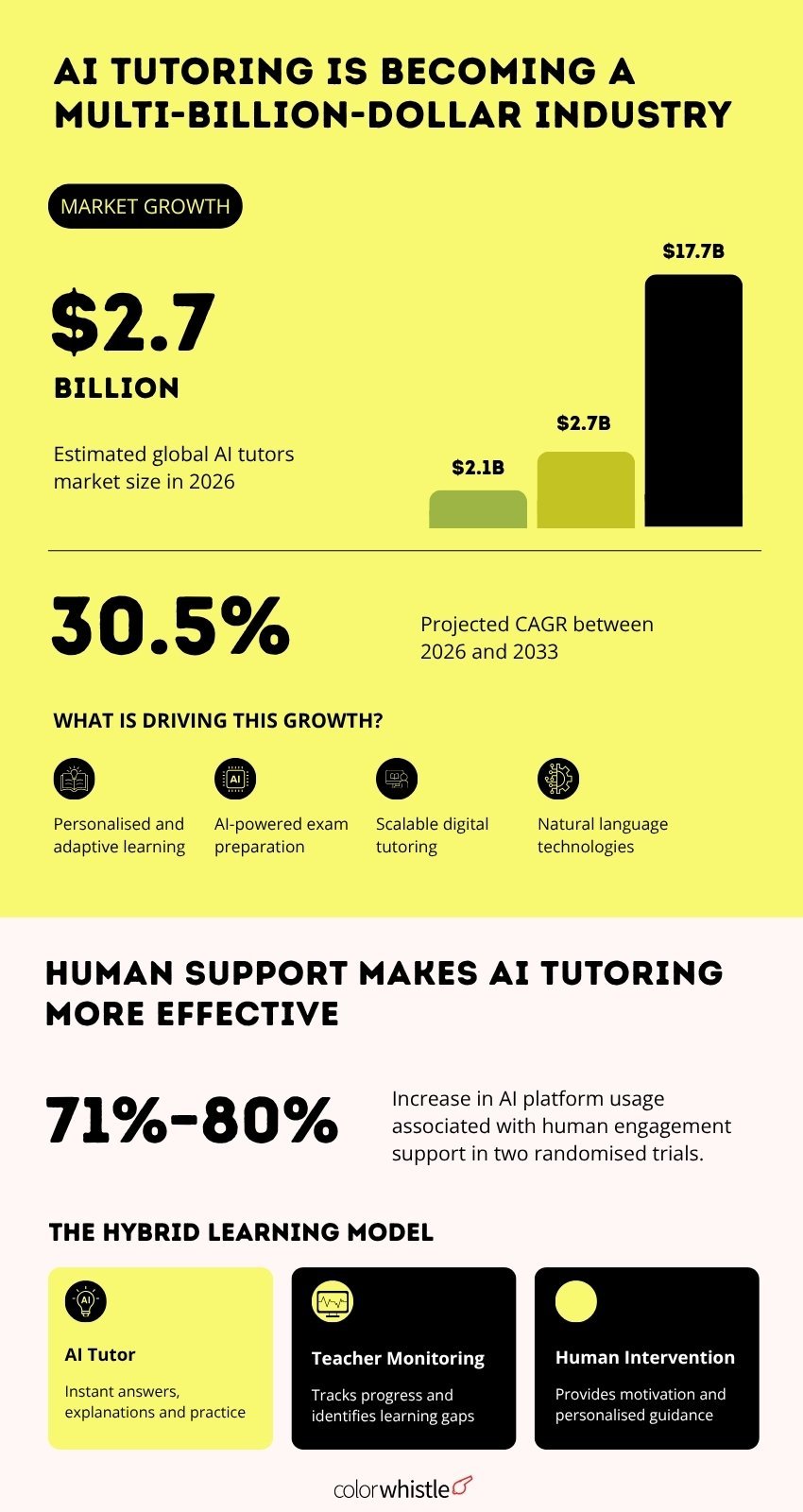
The global AI tutors’ market is estimated at $2.7 billion in 2026
Grand View Research estimates that the global AI tutors market will reach $2.7 billion in 2026, up from an estimated $2.1 billion in 2025. The market is projected to reach $17.7 billion by 2033, representing a 30.5% CAGR from 2026 to 2033.
The growth is being driven by personalized and adaptive learning models, institutional adoption, natural language technologies, and demand for scalable digital tutoring.
Source: Grand View Research
What does this mean?
AI tutoring is becoming a distinct product category rather than simply another feature inside an LMS or chatbot.
For EdTech companies, this creates opportunities to build platforms around:
- Personalized tutoring
- Subject-specific AI tutors
- Adaptive learning
- AI exam preparation
- AI-powered practice
- Learning companions
- Skills-based tutoring
- AI teaching assistants
- Corporate learning copilots
The competitive advantage is increasingly likely to come from how well the AI understands the learner and learning context, rather than simply whether a platform has an AI chatbot.
AI Learning Assistants Are Already Being Used at Scale
58% of IU online students used its AI learning companion
A 2026 study by IU International University of Applied Sciences analyzed anonymized usage data from approximately 77,000 online students using its AI learning companion, Syntea.
Around 58% of the students included in the study used Syntea during the observation period.
The study is particularly valuable because it examines actual usage behavior rather than relying only on surveys.
Usage also changes according to learner circumstances
The IU research found that:
- Around 64% of Gen Z students used Syntea
- Around 50% of Gen X students used it
- Around 38% of Baby Boomers used it
- 59% of women used it compared with 55% of men
- Part-time students were more likely to use the AI companion during evenings and weekends
- Psychology and Education, and Marketing and Communication, were among the areas with particularly intensive usage
What does this mean?
Personalization is not simply about changing the difficulty of a question.
A mature AI tutor can potentially personalize around:
Who the learner is + what they are learning + when they learn + why they are learning + where they are struggling.
That makes learner context an important product-design consideration for AI tutor platforms.
AI Has Become Almost Universal in Higher Education
More than 95% of students and faculty surveyed by Coursera use AI
Coursera’s 2026 AI in Higher Education Report surveyed more than 4,200 university faculty members and college students across the US, UK, India, Saudi Arabia, and Mexico.
More than 95% of respondents said they use AI tools in an educational context.
The survey also found that 81% believed AI was positively influencing higher education.
But AI use is not the same as AI tutoring
This distinction is important.
Students reported using AI for:
- Research: 51%
- Writing: 49%
- Practice questions or exams: 46%
- Time management: 44%
Only 63% said they use AI for less than half of their tasks.
What does this mean?
The market opportunity is shifting from generic AI access toward purpose-built learning experiences.
A student asking ChatGPT a question is not necessarily using an AI tutor.
An AI tutor should ideally understand:
- The learner’s curriculum
- Previous performance
- Learning objectives
- Current level
- Mistake patterns
- Assessment requirements
- Preferred learning approach
- Progress over time
That is where a dedicated AI tutor platform can create more value than a general-purpose chatbot.
Personalized Learning Is the Leading Perceived Benefit
47% identify personalized learning as a key benefit of AI
In Coursera’s 2026 higher education survey, 47% of students and educators identified facilitating personalized learning as a positive effect AI can deliver.
Among students, the figure was 49%, compared with 44% among faculty.
Other frequently selected benefits included:
- Productivity and efficiency: 40%
- Better support: 40%
- Real-time feedback: 36%
What does this mean?
Personalization is emerging as one of the strongest reasons to build AI into learning platforms.
But effective personalization requires more than:
“Explain this in simpler words.”
A sophisticated AI tutor could personalize the learning journey by adjusting:
Content → Difficulty → Pace → Examples → Practice → Feedback → Revision → Assessment
This creates an opportunity for EdTech platforms to build adaptive learning loops, rather than simply adding an AI chat window.
Khanmigo Shows How Quickly AI Tutor Adoption Can Scale
Khanmigo reached 2 million users
Khan Academy’s annual report for the 2024-25 school year reported 2 million global Khanmigo users, including students, educators, and parents.
Khanmigo sign-ups grew 731% year over year compared with the previous school year.
Khan Academy also reported that Khanmigo was used alongside Khan Academy Districts by approximately 770,000 students in US district partnerships.
What does this mean?
The growth demonstrates an important trend:
AI tutoring adoption can scale rapidly when it is integrated into an existing learning ecosystem.
The strongest AI tutor platforms may therefore not be standalone applications. They may be embedded into:
- LMS platforms
- School management systems
- Online course platforms
- Test preparation platforms
- University portals
- Corporate learning platforms
- Student apps
Integration reduces friction because learners encounter the tutor within the environment where learning is already happening.
AI Tutors Are Being Used Outside Traditional Learning Hours
Part-time learners use AI companions more heavily during evenings and weekends
The IU study found that AI learning assistant usage reflected students’ individual schedules.
Full-time students predominantly used the AI companion during weekday daytime hours, while part-time students were more likely to use it during evenings and weekends.
Source: IU International University of Applied Sciences, 2026
What does this mean?
One of the strongest advantages of AI tutoring is availability at the moment of need.
Traditional tutoring is constrained by:
- Tutor availability
- Class schedules
- Office hours
- Geography
- Student-tutor ratios
AI tutors can potentially provide support whenever a learner gets stuck.
This makes AI tutoring particularly relevant to:
Online education + working professionals + distance learning + self-paced courses + global learners.
AI Tutors Can Handle High Volumes of Student Questions
LearnWise AI Tutor resolved 99.4% of student questions in its 2025-26 dataset
LearnWise analyzed 191,283 real AI tutoring conversations across 56 higher education institutions in 11 countries between September 2025 and April 2026.
The dataset contained more than 1.7 million student messages.
The AI tutor reported a 99.4% resolution rate, while 15% of conversations included referrals to a human resource such as an instructor, campus service, or library.
The median time from question to working answer was reported as 3 minutes, and 52% of conversations occurred outside standard business hours.
Source: LearnWise, State of AI-Powered Teaching & Learning 2026
What does this mean?
The value proposition isn’t necessarily “replace teachers.”
A more realistic model is:
AI handles high-volume, repetitive and immediate questions → educators handle complex, contextual and high-value interventions.
This can help institutions expand learner support without increasing the student-to-human-support ratio at the same rate.
Real Usage Data Shows That Access Alone Does Not Guarantee Engagement
96% of students tried Khanmigo, but usage was relatively infrequent
A 2026 NBER study examined a two-year randomized trial involving Khanmigo in 18 Tennessee middle schools.
The study found that 96% of students tried Khanmigo at least once.
However, the median student messaged the tutor on only about one-third of practice days and during only 17% of exercise sessions in which they made a mistake.
The researchers identified engagement as an important constraint on the effectiveness of AI tutoring.
Source: NBER, One Click Away: AI Tutoring with Khanmigo in a Two-Year School Experiment, 2026
What does this mean?
This is one of the most important findings for AI tutor product developers.
Providing an AI tutor is not enough.
The platform also needs to encourage learners to use it at the right moment.
That could mean:
- Proactive hints
- Contextual nudges
- “Need help?” prompts
- Adaptive practice
- Difficulty detection
- Mistake-triggered tutoring
- Progress reminders
- Personalized learning plans
- Teacher-recommended interventions
The future of AI tutoring is therefore partly an engagement design problem, not only an AI problem.
Human Support Can Increase AI Tutor Engagement
Human support increased AI platform engagement by 71% to 80% in two randomized trials
A 2026 EdWorkingPaper examined two randomized controlled trials involving elementary students using an AI literacy platform.
The researchers found that human tutors focused on encouraging platform engagement increased usage by 71% to 80%.
However, the intervention did not improve reading achievement, and overall usage remained low.
What does this mean?
This supports a broader product principle:
AI + human support can be more useful than AI access alone.
For EdTech platforms, this could translate into hybrid models where:
- AI provides immediate assistance
- Teachers monitor progress
- Tutors intervene when engagement drops
- AI identifies struggling learners
- Human educators handle exceptions
- Institutions control learning policies
This is especially relevant for K-12 and higher education platforms where learner accountability matters.
Research Is Beginning to Show Learning Gains, But Results Depend on Design
A randomized study found stronger learning gains with a pedagogically designed AI tutor
A randomized controlled trial published in Scientific Reports compared an AI-powered tutor with an active-learning classroom environment.
The researchers reported that students using the AI tutor learned significantly more in less time and showed higher engagement and motivation. The median learning gains in the AI-tutored group were more than twice those of the in-class active-learning group.
Importantly, the AI tutor was designed around the same pedagogical principles used in the classroom intervention.
Source: Scientific Reports
What does this mean?
The important lesson is not simply:
AI tutoring works.
It is:
AI tutoring designed around sound pedagogy can work.
That distinction matters enormously.
A platform that simply connects an LLM to a course library is not necessarily an effective AI tutor.
A stronger system needs:
- Learning objectives
- Pedagogical rules
- Guided questioning
- Feedback loops
- Appropriate difficulty
- Retrieval and practice
- Assessment
- Progress tracking
- Human oversight
AI Tutor Platforms Are Moving Toward Learning Companions
The IU Syntea example illustrates an important product shift.
Syntea has evolved from an AI assistant into a Learning Companion, with plans to introduce multimodal capabilities and more personalized learning dialogues connected to students’ career goals and interests.
What does this mean?
The next generation of AI tutor platforms is likely to move beyond:
Question → Answer
toward:
Assess → Understand → Teach → Practice → Evaluate → Adapt → Repeat
This creates a much more continuous relationship between learner and platform.
AI Is Becoming a Learning Tool Beyond Dedicated Tutor Platforms
74% of AI users say they use AI to learn something new or understand a complex topic
Google’s 2026 report on its 2025 “Our Life with AI” survey found that 74% of AI users reported using AI to learn something new or understand a complex topic.
The survey covered 21,000 people across 21 countries.
Among students aged 18 and above:
- 85% reported using AI
- 83% used it for schoolwork
- 78% used it to understand complex topics
What does this mean?
AI tutoring is competing with general-purpose AI for learners’ attention.
This creates a challenge for dedicated EdTech platforms.
An AI tutor cannot simply be “ChatGPT inside an LMS.”
It needs to provide learning-specific value that general-purpose AI does not automatically provide.
That could include:
- Curriculum alignment
- Verified learning content
- Student profiles
- Learning analytics
- Teacher dashboards
- Assessments
- Institutional controls
- Academic integrity
- Progress tracking
- Personalized pathways
Indian Higher Education Is Already Adopting AI Tutoring
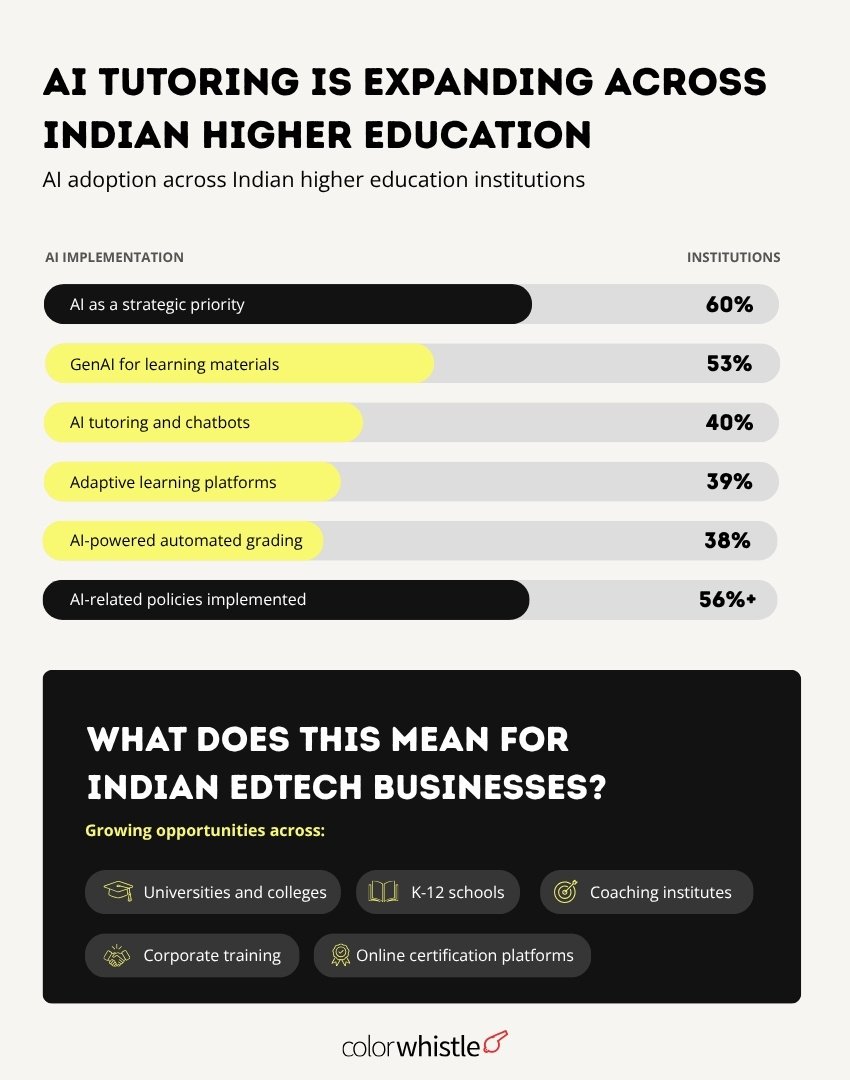
40% of surveyed Indian HEIs use AI-powered tutoring and chatbots
An EY-Parthenon and FICCI study of 30 leading Indian higher education institutions found that:
- 60% had identified AI as a strategic priority
- 53% were using GenAI for learning materials
- 40% were using AI-powered tutoring and chatbots
- 39% had introduced adaptive learning platforms
- 38% were using AI for automated grading
- More than 56% had implemented AI-related policies
Source: EY India, Future-Ready Campuses: Unlocking the Power of AI in Higher Education
What does this mean?
For the Indian EdTech market, AI tutoring is already moving into institutional use.
The opportunity extends beyond consumer learning apps into:
Universities + Colleges + Coaching Institutes + K-12 Schools + Corporate Training + Certification Platforms
This also means platform developers need to think about institutional requirements such as data privacy, governance, integrations, analytics and teacher controls.
AI Tutor Adoption Is Growing, But Institutions Still Need Governance
Only 26% of surveyed faculty said their institution has a formal AI policy
Despite more than 95% of Coursera’s surveyed students and faculty using AI in an educational context, only 26% of faculty said their institution had a formal policy governing AI use.
Only 28% believed their university was ready to manage students’ AI use.
Source: Coursera, AI in Higher Education Report 2026
The OECD’s 2026 Digital Education Outlook makes a similar distinction: GenAI can support learning when guided by clear teaching principles, but using it without pedagogical guidance can improve task performance without necessarily producing learning gains.
What does this mean?
The next stage of AI tutor adoption will not be determined only by model intelligence.
It will also depend on:
- AI governance
- Data protection
- Academic integrity
- Curriculum alignment
- Teacher oversight
- Explainability
- Content accuracy
- Age-appropriate design
- Assessment integrity
- Institutional controls
Key AI Tutor Platform Trends for 2026 and Beyond
The statistics point toward several clear developments.
1. From AI chatbot to AI learning companion
The basic conversational interface is becoming commoditized.
The differentiation will come from understanding the learner’s journey.
2. From personalization to adaptive learning
Personalized content is only the beginning.
AI tutor platforms will increasingly adjust difficulty, pace, practice and intervention based on learner behavior.
3. From reactive answers to proactive tutoring
Instead of waiting for students to ask:
“I don’t understand this.”
AI systems can detect repeated mistakes, hesitation, low engagement or knowledge gaps and intervene.
4. From standalone AI to LMS-integrated tutors
Integration with existing learning platforms can make AI tutoring part of the normal learning workflow rather than another application students need to open.
5. From AI-only to human-AI tutoring
The evidence increasingly supports a model where AI handles scale and immediacy while teachers and tutors provide judgment, motivation and complex intervention.
6. From content delivery to learning outcomes
The important question is shifting from:
“Does the platform have AI?”
to:
“Does the AI help students learn better?”
That means future AI tutor platforms will increasingly need measurable outcomes such as:
- Knowledge retention
- Assessment improvement
- Course completion
- Engagement
- Time to mastery
- Skill progression
- Learner satisfaction
- Reduction in support workload
What AI Tutor Statistics Mean for EdTech Businesses
The market is entering an important transition.
The first wave of AI education products focused heavily on access to generative AI.
The next wave is likely to focus on structured learning experiences built around AI.
For an EdTech company considering an AI tutor platform, the architecture may increasingly look like:
Learner Profile → Knowledge & Curriculum Layer → AI Tutor / Learning Companion → Adaptive Practice → Assessment & Feedback → Learning Analytics → Teacher / Mentor Intervention
The AI model is only one component.
The real product value comes from everything surrounding it.
Conclusion
AI tutoring is moving into a more mature phase.
The latest statistics show strong adoption, but they also reveal an important distinction: access to AI does not automatically create better learning.
The most promising AI tutor platforms are moving toward personalized learning companions that understand the learner, provide contextual guidance, adapt to performance, encourage engagement and involve human educators when needed.
For EdTech companies, this creates a much larger opportunity than simply adding an AI chatbot.
The next generation of learning platforms will be built around a more intelligent question:
How can technology continuously adapt the learning experience to each learner while keeping educators in control?
That is where AI tutoring, adaptive learning, learning analytics and human expertise are beginning to converge.
For EdTech businesses planning an AI-powered learning platform, this shift creates opportunities to rethink everything from learner journeys and personalization to assessments, integrations and teacher workflows. ColorWhistle can help design and develop AI-enabled EdTech platforms around these evolving learning models.
- Grand View Research, AI Tutors Market
- Coursera, AI in Higher Education Report 2026
- IU International University, AI Learning Assistant Study 2026
- Khan Academy Annual Report
- OECD Digital Education Outlook 2026
- Google, Our Life with AI
- EY India, AI in Higher Education
- LearnWise, State of AI-Powered Teaching & Learning 2026
- NBER, Khanmigo AI Tutoring Study 2026
- Scientific Reports, AI Tutoring RCT
- SCALE Initiative, AI Tutoring and Human Support
Frequently Asked Questions
What is an AI tutor platform?
An AI tutor platform is an educational software system that uses artificial intelligence to provide personalized instruction, explanations, practice, feedback and learning support. Unlike a general-purpose chatbot, an AI tutor can be designed around a specific curriculum, learner profile, assessment system and learning objective.
How many students are using AI tutors?
There is no single global figure for dedicated AI tutor users because platforms define and report usage differently. However, large-scale evidence shows substantial adoption. Khan Academy reported 2 million Khanmigo users during the 2024-25 school year, while an IU study analyzed actual usage from approximately 77,000 online students using its AI learning companion.
How effective are AI tutors?
Evidence is promising but not uniform. Research has found positive learning outcomes for some pedagogically designed AI tutoring systems, while other studies show that simply providing access does not guarantee meaningful engagement or achievement improvements. The quality of instructional design, engagement strategy and human support matters.
Can AI tutors replace teachers?
AI tutors are better viewed as a support layer rather than a complete replacement for teachers. AI can provide immediate explanations, practice and repetitive support at scale, while educators remain important for motivation, judgment, complex instruction, pastoral support and learning decisions.
What features should an AI tutor platform have?
Important capabilities can include personalized learner profiles, curriculum-aware tutoring, adaptive difficulty, guided questioning, practice generation, instant feedback, assessments, progress analytics, multilingual support, teacher dashboards, LMS integration and human escalation.
What is the future of personalized AI tutoring?
The direction is moving from simple question answering toward continuous learning companions that understand a learner’s goals, performance, context and progress. The strongest platforms are likely to combine AI tutoring with adaptive learning, analytics, assessments and human oversight.
 Online Learning Statistics for Working Profes...