




Top E-Learning Website Features, Ideas, and Inspirations

Powered by an expert content team, this blog blends SEO precision with compelling storytelling. Every insight is supported by data-driven research, ensuring content that ranks, engages, and drives conversions.

Our authors are proven experts in their fields, writing on topics where they have demonstrated expertise. Every piece of content undergoes peer review and validation by industry professionals.
AI Summary
A Quick Summary of Top E-Learning Website Features
This serves as a practical guide for e-learning website creators aiming to build engaging, efficient platforms. The key insight: incorporating features like online admissions, course creation, reporting, gamification, and video conferencing differentiates sites and boosts user experience. The blog details essential tools such as dashboards for progress tracking, asynchronous learning for flexibility, and payment gateways for seamless transactions. It targets educators and developers seeking to optimize digital learning environments, promising improved student engagement, streamlined administration, and higher enrollment. By adopting these proven features, readers can create competitive e-learning websites that meet modern educational demands and drive user success.
In 2026, the e-learning landscape is evolving faster than ever, powered by artificial intelligence, immersive technologies, and data-driven personalization. Today’s learners expect platforms that do more than host static courses: they want tailored learning paths, intelligent recommendations, real-time feedback, and experiences that feel as engaging as native mobile apps.
Modern e-learning websites are now integrating AI-guided content generation, adaptive learning engines, microlearning workflows, and immersive AR/VR modules to meet diverse learner needs and boost engagement.
Beyond traditional features like course catalogs and dashboards, next-generation platforms leverage AI tutors, analytics-backed skill paths, social learning environments, and blockchain-enabled credentials, transforming how education, corporate training, and skills development happen online. This blog explores both the essential features e-learning websites still need and the latest innovations shaping the future of digital learning.
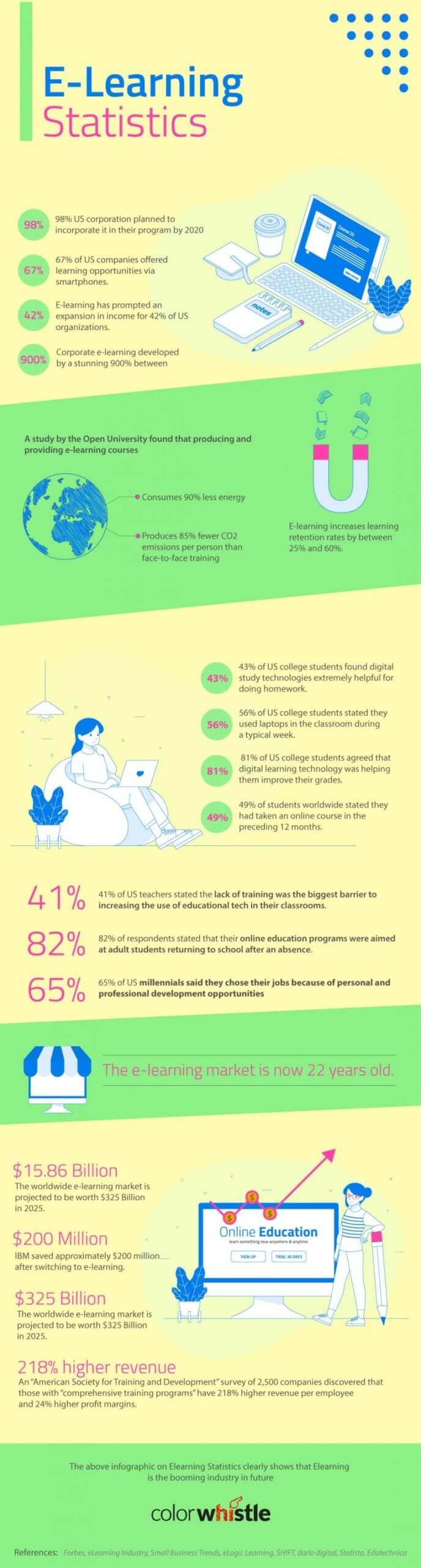
e-Learning Industry Statistics That You Should Know!
Features that Enhance Your E-Learning Website
1. AI-Driven Personalization (Major Gap)
The blog talks about features but does not cover AI-powered learning paths, such as:
Adaptive course sequencing based on learner behavior
AI recommendations for next lessons, certifications, or skill gaps
Personalized assessments that adjust difficulty in real time
2. AI Tutors & Chatbots
- 24/7 AI tutors for instant doubt clarification
- Context-aware chatbots trained on course content
- AI-assisted exam prep and revision summaries
Modern platforms (Coursera, Udemy Business, Degreed) already use this.
3. Microlearning & Nano-Learning Design
Bite-sized lessons (3–7 minutes)
Scroll-based learning (similar to social media UX)
Scroll-based learning (similar to social media UX)
This is critical for mobile-first and working professionals.
Also Read
4. Skills-Based Learning & Career Mapping
- Skill graphs (what skills a learner has vs. needs)
- Role-based learning paths (e.g., “Become a React Developer”)
- Career outcome tracking (job readiness indicators)
Modern e-learning is shifting from course-centric to skill-centric.
5. Learning Analytics for Learners (Not Just Admins)
Personal learning analytics for users
Time-to-skill metrics
Strength/weakness visualizations
Benchmarking against peers or industry standards
6. Social & Collaborative Learning
- Peer-to-peer learning spaces
- Study groups / cohort-based learning
- Community discussions tied to lessons
- Mentor / coach interaction layers
Social learning significantly improves completion rates.
7. Credentialing Beyond Certificates
Blockchain-verifiable credentials
Shareable digital badges (LinkedIn, GitHub, portfolio sites)
Stackable credentials (micro-credentials → diploma)
This is becoming standard in professional education.
Also Read
8. Immersive Learning (AR/VR / Simulations)
- Virtual labs (especially for healthcare, engineering, science)
- Role-play simulations
- Scenario-based learning environments
This is a growing differentiator in enterprise and higher education.
9. Offline-First & Low-Bandwidth Optimization
Offline course access with sync
Low-data modes for emerging markets
Progressive Web App (PWA) strategy
This is critical for global reach, especially in regions like India, Africa, SEA.
10. Compliance, Privacy & AI Governance
- GDPR / data privacy compliance for learners
- AI transparency (how recommendations are generated)
- Consent-based analytics tracking
This is increasingly important for enterprise and government clients.
11. Instructor-Side AI Tools
AI-assisted course creation
Auto-generated quizzes and summaries
Content gap detection using learner data
This reduces instructor workload and speeds up content scaling.
12. Integration with External Ecosystems
- LMS ↔ HRMS integration (for corporate training)
- Integration with GitHub, Jira, Salesforce, Slack
- API-first architecture for enterprise adoption
Looking for EduTech Digital Services?
Seize and experience the transformative impact of EduTech digital services with ColorWhistle.

Conclusion
There are lots of systems available to lead your students through the path of building your education and training programs in a successful way. Choose the best system which has all the necessary LMS features you need and proceed with that.
Also, make sure to focus on technology because without proper technology, you cannot offer courses and the learner will fall short in achieving the course objectives.
If you need help creating an e-learning website with all the latest features, contact us. We will exceed your expectations.
Are you confused about choosing your system? Reach us and we at ColorWhistle are here to help you out.
 Combining illustrations and photographs to ma...








Nice blog about e-learning website.