


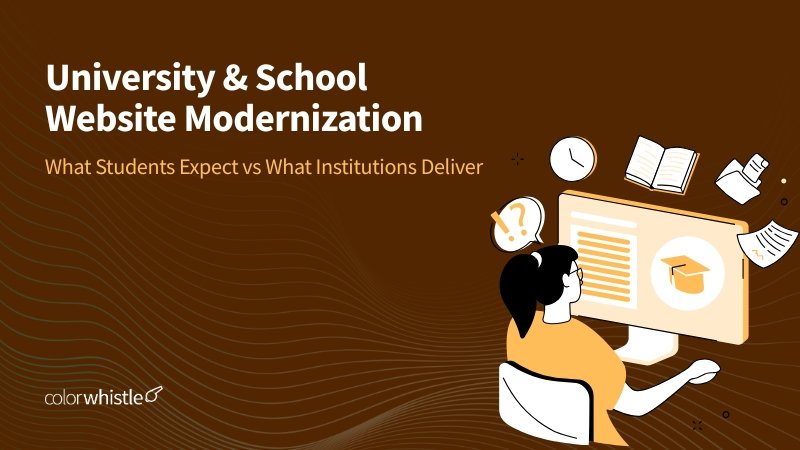
University & School Website Modernization: Student Expectations vs Reality

With half a decade of experience in creating tech content for education, healthcare, hospitality, and real estate, Nandhini excels at turning complex insights into clear, credible, in-depth, research-backed, and engaging content that helps readers make informed decisions.

Our authors are proven experts in their fields, writing on topics where they have demonstrated expertise. Every piece of content undergoes peer review and validation by industry professionals.
AI Summary
University & School Website Modernization: Student Expectations vs Reality
This post explores the critical gap between prospective students' expectations and universities' outdated website offerings. The key insight: modern students demand mobile-first, personalized, and clear information on programs, costs, and admissions, yet many institutional sites remain stuck in slow, fragmented redesign cycles. The blog highlights common failures—poor navigation, outdated content, lack of mobile optimization—and shows how AI-driven maintenance and technical SEO can bridge this divide. It serves university administrators and web teams aiming to boost enrollment by transforming websites into dynamic, user-focused platforms that convert interest into action efficiently.
There’s a quiet crisis playing out across higher education and it doesn’t show up in tuition reports or enrollment dashboards. It lives inside the browser tab a prospective student opens on their phone at 11 pm, hunting for a program, a deadline, a financial aid form and leaves empty-handed three minutes later.
Universities spend millions on campus infrastructure, faculty recruitment, and marketing campaigns. Then they send interested students to a website built with the organizational logic of a faculty senate meeting and the design sensibilities of 2011.
This piece cuts through the usual “go mobile-first” advice to look at what’s actually happening on the ground: what students specifically expect, where institutions are genuinely falling short, and what the gap costs in real enrollment numbers.
For institutions looking to bridge this digital expectation gap, partnering with an experienced website redesign company can help transform outdated education portals into modern, student-focused digital experiences.
The Reality Check: A 5-Year Redesign Cycle in a 6-Month World
The average gap between university website redesigns is five years. In five years, Google has overhauled its Core Web Vitals scoring twice, TikTok has become a primary college-research channel, and an entire generation of students has grown up using mobile apps as their default interface for everything from banking to course scheduling.
Yet many institutional websites remain locked in cycles dictated by budget committees and governance structures, not by user behavior. The result is a growing mismatch that is costing institutions in the one place they can least afford it: enrollment decisions.
A 2025 higher‑education research report shows that 93% of enrollment leaders believe a better website experience would improve student recruitment and retention, highlighting how critical finding clear information is to a prospective student’s decision to apply.
What Students Actually Want From an Institutional Website
By the time a prospective student lands on a college homepage, they’ve already consumed YouTube reviews, Reddit threads, and Instagram campus stories. The website isn’t an introduction to the institution; it’s a verification tool. They arrive with a specific checklist:
- Clear, program-level career outcome data – median salaries, employment rates, real employer names
- A transparent, plain-language breakdown of all costs: tuition, fees, hostel, hidden charges
- A step-by-step admission process with exact deadlines and document lists
- Mobile-first access to everything – no pinch-zooming, no broken forms, no PDFs that don’t open
- Personalized content – engineering students don’t want nursing information surfaced first
- A virtual campus tour or at minimum a rich media experience of campus life
- Chatbot or live chat for instant answers on deadlines, eligibility, and scholarships
Students want to know the return on their higher education investment. Not having salary and career outcome data on program pages is one of the top frustrations we hear.
The Expectation Gap: Side-by-Side
The disconnect between student expectation and institutional delivery is specific and documented. Here’s what the research reveals across the most critical touchpoints:
| Touchpoint | What Students Expect | What Institutions Typically Deliver |
|---|---|---|
| Homepage | Clear entry points: programs, admissions, fees, contact | Dean's welcome message, mission statement, rotating banners |
| Program Pages | Salary data, career outcomes, graduate testimonials, syllabus | Generic course description, faculty names, accreditation logos |
| Fees & Finance | Plain-language cost calculator, scholarship finder, net cost estimate | PDFs with fine print, separate pages for each fee type |
| Navigation | Task-first menus: "Apply," "Explore Programs," "Get Aid" | Departmental structure mirroring org chart: "Registrar," "Bursar," "IQAC" |
| Mobile Experience | Everything works on a 375px screen, one-thumb navigation | Desktop layout squeezed to mobile, broken forms, tiny tap targets |
| Search | Google-like keyword search returning instant, relevant results | Basic search returning a list of unformatted pages or returning nothing |
| Student Portal | Unified dashboard: schedule, fees, grades, aid - all in one place | Multiple logins, siloed systems, data mismatches between departments |
The navigation problem is particularly structural. Most university websites are built around how the institution is organized internally, not how students think. A prospective student looking for “scholarship information” doesn’t know whether that lives under “Financial Services,” “Student Affairs,” or “Admissions.” They type it in search, find nothing useful, and leave.
A successful website SEO technical migration ensures that universities and schools can modernize their websites without losing existing search rankings, traffic, or student inquiry visibility.
Common Failure Points in Education Websites
Despite knowing what students want, most university and school websites consistently fail in these critical areas:
Outdated Information
One of the most common mistakes is failing to update website content regularly. Outdated event listings, old news articles, and obsolete policies create confusion and frustration. Students question whether the institution itself is current and relevant.
Poor Navigation
Visitors should find information quickly, but many education sites have:
- Confusing menu structures
- Missing breadcrumbs
- Broken or ineffective search functions
- Information buried under 4-5 click depths
This friction costs institutions prospective students who simply give up.
Lack of Mobile Optimization
Most parents and students browse on phones, yet many school websites:
- Require pinching and zooming
- Have broken layouts on mobile devices
- Don’t translate the student experience across devices
If your site isn’t native on mobile, you’ve already lost their attention.
Accessibility Gaps
School websites should be accessible to all visitors, including those with disabilities. Common failures include:
- Missing alternative text for images and videos
- No transcripts for audio/video content
- Poor color contrast and unreadable fonts
This isn’t just bad UX; it can result in substantial fines and legal ramifications.
Inconsistent Design
Inconsistent fonts, colors, and imagery make websites look unprofessional and confusing. A cohesive look and feel is essential for building trust and credibility.
Slow Load Times
Many education websites are:
- Patched together with plugins and dated logic
- Slow to load due to unoptimized images and flash elements
- Overloaded with excessive flash and images
Gen Z won’t tolerate friction, they expect responses in seconds.
Static, Non-Personalized Content
Static pages don’t cut it anymore. Modern students expect content to adapt to them based on their interests and goals. Most institutions still deliver one-size-fits-all experiences.
Missing Clear Career Pathways
Institutions fail to explicitly show how programs connect to jobs. This is critical, as 79% of prospective students want to see transparent job outcomes and career pathways.
Inadequate Data Security
Failure to keep visitor and student data safe can result in legal ramifications and loss of trust.
What Modernized Education Websites Do Differently
The institutions winning the “enrollment war” in 2026 have moved beyond static pages. They treat their website as a dynamic, personalized ecosystem.
Frictionless Micro-Conversions
Instead of one massive “Apply Now” button, modernized sites use low-stakes engagement points. This might include a “WhatsApp our Student Ambassadors” chat widget or a “Build Your Custom Degree” interactive tool that emails a personalized PDF to the student.
Vibrant, Narrative Multimedia
They trade stock photos of smiling students for authentic, high-fidelity video content. Short-form, TikTok-style vertical videos are often embedded directly into program pages to give a “vibe check” of campus life that feels genuine.
Self-Service Portals & Hubs
Modernized sites replace fragmented links with a unified “Student Hub.” Using Single Sign-On (SSO), students can access their LMS, housing portal, and meal plan from one dashboard that feels like a native app rather than a series of disparate websites.
Implementing AI-first website maintenance solutions also helps educational institutions keep their websites secure, optimized, updated, and aligned with evolving student expectations without constant manual intervention.
Speed and Technical SEO
Top-tier sites are built on headless CMS architectures or lightweight frameworks. They prioritize Core Web Vitals, ensuring that even the most media-heavy pages load in under 2 seconds, meeting the high expectations of a generation that doesn’t wait for “Loading…” icons.
How ColorWhistle Modernizes Education Websites
ColorWhistle transforms legacy portals into high-performance assets by focusing on three core pillars:
- Technical Excellence: Optimizing frontend performance and backend stability to ensure sites meet modern speed and security benchmarks
- Student-Centric UX: Redesigning architectures to prioritize student needs, reducing clicks-to-conversion for admissions
- Future-Ready Scalability: Implementing Headless CMS solutions and AI strategies that allow institutions to scale content without technical debt
By moving beyond the “digital brochure” model, ColorWhistle helps institutions deliver the seamless, accessible, and fast experience today’s students demand.
Wrap-Up
The gap between what students expect from an education website and what most institutions deliver is not a technology problem. The technology exists, it’s accessible, and it’s increasingly affordable. The gap is organizational, a governance model that fragments website ownership across departments, a budget cycle that treats web infrastructure as a once-in-five-years capital project, and a cultural assumption that the website exists to represent the institution rather than serve the student.
The data makes the stakes unavoidable. 79% of students drop an institution from consideration when they can’t find what they need. More than half expect personalized experiences. The majority start their search on mobile. Every enrollment strategy that doesn’t begin with the website’s ability to convert intent into action is built on a compromised foundation.
Students are already there, already looking. The question is whether they find your answer — or someone else’s.
 Headless CMS for Business: Benefits, Costs & ...