


Headless CMS for Business: Benefits, Costs & ROI Guide

Phurvishaa specializes in crafting travel tech and marketing content, leveraging deep research, SEO expertise, and AI-driven insights. Her strategic approach ensures content that educates, engages and delivers knowledge.

Our authors are proven experts in their fields, writing on topics where they have demonstrated expertise. Every piece of content undergoes peer review and validation by industry professionals.
Not too long ago, website modernization meant migrating from one monolithic CMS to another. You’d move from Drupal 7 to WordPress, or from a legacy proprietary platform to Sitecore, and call it a day.
Today, that conversation looks very different. Organizations are being asked to deliver content to websites, mobile apps, digital signage, voice interfaces, and third-party integrations all from a single source of truth. The pressure isn’t just to build faster. It’s to build smarter, at scale, across an ever-expanding constellation of digital touchpoints.
That’s exactly where the headless CMS enters the picture. And for businesses evaluating their next architecture move, understanding what headless delivers and where it doesn’t is essential before committing to a full modernization initiative.
What Makes a CMS “Headless”?
A traditional CMS couples your content management backend with a fixed front-end presentation layer. WordPress, for example, stores your content and also controls how it gets rendered in the browser. The two are tightly linked.
A headless CMS decouples these two layers entirely. The backend of your content repository, workflows, and editorial tools communicates with the front-end through a CMS API, typically REST or GraphQL. The front-end can be anything: a React application, a mobile app, a JAMstack site, or even a smart TV interface.
Think of it as content as a service. Your content lives in one place and gets consumed wherever it’s needed, in whatever format the consuming application requires.
This architectural shift is at the heart of most modern digital product stacks and it’s why headless CMS is increasingly central to website modernization discussions across industries.
Why Headless Is Becoming Part of Every Modernization Conversation
Several forces are converging to make headless architecture more relevant than ever:
The multi-channel reality is non-negotiable: Customers interact with brands across the web, mobile, apps, social commerce, IoT, and voice often within the same journey. Architectures that silo content by channel create redundancy, inconsistency, and slow time-to-market. Multi-channel content delivery through a headless layer solves this structurally.
Front-end performance expectations have shifted: Core Web Vitals are now a ranking factor. Users bounce in under three seconds. JAM stack CMS architectures which pre-render pages at build time and serve them from a CDN can deliver measurably faster experiences than server-rendered, plugin-heavy traditional CMS setups.
Developer talent expectations have changed: Modern developers want to work in React, Next.js, Nuxt, or similar frameworks. Asking a senior front-end engineer to work within the template constraints of a legacy CMS is a real friction point in hiring and retention. Headless gives development teams the freedom to use the tools they’re best at.
Enterprise digital teams are scaling content operations: When marketing teams manage dozens of markets, languages, and brand properties, a headless backend with structured content modeling and robust API delivery becomes a genuine operational advantage, not just a technical preference.
Did You Know?
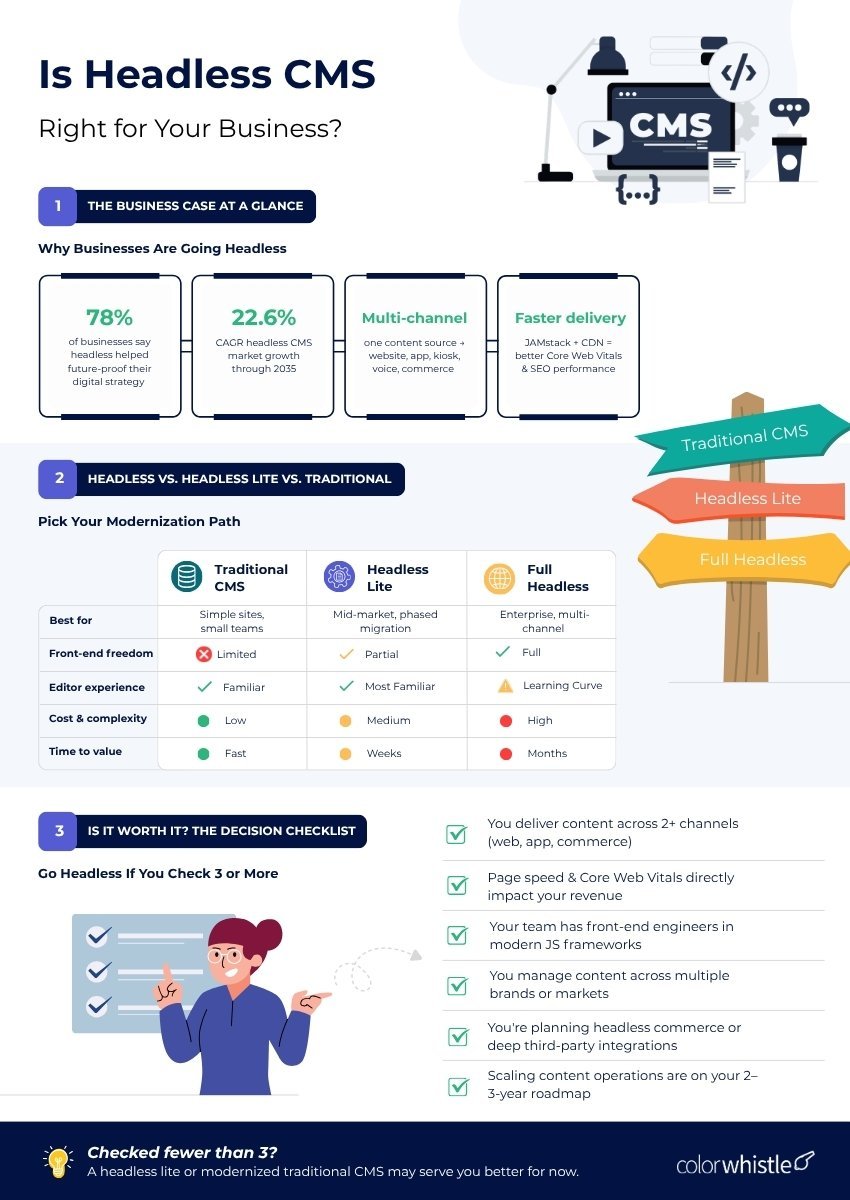
The global headless CMS software market was valued at $816.9 million in 2024 and is projected to grow at a CAGR of 22.6% through 2035, reaching over $7 billion.
Key Advantages of Headless for Scaling Businesses
For businesses at the right stage of digital maturity, headless CMS delivers real, measurable value:
Omnichannel content delivery without duplication
Write once, publish everywhere. Content structured in a headless CMS can be served simultaneously to a website, a mobile app, a digital kiosk, and a third-party aggregator without maintaining four separate content libraries.
Front-end freedom and performance gains
Developers can build with any framework. Combined with a CDN delivery layer, this typically results in faster load times, better Lighthouse scores, and improved SEO performance.
Independent scalability
Content operations and front-end delivery can be scaled separately. A traffic spike doesn’t clog up your editorial workflow, and a redesign doesn’t require migrating your entire content repository.
Stronger security posture
Because the content of API doesn’t expose a public-facing admin interface, the attack surface is meaningfully reduced compared to traditional CMS platforms with public login endpoints.
Futureproofing
When the next digital channel emerges and it will, a headless architecture is ready to serve it. Your content layer isn’t tied to a specific rendering technology.
The Costs and Complexity Businesses Underestimate
Here’s where many headless CMS evaluations go sideways: organizations focus on the architectural benefits and underestimate what full headless requires succeeding.
Higher upfront engineering investment. Traditional CMS platforms come with themes, plugins, and built-in features. Headless means building or assembling much of that infrastructure yourself. Custom front ends, preview environments, form handling, search, and personalization all require deliberate engineering effort.
Content editors face a steeper learning curve. Editorial teams accustomed to WYSIWYG interfaces often find headless CMS tools more abstract. Structured content models are powerful, but they require a mindset to shift from “what does this look like” to “what is this content, and where will it appear.”
Operational complexity increases. More moving parts mean more potential failure points. You’re now managing a content API, a front-end deployment pipeline, a CDN configuration, and potentially multiple consuming applications. A mature DevOps culture is not optional; it’s a prerequisite.
Headless CMS cost adds quickly. Leading platforms like Contentful, Sanity, or Contentstack can carry significant SaaS licensing costs at enterprise scale. Add infrastructure, front-end development, and ongoing maintenance, and the total cost of ownership can surprise organizations that compare sticker prices without fully scoping the implementation.
Also Read
Where Headless Drives ROI vs. Where It Adds Overhead
Not every use case benefits equally from a fully headless approach. Understanding where the ROI actually materializes and where it doesn’t is essential for sound architecture decisions.
Strong ROI scenarios:
- High-traffic digital products where performance directly impacts conversion
- Multi-brand or multi-market enterprises managing large content operations
- Organizations building headless commerce experiences with personalized, channel-specific product storytelling
- Teams with established front-end engineering capability and DevOps maturity
- Businesses where the same content must be delivered to multiple distinct front-end applications
Lower ROI scenarios:
- Small-to-mid-sized marketing sites with simple content structures and a single channel
- Teams without in-house front-end developers or budget for specialized agency support
- Organizations early in their digital maturity with limited content operations
- Projects with short timelines where traditional CMS can deliver acceptable results faster and cheaper
The Headless Lite Strategy: A Smarter Middle Path
Here’s a truth that often gets lost in headless advocacy: going fully headless is not binary, and it’s not always the right answer.
Headless lite sometimes called a hybrid or partial headless approach allows organizations to decouple strategically rather than all at once. In a headless lite implementation, portions of the digital experience are served through a traditional or coupled CMS, while selecting front ends (a mobile app, a microsite, a high-performance campaign page) consume content via API.
This approach offers several pragmatic advantages:
Lower risk and lower cost. You’re not throwing away your existing CMS investment or retraining your entire editorial team overnight. You can modernize incrementally, proving value at each stage.
Faster time to value. A headless lite migration can be scoped and delivered in weeks rather than months. Specific high-impact use cases like decoupling a product catalog or powering a mobile app can be tackled first.
Maintains editorial familiarity. Content teams continue working in known tools while development teams gain the API flexibility they need for specific front-end experiences.
Reduces organizational change management burden. Full headless transformations are as much a people and process challenge as a technical one. Headless lite lets organizations build capability and confidence progressively.
For many businesses, particularly those in the mid-market or early enterprise phase, headless lite is not a compromise. It’s the genuinely appropriate architecture for where they are today.
Also Read
Decision Criteria: Choosing the Right Architecture for Your Business
Choosing between fully headless, headless lite, or a modernized traditional CMS depends on an honest assessment of several factors:
Team capability. Do you have front-end engineers experience in modern JavaScript frameworks? Is your DevOps function maturing enough to manage additional infrastructure? Honest answers here drive realistic implementation scoping.
Content complexity and volume. Are you managing structured content across multiple brands, markets, and channels? Or is your content relatively simple and contained? The more complex and distributed, the more headless architecture pays off.
Performance requirements. Are Core Web Vitals and page speed directly tied to business outcomes like conversion or SEO? High-performance requirements are a clear signal toward headless or JAMstack CMS architectures.
Budget and timeline. A fully headless implementation done right takes time and investment. If budget or timeline constraints are tight, headless lite or a well-implemented traditional CMS may deliver better results within real constraints.
Integration requirements. Are you building headless commerce experiences that need to connect to CMS, commerce engine, and personalization layer? Complex integration landscapes are often better served by API-first headless architectures.
Future roadmap. Where is your organization headed in the next two to three years? If new digital channels, international expansion, or significant content scaling are on the horizon, investing in headless architecture now reduces future re-platforming costs.
Final Thoughts
Headless CMS is not a silver bullet, and it’s not the right fit for every organization at every stage. But for businesses with genuine multi-channel ambitions, scaling content operations, and the technical capability to support it, headless architecture offers a fundamentally stronger foundation for digital growth.
The most important shift is moving from “should we go headless?” to “what’s the right degree of decoupling for where we are today and where we’re headed?”
Sometimes that’s fully headless. Often, it’s a headless lite. In both cases, the answer should come from a clear-eyed assessment of your team, your content, your customers, and your roadmap not from architectural trend-chasing.
At ColorWhistle, we help businesses navigate these decisions with architecture assessments, headless CMS implementation, and modernization strategies built around your actual context, not a template. Whether you’re evaluating your first headless pilot or planning an enterprise-wide migration, we bring the technical depth and strategic clarity to help you make the right call.
Ready to explore what headless modernization could look like for your business? Connect with the ColorWhistle team to start the conversation.
FAQ’s
What is the difference between headless CMS and traditional CMS?
A traditional CMS tightly couples content management with front-end rendering, while a headless CMS delivers content purely via API giving developers the freedom to build any front-end experience independently.
Is headless CMS suitable for small and mid-sized businesses?
Not always fully headless requires engineering investment and DevOps maturity. For SMBs, a headless lite or hybrid approach often delivers the same modernization benefits at lower cost and complexity.
How long does a headless CMS migration typically take?
A focused headless lite implementation can be completed in a few weeks, while a full enterprise headless migration covering content modeling, front-end build, and integrations typically takes three to six months.
 eCommerce Website Modernization: Fix Hidden L...