




Best SaaS Credits System Guide and How Tech Businesses Can Implement It

Anusha is a digital strategy expert with deep expertise in branding, UI/UX, and performance-focused content. She brings advanced insight into brands to scale intelligently, blending creativity with conversion-focused thinking.

Our authors are proven experts in their fields, writing on topics where they have demonstrated expertise. Every piece of content undergoes peer review and validation by industry professionals.
AI Summary
Key Highlights of SaaS Credits System Implementation
This post explores how SaaS credits systems solve modern billing challenges for AI and API-driven businesses. The key insight: credit-based billing unites predictable revenue with flexible, usage-based pricing to match volatile consumption patterns. It outlines core components—immutable credit ledgers, real-time wallet management, and consumption event tracking—that ensure transparent, scalable billing. Targeted at SaaS founders, CEOs, and product managers, it offers a strategic blueprint to build credit architectures that prevent disputes and support growth. By adopting credits, tech companies can optimize monetization, meet customer expectations, and scale efficiently in a consumption-driven market.
The world of SaaS billing is at a turning point. Traditional subscription models, which used to be the foundation of software monetization, are having a hard time keeping up with the rapid rise of AI-powered applications, API-driven platforms, and workloads that heavily rely on consumption, these are the defining features of today’s cloud infrastructure. The fixed nature of flat-rate pricing doesn’t work well with the unpredictable nature of compute-intensive operations, leaving both providers and customers stuck in mismatched billing arrangements.
Credits and subscription models have emerged as the architectural solution to this challenge. A well-designed SaaS credits system bridges the gap between predictable revenue streams and flexible usage-based pricing, allowing businesses to prepay for resources while maintaining the elasticity required for volatile consumption patterns. This hybrid approach to subscription billing transforms how companies monetize their platforms, creating alignment between value delivered and revenue captured.
For tech founders, SaaS CEOs, product managers, CTOs, and API-first startups navigating SaaS monetization 2026, implementing a robust credits architecture is no longer optional. The complexity of modern SaaS billing workflows demands systems that can handle real-time consumption tracking, prevent billing disputes through transparent ledgers, and scale alongside unpredictable usage spikes. This guide provides the technical blueprint and strategic framework for building credit-based billing systems that support sustainable growth in an increasingly consumption-driven market.
In addition to these technical aspects, it’s also crucial for tech businesses to understand the importance of SEO for IT services companies as a long-term marketing investment option for compounding growth returns. Moreover, if your business involves e-commerce or travel sectors, exploring innovative travel marketing campaigns or utilizing our Shopify store redesign checklist could significantly enhance your online presence.
Finally, partnering with a reputable digital marketing agency can further bolster your efforts in establishing a strong online footprint. For those based in Canada, we have compiled a list of the best digital marketing agencies that can help you make a mark in the digital world.
Understanding SaaS Credits Systems
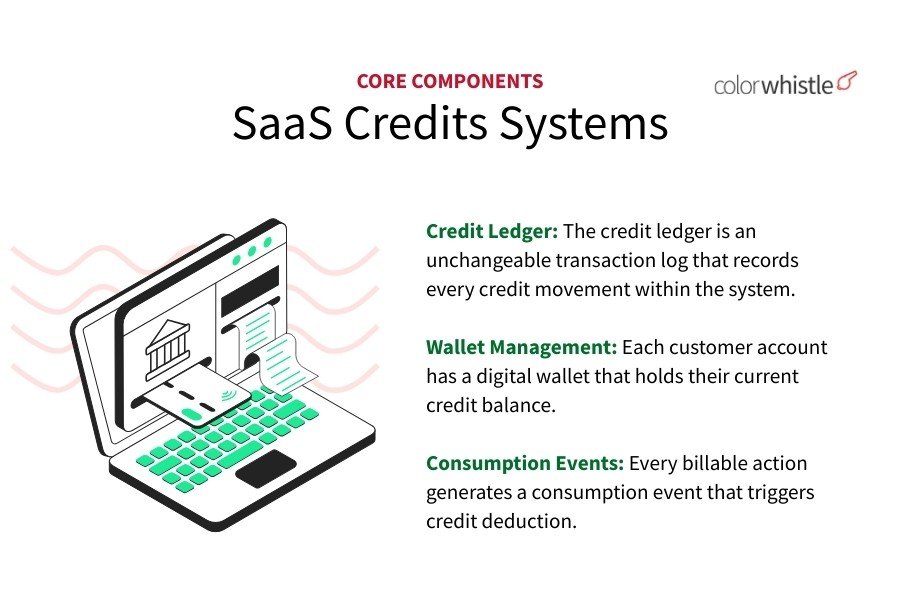
A credit-based billing system is a prepaid consumption model where customers buy credits in advance and use them as they access specific services or features. This system has three main parts that work together to provide accurate, real-time billing:
Core Components
1. Credit Ledger
The credit ledger is an unchangeable transaction log that records every credit movement within the system. Each entry captures deposits (purchases, bonuses, promotions), withdrawals (consumption events), and balance adjustments with timestamps and metadata. This structure ensures complete auditability and prevents retroactive changes that could compromise billing accuracy.
2. Wallet Management
Each customer account has a digital wallet that holds their current credit balance. The wallet management layer handles real-time balance calculations, enforces spending limits, and manages multiple credit pools when businesses offer different credit types (promotional vs. purchased, expiring vs. perpetual). Advanced implementations support multi-currency wallets and hierarchical structures for enterprise accounts with sub-organizations.
3. Consumption Events
Every billable action generates a consumption event that triggers credit deduction. These events capture detailed usage data, API calls, compute minutes, storage gigabytes, model inference requests, and translate them into credit costs based on predefined rate cards. The developer credits workflow relies on these events to provide transparent usage tracking that engineers can monitor and optimize.
Distinction from Traditional Models
The subscription credits model differs from traditional billing methods in several ways:
- Flat-rate subscriptions charge fixed monthly fees regardless of usage intensity
- Pure usage-based billing invoices customers after consumption occurs, creating unpredictable costs
- Credit-based billing combines prepayment predictability with usage flexibility, allowing customers to control spending while accessing variable resources
This hybrid approach is particularly valuable for AI and API-heavy workloads where consumption patterns vary significantly between billing periods.
In addition to these primary features, the SaaS industry is also experiencing significant shifts due to technological advancements like the Metaverse, which is transforming sectors such as K-12 education by improving learning through immersive virtual environments. Furthermore, understanding the Total Addressable Market (TAM) is crucial for SaaS companies to maximize their growth potential and impress investors. On a different note, businesses using platforms like WordPress may face various challenges; however, many of these common WordPress problems can be effectively resolved with the right solutions.
Also Read
Market Drivers Behind Credit-Based Billing Adoption
The rise of AI-powered services, such as those seen in marketing automation for educational institutions and CRM automation with AI workflows, has fundamentally changed how SaaS companies approach pricing. Large language models, computer vision APIs, and machine learning inference endpoints use computing resources in unpredictable ways. A single customer request might cost a few cents or dollars depending on the complexity of the model, the number of tokens, or the time it takes to process. Traditional pricing models based on the number of seats or flat rates can’t handle this unpredictability, leading to pressure on profit margins and confusion for customers.
API-driven workloads, which are common in these AI applications, make this complexity even worse. Modern applications often need to make many API calls to different services, such as geocoding, payment processing, data enrichment, and real-time analytics, in order to work properly. Each of these endpoints has its own cost structure, rate limits, and usage patterns. Businesses that provide these consumption-heavy workloads face a big challenge: how do they price their services when the costs behind the scenes can change from minute to minute based on what their customers do?
Credit-based billing emerges as the natural solution to this pricing chaos. By converting diverse consumption events into a unified credit currency, companies can:
Normalize volatile costs across different service types and computational intensities
Decouple pricing from infrastructure expenses while maintaining healthy margins
Provide cost predictability to customers through prepaid credit packages
Enable granular usage tracking without exposing complex backend pricing logic
The shift in SaaS billing towards hybrid models reflects changing customer expectations. Enterprise buyers want the budget predictability of subscriptions but also need flexibility for seasonal spikes or experimental projects. Startups building on API platforms need safeguards against excessive costs but don’t want to hinder their growth potential. Credits meet these needs by combining upfront commitments with consumption-based flexibility.
This combination of technical requirements and customer preferences has sped up the adoption of credit systems in various industries, from developer platforms and AI services to data infrastructure and communication APIs. The technology behind these systems has to be able to handle updates to balances in real time, apply complex pricing rules, and track consumption transparently at a large scale.
As we explore this landscape further, it’s important to consider how Google AI is being integrated into various aspects of our lives, which in turn influences consumer behavior and expectations in the online marketplace.
Designing an Effective SaaS Credits Architecture
Building a robust credits architecture requires careful consideration of data integrity, real-time accuracy, and system reliability. The foundation rests on three interconnected components that work together to deliver a seamless billing experience.
Immutable Credit Ledger Design
An immutable ledger serves as the single source of truth for all credit transactions. Each entry, whether a purchase, consumption, expiry, or adjustment, creates a permanent, append-only record that cannot be modified or deleted. This approach ensures complete auditability and eliminates discrepancies between what customers believe they purchased and what the system records.
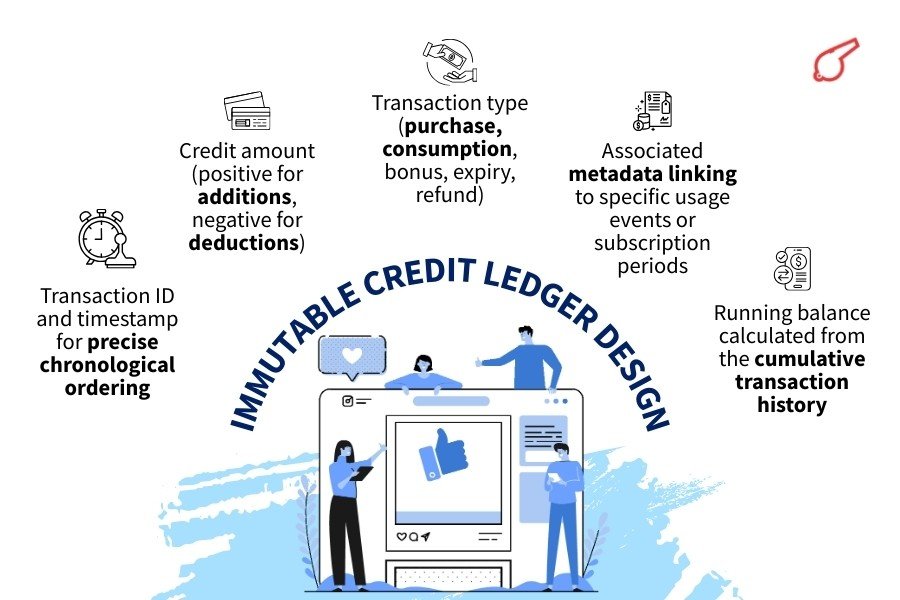
The ledger structure should capture:
- Transaction ID and timestamp for precise chronological ordering
- Credit amount (positive for additions, negative for deductions)
- Transaction type (purchase, consumption, bonus, expiry, refund)
- Associated metadata linking to specific usage events or subscription periods
- Running balance calculated from the cumulative transaction history
Real-Time Wallet Management System
The wallet acts as the customer-facing representation of available credits. Unlike the ledger, which maintains historical records, the wallet provides instant balance queries optimized for performance. Implementing a dual-layer approach, where the ledger maintains accuracy while the wallet enables speed, allows systems to handle thousands of concurrent balance checks without degrading performance.
Wallet management strategies include:
- Caching mechanisms with Redis or similar in-memory stores for sub-millisecond balance retrieval
- Asynchronous balance updates triggered by ledger events
- Multi-currency support when credits represent different resource types (API calls, compute hours, storage)
Expiry Logic and Policy Implementation
Credit expiry rules introduce temporal complexity that requires systematic handling. Implementing First-In-First-Out (FIFO) expiry ensures customers consume oldest credits first, reducing confusion and support tickets. The system should track expiry dates at the transaction level, enabling precise calculations of available versus expiring balances.
Rollover policies for Credits and Subscription models demand special attention. When customers upgrade tiers or renew subscriptions, the architecture must handle partial credit transfers, prorated adjustments, and promotional bonus allocations without creating exploitable loopholes.
Concurrency Handling and Data Integrity
Race conditions pose significant risks in credit systems where multiple consumption events occur simultaneously. Implementing concurrency handling through database-level locks, optimistic locking patterns, or distributed transaction coordinators prevents double-spending scenarios.
Event deduplication mechanisms using idempotency keys ensure that network retries or duplicate webhooks don’t result in multiple credit deductions for a single consumption event. Each incoming event should carry a unique identifier that the system checks against a deduplication cache before processing.
Additional Considerations: Mobile Optimization and SaaS Website Design
As we delve deeper into designing an effective SaaS credits architecture, it’s essential to consider mobile-friendly travel website design best practices in 2026 if your SaaS product is related to the travel industry. Optimizing user experience on mobile can significantly boost engagement.
Moreover, if your business model involves mobile applications such as Android and iOS apps, understanding how to build these apps effectively can enhance your service offering.
In addition to these aspects, focusing on SaaS website designs is crucial. A well-designed website can provide a seamless user interaction experience which is vital for retaining customers.
Also Read
UX Considerations for Credit Visibility and Management
The technical robustness of a credit ledger means little if users cannot easily understand their consumption or take action when needed. Credit balance visibility must be immediate and contextual, appearing prominently within the product interface rather than buried in account settings. This is akin to the latest UI/UX trends in automotive websites where modern design elements enhance user experience and improve website performance. Dashboards should present both absolute credit counts and projected depletion timelines based on recent usage patterns, giving users actionable intelligence about their spending trajectory.
Real-time Insights
Real-time burn rate indicators transform raw numbers into meaningful insights. A simple visualization showing daily or hourly consumption trends helps users correlate specific activities with credit depletion. This transparency builds trust and reduces support inquiries about unexpected charges or service interruptions.
Critical Safeguards
User notifications serve as critical safeguards against service disruption. Automated alerts triggered at configurable thresholds (75%, 90%, 95% depletion) provide graduated warnings that respect user attention without creating alarm fatigue. Email, in-app notifications, and webhook integrations to Slack or Microsoft Teams ensure alerts reach the right stakeholders through their preferred channels.
Frictionless Top-up Experience
Top-up flows require friction-minimized design. One-click repurchase options for previously bought credit packages eliminate unnecessary form fields. Saved payment methods combined with intelligent package recommendations based on historical usage patterns convert urgency into revenue without creating user frustration.
Tailored Solutions for Different User Types
Enterprise users demand different capabilities than self-service customers. Multi-user organizations need role-based access controls allowing finance teams to monitor spending while restricting purchase authority. Centralized billing dashboards with department-level breakdowns, approval workflows for large purchases, and integration with procurement systems address the complexity of organizational buying processes. Self-service users benefit from simplified interfaces emphasizing speed and clarity over administrative controls.
Incorporating user-generated content in video marketing strategies we could explore innovative ways to utilize customer feedback and experiences in our platform’s design, making it even more user-centric.
Moreover, considering the popularity of Flutter apps among users, implementing this technology could significantly enhance our mobile platform’s usability and performance, aligning with the aforementioned UX considerations.
Finally, leveraging online education ads design ideas can inspire us to create informative and engaging content that guides users through understanding their credit usage better.
Also Read
Monetization Strategies Using Credits Models
Credit-based billing unlocks sophisticated revenue optimization opportunities that traditional subscription models cannot match. The architecture enables businesses to segment customers precisely while maintaining pricing flexibility that responds to real-world usage patterns.
Tiered Credit Packs for Market Segmentation
Tiered credit packages allow SaaS businesses to serve diverse customer profiles without creating separate product SKUs. A startup might purchase a 10,000-credit starter pack at $0.012 per credit, while an enterprise customer commits to 5 million credits at $0.006 per credit, a 50% volume discount that reflects their scale. This tiering strategy:
Reduces friction for small users testing the platform
Incentivizes growth through volume-based pricing advantages
Creates natural upgrade paths as usage expands
Simplifies pricing communication across market segments
Dynamic Pricing and Surge Credits
Surge credits introduce demand-responsive pricing that protects infrastructure during peak loads. When API request volumes spike beyond baseline thresholds, the system can automatically apply surge multipliers, consuming 1.5x or 2x credits per operation. This approach mirrors ride-sharing economics, where customers accept premium pricing during high-demand periods in exchange for guaranteed service availability.
Strategic Partner Credit Bundles
Partner bundles transform credits into strategic alliance tools. A cloud infrastructure provider might bundle 50,000 credits with their hosting packages, creating co-marketing opportunities while driving qualified traffic. These arrangements establish ecosystem lock-in effects where multiple vendors benefit from shared customer success.
Promotional Credits for Growth
Bonus credits accelerate customer acquisition without permanent price reductions. Offering 20% bonus credits on annual commitments or first-time purchases creates urgency while maintaining perceived value. Time-limited promotional credits drive conversion during product launches or seasonal campaigns without establishing unsustainable pricing expectations.
Moreover, these monetization strategies are not just limited to SaaS businesses but can also be effectively utilized in sectors like education where digital marketing plays a crucial role in driving growth and engagement.
Hybrid Subscription & Usage-Based Pricing Models Explained
Hybrid pricing models SaaS architectures merge the stability of recurring subscriptions with the elasticity of consumption-based billing through credits. This approach allocates a base credit allowance within monthly or annual subscription tiers, while enabling customers to purchase additional credits as usage demands escalate. The subscription component establishes predictable baseline revenue, while the subscription plus usage billing mechanism captures value from variable workloads without forcing customers into rigid plan constraints.
Benefits for Different Customer Segments
The strategic advantage lies in accommodating heterogeneous usage profiles across your customer base:
Enterprise clients benefit from committed subscription credits that align with budgeting cycles and provide cost certainty.
Startups and scale-ups gain flexibility to expand consumption during growth phases without renegotiating contracts.
Credits and Subscription models eliminate the friction of plan migrations, users simply exhaust their included credits and seamlessly purchase top-ups rather than upgrading entire subscription tiers.
A notable example of a business successfully leveraging hybrid pricing models is Mizzen+Main, which used Shopify POS to connect online and offline stores, thereby improving customer experiences and significantly growing their menswear brand.
How Billing Automation Supports Hybrid Models
Billing automation systems supporting hybrid models track both subscription renewals and credit consumption events through unified ledgers. Consider an AI image generation platform offering a Professional plan with 10,000 monthly credits at $99, where each image generation consumes 1-5 credits based on resolution. Users exceeding their allocation purchase credit packs at tiered rates, $15 for 2,000 credits or $50 for 10,000 credits, creating natural upsell opportunities.
This structure demonstrably reduces billing disputes by providing transparent consumption visibility. Customers understand exactly what they’re paying for: the subscription covers baseline needs while additional credits address overflow usage. The predictability of subscription revenue combined with the revenue expansion potential from credit purchases creates a balanced financial model that scales with customer success rather than penalizing growth.
Also Read
Implementation Guide for Tech Businesses
Building a credit-based billing system requires careful selection of technologies and a structured deployment approach. The SaaS implementation guide begins with choosing backend languages that excel at handling concurrent operations and maintaining data integrity.
Backend Technology Stack Recommendations
Node.js offers excellent real-time capabilities through its event-driven architecture, making it ideal for processing consumption events as they occur. The ecosystem provides mature libraries for handling API integrations and webhook processing.
Python brings robust data processing capabilities and extensive library support for analytics pipelines. Django or FastAPI frameworks provide solid foundations for building credit management APIs with built-in validation and serialization.
Go delivers superior performance for high-throughput scenarios where millions of consumption events require processing. Its strong typing and concurrency primitives help prevent race conditions in credit deduction operations.
Database Architecture for Ledger Patterns
PostgreSQL serves as the primary choice for credit ledgers due to its ACID compliance and support for row-level locking. Implementing an append-only transaction log ensures immutability while maintaining complete audit trails.
Firebase Realtime Database enables instant balance updates across client applications, providing users with immediate visibility into credit consumption without polling mechanisms.
Integration Strategy with Existing Billing Platforms
Many established billing platforms lack native credit support, requiring custom middleware layers. Build API adapters that translate credit transactions into compatible billing events. Stripe, Chargebee, and Recurly can process credit purchases as one-time charges while your system handles the actual credit allocation and consumption tracking.
Implement webhook listeners to synchronize payment confirmations with credit wallet top-ups. Design idempotency keys into every transaction to prevent duplicate credit grants during payment processing retries.
Internal Tooling Requirements
Finance teams need dashboards displaying aggregate credit liability, revenue recognition schedules, and breakage analysis for expired credits. Support teams require interfaces for manual credit adjustments, refund processing, and usage investigation tools.
Build administrative panels with role-based access controls allowing operations staff to view customer credit histories, apply promotional credits, and resolve billing inquiries without direct database access.
Considering Remote Staffing or Outsourcing?
While implementing such a complex system, you might consider whether to adopt remote staffing or outsourcing. Each option has its pros and cons depending on your project needs.
Importance of Professional Website Design
Moreover, having a professional online presence is crucial in today’s digital age. If you’re looking for assistance in this area, consider hiring one of the top website design agencies in Indiana to elevate your online presence with stunning sites.
Debunking Myths about Website Development
However, it’s essential to be aware of the common misconceptions surrounding website development. Understanding these myths can help you make informed decisions while developing your website or web application.
Utilizing ReactJS for Web Development
If you’re considering a more dynamic web application, ReactJS could be a suitable choice due to its flexibility and resilience in providing business-specific solutions.
Risk Management in Credit Systems
Risk mitigation SaaS billing requires proactive architectural decisions to prevent revenue leakage and maintain system integrity. Credit-based billing introduces unique challenges that demand specialized safeguards beyond traditional subscription models.
Preventing Double Spending Through Concurrency Controls
Concurrency handling becomes critical when multiple consumption events occur simultaneously against a single credit wallet. Without proper controls, race conditions can allow users to consume more credits than available. Implementing atomic operations at the database level ensures that credit deductions happen as indivisible transactions:
Use database-level locks (pessimistic locking) for high-value transactions
Implement optimistic locking with version numbers for frequent, low-value operations
Leverage PostgreSQL’s SELECT FOR UPDATE or Redis distributed locks for wallet balance checks
Design idempotency keys for every consumption request to prevent duplicate processing
Event Deduplication Strategies
Event deduplication protects against duplicate consumption records that can arise from network retries, webhook replays, or system failures. A robust deduplication strategy includes:
- Assign unique identifiers to every consumption event at the source
- Maintain a deduplication cache (Redis with TTL) storing processed event IDs
- Implement a grace period matching your retry window (typically 24-72 hours)
- Create audit trails linking original events to ledger entries for reconciliation
Managing Expired and Unused Credits
Expired credits represent both a financial liability and customer experience concern. Clear policies minimize exposure:
- Define explicit expiry windows in terms of service (30, 60, or 90-day cycles)
- Implement automated notifications at 30-day, 7-day, and 24-hour thresholds before expiry
- Consider grace periods for enterprise customers with annual contracts
- Track expired credit metrics to identify patterns suggesting pricing misalignment
Also Read
Analytics & Reporting for Credit-Based Billing
Analytics dashboards SaaS credits are essential for understanding customer behavior and system performance. To build effective monitoring systems, we need to track various factors such as how quickly credits are being used, usage patterns among different customer groups, and real-time balance distributions. Modern dashboards should display credit depletion rates alongside subscription renewal cycles, allowing finance teams to spot any irregularities before they affect revenue recognition.
Burn Rate Analysis
Burn rate analysis provides valuable insights for making product and pricing decisions. Here are some key metrics to track:
Average daily credit consumption per customer tier
Peak usage periods associated with specific features or API endpoints
Variance between purchased credit packages and actual consumption rates
Time-to-depletion metrics for different pack sizes
These insights will help us understand whether customers consistently use up their credits before renewal periods or if they have unused balances, indicating a potential misalignment in pricing.
Usage Forecasting
Usage forecasting takes historical consumption data and turns it into predictive models. By using machine learning algorithms, we can analyze patterns such as seasonal trends, feature adoption rates, and customer growth trajectories to estimate future credit demand. This information will enable us to optimize our credit pack offerings, introducing smaller packages for cautious users or premium bundles for power users with predictable high consumption.
Integration of Credits and Subscription Analytics
It’s crucial that our analytics for credits and subscriptions work together seamlessly to give us a complete view of our revenue. We need detailed reporting systems that track credit purchases as separate revenue events while also mapping consumption against the costs of delivering our services. This level of granularity will help reduce billing disputes by providing customers with clear explanations of how their credits were used across different services, API calls, or compute resources.
Automated reporting workflows can generate monthly statements that include information on credit purchases, consumption events, remaining balances, and expiry schedules. This creates an audit trail that supports both our internal finance operations and our customer success teams.
Future Trends & Enhancements in SaaS Credit Systems
The future of SaaS monetization extends beyond traditional monetary credits into innovative frameworks that redefine customer engagement and value exchange. Nonmonetary credits support represents a significant evolution, enabling businesses to integrate loyalty programs, referral rewards, and community contribution systems directly into their billing infrastructure. These credits function as alternative currencies within the platform ecosystem, allowing users to earn credits through actions like content creation, peer support, or product advocacy. This approach transforms passive customers into active participants while creating new retention mechanisms that complement revenue-generating credit purchases.
As we look towards the future, developing scalable AI-powered MVPs for seamless integration and growth will be crucial. These solutions will not only enhance user experience but also provide efficient frameworks for managing nonmonetary credits.
The Importance of Real-time Balance Updates
Real-time balance updates powered by event-driven architectures and WebSocket connections are becoming standard expectations rather than premium features. Modern credit systems leverage streaming data pipelines to reflect consumption changes instantaneously across all customer touchpoints. This immediacy eliminates the frustration of delayed balance refreshes and enables proactive usage management, particularly critical for high-velocity API consumers who need second-by-second visibility into their credit expenditure.
The Need for Granular Funding Controls
Granular funding controls represent the next frontier in enterprise credit management, allowing organizations to establish department-level budgets, project-specific allocations, and automated approval workflows for credit purchases. These controls integrate with corporate procurement systems and enable finance teams to maintain spending governance without sacrificing the flexibility that makes credits attractive.
The Role of Automated Promotion Engines
Automated promotion engines are evolving to dynamically adjust credit bonuses based on customer behavior patterns, seasonal demand fluctuations, and competitive market conditions. Machine learning models analyze historical usage data to determine optimal bonus structures that maximize conversion rates while maintaining healthy unit economics. These systems can automatically trigger personalized credit offers when detecting churn signals or usage pattern changes that indicate expansion opportunities.
Conclusion
The combination of credits and subscription models represents a significant change in how tech businesses approach making money. As AI workloads, API usage, and variable usage patterns continue to reshape the SaaS industry, credit systems offer the flexibility needed to succeed in 2026 and beyond.
Implementing a strong credit-based billing system brings measurable benefits across multiple areas:
Revenue predictability through prepaid credit packages while still allowing for flexible usage
Fewer billing disputes through clear consumption tracking and real-time balance visibility
Improved customer satisfaction through self-service top-ups and clear credit allocation
Operational efficiency with automated expiry policies, rollover rules, and promotional frameworks
The technical foundation, immutable ledgers, atomic wallet operations, event deduplication, ensures data integrity at scale. When combined with thoughtful UX design and comprehensive analytics, credit systems evolve from just being billing infrastructure to becoming scalable monetization strategies SaaS businesses can use to gain a competitive edge.
Tech founders and product leaders who invest in credit architecture today position their organizations to quickly adapt to new consumption patterns. The hybrid approach that combines prepaid credits with subscription elements creates resilient revenue streams capable of supporting diverse customer segments while maintaining the agility required in modern software markets.
Related Articles
- How Developers Can Implement a Credits Workflow in SaaS Applications
- SaaS Pricing Strategy Using Credits and Usage Based Monetization
- How to Build a Credits System for AI Powered SaaS Platforms with Custom Development Services
- How to Implement a Credits Model for GPT Apps, Image Generators, and Data Processing Tools
 How to Build a Credits Based Billing System f...