




How to Build a Credits Based Billing System for Your SaaS Product

Anusha is a digital strategy expert with deep expertise in branding, UI/UX, and performance-focused content. She brings advanced insight into brands to scale intelligently, blending creativity with conversion-focused thinking.

Our authors are proven experts in their fields, writing on topics where they have demonstrated expertise. Every piece of content undergoes peer review and validation by industry professionals.
AI Summary
Key Highlights of Building Credits Based Billing Systems
This post explores how credits-based billing systems solve SaaS monetization challenges by blending subscription and usage models. The key insight: credits offer predictable revenue for providers and flexible consumption for customers, improving satisfaction and alignment. It details billing architectures including credit ledgers, entitlement enforcement, and real-time metering, suited for AI-powered MVPs, multi-feature products, and tools with variable usage. The guide serves SaaS founders and developers aiming to implement scalable, accurate billing workflows. It emphasizes designing robust processes from credit purchase to invoicing, leveraging technical and marketing strategies to optimize revenue and customer engagement.
The SaaS industry has seen a significant change in how companies approach monetization. Traditional flat-rate subscriptions no longer capture the diverse ways customers consume software services. As products become more sophisticated, especially those using AI, APIs, and multi-feature platforms, the need for flexible billing models has grown stronger.
Credits and subscription hybrid models have emerged as a compelling solution to this challenge. Unlike rigid monthly plans or purely unpredictable usage-based billing, a credits based billing system offers a middle ground that resonates with both providers and customers. Companies implementing these systems report higher customer satisfaction, improved revenue predictability, and better alignment between product value and pricing.
The appeal is straightforward: customers purchase credit bundles upfront, gaining the flexibility to allocate resources across different features or usage patterns. This approach addresses the core tension in SaaS monetization, balancing the provider’s need for predictable revenue streams with the customer’s desire for consumption flexibility. Usage based billing through credits eliminates the anxiety of unpredictable monthly bills while maintaining the fairness of pay-per-use economics.
A well-designed credits-based billing system does more than just handle payments. It becomes a strategic tool that aligns pricing with delivered value, provides transparency into consumption patterns, and creates opportunities for sophisticated product packaging and customer segmentation.
In this changing landscape, it’s also important for SaaS companies to improve their online visibility and reach. This is where SEO for IT services companies comes in. Using effective SEO strategies can greatly enhance a company’s online presence, attracting more potential customers.
Additionally, since SaaS products often overlap with mobile applications, understanding the details of Android and iOS app development can offer valuable insights for companies looking to expand their service offerings.
Alongside these strategies, exploring innovative marketing approaches like those seen in successful travel marketing campaigns can inspire new ways to connect with customers and promote services.
Finally, for SaaS companies running e-commerce platforms such as Shopify, following a thorough Shopify store redesign checklist can help revamp their online stores, increase conversions, boost sales and ultimately dominate their market.
Also Read
Understanding Credits and Subscription Billing Models
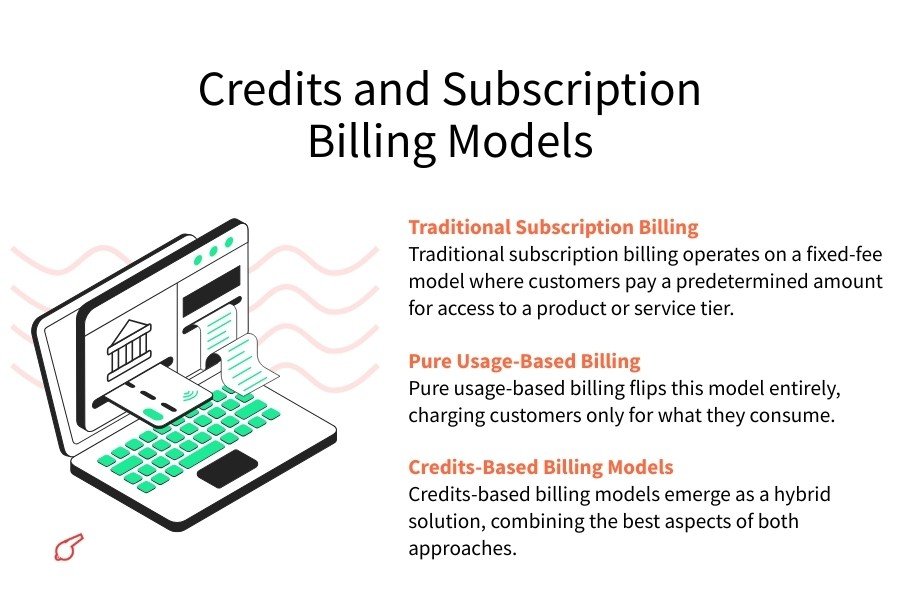
The world of SaaS pricing models has changed a lot. It’s no longer just about monthly or annual subscriptions. Now, there are three main billing methods that are popular in the industry. Each of these methods is designed to meet the specific needs of businesses and their customers.
1. Traditional Subscription Billing
Traditional subscription billing operates on a fixed-fee model where customers pay a predetermined amount for access to a product or service tier. This approach offers revenue predictability but often fails to align costs with actual usage. A customer paying $99/month receives the same access whether they use the service once or a thousand times.
2. Pure Usage-Based Billing
Pure usage-based billing flips this model entirely, charging customers only for what they consume. While this creates perfect value alignment, it introduces revenue unpredictability for providers and budget uncertainty for customers. Companies like AWS pioneered this model, but many customers struggle with fluctuating bills that can vary dramatically month-to-month.
3. Credits-Based Billing Models
Credits-based billing models emerge as a hybrid solution, combining the best aspects of both approaches. Customers purchase credit packs upfront, providing revenue predictability for the provider, then consume these credits as they use the service. This structure delivers:
Budget control for customers who know their maximum spend upfront
Usage flexibility without the constraints of fixed subscription tiers
Revenue predictability for SaaS companies through prepaid credit purchases
Value alignment where heavy users naturally purchase more credits
When Do Credits-Based Systems Work Best?
Credits-based systems particularly excel in specific scenarios:
- When developing scalable AI-powered MVPs
- In multi-feature products where customers use different capabilities at varying rates
- For development tools with unpredictable usage patterns
Developing Scalable AI-Powered MVPs
When creating scalable AI-powered Minimum Viable Products (MVPs), credits can be advantageous due to the unpredictable nature of AI API usage such as OpenAI’s GPT models which vary based on token consumption.
Multi-Feature Products with Varying Usage Rates
For communication platforms offering SMS, voice, and email services, credits are ideal for bundling diverse functionalities under a unified pricing structure.
Development Tools with Unpredictable Usage Patterns
Continuous Integration/Continuous Deployment (CI/CD) platforms or testing services can also benefit from credit systems allowing teams to scale consumption without immediate billing consequences.
Also Read
Additional Scenarios Where Credits Can Make an Impact
In addition to these scenarios, credits can also play a significant role in addressing common WordPress problems by providing a flexible payment structure that aligns with variable usage patterns typical in website management tasks.
Furthermore, businesses seeking to enhance their online presence might find it beneficial to explore options from top website design agencies in Indiana, who can provide creative web solutions tailored to their specific needs.
It’s also essential to debunk some prevalent myths about website development and design that may hinder businesses from taking necessary steps towards improving their online platforms.
Lastly, incorporating user-generated content into video marketing strategies can yield significant benefits in terms of brand communication and engagement if executed properly within the flexible framework provided by credits-based billing models.
Building a Robust Credits Billing System Architecture
A credits billing system requires a carefully designed architecture that balances accuracy, performance, and scalability. The foundation rests on three interconnected components that work together to track, enforce, and reconcile credit transactions across your entire customer base.
The Credit Ledger: Your Source of Truth
The credit ledger serves as the immutable record of all credit-related transactions in your SaaS billing architecture. Think of it as a financial blockchain for your billing system, every credit purchase, deduction, refund, or adjustment gets recorded as a discrete entry with timestamps, transaction IDs, and associated metadata.
This ledger structure provides several critical advantages:
Audit trails that allow you to trace any credit balance back through its complete history
Dispute resolution capabilities when customers question their billing
Compliance documentation for financial reporting and regulatory requirements
Debugging support when investigating billing anomalies or system errors
The ledger should be append-only, meaning entries are never modified or deleted. Instead, corrections happen through new offsetting entries, preserving the complete transaction history.
Entitlement Enforcement: Gatekeeping Access
Entitlement enforcement mechanisms act as the gatekeepers between your customers and your product features. Before allowing any action that consumes credits, the system must verify:
- Does the customer have sufficient credits available?
- Is the requested feature included in their plan?
- Are there any rate limits or usage caps in effect?
This enforcement layer typically sits at the API gateway level or within your application middleware. The check happens in real-time, preventing unauthorized access before it occurs rather than detecting it after the fact. For high-throughput systems, implementing a caching layer can reduce latency while maintaining accuracy through periodic synchronization with the authoritative credit ledger.
Real-Time Metering: Capturing Usage Events
Real-time metering forms the nervous system of your credits billing system, capturing usage events as they occur and translating them into credit deductions. This component requires careful instrumentation throughout your application to emit events whenever customers perform credit-consuming actions.
The metering system must handle:
Event ingestion at scale, processing thousands or millions of usage events per second
Deduplication logic to prevent double-charging when events are retried
Batching strategies that balance between real-time accuracy and system performance
Failure recovery mechanisms to ensure no usage goes untracked during outages
Your architecture should support both synchronous deductions (blocking the action until credits are deducted) and asynchronous processing (allowing the action and deducting credits afterward), depending on your product’s latency requirements and risk tolerance.
In this context, leveraging education digital marketing services can help streamline customer engagement by providing targeted marketing strategies that resonate with your audience. Furthermore, if you’re considering mobile app integration as part of your solution, understanding the reasons why Flutter apps matter could be beneficial due to their popularity among users and flexibility for customized solutions. Lastly, exploring effective education ads design ideas can inspire creative approaches to promote your services within the education sector effectively.
Also Read
Streamlining Developer Billing Workflows for Efficiency and Accuracy
A well-organized developer billing workflow turns raw usage data into accurate invoices while keeping the system intact. The process from credit purchase to final invoice has multiple connected stages that require precision and reliability.
The Complete Workflow Lifecycle
The workflow starts when a customer buys a credit package, which immediately updates their credit ledger. This initial transaction creates an unchangeable record that serves as the basis for all future operations. As customers use services, such as those offered by a React JS web development company, the system must capture usage events, validate entitlements, and deduct the appropriate credit amounts in near real-time.
The deduction phase requires careful coordination between your application layer and billing infrastructure. When a user invokes an API endpoint or consumes a resource, the system must:
- Capture the usage event with relevant metadata (timestamp, user ID, resource type, quantity)
- Query the customer’s current credit balance
- Validate sufficient credits exist before processing the request
- Execute the deduction atomically to prevent race conditions
- Log the transaction with full audit trail details
This sequence must complete within milliseconds to avoid degrading user experience, yet maintain absolute accuracy to prevent revenue leakage or customer disputes.
Webhook-Driven Automation for Synchronization
Webhook-driven automation eliminates manual reconciliation and reduces synchronization errors between systems. When integrated properly, webhooks provide event-driven updates that keep your application, billing platform, and customer-facing dashboards aligned. You can find more about various webhook use cases for workflow automation which can be beneficial in this regard.
Configure webhooks to trigger on critical events such as credit purchases, low balance warnings, and invoice generation. Your application should implement idempotent webhook handlers that can safely process duplicate events without creating inconsistent states. Include retry logic with exponential backoff to handle temporary network failures, and maintain a webhook event log for debugging and compliance purposes.
The automation pipeline should validate webhook signatures to prevent unauthorized modifications and queue events for asynchronous processing when immediate handling isn’t required. This approach prevents webhook timeouts while ensuring no billing event goes unprocessed.
Managing Refunds, Adjustments, and Reversals
Credits and subscription models require robust mechanisms for handling financial corrections. Refunds necessitate crediting the customer’s ledger while maintaining a clear audit trail of the original transaction and reversal. Implement a dedicated refund workflow that:
- Creates a compensating transaction rather than deleting the original
- Updates the customer’s available credit balance
- Triggers notifications to relevant stakeholders
- Synchronizes the refund with your payment processor
Adjustments for billing errors or goodwill gestures follow similar patterns but may require approval workflows based on the adjustment amount. Document the reason for each adjustment and link it to supporting tickets or communications. Reversals for fraudulent transactions demand additional scrutiny, including flagging accounts for review and implementing velocity checks to detect patterns of abuse.
In parallel with these processes, leveraging AI-driven marketing automation can significantly improve customer engagement through personalized communication strategies tailored to individual user behavior patterns. Moreover, integrating CRM automation with AI workflows.
Also Read
Managing Multitenant Credit Systems at Scale
The complexity of credit management increases exponentially when serving hundreds or thousands of tenants simultaneously. A multitenant architecture requires careful consideration of data isolation, performance optimization, and fair resource allocation to prevent one tenant’s usage patterns from impacting others.
Architectural Considerations for Tenant Isolation
Each tenant’s credit balance, transaction history, and usage metrics must remain completely isolated while sharing the same underlying infrastructure. This demands a robust partitioning strategy:
Database-level isolation using tenant-specific schemas or row-level security policies
Credits and Subscription Billing ModelsCache segmentation to prevent cross-tenant data leakage in Redis or similar systems
Event stream partitioning to ensure credit deduction events process independently per tenant
Idempotency keys scoped by tenant ID to prevent duplicate charges across tenant boundaries
The credit ledger architecture must support concurrent writes from multiple services while maintaining consistency. Implementing optimistic locking with version numbers prevents race conditions when multiple API calls attempt to deduct credits simultaneously for the same tenant.
To develop a high-quality API that can handle these operations efficiently, it’s essential to follow some best practices. You can find a comprehensive API Development Guide that covers various aspects such as API types, tools, and functions which could be beneficial in this context.
Rate-Limiting vs Credit-Limiting: Two Distinct Control Mechanisms
Many developers conflate rate-limiting with credit-limiting, but these serve fundamentally different purposes in credit management at scale:
Rate-limiting protects infrastructure by capping requests per time window (e.g., 1000 requests per minute). This prevents system overload regardless of credit availability. A tenant with 10,000 credits remaining still cannot exceed the rate limit.
Credit-limiting enforces business logic by blocking requests when credit balance reaches zero or a defined threshold. This operates independently of request velocity, a tenant could make one expensive API call that consumes all remaining credits.
The decision path for request processing should evaluate both constraints:
- Check rate limit → reject if exceeded
- Check credit balance → reject if insufficient
- Process request → deduct credits asynchronously
- Update both rate limit counter and credit balance
Scaling Challenges and Solutions
High-volume tenants create unique scaling challenges. A single tenant making millions of API calls daily can generate bottlenecks in credit deduction pipelines. Strategies to address this include:
Batch aggregation for high-frequency, low-cost operations
Dedicated processing queues for enterprise tenants with guaranteed throughput
Pre-allocated credit pools that refresh periodically rather than checking on every request
Horizontal partitioning of the credit ledger by tenant tier or usage volume
Database contention becomes a critical concern when thousands of tenants simultaneously deduct credits. Implementing write-ahead logging with eventual consistency for non-critical balance updates can significantly improve throughput while maintaining accuracy for billing purposes.
Also Read
Enhancing Customer Experience with Transparency and Control
Building trust with customers requires giving them complete visibility into their credit consumption patterns. A credits-based billing system should prioritize customer transparency through comprehensive usage dashboards that empower users to monitor and control their spending in real-time.
Real-Time Usage Meters and Dashboards
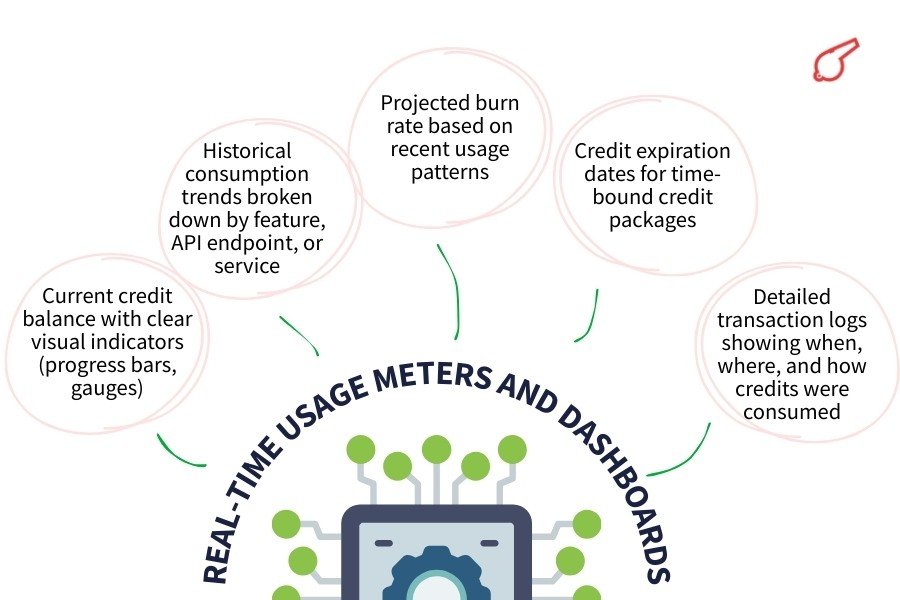
Customers need immediate access to their credit balance and consumption metrics. A well-designed dashboard should display:
- Current credit balance with clear visual indicators (progress bars, gauges)
- Historical consumption trends broken down by feature, API endpoint, or service
- Projected burn rate based on recent usage patterns
- Credit expiration dates for time-bound credit packages
- Detailed transaction logs showing when, where, and how credits were consumed
These dashboards should update in near real-time, ideally within seconds of credit deduction events. For high-volume products, displaying usage with a 1-5 minute delay strikes a balance between accuracy and infrastructure costs. The interface should allow customers to filter and segment their usage data by time periods, team members, or specific features to identify optimization opportunities.
API access to usage data proves equally valuable. Customers can build their own monitoring tools, set up custom alerts, or integrate consumption metrics into their internal dashboards. Providing both a web interface and programmatic access demonstrates respect for different customer workflows and technical sophistication levels.
Implementing Protective Spending Limits
Bill shock remains one of the primary concerns customers express about usage-based pricing models. Implementing configurable spending controls addresses this anxiety directly:
Hard caps prevent any usage beyond a specified credit threshold, automatically pausing service access until customers add more credits or reset their limit. This approach works well for cost-sensitive customers who prioritize budget certainty over uninterrupted service.
Soft limits trigger notifications at predetermined thresholds (e.g., 50%, 75%, 90% of monthly allocation) without blocking access. Customers receive email alerts, in-app notifications, or webhook events that allow them to take proactive action before exhausting their credits.
Auto-reload mechanisms offer a middle ground, automatically purchasing additional credit packages when balances fall below a specified amount. This feature requires explicit customer opt-in and clear communication about the recharge amount and frequency.
The most sophisticated systems allow customers to set different limit types for different environments (production vs. development) or team members, providing granular control over spending across their organization. These protective measures transform credits from a source of anxiety into a predictable, manageable resource.
Exploring New Frontiers: The Metaverse in Education
In addition to enhancing customer experience in various sectors such as retail with omnichannel strategies, the metaverse is also making significant strides in K-12 education. This immersive virtual environment is not only transforming traditional learning methods but also personalizing education through innovative teaching techniques.
Keeping Up with UI/UX Trends
As we delve deeper into the digital age, understanding the latest UI/UX trends is crucial for businesses aiming to improve user experience on their websites. This knowledge is particularly beneficial for industries like automotive where website performance can significantly influence customer engagement.
Leveraging AI for Enhanced Customer Experience
Finally, businesses can also explore ways to integrate advanced AI features into their platforms. These features have the potential to streamline processes, provide personalized recommendations, and ultimately enhance overall customer satisfaction.
Ensuring Billing Health through Technical Infrastructure & Observability
A credits-based billing system processes thousands of transactions daily, making robust monitoring essential to prevent revenue leakage and maintain customer trust. The observability stack serves as your early warning system, detecting issues before they cascade into significant financial or reputational damage. This is a key aspect of full-stack observability, which provides a comprehensive view across all layers of your infrastructure.
Building a Comprehensive Monitoring Framework
The foundation of billing health monitoring requires instrumentation at every critical junction where credits flow through your system. Start by establishing metrics collection for:
- Credit issuance rates – Track the volume and timing of credit grants to identify unusual spikes that might indicate system errors or fraudulent activity
- Deduction accuracy – Monitor the ratio between expected and actual credit deductions across different service tiers
- Reconciliation lag – Measure the time delta between usage events and their corresponding credit deductions
- Failed transaction rates – Alert on any increase in failed deduction attempts or payment processing errors
Your monitoring infrastructure should capture both technical metrics (API response times, database query performance) and business metrics (average credit consumption per customer, revenue recognition timing). This dual-lens approach enables teams to correlate technical issues with their business impact.
Implementing Anomaly Detection Systems
Monitoring billing health extends beyond simple threshold alerts. Implement pattern recognition algorithms that learn normal behavior for your credits and subscription model:
Machine learning-based anomaly detection can identify subtle deviations such as a customer suddenly consuming credits at 10x their historical rate, or a specific API endpoint triggering disproportionate deductions. These systems should generate alerts with varying severity levels, allowing your team to prioritize investigations based on potential revenue impact.
Time-series analysis proves particularly valuable for detecting delayed reconciliations. When credits should be deducted in real-time but processing lags occur, your system needs to flag these discrepancies immediately. Set up dashboards that visualize:
Credit balance discrepancies between your ledger and customer-facing displays
Webhook delivery failures that might prevent downstream billing operations
Database replication lag that could cause inconsistent credit reads across services
Establishing Audit Trails and Debug Capabilities
Every credit transaction must generate immutable audit logs containing the triggering event, calculation logic applied, and resulting balance change. These logs become invaluable when investigating customer disputes or debugging unexpected deductions. Structure your logging to enable rapid querying by customer ID, transaction type, or time range.
Implement distributed tracing across your billing pipeline to visualize the complete journey of a credit deduction from the initial usage event through final invoice generation. This visibility accelerates root cause analysis when investigating billing anomalies.
Also Read
Choosing the Right SaaS Billing Platform for Credits Management
The decision between building a custom credits management system or adopting a third-party SaaS billing service shapes your operational capabilities for years to come. This choice demands careful evaluation of both technical requirements and business constraints, including whether to consider remote staffing vs outsourcing when developing your system.
Essential Platform Capabilities
A robust billing platform must support granular credit operations beyond basic subscription management. Look for systems that provide:
- Immutable credit ledgers that maintain complete audit trails of every credit transaction
- Flexible credit types supporting different expiration policies, rollover rules, and allocation strategies
- Real-time balance tracking with sub-second latency for immediate entitlement checks
- Sophisticated metering integrations that connect seamlessly with your product’s usage instrumentation
- Multi-dimensional reporting breaking down credit consumption by customer, feature, time period, and cost center
Evaluating Reporting and Analytics
Credit-based models generate complex data patterns that require specialized reporting infrastructure. The platform should deliver clear visibility into credit economics through:
Revenue recognition reports that handle prepaid credit scenarios correctly
Consumption analytics showing which features drive credit usage
Forecasting tools predicting future credit burn rates based on historical patterns
Customer-facing dashboards displaying remaining balances and usage trends
Integration and Customization Depth
The platform’s API surface area determines how tightly you can integrate credits into your product experience. Assess whether the solution supports:
- Webhook events for every credit state change
- Programmatic credit grants and adjustments via API
- Custom pricing formulas that map product actions to credit deductions
- Tenant-specific configurations for enterprise customers requiring unique credit rules
Considerations for SaaS Companies
As you evaluate these aspects, it’s also important to consider the Total Addressable Market (TAM) for SaaS companies. Understanding TAM can help you maximize the growth potential of your SaaS company by impressing investors and achieving success.
Additionally, if you’re leaning towards custom development, be mindful of the engineering time required to maintain feature parity with specialized billing platforms. This is particularly critical as your credit model evolves with market demands.
Lastly, whether you choose to build or buy, the design of your SaaS website plays a crucial role in user experience. Exploring top SaaS website designs can provide insights into cutting-edge trends and sleek interfaces that ensure seamless user interactions.
Best Practices & Lessons Learned from Building Credits-Based Systems
Implementing best practices credits billing requires careful attention to both technical execution and business strategy. Organizations that have successfully deployed credit systems share common approaches to managing complexity while maintaining customer satisfaction.
Evolving Pricing Without Disruption
Pricing changes represent one of the most sensitive aspects of credit system management. Grandfathering existing customers on their current credit rates while introducing new pricing tiers for future customers prevents unexpected cost increases that damage trust. Version your credit packages internally, allowing your system to track which pricing schema applies to each customer cohort. This approach enables A/B testing of new pricing structures with new signups before committing to broader rollouts.
When adjusting credit values or introducing new deduction rates for features, provide customers with advance notice, typically 30 to 90 days depending on contract terms. Build migration paths that allow customers to opt into new pricing voluntarily when it offers better value, rather than forcing immediate changes.
Balancing Flexibility with Revenue Predictability
Credit systems inherently introduce revenue recognition complexity. Establish clear policies around credit expiration windows that balance customer flexibility with revenue certainty. Many successful SaaS companies implement 12-month expiration periods, allowing sufficient usage time while enabling annual revenue recognition.
Create credit package tiers that encourage upfront commitments through volume discounts. A customer purchasing 10,000 credits receives better per-credit pricing than one buying 1,000 credits, incentivizing larger purchases that improve cash flow predictability.
Implement usage alerts at strategic thresholds:
- 50% consumption triggers first notification
- 75% consumption prompts renewal consideration
- 90% consumption initiates urgent renewal communication
Monitor your credit burn rate metrics across customer segments to identify patterns. Customers consuming credits faster than projected may indicate underpricing, while slow burn rates suggest overpricing or feature adoption challenges. These insights inform both product development priorities and pricing adjustments, creating a feedback loop that continuously refines your credit economics.
In addition to these strategies, it’s also essential to consider the digital landscape in which these credit systems operate. For instance, if you’re in the travel industry, adopting a mobile-friendly travel website design can significantly enhance user experience and boost engagement.
Similarly, if you’re a fashion brand looking to leverage digital platforms for marketing, employing effective YouTube lookbook strategies can improve visual storytelling and SEO performance.
Lastly, collaborating with a top-tier digital marketing agency can help enhance your online presence and drive more traffic towards your credit system platform.
Conclusion
The future of SaaS billing lies in systems that adapt to how customers actually consume value. Traditional subscription models served their purpose, but today’s products, particularly those powered by AI, APIs, and variable computational resources, demand more sophisticated approaches.
Credits and Subscription models represent this evolution. They bridge the gap between predictable recurring revenue and usage-based fairness, creating alignment between what customers pay and what they receive. This alignment builds trust, reduces churn, and opens new market segments that pure subscription models might exclude.
Building a credits-based billing system requires thoughtful architecture, robust technical infrastructure, and unwavering commitment to transparency. The investment pays dividends through:
Reduced customer acquisition friction for usage-sensitive buyers
Natural expansion revenue as customers grow within your platform
Competitive differentiation in crowded markets
Operational insights into product value and customer behavior
The technical challenges, real-time metering, multitenant credit management, webhook automation, and observability, are solvable with modern tooling and disciplined engineering practices. Whether you build custom infrastructure or leverage specialized billing platforms, the key is starting with clear requirements and iterating based on customer feedback.
Your billing model is a product feature, not just a back-office function. Treat it with the same care you apply to your core offering, and it will become a strategic advantage that drives sustainable growth.
FAQs (Frequently Asked Questions)
What are the key benefits of a credits-based billing system in SaaS monetization?
A well-designed credits-based billing system aligns SaaS pricing with the value delivered to customers, offering both predictability and flexibility. It enables usage-based billing while maintaining the simplicity of subscription models, making it ideal for multi-feature products and services like AI APIs.
How does a credits-based billing model compare to traditional subscription and pure usage-based billing?
Traditional subscription models charge fixed fees regardless of usage, while pure usage-based billing charges strictly per use. Credits-based models combine these approaches by selling credit packs that customers redeem based on their consumption, providing a hybrid system that balances predictability with flexibility.
What are the essential components of a robust credits billing system architecture?
Key components include a credit ledger for immutable transaction records, entitlement enforcement mechanisms to ensure customers access only what they’ve paid for, and real-time metering to accurately track usage and deduct credits accordingly. This architecture supports accurate and transparent billing processes.
How can automation improve developer billing workflows in a credits-based system?
Automation streamlines workflows from credit purchase to deduction and invoicing by leveraging webhook-driven synchronization. It ensures accuracy in real-time credit deductions, handles refunds, adjustments, and reversals efficiently, reducing manual errors and enhancing operational efficiency.
What challenges arise when managing multitenant credit systems at scale, and how can they be addressed?
Scaling credit management across multiple tenants involves handling rate-limiting API calls versus limiting by available credits. Effective multitenant architecture must differentiate these limits to ensure fair usage while maintaining system performance and customer satisfaction.
How does providing transparency and control enhance customer experience in credits-based SaaS billing?
Offering real-time usage dashboards and meters allows customers to monitor their credit consumption actively. Implementing monthly limits or caps helps prevent unexpected charges or bill shock, fostering trust and satisfaction through clear communication and control over spending.
Related Articles
- Custom Credits Workflow Development for No Code Tools and Automation Platforms
- Stripe Metered Billing Implementation Services for Developer Focused SaaS Companies
- Usage Based Pricing with Credits for Cybersecurity and Monitoring Software
- How to Implement a Credits Model for GPT Apps, Image Generators, and Data Processing Tools
- Hybrid Subscription and Credits Model Development for Productivity and Collaboration Apps
 How Credits Help Improve Revenue and Customer...