




Furniture eCommerce Market Statistics: Trends, Buyer Behavior & Sales Insights 2026

With half a decade of experience in creating tech content for education, healthcare, hospitality, and real estate, Nandhini excels at turning complex insights into clear, credible, in-depth, research-backed, and engaging content that helps readers make informed decisions.

Our authors are proven experts in their fields, writing on topics where they have demonstrated expertise. Every piece of content undergoes peer review and validation by industry professionals.
AI Summary
Furniture eCommerce Market Statistics: Trends, Buyer Behavior & Sales Insights 2026
This post explores the rapid growth and evolving dynamics of the furniture eCommerce market, aiming to educate online sellers and brand builders. The key insight: furniture sales online are booming due to AR technology, shifting buyer habits, and hybrid shopping journeys. It details market size projections, buyer behavior, high cart abandonment causes, and conversion challenges. The analysis includes generational preferences, leading players, and tech trends like augmented reality that improve visualization and reduce returns. Readers will learn strategic gaps and practical solutions to optimize their furniture eCommerce stores, boosting conversions and addressing the unique challenges of selling large, tactile products online.
Furniture was once the category everyone said could never fully move online. Too big, too expensive, too tactile, shoppers needed to sit on the sofa before they’d buy it.
That logic held up until it didn’t. Today, furniture is one of the fastest-growing segments in global e-commerce, driven by better visualization technology, shifting generational expectations, and a post-pandemic redefinition of what “home” means to people. If you sell furniture online or are building a Shopify or custom store for a furniture brand, the numbers in this post will tell you exactly where the market is headed, how buyers actually behave, and where the biggest performance gaps are hiding.
Wondering how much it costs to build a furniture website in the US? Our detailed cost guide breaks down budgets, features, and development considerations for furniture brands.
The Global Furniture eCommerce Market: Size & Growth
Market Scale
The online furniture industry has crossed from “emerging” to “established” and it’s still accelerating.
- The market is projected to hit $436 billion by 2029, growing at an average annual rate of 8.2% between 2025 and 2029
- The global online furniture market was valued at $242.67 billion in 2024 by Straits Research, which projects it to reach $291.69 billion in 2025 and eventually $1.27 trillion by 2033 at a CAGR of 20.2%
- Intel Market Research pegs the market at $101.1 billion in 2024, forecast to reach $226.41 billion by 2032 at a 12% CAGR, with North America holding 36% of global revenue
Historical Growth Pattern
The growth story has been far from linear. Understanding the trajectory matters:
- 2017-2019: Steady growth of 8-9% annually, furniture e-commerce was growing but remained a fraction of total furniture retail
- 2020: Pandemic surge, eCommerce furniture revenues jumped 26.2% as homebound consumers turned to online channels
- 2021: Growth continued at 14.4% as the home investment trend held strong
- 2022-2023: Post-pandemic normalization, slight revenue declines as consumers shifted spending back to experiences. Online home furnishing retailers saw a 0.4% year-on-year decline across 193 US firms
- 2024 onward: Recovery and rebound, with double-digit growth resuming and forecast to continue through 2027.
Also Read
Regional Leaders
- The United States is the single largest furniture eCommerce market, with 2025 revenues exceeding $120 billion
- China ranks second globally, with furniture e-retail revenues of approximately $23.03 billion in 2025
- In the US, 31% of shoppers actively purchase household furniture online on a monthly basis, the highest adoption rate of any country surveyed
Leading Players
- Wayfair dominate the US online furniture market. Wayfair alone placed nearly two-thirds of its orders on mobile devices, highlighting just how mobile-native modern furniture commerce has become
- IKEA leads global omnichannel strategy, converting store foot traffic into online loyalty at scale.
- Venture capital poured over $300 million into online furniture startups in 2023–2024 alone, enabling SKU expansion and logistics scaling
Buyer Behavior: How People Actually Shop for Furniture Online
Understanding how furniture buyers move from discovery to purchase is where strategy meets data. The journey is longer, more complex, and more digital than most brands realize.
The Research Window Is Wide
Furniture is a considered purchase and buyers take their time.
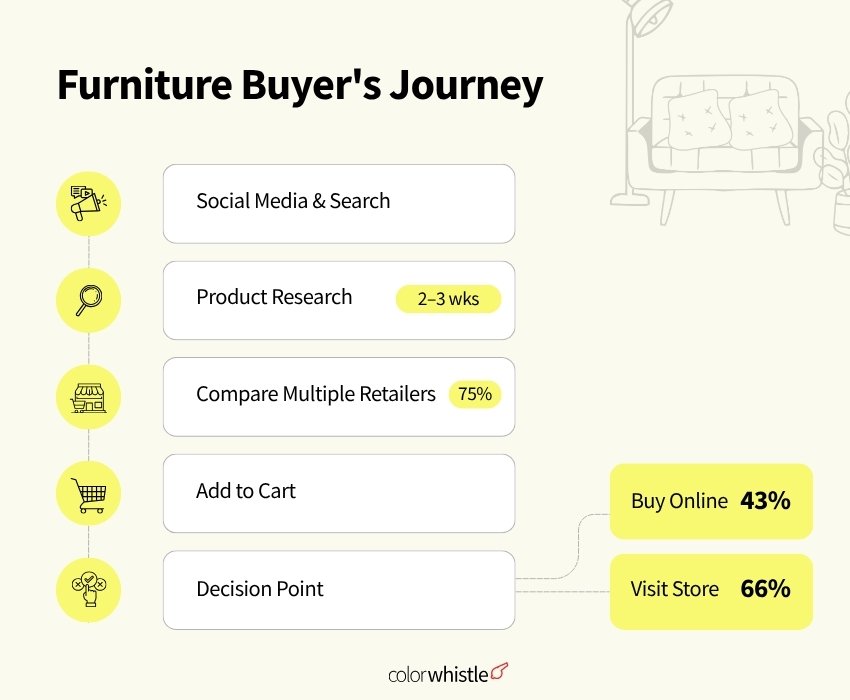
- Millennial furniture buyers spend an average of 2-3 weeks researching before completing a purchase
- Three-quarters of millennials (75%) cross-shop multiple retailers before buying, loyalty to a single brand is earned, not assumed
- 63% of consumers begin their furniture shopping journey online, typically seeking inspiration on Pinterest, Instagram, or retailer websites
- Despite that digital-first start, only 43% ultimately complete the purchase online, a 20-point gap that represents the single biggest friction point in furniture eCommerce
If you’re planning to launch or scale an online furniture business, explore our comprehensive eCommerce development services to build a store optimized for growth and conversions.
The Hybrid Journey: Digital Start, Physical Finish
The dominant buying pattern today is neither purely online nor purely offline.
- Consumers frequently initiate their journey online before finalizing purchases in-store, combining digital convenience with the tactile assurance of physical interaction
- Older buyers lean toward in-store purchases; younger shoppers lean toward online and hybrid models. Baby Boomers still strongly prefer starting and finishing in-store
- Of consumers who begin online, 41% start on a furniture store website and 40% begin with a general search engine query
- Two-thirds of Americans (66%) who research online ultimately complete their purchase in-store, reinforcing that digital presence drives physical store revenue, even when no online transaction occurs
Generational Spending Patterns
Not all buyers are equal. Each generation approaches furniture shopping with distinctly different expectations:
Gen Z (born 1997-2012):
- Spends an average of $430 annually on furniture, representing the lowest spend among generations but with the fastest-growing purchasing power
- 84% of Gen Z furniture purchases are shaped by social media, with YouTube, Instagram, and TikTok as the primary influencers
- 68% of Gen Z prioritize eco-friendly furniture made from natural or sustainable materials
Millennials (born 1981-1996):
- 75% compare prices across multiple retailers before committing
- Millennials continue to drive furniture demand through homeownership, renovation projects, and hybrid-work lifestyles
- Convenience, value, and seamless omnichannel experiences are key purchase drivers
Gen X (born 1965–1980):
- Gen X remains one of the most valuable consumer groups due to high disposable income and established homeownership
- Gen X shoppers prioritize quality, craftsmanship, durability, and long-term value over trends
- They frequently research online but still show a stronger preference for in-store purchasing than younger generations
For businesses considering Shopify, this guide to Shopify website design costs in the USA explains what you can expect to invest based on your requirements.
Conversion Rates: Where Furniture Lags Behind
Furniture is one of the lowest-converting categories in all of eCommerce and understanding why is the first step to fixing it.
The Baseline Benchmark
- The Home & Furniture category recorded an average eCommerce conversion rate of 1.41% over the past 12 months, making it one of the lowest-converting retail sectors
- Industry benchmarks place furniture ecommerce conversion rates between 1.2% and 1.6%, reflecting the longer consideration cycles associated with high-value purchases
- Furniture shoppers often require additional reassurance before buying. Product visualization tools, customer reviews, user-generated content, financing options, and transparent delivery information can help reduce purchase hesitation and improve conversion performance
Cart Abandonment: The Highest Rate in Retail
Furniture shoppers are notorious abandoners and the data confirms it.
- Cart abandonment remains a major challenge. According to Baymard Institute research, the average ecommerce cart abandonment rate is approximately 70.2%, meaning more than seven out of ten shoppers leave without completing their purchase
- The furniture cart abandonment rate is 86.9% in the US, meaning fewer than 14 in 100 shoppers who add a piece of furniture to their cart complete the purchase
- First Chair research puts the figure at 78.65%, describing it as “the highest rate of any non-luxury retail category.”
- Across all eCommerce, home and furniture has a cart abandonment rate of approximately 80.32%, according to Sales Cycle data, substantially above the retail-wide average of 72.23%
- The broader global eCommerce cart abandonment rate sits at approximately 74.8% when averaged across all industries and sources
Why Furniture Shoppers Abandon
Why Furniture Shoppers Abandon
- Inability to visualize the product in their own space – the most furniture-specific driver of abandonment, unique to high-consideration, large-format products
- Unexpected shipping costs – long-haul delivery for large items frequently adds $100-$300+ that shoppers don’t anticipate
- Delivery timeline uncertainty – “4-6 weeks” estimates create hesitation that smaller product categories don’t face
- Lack of confidence in product dimensions – “will this actually fit?” is a furniture-specific anxiety that 2D images rarely resolve
- Desire to see the product in person first – reinforcing why the hybrid journey dominates
Displaying shipping costs early, showing real delivery windows upfront, and providing dimension reference tools (room planners, AR visualization) directly address the highest-friction abandonment drivers.
Also Read
Technology & Trends Reshaping Furniture eCommerce
Augmented Reality
The technology that has moved the needle most for furniture online is AR, and the data makes clear why adoption is accelerating.
- AR increases conversion rates by up to 40% for furniture retailers who implement it effectively
- Macy’s pilot found that AR/VR furniture visualization led to a 60% larger average basket size and 25% fewer returns
- Shopify reports that 3D/AR product media can reduce returns by 40% by aligning customer expectations with the actual product
- Retailers using 3D/AR visualization see 150% higher conversion rates than those relying on traditional 2D photography
- Over 40% of furniture shoppers have tried AR placement tools, and AR SKU listings on major platforms grew over 25% in recent years
- The global AR furniture market is projected to reach $15.6 billion by 2025, growing at a CAGR of 32.8%
Social Media & Social Commerce
Social media has evolved from a brand awareness channel to a direct purchase driver for younger furniture buyers.
- 80% of Gen Z and millennial consumers now integrate social media into their shopping journeys, per the Bazaar voice Shopper Preference Report
- 50% of Gen Z say their first stop when looking for furniture is Amazon, not a traditional furniture retailer’s website
- 92% of Gen Z want to use AR for shopping, and 49% of millennials describe AR as “very important” to their purchase experience
Direct-to-Consumer (DTC) Growth
- Approximately 20% of all furniture orders now flow through drop-ship or white-label DTC models, as brands move to control the customer relationship and margin
- The fragmented nature of the furniture market, no single brand dominates the way Apple owns consumer electronics, creates significant opportunities for new, direct-to-consumer brands to capture share through a superior digital experience
Sustainability as a Purchase Driver
- 73% of Gen Z consumers are willing to pay more for products considered sustainable or eco-friendly
- Sustainability messaging is no longer a differentiator, it’s a baseline expectation for furniture brands targeting buyers under 40
How ColorWhistle Can Help Furniture Brands Win Online
Building a high-converting furniture eCommerce store requires more than a good theme. It demands expert design, performance engineering, and a deep understanding of how furniture buyers actually make decisions.
At ColorWhistle, we work with furniture and home furnishing brands to build and optimize Shopify and custom eCommerce stores that close the confidence gap: stores that load fast on mobile, showcase products with the depth buyers need, and guide visitors through a checkout experience designed to convert.
From AR and 3D visualization integration to CRO-led UX design and Shopify development, we bring the technical and strategic depth that high-AOV furniture commerce demands.
Note: Market size figures vary significantly across research firms due to differing scope definitions (furniture only vs. home furnishings including décor, lighting, and textiles). All figures above are from their respective primary sources, treat them as directional indicators rather than precise benchmarks.
Wrap-up
Furniture eCommerce is growing rapidly, but high cart abandonment and low conversion rates remain major challenges. Brands that invest in AR visualization, transparent pricing, seamless user experiences, and omnichannel shopping journeys will be better positioned to win over modern buyers and capture a larger share of this expanding market.
FAQs
Is Shopify a good platform for furniture stores?
Yes. Shopify offers scalability, mobile optimization, and integrations for advanced features such as AR, product customization, and omnichannel selling.
What features should a furniture eCommerce website include?
Essential features include high-quality product images, AR visualization, detailed dimensions, customer reviews, flexible payment options, delivery tracking, and a mobile-friendly shopping experience.
How can furniture brands increase online sales?
Improving product visualization, reducing checkout friction, offering transparent shipping information, and optimizing the mobile shopping experience can significantly improve conversions and revenue.
 Healthcare Appointment Booking Statistics for...