


Healthcare Appointment Booking Statistics for Hospitals (2026 Trends & Insights)

Phurvishaa specializes in crafting travel tech and marketing content, leveraging deep research, SEO expertise, and AI-driven insights. Her strategic approach ensures content that educates, engages and delivers knowledge.

Our authors are proven experts in their fields, writing on topics where they have demonstrated expertise. Every piece of content undergoes peer review and validation by industry professionals.
AI Summary
Healthcare Appointment Booking Statistics for Hospitals (2026 Trends & Insights)
This post explores critical healthcare appointment booking statistics for 2026, aiming to educate hospitals and clinics on the shift toward digital scheduling. The key insight: patients overwhelmingly prefer online, mobile, and 24/7 booking options, driving growth in scheduling software markets. The blog highlights how adopting self-scheduling tools and automated reminders can reduce costly no-shows by up to 29%. It also covers technology adoption trends, including virtual care and AI integration, showing real-world benefits like increased patient retention and operational savings. Clinics are urged to upgrade their systems to boost convenience, reduce revenue loss, and enhance patient engagement.
Healthcare has always been personal. But how do patients access that care? That’s changed dramatically. The days of calling a clinic at 9 AM, waiting on hold, and hoping someone picks up are quickly becoming a relic of the past. In 2026, appointment booking is a digital-first experience and hospitals and clinics that haven’t adapted are feeling it in their occupancy rates, no-show numbers, and patient retention.
This blog compiles the most relevant healthcare appointment booking statistics for 2026, alongside practical guidance for clinics and hospitals looking to upgrade their scheduling infrastructure.
The Rise of Online Healthcare Appointment Booking
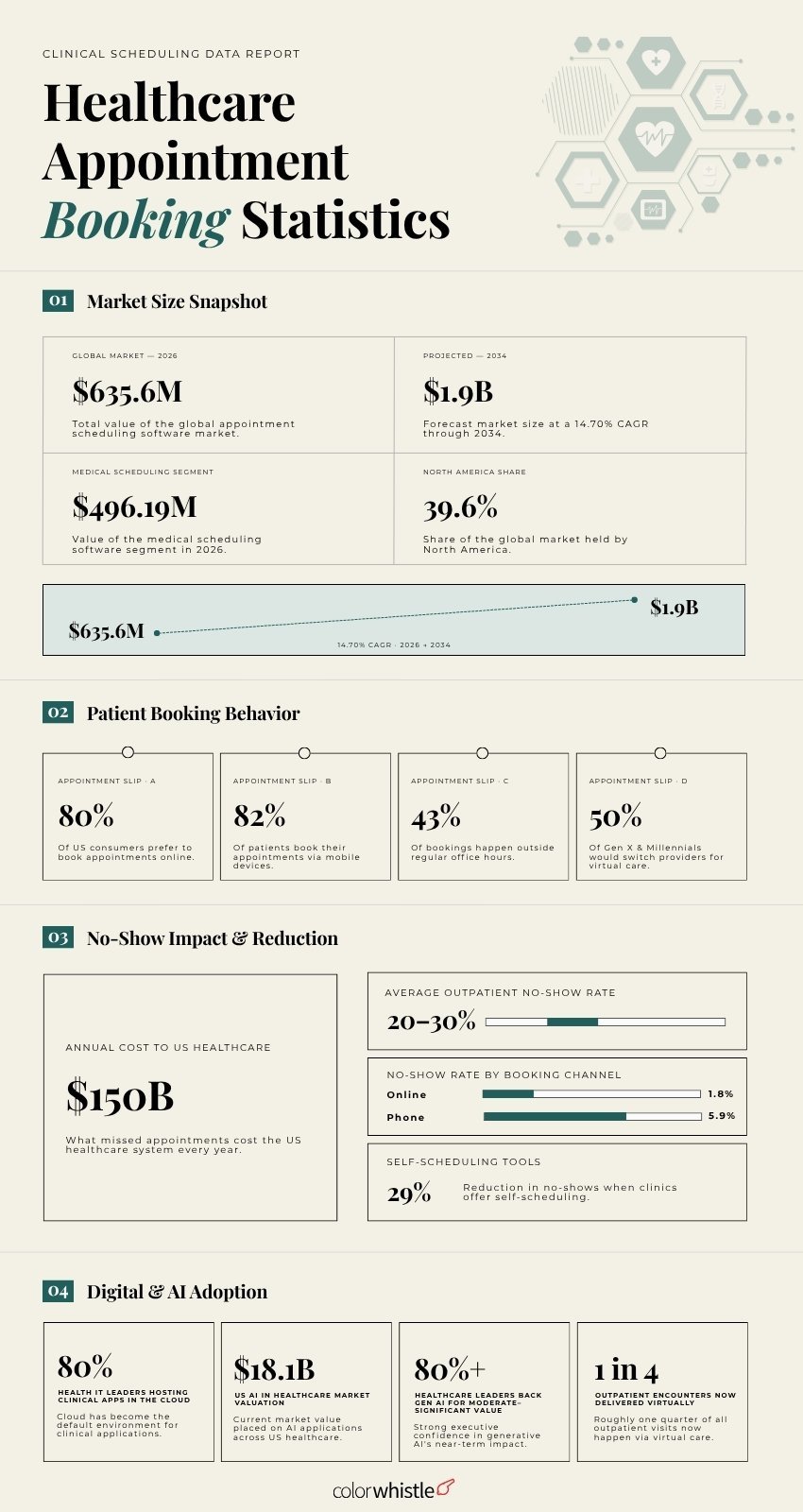
The market signals are hard to ignore. The global appointment scheduling software market is projected to reach $635.6 million in 2026, growing toward $1.9 billion by 2034 at a CAGR of 14.70%, according to Fortune Business Insights. A separate analysis from Mordor Intelligence pegs the medical scheduling software segment specifically at $496.19 million in 2026, growing at an 11.92% CAGR through 2031.
This growth isn’t happening in a vacuum. It’s being driven by a healthcare consumer who expects the same digital convenience from their doctor that they get from their bank or their airline.
- 8 in 10 U.S. consumers prefer to set appointments online (Mordor Intelligence, 2026)
- More than half of self-service bookings come from new patients meaning online scheduling is also a patient acquisition channel (Mordor Intelligence, 2026)
- 40% of appointments are booked after business hours, making 24/7 availability a functional necessity, not a premium feature (Allied Market Research)
- North America dominates with a 39.6% share of the global medical scheduling software market (Market.us, March 2026)
The global digital health market as a whole reached $347–$427 billion in 2025 and is projected to surpass $490 billion in 2026, per Axis Intelligence Research synthesizing data from Grand View Research and Fortune Business Insights.

Patient Behavior & Booking Preferences
Understanding how patients want to book is just as important as understanding that they want to book online. The data reveals clear preferences that healthcare providers can act on immediately.
- 82% of clients use mobile devices to book appointments; only 16% use desktops (Zippia, 2026)
- Nearly 70% of bookings are placed on mobile devices and 43% occur outside standard office hours (Mordor Intelligence, 2026)
- 60% of Gen Xers and Millennials say they’d switch to a healthcare provider that offers virtual care (Rockhealth)
- 24% of consumers say they would look for a new doctor if a virtual appointment wasn’t available, according to Deloitte.
- More than 90% of consumers who had a virtual health visit said they would be willing to have another (Deloitte 2026 Healthcare Outlook Survey)
No-Show Rates: The Hidden Revenue Drain
No shows represent one of the most significant and most solvable operational problems in healthcare today.
- Patient no-shows cost the U.S. healthcare system an estimated $150 billion annually (insights.wchsb)
- The average missed appointment costs a clinic approximately $200 in lost revenue (insights.wchsb)
- The average no-show rate across U.S. outpatient clinics ranges from 20–30%, with certain specialties reaching as high as 40% (insights.wchsb.com)
Also Read
Here’s where online scheduling directly moves the needle:
- Self-scheduling tools reduce patient no-show rates by 29% (insights.wchsb.com)
- Automated SMS reminders reduced no-shows with an Odds Ratio of 0.93 in hospital settings (PMC)
- Organizations using both email and text reminders report up to 90% client show rates (AgentZap, 2026)
A primary care practice seeing 30 patients per day with a 19% no-show rate loses over $250,000 per year from missed appointments alone before accounting for downstream referrals and procedures.
How to Choose the Right Appointment Booking System for Your Clinic
Before diving deeper into adoption trends, it’s worth taking a practical pause. The statistics above make the why clear but the what is where many clinics get stuck. Here’s a quick feature checklist to evaluate any scheduling platform:
| Features | Why It Matters |
|---|---|
| Real-time slot visibility | Eliminates double-bookings and call-backs |
| Automated reminders (SMS + email) | Directly reduces no-show rates by up to 29–30% |
| Mobile-optimized interface | 82% of patients book on mobile |
| After-hours booking | 40–43% of bookings happen outside office hours |
| EHR/EMR integration | Avoids fragmented data and manual re-entry |
| Self-rescheduling capability | 75% of patients say this encourages attendance |
| Telehealth appointment support | Virtual visits now account for ~1 in 4 outpatient encounters |
| HIPAA compliance | Non-negotiable for any patient data handling |
If you’re evaluating a full healthcare website rebuild to incorporate these features, ColorWhistle’s Website Cost & Features page breaks down what goes into building a scalable, compliant healthcare web platform.
Hospital & Clinic Technology Adoption Trends
The shift isn’t just happening at individual clinics. Health systems at scale are restructuring their digital infrastructure.
- 70% of health IT leaders already host at least one clinical application in the public cloud, with another 20% planning migrations by 2027 (Mordor Intelligence, 2026)
- Early cloud movers report $2 million in two-year savings versus on-premises systems, alongside 94% higher satisfaction with upgrade velocity (Mordor Intelligence, 2026)
- Virtual visits now account for roughly 1 in 4 outpatient encounters across large U.S. health systems (Mordor Intelligence, 2026)
- About 60% of health plan and health system executives plan to invest in virtual health services to support preventive care in 2026 (Deloitte 2026 )
- More than 80% of healthcare leaders believe that generative AI and agentic AI can provide “moderate-to-significant value” across clinical and business operations in 2026 (MedCity News, December 2025)
- The U.S. AI in healthcare market was valued at $18.1 billion in 2025 and is projected to reach $222.9 billion by 2033 at a CAGR of 36.9% (Grand View Research, 2026)
Also Read
Ready to Build a Healthcare Booking Experience That Works?
The data is clear: patients want digital, mobile, and always-on. Hospitals and clinics that invest in the right scheduling infrastructure don’t just improve convenience; they reduce no-shows, improve staff productivity, and grow their patient base.
If your clinic website isn’t set up to handle online appointment booking, automated reminders, and telehealth integration, it’s time to change that. ColorWhistle Specializes in building healthcare websites and digital platforms that are fast, compliant, and built around how patients actually behave.
Talk to the ColorWhistle team about what the right healthcare web solution looks like for your practice.
FAQ’s
1. Why are online appointment booking systems becoming essential for hospitals and clinics?
Patients value convenience and expect to book appointments anytime without calling during business hours. Online scheduling also reduces administrative workload, improves patient experience, and minimizes scheduling errors.
2. Can appointment booking software reduce patient no-shows?
Yes. Modern booking systems typically include automated SMS and email reminders, confirmation requests, cancellation options, and rescheduling features that help significantly reduce missed appointments.
3. What features should healthcare appointment booking software include?
A good solution should offer online self-scheduling, real-time availability, automated reminders, patient record integration, secure payments (if applicable), calendar synchronization, and mobile accessibility for both patients and staff.
 Car Rental Market Statistics: Digital Booking...