


Diagnostic lab market stats 2026 on growth, AI and digital trends

Phurvishaa specializes in crafting travel tech and marketing content, leveraging deep research, SEO expertise, and AI-driven insights. Her strategic approach ensures content that educates, engages and delivers knowledge.

Our authors are proven experts in their fields, writing on topics where they have demonstrated expertise. Every piece of content undergoes peer review and validation by industry professionals.
AI Summary
Diagnostic lab market stats 2026 on growth, AI and digital trends
This post explores the rapid transformation of the diagnostic laboratory market driven by AI, automation, and telehealth. The key insight: labs are evolving into digital-first enterprises reshaping patient access to testing. It serves healthcare providers, tech businesses, and hospital operators aiming to stay competitive. Readers will learn about market size growth, segment performance, AI adoption, lab automation, and the rise of home testing and telehealth integration. The blog highlights benefits like improved diagnostic accuracy, reduced errors, and enhanced patient experience via digital infrastructure. Next steps include investing in advanced digital platforms to meet rising patient expectations and operational efficiency.
The diagnostic laboratory market is undergoing one of the most significant transformations in its history and the numbers behind it are accelerating fast. Clinical labs are no longer just back-office operations processing samples. They are becoming digital-first enterprises powered by AI, automation, and telehealth integrations that are reshaping how, where, and when patients access diagnostic services. For hospitals, clinic operators, and healthcare technology businesses, understanding the latest diagnostic laboratory market statistics is essential to staying competitive in a rapidly evolving landscape.
Here’s a comprehensive, data-backed look at the global diagnostic lab industry in 2026 from market size and technology adoption to home testing, AI, and what it all means for patient-facing digital infrastructure.
TL; DR
A data-backed look at the global diagnostic laboratory industry in 2026 covering how the market is sized and segmented, which test types and technologies are growing fastest, how AI and automation are reshaping lab operations, and how the patient journey is shifting toward digital and home-based diagnostics.
This blog is for: diagnostic lab operators, hospital administrators, healthcare IT decision-makers, and web agencies building digital products for the clinical diagnostics and pathology space.
- Where the global clinical lab and diagnostic testing market stands in size and growth
- Which test segments molecular, oncology, POCT are growing fastest and why
- How AI is moving from a support tool to an active diagnostic partner in labs
- What lab automation investment looks like in 2026 and what it delivers operationally
- How telehealth, home testing, and online booking are redefining the patient-lab relationship
Market Size & Global Growth
The scale of the diagnostic laboratory industry is substantial and growing faster than most healthcare segments:
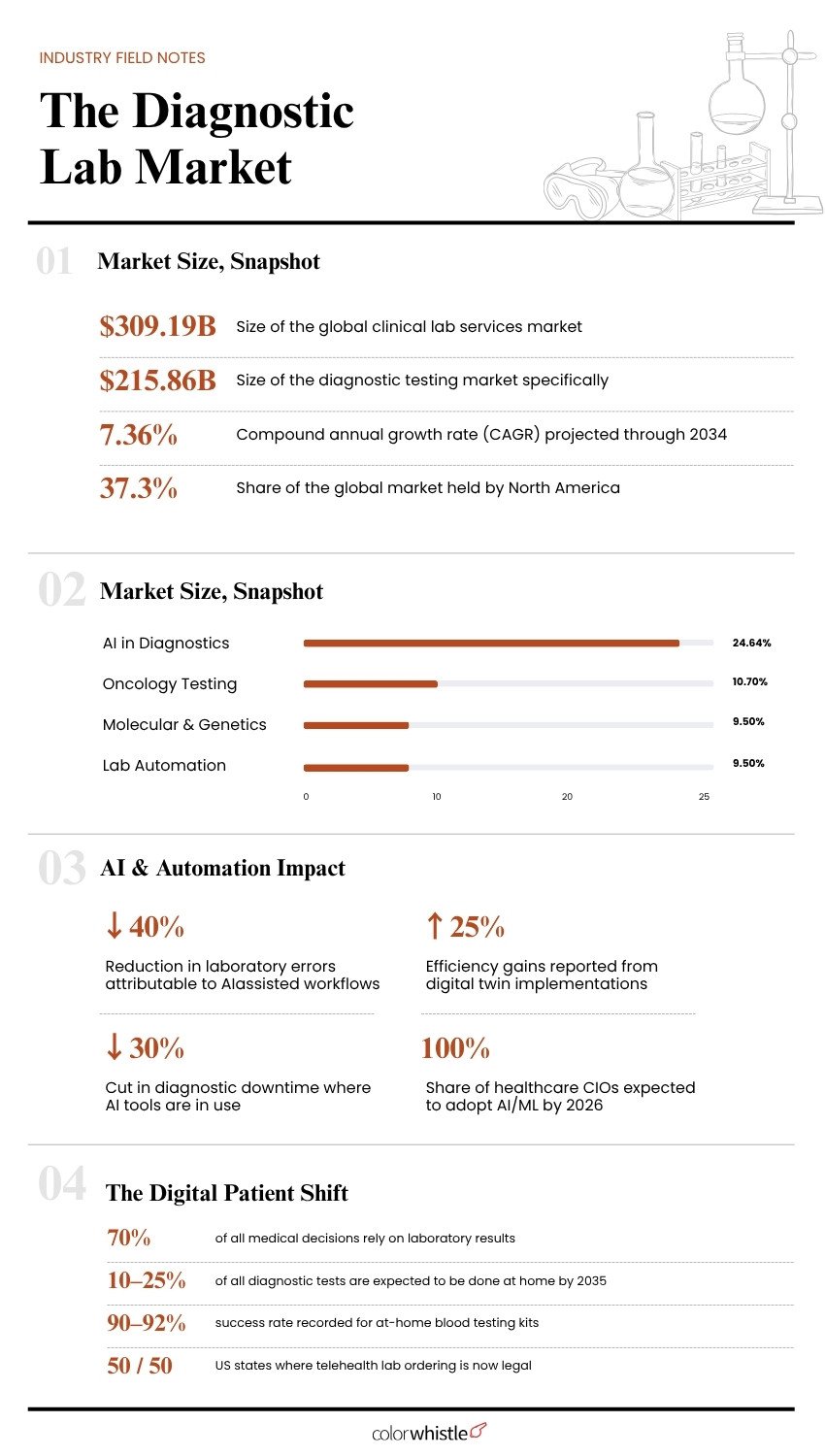
- The global clinical laboratory services market was valued at $309.19 billion in 2026 and is projected to reach $545.79 billion by 2034, growing at a CAGR of 7.36%. (Source: Fortune Business Insights)
- A parallel estimate from Mordor Intelligence places the market at $315.14 billion in 2026, projected to reach $431.56 billion by 2031 at a CAGR of 6.49%. (Source: Mordor Intelligence)
- The diagnostic testing market specifically was valued at $215.86 billion in 2026 and is projected to reach $274.53 billion by 2034, growing at a CAGR of 3.04%. (Source: Towards Healthcare)
- North America dominates the global clinical laboratory services market with a 37.3% market share in 2026, driven by advanced healthcare infrastructure, high per-capita spending, and early technology adoption. (Source: Coherent Market Insights)
- Asia-Pacific is the fastest-growing region, with the clinical laboratory services market projected to grow at a CAGR of 7.84% through 2031, driven by expanding urban populations, rising chronic disease burden, and government health infrastructure investment. (Source: Mordor Intelligence)
- Hospital-based laboratories hold the dominant service provider share at 53.40% in 2026, owing to high patient volumes and strong integration within clinical workflows. (Source: Fortune Business Insights)
“Laboratories that adopt high-throughput automation, liquid biopsy platforms, and mobile phlebotomy services are well-positioned to mitigate reimbursement pressures while capitalizing on the growing demand for preventive screenings and chronic care programs.”
– Mordor Intelligence, Clinical Laboratory Services Market Report, January 2026
Test Types & Segment Performance
Understanding which segments are growing fastest reveals where lab investment is headed:
- Clinical chemistry dominates by test type, accounting for 58% market share in 2026, driven by high volumes of diabetes, thyroid, and hormonal disorder testing. (Source: Coherent Market Insights)
- Genetics and molecular diagnostics are the fastest-growing segment, expected to advance at a CAGR of 9.50% through 2031 fueled by demand for personalized medicine and genomic testing. (Source: Mordor Intelligence)
- Oncology testing is projected to grow at a CAGR of 10.70% through 2031, as cancer screening and early detection programs scale globally. (Source: Mordor Intelligence)
- Infectious disease testing remains the largest application segment at 31.40% of market share, a structural legacy of pandemic-era investment in testing capacity. (Source: Mordor Intelligence)
- Hospitals and clinics are the largest end-user segment, contributing to approximately 45% of diagnostic testing market revenue. (Source: Towards Healthcare)
- The point-of-care testing (POCT) segment is expected to show the fastest growth over the forecast period, driven by demand for rapid, decentralized results in urgent care and remote settings. (Source: Towards Healthcare)
Also Read
AI in Diagnostics: The Fastest-Growing Tech Layer
AI is no longer a future investment for diagnostic labs it is an active, revenue-generating tool:
- The AI in diagnostics market was valued at $2.17 billion in 2026 and is projected to reach $15.74 billion by 2035, growing at a remarkable CAGR of 24.64%. (Source: Towards Healthcare)
- Healthcare leads all industries in AI adoption growth, with a 36.8% CAGR the highest of any sector tracked, driven by breakthroughs in diagnostics, patient management, and clinical documentation. (Source: Second Talent)
- Mayo Clinic Labs’ 2026 forecast predicts AI shifting from a support tool to a diagnostic partner, with projected accuracy gains of 20–30% for AI-assisted diagnostic workflows. (Source: Bio-Reach Lab Digitalization Report)
- AI-driven automation is projected to reduce laboratory errors by up to 40% and cut diagnostic workflow downtime by 30% through predictive scheduling. (Source: Bio-Reach)
- In a high-profile example, Quest Diagnostics and PathAI formed an extensive partnership to accelerate AI-driven pathology adoption, specifically targeting faster and more accurate cancer diagnosis. (Source: Towards Healthcare)
Lab Automation: The Operational Backbone
Automation is the infrastructure layer that makes AI and high-volume diagnostics operationally viable:
- The global lab automation market was valued at $7.1 billion in 2026 and is projected to reach $16.1 billion by 2035, growing at a CAGR of 9.5%. (Source: Roots Analysis)
- In February 2026, Automata secured $45 million in Series C funding to advance autonomous, AI-ready lab infrastructure, expanding its partnership with Danaher to scale modular lab workflows globally. (Source: Roots Analysis)
The Digital Patient Journey: Telehealth, Home Testing & Online Booking
The diagnostic lab is meeting patients where they are digitally and physically:
- Over half of diagnostics experts in both the US and Europe expect 10–25% of all diagnostic tests to be performed at home by 2035, based on a survey of 1,130 industry experts and lab directors. (Source: Simon-Kucher Global IVD Trend Study)
- At-home blood tests have demonstrated 90–92% success rates, making them clinically viable for older adults, people with disabilities, and rural populations without easy access to physical labs. (Source: Healthline, medically reviewed March 2026)
- Telehealth-ordered lab work is now legal in all 50 US states, with licensed providers able to electronically submit lab requisitions to nationwide networks like Quest Diagnostics and Labcorp during a virtual visit. (Source: Doctronic, reviewed May 2026)
- Platforms like Helloklarity connect patients with licensed providers within 24 hours, with lab requisitions delivered to the same day standard patients are increasingly expecting from all diagnostic providers. (Source: Helloklarity 2026 Guide)
This is a direct signal for diagnostic labs and hospital systems: patients now expect online booking, digital results delivery, and telehealth-integrated workflows as baseline service features not premium add-ons.
What Labs Look Like When Digital Infrastructure Is Done Right
The data tells one side of the story. The other side is what a well-digitized diagnostic lab looks like in practice in 2026 and how wide the gap remains for labs that haven’t made the transition.
Labs that are leading the digital shift share a few common traits:
- Frictionless online booking patients can schedule, reschedule, and choose between in-clinic, home collection, or mobile phlebotomy in a single flow, without calling a front desk
- Real-time results delivery results are pushed to a patient portal or app directly, reducing both patient anxiety and inbound follow-up calls to staff
- EHR integration lab orders from telehealth visits route directly into the lab’s system, eliminating fax-based workflows and manual re-entry
- AI-assisted triage incoming samples are automatically prioritized by urgency, test type, and turnaround SLA, reducing manual sorting bottlenecks
- Proactive patient communication automated SMS/email reminders for appointments, prep instructions, and result notifications
Labs still running on paper requisitions, phone-only booking, and manual results of dispatch are increasingly losing patients to more digitally accessible providers, and the data on home testing adoption confirms this pressure will only intensify.
Also Read
What This Means for Diagnostic Lab Websites & Digital Presence
Every stat in this blog points to a clear strategic conclusion: a diagnostic laboratory’s website and digital infrastructure is now a core part of its clinical delivery model.
With 70% of medical decisions depending on lab results and patients increasingly accessing services digitally, the lab website is not a brochure it’s a patient acquisition and retention tool
Online appointment booking, result portals, and telehealth integration are now table-stakes expectations from patient’s labs that lack these features are losing volume to competitors who have them
The rapid growth of home testing and mobile phlebotomy means labs need digital infrastructure that can coordinate multi-location, multi-channel service delivery seamlessly
Whether you’re building a new diagnostic lab website, upgrading an outdated patient portal, or integrating booking and results of delivery into an existing hospital system, the investment directly impacts patient volume and satisfaction. Explore what a healthcare website build actually involves, or see how ColorWhistle approaches healthcare web design and development.
Ready to build a diagnostic lab or hospital website that matches today’s patient expectations? Talk to ColorWhistle we build healthcare digital experiences designed to serve patients and convert traffic into booked appointments.
FAQ’s
How big is the global diagnostic laboratory market in 2026?
The global clinical laboratory services market was valued at $309.19 billion in 2026 and is projected to reach $545.79 billion by 2034, growing at a CAGR of 7.36% driven by rising chronic disease burden and rapid technology adoption.
How fast is AI growing in the diagnostics space?
The AI in diagnostics market was valued at $2.17 billion in 2026 and is expected to reach $15.74 billion by 2035 at a CAGR of 24.64%, making it the fastest-growing technology layer within the entire clinical lab ecosystem.
Which diagnostic test segments are growing the fastest?
Molecular and genetics diagnostics are growing at a 9.50% CAGR, oncology testing at 10.70%, and point-of-care testing is the fastest-growing technology segment overall all driven by demand for faster, more personalized, and decentralized diagnostics.
 Furniture eCommerce Market Statistics: Trends...