



![Car Rental Market Statistics: Digital Booking Trends & Industry Growth [2026]](https://colorwhistle.com/wp-content/uploads/2026/07/Car-Rental-Market-Statistics-Digital-Booking-Trends-Industry-Growth-ColorWhistle.jpg "Car Rental Market Statistics: Digital Booking Trends & Industry Growth [2026]")
Car Rental Market Statistics: Digital Booking Trends & Industry Growth [2026]

Phurvishaa specializes in crafting travel tech and marketing content, leveraging deep research, SEO expertise, and AI-driven insights. Her strategic approach ensures content that educates, engages and delivers knowledge.

Our authors are proven experts in their fields, writing on topics where they have demonstrated expertise. Every piece of content undergoes peer review and validation by industry professionals.
AI Summary
Car Rental Market Statistics: Digital Booking Trends & Industry Growth [2026]
This post explores the rapid digital transformation of the global car rental market, emphasizing growing online bookings, AI-driven pricing, and EV adoption. The key insight: over 70% of rentals now occur via digital channels, drastically reducing booking times and boosting revenues. It serves travel businesses, fleet operators, and mobility tech developers seeking data-driven market intelligence. Readers learn about market growth, demand segments, and technology impacts, enabling smarter digital strategies. Supported by recent statistics and case examples, the blog urges investment in digital platforms, AI tools, and EV fleets to capture rising demand and improve operational efficiency in a competitive landscape.
The car rental market has quietly become one of the most digitally transformed segments in the entire travel industry. What was once a clipboard-and-counter business is now driven by mobile apps, AI-powered pricing, and contactless pickup, and the numbers behind this shift are accelerating fast. For travel businesses, fleet operators, and anyone building digital products in the mobility space, understanding the latest car rental market statistics is the clearest window into where demand is growing and where the digital gaps are.
Here’s a data-first look at the global car rental industry in 2026 from market size and booking behavior to EV adoption and what it all means for your digital strategy.
TL; DR
A data-backed look at the global car rental industry in 2026 covering how big the market is, how travelers are booking today, which demand segments are growing fastest, how EV fleets are reshaping operations, and what the shift to digital-first means for rental businesses online.
This blog is for: car rental operators, fleet managers, travel platform builders, and web agencies building digital products for the mobility and vehicle rental segment.
- Where the global and US car rental market stands in size and growth trajectory
- How digital and mobile booking has taken over as the dominant reservation channel
- Who’s renting, for how long, and which vehicle types are in highest demand
- How EV adoption and AI-powered operations are changing the fleet and pricing game
- What all of this means for car rental businesses competing for bookings online
Market Size & Global Growth
The scale of the car rental industry is larger than most people assume:
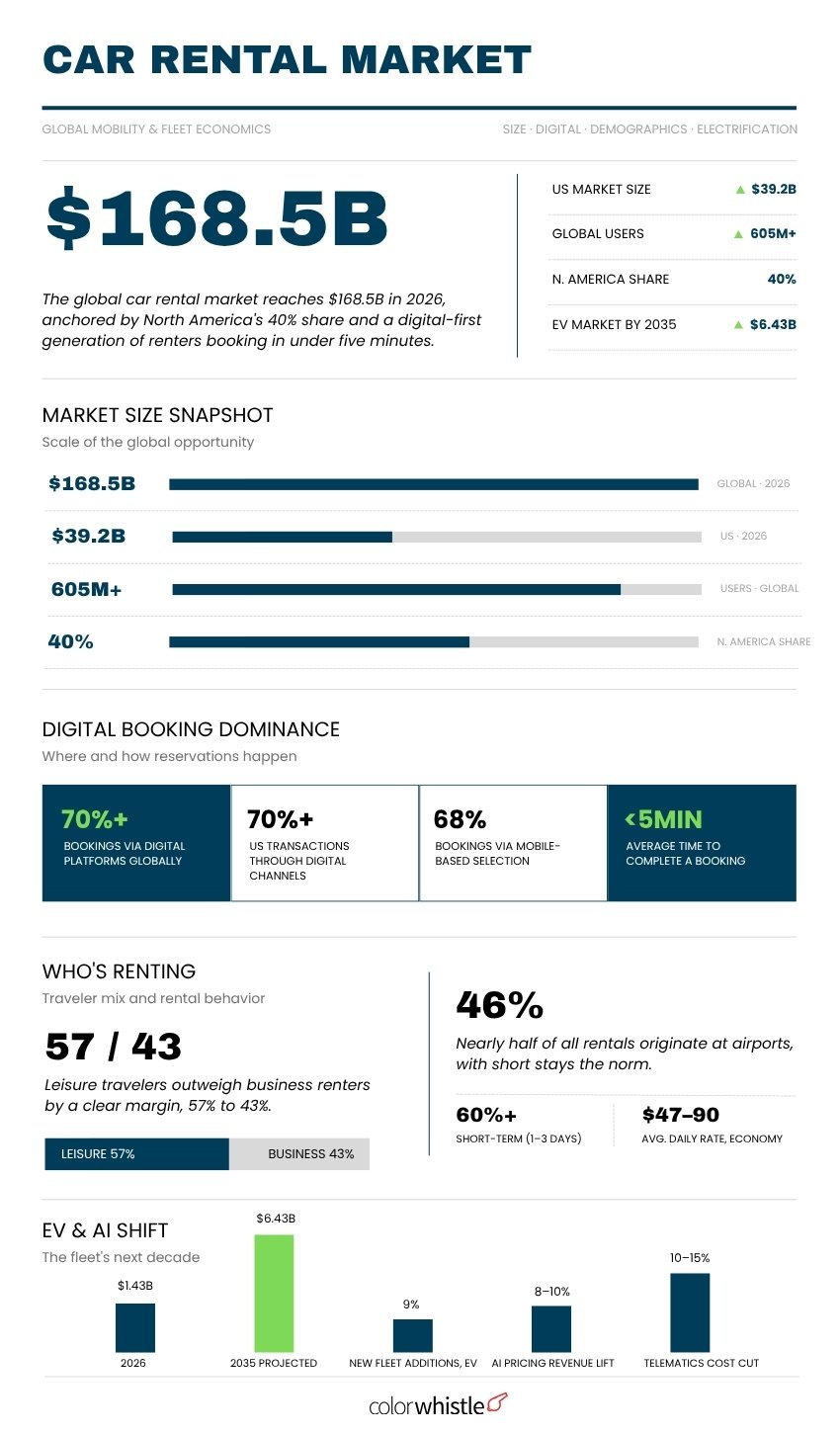
- he global car rental market was valued at $168.5 billion in 2026 and is projected to reach $278.03 billion by 2030, growing at a CAGR of approximately 6.5%. (Source: Grand View Research via Passport Photo Online)
- The US car rental market was valued at $39.20 billion in 2026 and is projected to reach $56.27 billion, growing at a CAGR of 7.5% from 2026 to 2030. (Source: Passport Photo Online)
- The global luxury car rental market was valued at $52.82 billion in 2026, reflecting strong demand from premium leisure and corporate travelers. (Source: Passport Photo Online)
- North America leads with 40% of global market share in 2026, while Asia-Pacific is the fastest-growing region, fueled by rising disposable incomes, domestic tourism, and rapid digital adoption. (Source: Coherent Market Insights)
- There are currently 2,533 car rental businesses operating in the US, employing approximately 93,290 people. (Source: Passport Photo Online)
- Global car rental users are projected to reach 605.44 million in 2026, growing to 776.96 million by 2030. (Source: news.market.us)
“The biggest winners in 2026 are likely to be the operators that turn scale into a faster and more predictable customer experience through digital booking, tighter fleet discipline, and better utilization.”
– Car Audio Radar, Car Rental Industry Statistics 2026
Digital Booking: The Channel That Now Dominates
The shift from counter to click is near-complete:
- More than 70% of car rental reservations globally are now made through online platforms including mobile apps and aggregator websites. (Source: Coherent Market Insights)
- In the US specifically, digital reservation channels contributed nearly 76% of rental transactions in 2026, with mobile-based vehicle selection accounting for 68% of all customer interactions. (Source: Business Research Insights)
- By 2030, 75% of the entire car rental industry’s revenue is expected to be generated through online sales channels up from roughly 70% today. (Source: Statista via Passport Photo Online)
- Mobile reservation platforms have reduced booking completion times to less than 5 minutes, directly improving conversion and reducing drop-off at the checkout stage. (Source: Coherent Market Insights)
- Integration with travel planning tools boosted cross-platform bookings by approximately 31% in leisure-focused regions, highlighting the value of multi-channel booking presence. (Source: Global Growth Insights)
- Global car rental platforms are expected to generate over $107 billion by 2027, driven almost entirely by digital channel growth. (Source: Passport Photo Online)
Also Read
Who’s Renting & Why: Demand Segments
Understanding who rents and why reveals where growth is actually happening:
- Leisure travelers contribute 57% of US rental revenues, while business travel accounts for approximately 33% of bookings making tourism the engine of the market. (Source: Coherent Market Insights)
- Short-term rentals (1–3 days) account for 60%+ of all bookings, reflecting strong demand for flexible, on-demand mobility from both tourists and urban commuters. (Source: Coherent Market Insights)
- Airport-linked rentals account for approximately 46% of total rental transactions globally, making airport locations the single most important demand channel in the industry. (Source: Business Research Insights)
- SUV demand reached 41% of total rented vehicle categories in the US in 2026, while economy and compact cars dominate globally at 40–45% of fleet composition. (Source: Business Research Insights, Coherent Market Insights)
- The average daily car rental price in the US ranges from $47 to $90 for economy cars, while the average rental duration sits at approximately 4 days. (Source: Passport Photo Online, Business Research Insights)
- Vehicle rental penetration among domestic leisure travelers in the US exceeded 28% in 2026. (Source: Business Research Insights)
How to Choose the Right Car Rental for Your Trip
A practical, scannable guide covering:
- Trip type first: City hop vs. road trip vs. airport transfer each call for a different vehicle class
- Book direct vs. Aggregator: When each makes sense and what you typically save
- Read the fine print: Fuel policy, mileage caps, cross-border restrictions, insurance overlap
- EV or ICE? How to decide based on route length, charging availability, and trip duration
- Timing matters: Booking 2–3 weeks ahead typically lands better rates than last-minute
EV Adoption: The Green Shift in Fleet Composition
Electrification is no longer a trend it’s a fleet reality:
- The electric car rental market was valued at $1.43 billion in 2026 and is projected to reach $6.43 billion by 2035, growing at a CAGR of 16.23%. (Source: 360 Research Reports)
- EVs represented approximately 9% of newly procured rental vehicles globally in 2026, with hybrid vehicles accounting for 14% of new fleet additions. (Source: Business Research Insights)
- Urban rental hubs recorded EV utilization rates exceeding 81% due to shorter trip cycles and proximity to charging infrastructure. (Source: Business Research Insights)
- 61% of business travelers preferred electric rentals for urban transportation in 2026, citing lower operational costs and access to low-emission city zones. (Source: 360 Research Reports)
- Charging infrastructure deployment expanded by more than 28% across premium rental corridors globally. (Source: Business Research Insights)
- In January 2026, Enterprise Holdings expanded its EV fleet by 30% across North American locations, adding over 15,000 EVs including Tesla Model 3, Model Y, and Ford Mustang Mach-E. (Source: Global Market Insights)
- Tesla launched official car rental services at $60/day in the US in November 2026, starting in California and expanding to major cities. (Source: Coherent Market Insights)
Technology & Operations: AI, Telematics & Contactless
The back end of the car rental business is being rebuilt around data:
- AI-driven dynamic pricing adopted by Avis Budget Group across all North American operations in late 2025 boosts revenue per vehicle by 8–10% by aligning supply with real-time demand fluctuations. (Source: Coherent Market Insights)
- Telematics and AI reduce operational costs by 10–15%, optimizing fuel use, maintenance scheduling, and logistics across large fleets. (Source: Coherent Market Insights)
- Predictive analytics cut vehicle downtime by up to 20%, ensuring higher fleet availability during peak demand periods. (Source: Coherent Market Insights)
- Average booking time at counters has dropped to 4.5 minutes thanks to digital pre-check-ins compared to over 22 minutes for customers who skip the digital process entirely. (Source: Coherent Market Insights)
- Technology investments account for approximately 41% of total capital spending among rental operators in 2026, focused on mobile booking, contactless pickup, and pricing optimization. (Source: Global Growth Insights)
- In 2026, Baidu Apollo and CAR Inc. launched the world’s first self-driving car rental service in China, marking the entry of autonomous vehicle technology into mainstream rental operations. (Source: Coherent Market Insights)
Competitive Landscape: Who Controls the Market
A handful of giants dominate but digital is leveling the playing field:
- Enterprise Holdings, Hertz, and Avis Budget Group collectively control more than 90% of the US car rental market. Globally, the top 5 players (Avis Budget, Enterprise, Europcar, Hertz, Sixt) held a combined 52.2% market share. (Source: Global Market Insights)
- Enterprise Mobility reported $39 billion in fiscal revenue with 9,500+ rental branches and a global fleet of 2.4 million+ vehicles. (Source: Car Audio Radar)
- Avis Budget Group reported $11.7 billion in full-year revenue, operating in approximately 180 countries with around 10,000 rental locations. (Source: Car Audio Radar)
- 58% of operators are allocating capital toward upgrading vehicle fleets in 2026, driven by demand for better utilization, EV transition, and customer experience improvements. (Source: Global Growth Insights)
- In October 2026, Enterprise Mobility expanded into Taiwan, part of a broader Asia-Pacific push as the region emerges as the industry’s fastest-growing market. (Source: Coherent Market Insights)
Also Read
What This Means for Car Rental Businesses Online
Every data point in this blog points to the same conclusion: a car rental business without a strong digital booking presence is operating at a structural disadvantage.
- With 70–76% of bookings happening digitally, your website and app are your primary revenue channel not the counter
- Mobile booking completion under 5 minutes is now the industry benchmark friction at checkout is directly costing bookings
- AI-driven personalization, dynamic pricing, and contactless pickup are shifting from differentiators to baseline expectations
- EV fleet demand is growing fast businesses that surface EV availability, charging info, and sustainability credentials online will attract the growing segment of eco-conscious renters
Whether you’re building a new car rental platform or optimizing an existing one for digital booking, the infrastructure investment pays back directly in utilization and revenue. Explore what a travel and mobility website build involves, see travel website design inspirations, or review travel & tourism industry trends for the wider context.
Building a car rental or mobility booking platform? Talk to ColorWhistle, we build travel and mobility websites designed to convert digital traffic into confirmed bookings.
FAQ’s
How big is the global car rental market in 2026?
The global car rental market was valued at $168.5 billion in 2026 and is projected to reach $278 billion by 2030, growing at a CAGR of approximately 6.5% driven by rising travel demand and digital adoption.
What percentage of car rentals are booked online?
More than 70% of car rental reservations globally are made through digital platforms, with the US sitting even higher at 76% and that share is projected to hit 75% of total industry revenue by 2030.
How fast is the electric car rental market growing?
The electric car rental market was valued at $1.43 billion in 2026 and is projected to reach $6.43 billion by 2035, growing at a CAGR of 16.23% making it one of the fastest-growing segments in the entire mobility space.
 Athlete Performance Tech Statistics: Wearable...