




Athlete Performance Tech Statistics: Wearables, AI & Training Insights

Archana's passion for data analysis, statistics, and content creation makes her well-equipped to write insightful, data-driven blogs that transforms complex data into engaging content, helping readers gain deeper insights and take informed decisions.

Our authors are proven experts in their fields, writing on topics where they have demonstrated expertise. Every piece of content undergoes peer review and validation by industry professionals.
AI Summary
Athlete Performance Tech Statistics: Wearables, AI & Training Insights
This post explores the rapid growth and impact of athlete performance technology, emphasizing wearables and AI as foundational tools in modern sports. The key insight: AI and wearable sensors are revolutionizing training and injury prevention, driving the $98 billion sports wearables market and a $9.76 billion AI sports segment. It serves sports professionals and tech innovators by detailing market growth, key features, and development costs for athlete tracking apps. Supported by peer-reviewed studies and market data, the blog highlights the shift toward data-driven performance optimization, empowering readers to leverage technology for improved athletic outcomes and innovation opportunities.
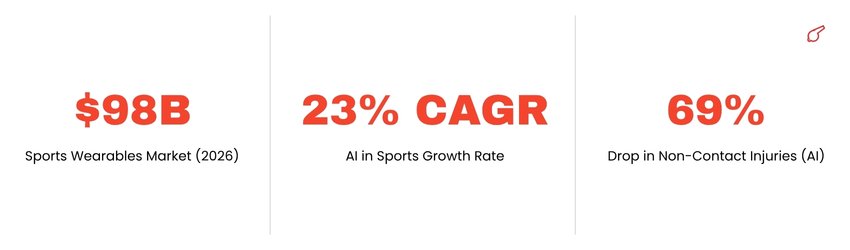
Athlete performance technology is no longer a competitive edge it is the competitive baseline. In 2026, the global sports technology market stands at $27.67 billion, with AI in sports alone valued at $9.76 billion and growing at 27.85% annually through 2031.
From GPS wearables worn by players across 5,000+ elite teams globally, to the NFL’s Digital Athlete processing 500 million data points per week sports analytics, AI-powered injury prevention, and real-time performance tracking have fundamentally changed how athletes train, recover, and compete at the highest level.
If you’re exploring how such solutions are built and what it takes to develop one, this detailed guide on athlete tracking app development cost breaks down the key features, costs, and considerations involved in building a high-performance athlete tracking app.
In this blog, we break down the latest statistics shaping wearables, AI, and the future of athlete performance.
32.3%
Wearable tech share of total sports tech market in 2026
Fortune Business Insights
$9B+
AI in sports projected market by 2030, up from $1.37B in 2026
Business Research Co. (Mar 2026)
23%
Reduction in reinjury rates through integrated AI systems
NIH / PubMed Central (2026)
85%
Random forest ML model accuracy for hamstring injury prediction
NCBI — ML Injury Model (2026)
The $98 Billion Wearables & Sports Tech Boom
The sports technology market has entered exponential growth. In 2026 alone, wearable devices in sports represent an estimated $98 billion market — and the trajectory steepens through 2031 at 4.13% CAGR, while the broader sports tech market races toward $192B by 2034.
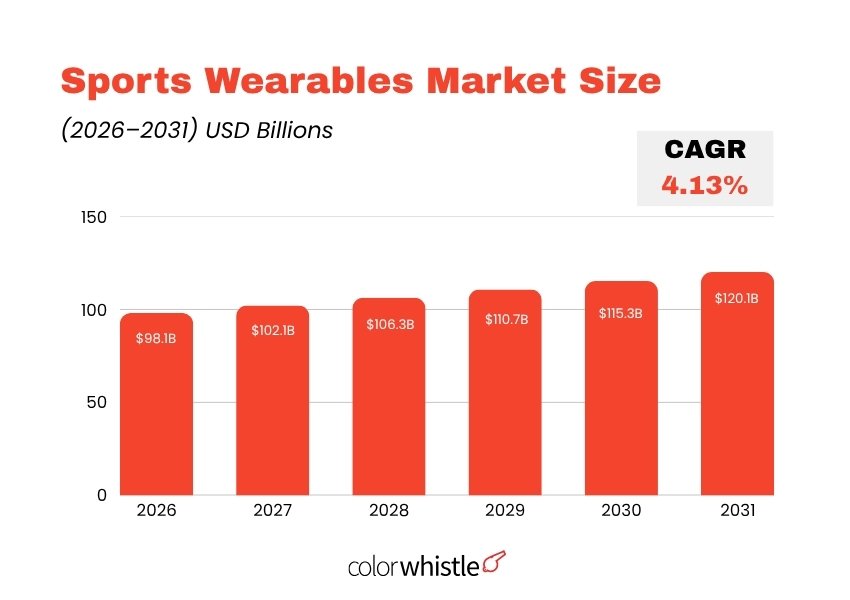
Sports Wearables Market Size (2026–2031)
The sports wearables market is experiencing steady and consistent growth, increasing from $98.1B in 2026 to $120.1B by 2031, at a 4.13% CAGR. This gradual rise indicates strong and sustained adoption of wearable devices across professional and amateur sports, driven by performance tracking, injury prevention, and fitness monitoring needs.
| Year | Market Size (USD Billion) |
|---|---|
| 2026 | $98.1 |
| 2027 | $102.1 |
| 2028 | $106.3 |
| 2029 | $110.7 |
| 2030 | $115.3 |
| 2031 | $120.1 |
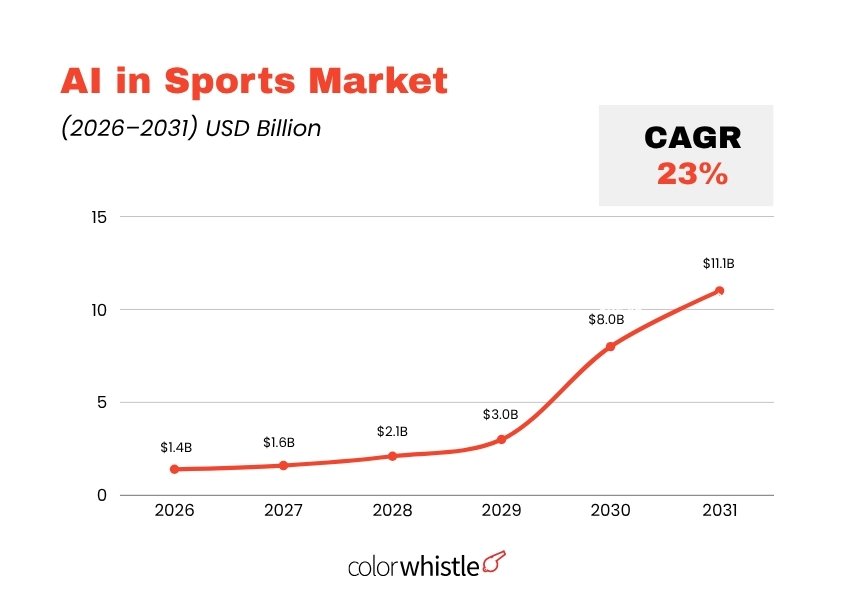
AI in Sports Market Growth
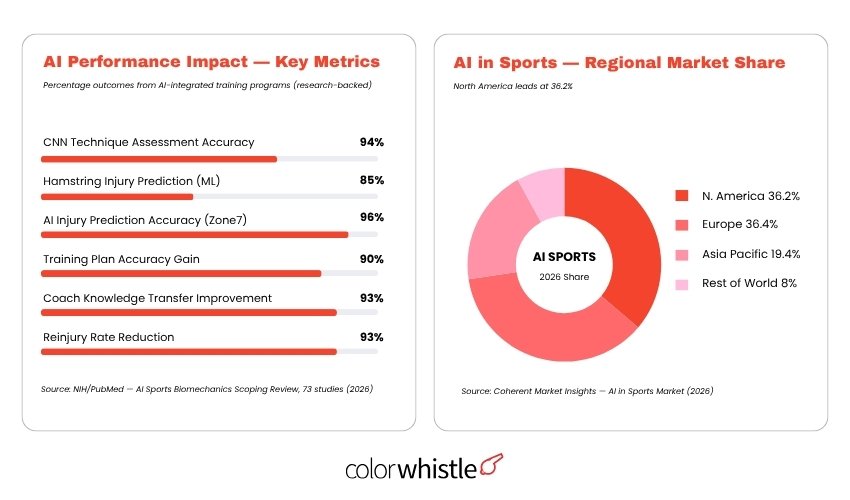
The AI in sports market is witnessing exponential growth, rising from $1.4B in 2026 to $11.1B by 2031, with a ~23% CAGR. Growth remains gradual until 2029, followed by a sharp surge post-2030—highlighting accelerated adoption of AI for performance analytics, injury prediction, and real-time decision-making.
| Year | Market Size (USD Billion) |
|---|---|
| 2026 | $1.4 |
| 2027 | ~$1.6 |
| 2028 | $2.1 |
| 2029 | ~$3.0 |
| 2030 | $8.0 |
| 2031 | $11.1 |
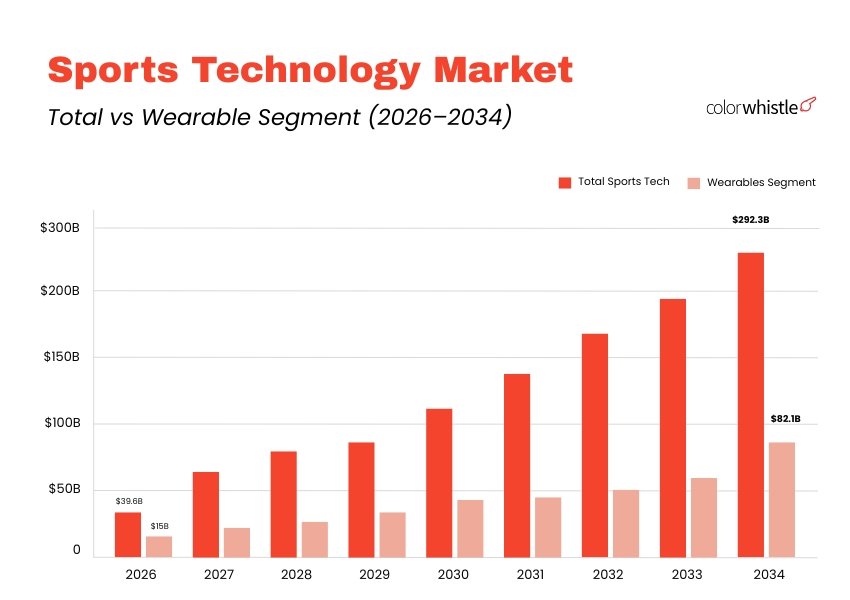
Sports Technology Market Expansion
The overall sports technology market is projected to grow at a 21.8% CAGR, expanding from $39.6B in 2026 to ~$292.3B by 2034. Within this, the wearables segment alone reaches ~$82.1B, showing that while wearables are a major driver, broader sports tech (AI, analytics platforms, smart infrastructure) is scaling even faster.
| Year | Total Market (USD Billion) | Wearables Segment (USD Billion) |
|---|---|---|
| 2026 | $39.6 | ~$15 |
| 2027 | ~$60 | ~$20 |
| 2028 | ~$75 | ~$25 |
| 2029 | ~$90 | ~$30 |
| 2030 | ~$110 | ~$35 |
| 2031 | ~$135 | ~$42 |
| 2032 | ~$165 | ~$50 |
| 2033 | ~$200 | ~$62 |
| 2034 | $292.3 | $82.1 |
Smart Sensors, Real-Time Intelligence
In 2026, 32.3% of all sports technology spend goes to wearables — the single largest technology category. From biometric vests to sensor-embedded match balls, wearable tech has become the nervous system of elite sport.
Biometric Sensing
Real-Time Physiological Monitoring
Modern wearables track heart rate variability, blood oxygen, cortisol, skin temperature, and neuromuscular fatigue simultaneously giving coaches a live physiological dashboard during training and competition.
GPS + Motion
Catapult, STATSports & Movement Analytics
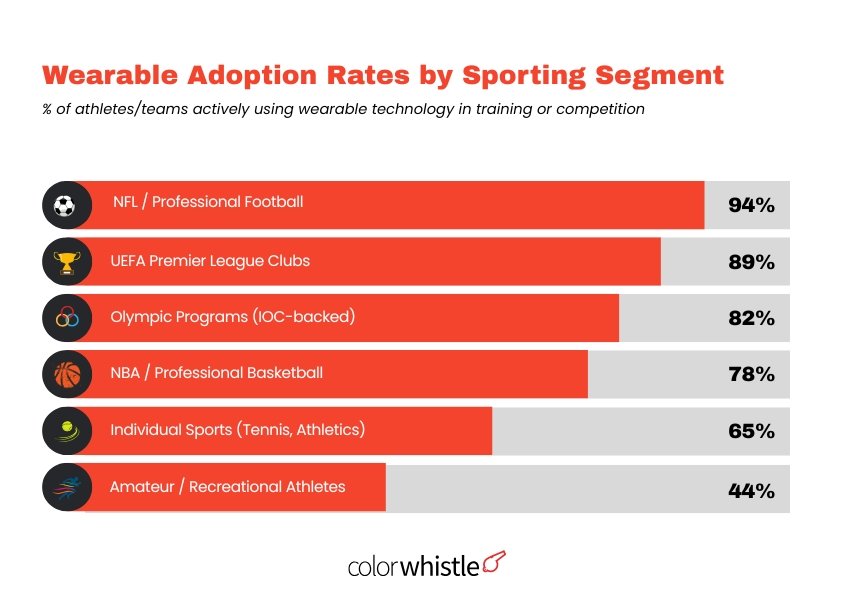
Catapult Sports and STATSports analyze player movements, acceleration patterns, and deceleration loads in real time. These platforms are standard across Premier League, NFL, and Olympic programs in 2026.
Connected Equipment
Adidas FIFA Club World Cup 2026 Smart Ball
In January 2026, Adidas unveiled an Official Match Ball for FIFA Club World Cup 2026 with embedded sensor technology providing real-time ball tracking and broadcast analytics marking a new era of connected equipment.
Apple AI Wearables
Next-Gen Smart Glasses & Sensing Devices (2027)
As of February 2026, Apple accelerated development of AI-integrated smart glasses, a wearable pendant, and camera-enabled AirPods expected to enter market by 2027, expanding athlete sensing ecosystems further.
AI as the New Head Coach
AI in sports is no longer experimental. Growing at 23% CAGR toward $9 billion by 2030, it is reshaping the foundation of modern athletic preparation — from personalized training plans to predictive injury forecasting.
| Organization | AI Application | Outcome / Result | Impact |
|---|---|---|---|
| FIFA / Club World Cup 2026 | VAR video analysis, real-time decision support, connected ball sensors | Improved referee accuracy; live broadcast analytics | Very High |
| IOC (Olympics) | Automated performance feedback; AI accessibility services | Live sign-language avatars; multilingual coverage; training insights | High |
| Getafe FC (Zone7 AI) | Predictive injury analytics, load management, specific injury-type forecasting | 40% injury reduction Year 1 → 66% Year 2 as AI matured | Very High |
| Manchester City FC | AI-powered player statistics platforms, optimized training regimens | Data-driven recruitment; personalized conditioning programs | High |
| NBA (Multiple Teams) | AI scheduling, arena resource optimization, automated match analysis | Majority of NA pro basketball leagues use AI for operations and broadcasting | High |
| Premier League (General) | Catapult / Hudl movement analytics, training load management | Personalized coaching insights; tactical decision support | High |
Predicting Injuries Before They Happen
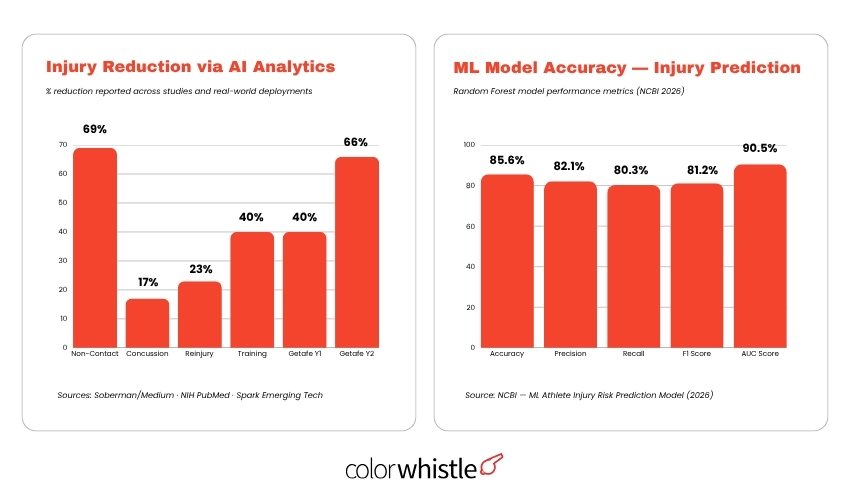
The combination of AI and wearable sensors is producing breakthrough results in injury prevention — from 69% reductions in non-contact injuries to 85% accurate ML prediction models.
Non-Contact Injury
69% Fewer Non-Contact Injuries
AI systems processing training load, movement patterns, and fatigue markers have demonstrated a 69% reduction in non-contact injuries across clubs using Zone7 and similar platforms.
Concussion Prevention
17% Decrease in Concussions
AI monitoring systems tracking biomechanical impact patterns and flagging high-risk scenarios have contributed to a 17% decrease in concussion incidence at pro level.
Reinjury Prevention
23% Reduction in Reinjury Rates
Integrated AI systems combining motion capture, wearable sensors, and historical injury data produce a 23% reinjury reduction — confirmed across a 73-study scoping review.
Predictive Accuracy
72% Accuracy in Injury Prediction
AI injury engines now achieve 72% accuracy forecasting injury events — including which body part is at risk and projected severity in days-lost — enabling targeted preventive interventions.
Wearables vs AI vs Video vs VR
| Technology | Primary Use Case | Key Metrics Produced | Impact | 2026 Adoption / Market |
|---|---|---|---|---|
| Wearables (GPS/Biometric) | Real-time load monitoring, physiological tracking during training & competition | HR, HRV, speed, distance, O₂ saturation, temperature, fatigue | High | 32.3% of total sports tech market; $98.06B |
| AI / Machine Learning | Predictive analytics, personalized training plans, injury forecasting, tactical intelligence | Injury risk scores, performance predictions, training load recommendations | Very High | 41.6% of AI sports spend on Data Interpretation; $1.37B → $9B+ by 2030 |
| Computer Vision / Video | Technique assessment, officiating (VAR), motion analysis, biomechanical review | Joint angles, movement efficiency, ball trajectory, player positioning | Medium–High | Standard in FIFA, Premier League, Olympics; CNN reaches 94% accuracy |
| GPS & Motion Tracking | Field positioning, sprint analysis, tactical pattern recognition | Distance covered, sprint count, heatmaps, deceleration loads | High | Near-universal in team sports globally |
| VR / AR Training | Cognitive training, game simulation, rehabilitation visualization | Decision speed, spatial awareness, reaction time, scenario recall | Emerging | Fastest-growing segment at 26.6% CAGR (broadcasters leading) |
| Cloud / Big Data Analytics | Historical trend analysis, comparative benchmarking, scouting databases | Career trajectory models, talent identification, team composition analysis | Very High | Standard in NFL, NBA, MLB front offices; core of $104.5B (by 2033) |
Personalized Training at Scale
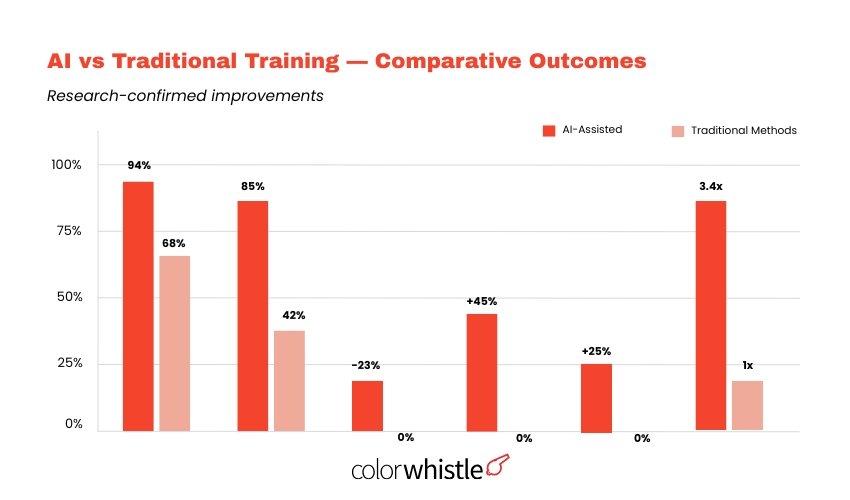
AI-driven training personalization is producing measurable gains in technique accuracy, coaching knowledge transfer, and athlete adherence confirmed across 73 peer-reviewed studies.
Technology Roadmap: 2026 & Beyond
Key milestones and projected developments in athlete performance technology
2026 — NOW
FIFA Club World Cup 2026 — Connected Ball & AI VAR
Adidas launches sensor-embedded match ball. AI VAR standard across top competitions. Sports wearables market at $98B. AI in sports at $1.37B+ growing at 23% CAGR.
2027
Apple AI Wearables Enter Sports Market
Apple’s smart glasses, AI pendant, and camera-enabled AirPods launch — expanding athlete sensing ecosystems. Sports wearables market forecast at ~$102.1B.
2028
Olympics LA 2028 — Full AI Integration
IOC-backed AI performance feedback systems, automated commentary, and real-time biomechanical analysis fully operational. AI in sports market projected at ~$3.5B.
2030
AI in Sports Surpasses $9 Billion
Soccer alone represents $2.9B (32% of AI sports market). North America leads at $3.1B. AI coaching becomes standard at amateur level.
2031
Sports Wearables Market Reaches $120 Billion
Mordor Intelligence projects $120.05B — completing multi-year expansion driven by miniaturization, AI integration, and league-backed biometric data commercialization.
2033–2034
Sports Technology Market Surpasses $150B+
Total sports technology market projected at $104.5–192.3B by 2033–2034 at 15–21.8% CAGR. AI, wearables, and VR converge into unified athlete performance operating systems.
Peer-Reviewed & Institutional Sources
Every insight in this report is grounded in peer-reviewed journals, institutional market intelligence, and governing body data.
AI-Driven Performance Analytics in Sports
Examines ML, deep reinforcement learning, and computer vision in training. Reports major effects on speed, endurance, agility, and recovery efficiency.
View Study → IEEE Xplore
AI in Sports Biomechanics: 73-Study Scoping Review
PRISMA-guided review from 3,248 articles. Reports 94% CNN technique accuracy, 85% hamstring prediction accuracy, 23% reinjury reduction.
View Study → PubMed Central
ML Athlete Injury Risk Prediction Model
Random forest achieves 85.6% accuracy with 10-fold cross-validation. SHAP/LIME identifies prior injury, training intensity, recovery time as top predictors.
View Study → NCBI
AI in Identifying Sports Injury Risk Factors
Scoping review demonstrating AI’s advantage in analyzing complex datasets to surface injury risk patterns undetectable through conventional analysis.
View Study → ScienceDirect
Wearable Devices in Sports Market Report
Confirms $98.06B market size in 2026, growing to $120.05B by 2031 at 4.13% CAGR. League data commercialization identified as a key driver.
View Report → Mordor Intelligence
Global Sports Technology Market Report
Market grows from $39.64B (2026) to $192.27B (2034) at 21.8% CAGR. Wearable technology at 32.29% of total market share in 2026.
View Report → Fortune Business Insights
The rise of wearables and AI is transforming sports into a data-driven ecosystem where performance is continuously optimized. For businesses and innovators, this shift opens up powerful opportunities to build smart athlete tracking solutions.
To understand the investment and features involved, explore Athlete Tracking App Cost USA | 2026 Pricing Guide
Looking to build your own solution? Contact ColorWhistle to get started.
FAQ
What is athlete performance technology?
Athlete performance technology encompasses wearable devices, AI/ML platforms, computer vision systems, GPS trackers, and cloud analytics tools that measure, analyze, and optimize how athletes train, compete, and recover. In 2026, this is a $39.6B+ global market growing at 21.8% CAGR.
How are wearables used in sports in 2026?
In 2026, wearables track heart rate variability, GPS position, acceleration forces, blood oxygen, and neuromuscular fatigue simultaneously in real time. This includes smart vests (Catapult, STATSports), biometric rings, and even sensor-embedded match balls (Adidas FIFA 2026). The wearable segment represents 32.3% of total sports tech spend.
How does AI improve athlete performance?
AI improves performance through:
- Personalized training plans adapted to individual physiology,
- Real-time technique assessment (CNN models reach 94% expert-agreement accuracy),
- Injury risk prediction (72% event accuracy), and
- Tactical analysis identifying opponent patterns. Research confirms 25% technique accuracy improvements with AI-driven plans.
 Tour Operator Industry Statistics: Market Tre...