


Why Businesses Outsource Website Modernization

Phurvishaa specializes in crafting travel tech and marketing content, leveraging deep research, SEO expertise, and AI-driven insights. Her strategic approach ensures content that educates, engages and delivers knowledge.

Our authors are proven experts in their fields, writing on topics where they have demonstrated expertise. Every piece of content undergoes peer review and validation by industry professionals.
AI Summary
Why Businesses Outsource Website Modernization
This post explores why outsourcing website modernization often outperforms building in-house teams. The key insight: modernization demands distinct, multi-disciplinary skills and rapid delivery that internal teams typically lack. It covers challenges internal teams face, including limited capacity and skill gaps in architecture, UX, performance, and security. Outsourcing to specialized agencies offers faster timelines, scalable expertise, cost predictability, and risk reduction. The post guides decision-making among in-house, freelance, or agency models based on project complexity and resources. Businesses gain a strategic advantage by partnering with agencies, enabling their teams to focus on core operations while ensuring successful digital transformation.
Your website is no longer just a digital brochure. It’s your highest-traffic sales rep, your brand’s first impression, and increasingly, a core piece of your operational infrastructure. Yet for many businesses, the website running today was built years ago on outdated frameworks, with bloated codebases, and with a user experience that no longer matches customer expectations.
Website modernization is the answer. But the question business leaders almost always face is: do we build an internal team for this, or do we outsource web development to an agency?
The answer, for most businesses, is increasingly clear. Here’s why.
TL; DR
Who this blog is for: CEOs, Founders, CMOs, Operations Directors, Procurement Managers, and Digital Transformation leaders evaluating whether to build internal web development capability or outsource website modernization to a specialized agency.
- Internal teams struggle – Modernization projects demand rare, cross-disciplinary skills that go far beyond day-to-day maintenance; most in-house teams simply aren’t set up for it.
- The real cost of in-house is hidden – Salaries, benefits, tooling, training, and ramp-up time make building internal modernization capability far more expensive than it appears on paper.
- Skill gaps are wide and real – Modern web transformation requires expertise across performance engineering, UX, security, CMS migration, and more a combination of few internal hires cover.
- Agencies bring compounded speed and specialization – Dedicated development teams have done this before, ship faster, and scale resources up or down with your project needs.
- Outsourcing reduces key business risks – Missed timelines, budget overruns, technical debt, and talent dependency all shrinks when you work with a proven external partner.
- The right model depends on your context – In-house, freelance, or agency each have their place; the smartest businesses match the model to the scope, budget, and timeline of the project.
Why Internal Teams Struggle with Modernization Projects
There’s an important distinction most organizations overlook: maintaining a website and modernizing one are fundamentally different challenges.
Your internal team, however talented, is typically optimized for the former. They handle content updates, bug fixes, minor feature additions, and routine QA. They know your systems, your brand, and your processes. That’s valuable.
But a website modernization project is a different animal entirely. It involves auditing and migrating legacy architecture, redesigning information flows for modern user behavior, integrating with new tech stacks, improving Core Web Vitals, and often replatforming from one CMS or framework to another. It’s a concentrated, high-complexity transformation effort not a steady-state operation.
Asking an internal team to take on this work alongside their regular responsibilities creates predictable problems: timelines stretch, priorities conflict, and the modernization project becomes the initiative that’s always “almost done.” Capacity is the first problem. Capability is often the second.
Did You Know?
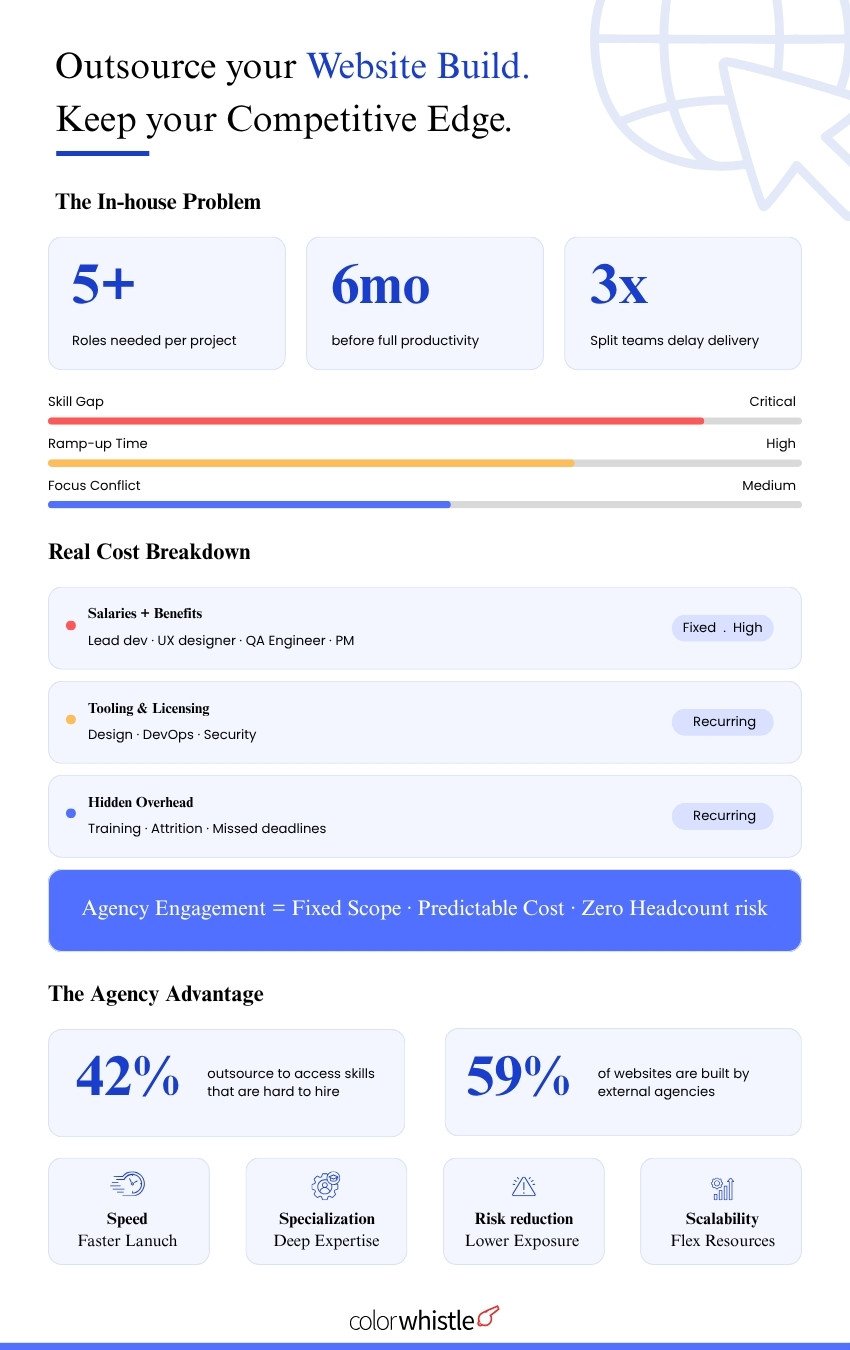
42% of businesses outsource specifically to access hard-to-source skills including modern frontend frameworks, AI/ML, and data engineering making talent access the #1 driver ahead of cost savings
The Real Cost of Building In-House Modernization Capability
When business leaders run the numbers on in-house vs. to outsource web development, they often underestimate what building internal capability actually costs.
Consider what a credible in-house modernization team requires: a senior full-stack developer, a front-end specialist familiar with modern frameworks, a UX/UI designer, a QA engineer, and ideally a project manager or tech led to coordinate it all. In competitive hiring markets, that’s a significant annual payroll commitment before you factor in benefits, equity, onboarding time, and ongoing training.
Then there’s tooling. Licensing for design software, testing environments, CI/CD pipelines, security auditing tools, performance monitoring platforms, these costs add up quickly.
And critically, there’s the time-to-productivity gap. Even a strong new hire takes three to six months to become fully effective in a new environment. On a website project with a six-month modernization window, that math simply doesn’t work.
When you outsource website modernization to a dedicated development team, you’re paying for capacity that’s already assembled, tooled up, and ready to deliver. The web development costs are predictable, scoped, and tied directly to output not to headcounts that persist long after the project ends.
Also Read
Skill Gaps That Make Modern Web Transformation Difficult Internally
Modern website modernization isn’t just a development task it’s a multi-disciplinary engagement. The full skill set required typically includes:
Technical architecture: Migrating from legacy systems to headless CMS, JAMstack, or modern monolithic frameworks requires deep architectural knowledge that most generalist developers don’t carry.
Performance engineering: Meeting today’s Core Web Vitals thresholds critical for both SEO and user retention requires specialized expertise in front-end optimization, image compression strategies, server-side rendering, and caching layers.
UX and conversion design: Modernization without UX uplift is a missed opportunity. Experienced agencies bring UX researchers, conversion-focused designers, and A/B testing frameworks that internal teams rarely have in-house.
Security and compliance: Modern web platforms must meet evolving data protection standards. Security-first development practices, regular vulnerability audits, and GDPR or WCAG compliance reviews demand focused expertise.
Integration and API development: Today’s websites rarely stand-alone connect to CRMs, ERPs, marketing automation tools, and payment gateways. Clean, scalable integration architecture is a specialty in itself.
Hiring for even half of these skills internally is expensive and time-consuming. An agency specializing in website project outsourcing comes with the full stack assembled.
Agency Advantages: Speed, Specialization, and Scalability
The agency model for website modernization offers three structural advantages that are difficult to replicate internally.
Speed to execution. A dedicated development team doesn’t need onboarding time, doesn’t split focus with other operational responsibilities, and has established workflows for exactly this kind of project. Agencies that specialize in managed website services can typically move from discovery to delivery in a fraction of the time an internal team would require.
Domain specialization. The best web agencies have modernized dozens sometimes hundreds of websites across industries. They’ve encountered your problem before. They know which CMS migrations go smoothly, and which don’t. They’ve solved the performance bottleneck you haven’t encountered yet. That accumulated experience is an asset you simply can’t hire into existence quickly.
Elastic scalability. One of the core challenges of the build vs buy decision in web development is that project needs are rarely constant. A modernization of engagement may require eight people for the first three months and two for the final phase. Agencies flex naturally with this. An internal headcount doesn’t exist.
For businesses facing a defined modernization window, a platform migration, a brand refresh, a commerce relaunch the agency model compresses the website development timeline while reducing coordination overhead.
Did You Know?
59% of website development is outsourced globally, giving businesses access to specialized expertise while reducing the overhead of maintaining full in-house teams.
Risks Businesses Reduce Through Outsourcing
Beyond speed and skill, outsourcing website modernization reduces several risks that business leaders often underweight in their build vs buy decision.
- Timeline risks. Internal teams are subject to competing priorities, turnover, and organizational interruptions. An agency with a defined scope and delivery commitment is accountable in ways that a salaried employee simply isn’t.
- Technical debt risk. Modernization projects built by generalist internal developers under time pressure often introduce new layers of technical debt. Agencies with established engineering standards and code review processes are structurally less likely to build debt into your new foundation.
- Talent dependency risk. If a key internal developer leaves mid-project or post-launch, the institutional knowledge around your modernized platform often walks out with them. An agency relationship includes documentation, knowledge transfer, and continuity by design.
- Budget overrun risk. Website projects have a notoriously poor track record of coming in on time and on budget when managed internally without dedicated project oversight. Clearly scoped agency engagements with defined deliverables shift the cost risk to the vendor.
For Procurement Managers and Operations Directors evaluating outsource web development proposals, these risk reductions are often as compelling as the cost comparison.
How to Decide: In-House, Freelance, or Agency
Not every web project belongs to an agency engagement. Here’s a practical framework for the build vs buy decision:
Choose in-house when:
- You have ongoing, continuous development needs that justify permanent headcount
- Your internal team already has the relevant skills and bandwidth
- Deep institutional knowledge is essential to the project and can’t be transferred efficiently
- Your organization has strong internal project management capability
Choose freelance when:
- The scope is narrow and well-defined (a specific feature, a performance audit, a design refresh)
- Budget is tight and the risk profile is low
- You have an internal technical lead who can manage the engagement
- Timeline flexibility exists
Choose an agency with a dedicated development team when:
- The project is complex, multi-disciplinary, and time-sensitive
- You’re replatforming, migrating, or doing a full modernization
- Accountability, project management, and delivery guarantee matter
- You want managed website services beyond the initial build (ongoing optimization, QA, monitoring)
- Your internal team needs to stay focused on core business operations
The agency model shines brightest in exactly the scenario most businesses face during modernization: a high-complexity, defined-timeline project where the cost of failure delayed launch, poor performance, user experience regressions is high.
Final Thoughts
Website modernization is one of the highest-leverage investments a business can make in its digital presence. But the path to a modern, performant, conversion-optimized website is rarely smooth when built on an underpowered internal team.
The businesses that modernize successfully tend to make a clear-eyed assessment of their internal capability, the true cost of building it, and the time they have available. More often than not, that assessment leads them to a specialized agency partner.
Outsourcing website modernization isn’t a concession it’s a strategic decision. It buys speed, specialization, risk reduction, and scalability. It lets your internal team focus on what they’re already good at, while a dedicated development team delivers the transformation your digital presence needs.
If your website is holding your business back, the question isn’t whether you can afford to outsource modernization. It’s whether you can afford not to.
ColorWhistle is a full-service digital agency helping businesses transform their web presence through purposeful design, modern engineering, and strategic digital thinking. Explore our website modernization services to see how we’ve helped businesses like yours.
FAQ’s
Is outsourcing website modernization suitable for small and mid-sized businesses, not just enterprises?
Yes, agencies offer flexible engagement models that fit SMB budgets, and the cost of outsourcing is often lower than hiring even one specialized in-house developer.
How long does a typical website modernization project take when outsourced to an agency?
Most modernization projects run 6–16 weeks depending on scope; agencies with dedicated teams consistently deliver faster than internal builds due to focused bandwidth and ready workflows.
What should we look for when choosing an agency for website modernization?
Prioritize agencies with documented case studies in your industry, clear discovery processes, and post-launch support, not just the lowest quote.
 PropTech Trends & Statistics 2026: How Digita...