



Rethinking Interior Design Website Experience in 2026: A Guide for Business Owners

Anusha is a digital strategy expert with deep expertise in branding, UI/UX, and performance-focused content. She brings advanced insight into brands to scale intelligently, blending creativity with conversion-focused thinking.

Our authors are proven experts in their fields, writing on topics where they have demonstrated expertise. Every piece of content undergoes peer review and validation by industry professionals.
AI Summary
Key Highlights of Interior Design Website Trends 2026
This post explores the transformation of interior design websites into connected digital ecosystems, serving studio owners and solo designers. The key insight: modern sites must offer immersive, interactive experiences before first contact, moving beyond portfolios to virtual consultations, online workflows, and personalized content. It covers evolving features like AR visualization, CRM integration, and data-driven marketing that reduce admin work and boost conversions. Readers learn how to build websites that function as comprehensive business hubs, improving client trust and streamlining operations. The guide emphasizes adopting emerging tech and strategic design to meet rising client expectations and enhance business scalability in 2026.
Interior design used to be… kind of local. Someone finds you through a friend, they come by, you show a portfolio, you vibe, done.
Currently, a lot of interior design businesses are basically digital-first brands. Not just “a designer with a website”. The website is where trust is built, where the process gets explained, where people self-qualify, where you get booked, where your leads get organized, where your content gets reused across Instagram, Pinterest, Google, email, even AI search.
And that’s the shift. The old portfolio-only website model is getting replaced by a connected digital ecosystem.
Current scnario feels like a tipping point because three things collided:
Clients are more remote:
Even “local” clients behave like remote clients. They want to browse, decide, compare, and shortlist without a call.
Expectations are higher:
People are used to smooth online experiences. If your site is confusing, slow, vague, or makes them wait for basic info, they bounce.
Good tech is cheaper and easier now:
Not free, not effortless. But accessible. A lot of what used to require a custom agency build is now doable with modern platforms and a smart stack.
So this guide covers interior design website trends such as SaaS Website Designs, emerging tech like omnichannel retail, practical features that actually help, integration ideas including website design myths, and realistic costs. It’s written for decision-makers such as studio owners and solo designers, interior architects planning a redesign or anyone building a new website trying not to waste a quarter of their year.
Our Custom web 3D capabilities enable interactive, responsive, and visually rich web experiences.
How Interior Design Websites Have Evolved So Far (What Worked)
Before we jump into the future, it’s worth saying this clearly. A lot of what worked in the last 5 to 10 years still matters.
Portfolio-led websites as credibility builders
Interior design is trust-based. Always has been. So websites became digital credibility folders:
- Before and after galleries
- Project case studies
- Press features
- Testimonials
- Awards, certifications, brand partners
The portfolio did the heavy lifting. It still does. If your work is strong, people feel it fast.
High-quality photography plus storytelling
The best sites didn’t just show pretty rooms. They showed taste and thought.
- Mood boards and early concepts
- Constraints and how you solved them (budget, layout, timeline)
- What the client actually wanted
- The sequence of decisions
- The final result with context
That kind of storytelling makes your process visible. Which reduces fear. People are not only buying the final photos, they’re buying the experience.
Mobile-first design and faster image delivery
Design audiences live on phones. Instagram referrals, Pinterest saves, Google searches, all mobile.
So we saw improvements like:
- Responsive layouts
- Thumb-friendly nav
- Lazy loading images
- Cleaner typography
- Faster load times
If your site loads slowly, it doesn’t matter how good the photos are. People leave.
To enhance user experience and engagement on these mobile platforms, incorporating mobile app functionalities could be a game changer for interior design websites. This could include features like virtual room staging or interactive mood board creation directly within an app.
Basic lead capture
Most websites added the usual:
- Contact forms
- Enquiry pages
- Downloadable PDFs
- Newsletter opt-ins
- “Book a call” links
This was enough when expectations were lower.
Here’s the catch though. In 2026, none of this differentiates you by itself. Everyone can do “pretty + fast” now. Templates are better. Photography is everywhere. Even newer studios can look polished.
So the bar moved.
What’s Changing Now: New Expectations From Interior Design Websites
Clients now expect to experience you before they ever email you.
That’s the big change.
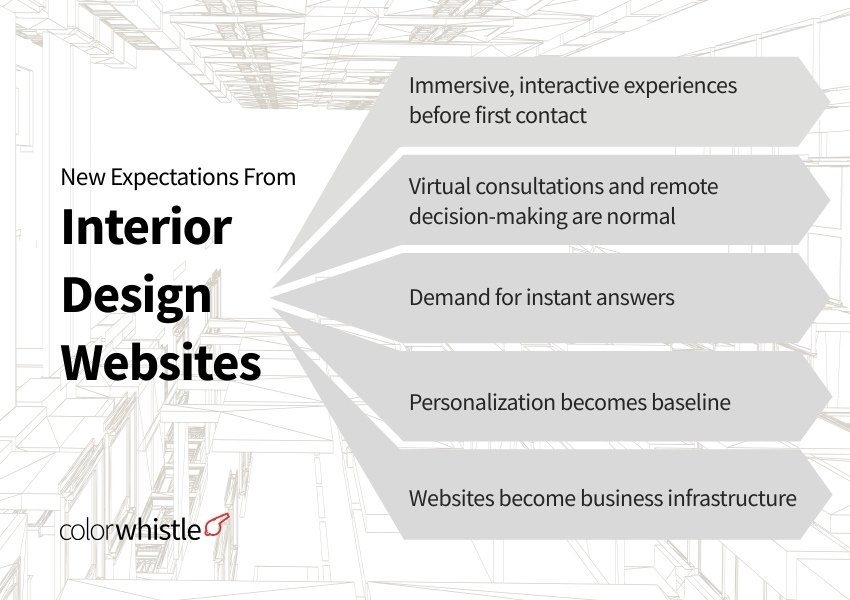
Immersive, interactive experiences before first contact
People want to feel your taste, and also your process. They want to explore your work in a way that feels confident. Not a slideshow. Not a grid of photos with no details.
Think:
Interactive case studies
Guided portfolios (by style, room, budget, timeline)
Materials and finish stories
“How we work” explained like a product, not a vague paragraph
Virtual consultations and remote decision-making are normal
Remote design used to feel like a niche offering. Now, it’s just… normal.
So clients want online workflows:
- Booking calls online
- Intake forms that actually capture what matters
- Upload photos, floor plans, inspiration links
- Clear next steps and prep checklists
A phone number is not a workflow.
Demand for instant answers
People are tired. Busy. They don’t want mystery.
They want:
- Starting prices or minimum budgets
- Package options
- Rough timeline expectations
- Availability signals (even if it’s just “booking 6 weeks out”)
- How your process works in steps
Not everyone will publish full pricing. Fine. But you need to give enough info for self-selection.
Personalization becomes baseline
Visitors expect the site to adapt a bit.
Not in a creepy way. More like:
“Show me kitchens” because I keep clicking kitchens
“I’m in Austin” so show local projects and services
“My budget is X” so show the right package and case studies
Websites become business infrastructure
Your website is not just a marketing tool. It’s a comprehensive system that handles:
- Lead management
- Qualification
- Follow-up
- Scheduling
- Proposal support
- Client experience touchpoints
A well-designed website minimizes admin work rather than adding to it.
The Website as the Central Digital Hub for Interior Design Businesses
The most effective way to conceptualize a modern interior design website is as a source of truth. This is the platform where your brand identity, service offerings, content, and client journey are all housed. Everything else integrates into this central hub.
Rather than relying on isolated tools, a modern interior design website orchestrates a small ecosystem that includes:
Website (content + conversion)
CRM (managing leads and pipeline)
Booking system (for consultations and reminders)
Email marketing platform (for nurturing leads and follow-ups)
Analytics tools (to assess performance)
AR/3D experiences (optional but increasingly popular)
Social media platforms (as traffic sources)
AI layer (for search optimization, assistance, personalization)
Occasionally IoT or showroom tech (specific to certain studios)
This hub model significantly reduces friction by creating a seamless journey and unified dataset. It ensures consistent messaging, follow-up, and cleaner reporting.
However, when your tools are disconnected, the consequences can be predictably disastrous:
- Leads may get lost
- Important replies could be forgotten
- Admin work may double
- Attribution becomes chaotic
- Marketing efforts appear random due to lack of visibility on what drives revenue
It’s entirely possible to have an aesthetically pleasing website while operating a disorganized business behind it. The hub approach addresses this issue by providing a structured framework for improvement.
In addition to interior design websites, mobile-friendly travel websites that optimize user experience and boost engagement are becoming increasingly essential in 2026. Similarly, as seen in the automotive industry, understanding the latest UI/UX trends can significantly enhance user experience and improve website performance.
Moreover, creative travel marketing campaigns from around the globe serve as excellent sources of inspiration for elevating one’s own travel marketing efforts.
How Data Flows Through a Website-Centric Ecosystem
Data is a scary word. But in practice, it’s just: what did the visitor tell you, and what did they do.
And you can do it without being creepy.
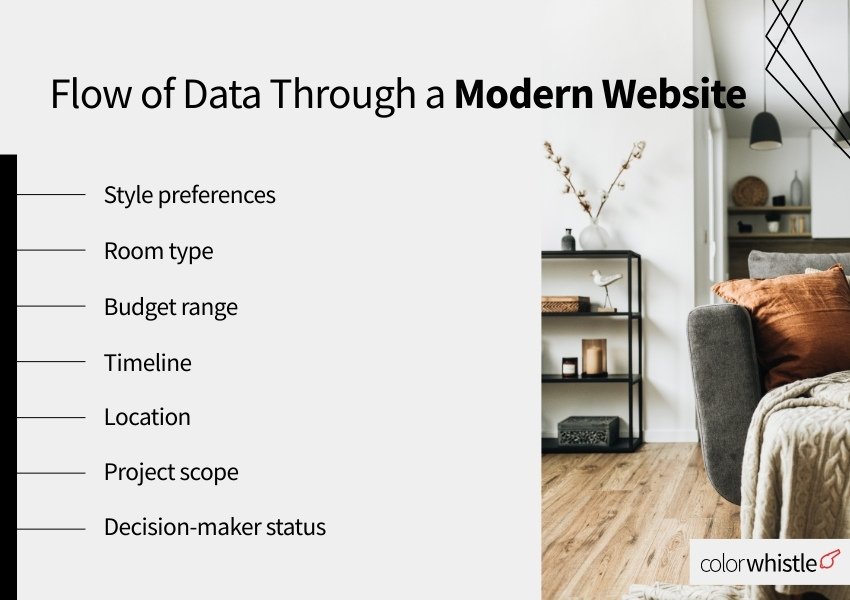
What your website should capture (usefully)
Via forms, quizzes, and booking flows:
- Style preferences (modern, transitional, warm minimal, etc)
- Room type (kitchen, whole home, commercial)
- Budget range
- Timeline
- Location
- Project scope (furnish only, renovation, new build)
- Decision-maker status (are they ready, are they collecting ideas)
Behavioral data that actually matters
This is not “spy on people” data. It’s basic intent signals:
Projects viewed
Time on specific case studies
Clicks on service packages
Downloads (pricing guide, checklist)
AR/3D interactions
Booking attempts (started but didn’t finish)
How that data feeds the business
- CRM creates a lead with tags like “Kitchen, Warm Minimal, 50k to 100k”
- Pipeline stage gets set (new lead, qualified, consult booked)
- Automatic follow-up sequence gets triggered
- Scheduling and reminders happen without manual chasing
- Proposal process starts with better context (less back-and-forth)
How that data feeds marketing
- Personalized content blocks on return visits
- Retargeting audiences (for ads if you run them)
- Lookalike audiences (if you have enough volume)
- Email segmentation (send kitchen-focused content to kitchen leads)
Non-negotiables
If you’re doing this do it properly:
Clear structure and clean tracking plan
Consent and cookie banners where required
Data retention basics (don’t keep everything forever)
Emerging Technologies Shaping Interior Design Websites
Think of these as experience upgrades that also reduce sales friction. You don’t need every shiny thing. But the right tech can increase conversion and shorten the decision cycle, which is the real point.
AR and 3D Visualization (From Nice-to-Have to Revenue Driver)
AR room previews let clients place furniture, fixtures, or built-ins in their own space, reducing uncertainty. Less “I’m not sure if it fits” energy.
3D configurators go further:
- Materials and finishes
- Colorways
- Dimensions
- Combinations for custom built-ins
Then there’s the “try before you design” workflow. This is interesting. Not full design, but more like:
- Style kits
- Mood board previews
- Curated product bundles
Business outcomes are pretty straightforward:
More consultation bookings
Better qualified leads
Faster approvals
Fewer revisions
Implementation notes:
- Mobile performance matters more than realism
- You need an asset creation pipeline (someone has to make the 3D models)
- Sometimes simple 3D spins are enough, you don’t always need full AR
VR and Virtual Showrooms (Selling Design Remotely)
VR sounds like a headline thing, but now, it’s quietly practical for certain studios. Use cases include remote walkthroughs of portfolio projects and design reviews for renovations or new builds.
However, when it comes to redesigning an interior design website to accommodate these technologies, consider following a detailed Shopify Store Redesign Checklist for 2026. This checklist can help revamp your Shopify store in 2026 with expert advice aimed at increasing conversions and boosting sales.
Moreover, the big win with virtual showrooms is trust. A virtual showroom communicates taste instantly; it’s not just words. Production tradeoffs include lightweight WebVR experiences that can run in-browser and are easier to share, versus high-end headset demos that look amazing but limit accessibility.
Choose based on audience. If your clients are busy homeowners, WebVR matters more. If you’re pitching a developer, a high-end walkthrough might actually win the deal.
In addition to these technological advancements, understanding the market size is crucial for scaling your business effectively. This is where knowledge about Total Addressable Market (TAM) for SaaS companies comes into play. Knowing how to calculate TAM can maximize growth potential for your SaaS company and impress investors.
Lastly, if you’re seeking inspiration for online education ads design ideas while implementing these technologies into your business model, this resource offers numerous design ideas from education agencies that could serve as valuable inspiration.
IoT Integration (Smart Homes Meet Design Storytelling)
This is not for everyone. But for luxury residential, hospitality, workspace design, smart-home-first clients… IoT is part of the story.
Examples of practical website-driven IoT storytelling:
- Interactive lighting scenes (day, evening, entertaining)
- Smart shading demos
- Temperature or acoustic material behavior explanations
- Connected showroom displays that show availability or live scenes
The goal is to bridge design plus functionality. Teach clients how the space works, not just how it looks.
Avoid gimmicks. If it doesn’t reduce confusion or improve decisions, skip it.
Local AI and On-Site Intelligence (Personalization Without Feeling Generic)
This is where a lot of websites start to feel different.
Useful AI on an interior design site could include AI-powered search: “show me warm minimal kitchens under $X”, style matching quizzes plus browsing behavior leading to tailored projects and packages, or studio-trained assistants that answer based on your own process, your own services, your own policies.
The “local/on-site” angle matters because privacy and speed matter. Lighter personalization, fewer dependencies, fewer weird vibes.
Guardrails are non-negotiable:
- Don’t let AI invent pricing
- Don’t let it promise timelines
- Disclaimers and human escalation paths
- Accuracy checks, especially on service details
Tools and Technology Stack for Interior Design Websites
This is categories plus examples, not endorsements. Tools change fast.
Selection principle: choose based on your business model (solo vs studio), your sales process (inbound vs referrals), and your growth goals.
Website-centric technology categories
| Category | What it does | Examples (not exhaustive) | Notes for designers |
|---|---|---|---|
| CMS / Website platform | Pages, portfolio, publishing | WordPress, Webflow, Squarespace | Choose based on editing comfort + SEO needs |
| Headless CMS + frontend | Performance, flexibility, multi-channel | Contentful, Sanity + Next.js | Best for scaling and custom experiences |
| CRM | Leads, pipeline, follow-up | HubSpot, Pipedrive, Zoho, HoneyBook | Your “no leads fall through cracks” layer |
| Booking + scheduling | Consult bookings, reminders | Calendly, Acuity, Google Calendar integrations | Must support intake forms and confirmations |
| Email marketing | Nurture, sequences, newsletters | Mailchimp, ConvertKit, Klaviyo | Segment by style/room/budget if you can |
| Payments | Deposits, paid discovery calls | Stripe, PayPal | Paid consults filter serious leads fast |
| Performance / hosting / CDN | Speed, caching, uptime | Managed WP hosts, Vercel, Cloudflare | Image optimization is the big one |
| Security + compliance | Trust + resilience | SSL, WAF, backups, consent tools | Basic, but absolutely not optional |
Integration Scenarios: How It Works in the Real World
This is where it stops being theory.
Scenario 1: Portfolio browsing to AR/3D to booking
- Visitor lands from Instagram on a project
- They filter by “warm minimal” and “kitchen”
- They open a case study and interact with a 3D materials view
- They click “Work with us” and see packages and starting budgets
- They book a consultation and complete a short intake form
That visitor is basically pre-sold. Not emotionally maybe, but logically. They’ve seen proof, process, and next step.
In this scenario, leveraging advanced technologies such as React.js can significantly enhance the user experience. React.js allows for the creation of highly interactive UIs that can seamlessly integrate with AR/3D functionalities.
Scenario 2: Booking + intake form to CRM with AI automation for follow-up
- Booking confirmed
- CRM creates a deal automatically, leveraging AI-driven automation to boost efficiency.
- Designer gets a notification with the intake summary
- Client receives a prep checklist (measurements, inspiration links, must-haves)
- Reminder email goes out 24 hours before the call
Less admin. More consistency. And honestly, a more professional vibe.
Scenario 3: Preferences captured to personalization on return
Visitor selects “Whole home” and “coastal modern” in a quiz
They leave without booking
When they return, homepage modules show relevant projects, services, and a “what to expect” guide
Email follow-up (if they opted in) sends two case studies that match their preferences
Practical warning: don’t over-automate. High-ticket projects need a clear human handoff point. Automation should support the relationship, not replace it.
Pricing Guide: Cost of Building and Maintaining a Website as a Hub
Pricing varies by region, complexity, content readiness, and asset quality (photography and 3D especially). But the cost drivers are pretty consistent:
- Custom UX and strategy work
- Copywriting that actually sells and clarifies
- Photography and editing
- Integrations (CRM, booking, email)
- 3D assets and hosting (if used)
- Performance optimization (Core Web Vitals work)
- Ongoing CRO and SEO iteration
A hub is a product, not a brochure. Budget like it.
One-time development costs (typical tiers)
Tier 1: Basic interior design website
Best for early-stage studios.
Typical range: $2,500 to $8,000
Usually includes: core pages, portfolio, contact, basic SEO, basic analytics, responsive design.
Tier 2: Portfolio + booking + CRM integration
Best for lead gen studios.
Typical range: $8,000 to $20,000
Usually includes: service packages, intake form, booking, CRM setup with AI automation for smarter customer management, automated follow-ups, better tracking, stronger copy.
Tier 3: Interactive catalog with AR/3D
Best for productized services or studios selling selections/materials.
Typical range: $20,000 to $60,000+
Usually includes: 3D pipeline, interactive experiences, asset hosting, performance tuning, higher QA.
Tier 4: Full headless, AI-enabled, multi-system ecosystem
Best for scaling firms with multiple locations or brands.
Typical range: $60,000 to $200,000+
Usually includes: headless architecture for flexibility and scalability , personalization for enhanced user experience , advanced analytics for data-driven decisions , custom integrations for seamless operations , governance for compliance and security , ongoing roadmap for continuous improvement.
Ongoing monthly and annual costs (what you actually pay for)
- Hosting, CDN, image optimization tooling
- CRM, booking, email marketing subscriptions
- AR/3D hosting (if applicable)
- Content updates (new projects, landing pages, campaigns)
- CRO and SEO iteration
- Security, backups, monitoring
- Compliance updates
A realistic range for many studios: $150 to $1,500 per month, depending on stack and update cadence. Bigger ecosystems go higher.
Why continuous investment matters (compounding vs depreciation)
Design expectations depreciate. Technology expectations depreciate. Your competitors improve.
But small monthly upgrades compound:
Speed improvements
A better intake form
A new case study with real numbers and constraints
Clearer package page
Each one can lift conversions in measurable ways.
In 2026, competitive advantage is iteration. Not “one big redesign” every five years.
Metrics That Matter: KPIs for Interior Design Websites
If you measure nothing, you’re guessing. And guessing gets expensive.
Track these:
- Lead-to-consultation conversion rate (and by channel: SEO vs Instagram vs referrals)
- Consultation-to-project conversion rate (quality over volume)
- Time-to-decision (days from first visit to booking to signed proposal)
- Repeat clients and referrals influenced by digital journeys (email sequences, client portal experience)
- Attribution (what content or channels actually drive revenue)
What’s Becoming Obsolete in Interior Design Websites
Some things are actively holding studios back now.
- Static brochure sites with no clear process, offers, or next steps
- Generic templates that look like every other studio
- Disconnected tools and siloed data
- Slow, image-heavy sites with no optimization
- Build once and forget websites with stale projects and broken links
“Looks good” is not the same as “works”.
Digital Investment as a Competitive Advantage (Why Some Studios Will Pull Ahead)
Leading studios treat the website like an evolving product.
They have a roadmap. They ship improvements. They test. They learn. They update positioning as trends change. They use data to see what clients respond to.
Continuous optimization beats one-time redesigns because it’s lower risk and higher learning speed. And the returns compound:
Better data leads to better personalization → Better personalization leads to better leads → Better leads lead to better projects → Better projects make the portfolio stronger, and then the whole loop gets easier
That’s how some studios pull ahead without necessarily being the cheapest, or even the most famous.
A Practical Roadmap for Interior Design Studios
Sequence matters. Foundation first, then integrations, then immersive experiences, then intelligence.
Phase 1: Foundation (Credibility + Discovery)
Core pages: services, process, portfolio/case studies, about, locations if relevant
Performance and mobile-first UX: image pipeline, Core Web Vitals basics
SEO foundation: local SEO, service pages, internal linking, schema basics
Analytics baseline: events, funnels, conversion tracking
In this phase, understanding the importance of SEO for IT services companies is crucial. It should be viewed as a long-term marketing investment option for compounding growth returns.
Phase 2: Integration (Leads Don’t Fall Through Cracks)
- CRM integration with structured fields and pipeline stages
- Booking + intake forms that qualify upfront (budget, scope, timeline)
- Automation: confirmations, reminders, follow-ups, next steps emails
- Basic personalization: recommended case studies based on viewed categories
Phase 3: Experience (Immersive + Confidence Building)
In this phase, we can take inspiration from how the Metaverse is upgrading K-12 education, using immersive virtual environments to enhance user experience.
Add AR/3D selectively on top converting pages first
Virtual showroom or guided interactive portfolio
Content upgrades: interactive mood boards, materials libraries, downloadable style guides
The integration of these digital strategies not only enhances user engagement but also builds confidence in potential clients. As seen in the education sector where digital marketing services are revolutionizing strategies, similar approaches can yield transformative growth in interior design studios as well.
Phase 4: Intelligence (Data-Driven Growth)
- On-site intelligent search and style matching
- Studio-trained assistant for FAQs about process, availability, and packages (with guardrails)
- Regular optimization cadence: monthly reporting, quarterly experiments, yearly positioning refresh
Final Thoughts: Designing Digital Experiences Like Physical Spaces
A good interior is not just beautiful. It flows. It functions. It makes decisions easier. It feels like someone thought about the person living there.
Websites deserve the same thinking.
Because the website is no longer just a showcase. It’s the business engine.
If you want a clean next step, do a simple audit this week. Look at your current site through the hub lens. Then pick one upgrade you can ship this quarter. One. Faster booking flow. Better intake form. Clearer packages. A new case study with real storytelling.
Small moves, shipped consistently, beat big plans that never launch.
FAQ: Interior Design Websites in 2026
Do I need AR or VR on my interior design website?
No. But if your clients struggle to visualize, or if you sell remote services, AR/3D and lightweight virtual showroom experiences can reduce hesitation and speed up approvals. Start small on your highest converting pages.
Should interior designers show pricing on their websites?
You don’t have to publish exact numbers, but in 2026 most studios benefit from at least sharing starting prices, minimum budgets, or package ranges. It filters out misfit leads and saves time.
What’s the most important integration for a design studio website?
For most studios, it’s CRM + booking + intake forms. That combo prevents lost leads, improves follow-up, and makes the business feel organized from the first interaction.
WordPress, Webflow, or Squarespace. Which is best in 2026?
It depends. WordPress is flexible and powerful with the right build. Webflow is great for design control and fast editing. Squarespace is simple for early-stage studios. The best choice is the one you can maintain without breaking your workflow.
How often should an interior design website be updated?
If you want it to perform like a hub, aim for at least monthly updates (new project, service page improvements, speed tweaks, CTA testing). And a deeper strategy refresh yearly.
What KPIs should I track if I only track a few things?
Track: lead-to-consultation conversion rate, consultation-to-project conversion rate, and time-to-decision. If you can add one more, track conversion by channel (SEO vs Instagram vs referrals).
Is Remote Staffing or Outsourcing better for design projects?
When deciding on the best approach for your design projects in 2026, consider Remote Staffing vs Outsourcing. Each option has its own pros and cons that could significantly impact your project’s success.
FAQs (Frequently Asked Questions)
Why is 2026 considered a tipping point for interior design website trends?
In 2026, interior design businesses are shifting to digital-first brands due to clients being more remote, having higher expectations, and the increased accessibility and affordability of advanced technology implementations. This makes 2026 a pivotal year for evolving interior design websites beyond traditional portfolio-only models into connected digital ecosystems.
How have interior design websites evolved up to 2026?
Interior design websites have traditionally focused on portfolio-led designs featuring before/after galleries, high-quality photography, storytelling through mood boards and timelines, SEO-driven discovery with local intent, mobile-first responsive layouts, and basic lead capture methods like contact forms. While these elements remain important in 2026, they no longer differentiate studios as ‘pretty and fast’ designs have become standard.
What new expectations do clients have for interior design websites in 2026?
Clients now expect immersive and interactive experiences that allow them to ‘feel’ the designer’s taste and process online. Virtual consultations and remote decision-making workflows are standard. The competition is global, so digital-first studios must offer superior online experiences. Clients also demand instant answers about timelines, pricing, processes, availability, and personalized content tailored to their style, room type, and budget.
How does an interior design website function as a central digital hub in 2026?
Modern interior design websites serve as the ‘source of truth’ for brand identity, offers, content, data capture, and client experience. They orchestrate multiple technologies including CRM systems, social platforms, AR/VR tools, IoT-enabled products/showrooms, analytics, and AI layers into a cohesive ecosystem. This website-centric model reduces friction by maintaining consistent messaging and unified data journeys while avoiding issues like lost leads or duplicated administration caused by disconnected tools.
What types of data should an interior design website capture without compromising privacy?
Websites should capture non-intrusive data such as style preferences, room types, budget ranges, project timelines and scopes, as well as behavioral data like pages viewed, time spent on projects, clicks on packages or downloads, AR/3D interactions, and booking attempts. This data supports CRM pipeline management, personalized marketing content blocks, retargeting audiences, email segmentation while adhering to clear structure standards including event tracking consent and privacy policies.
Which emerging technologies are shaping interior design websites in 2026?
Augmented Reality (AR) and 3D visualization technologies are transitioning from nice-to-have features to key revenue drivers. Features include AR room previews that allow clients to place furniture or fixtures virtually in their space reducing uncertainty; 3D configurators for customizing materials and finishes; ‘try before you design’ workflows with style kits and mood board previews. These technologies lead to higher consultation bookings, better-qualified leads, faster approvals with fewer revisions while considering mobile performance and asset creation pipelines.
 API Based Credits Billing Solutions for Tech ...








Loved how you showcased the latest interior design website trends with real examples. It gave a clear idea of how modern layouts and visuals can really improve user experience and engagement.
Great insights on how interior design websites are evolving into complete digital ecosystems. The focus on user experience, clarity, and technology integration is especially relevant for interior brands today. As an interior design company working across South India, we see how a strong website builds trust and simplifies client decisions. Thanks for sharing such valuable content.