



How Online Educators Are Building Scalable Teaching Businesses in 2026

Anusha is a digital strategy expert with deep expertise in branding, UI/UX, and performance-focused content. She brings advanced insight into brands to scale intelligently, blending creativity with conversion-focused thinking.

Our authors are proven experts in their fields, writing on topics where they have demonstrated expertise. Every piece of content undergoes peer review and validation by industry professionals.
AI Summary
Key Highlights of Building Scalable Online Teaching Businesses 2026
This post explores how online educators in 2026 build scalable teaching businesses beyond traditional live sessions. The key insight: success comes from packaging expertise into outcome-driven, self-correcting systems supported by diverse course formats like cohorts, hybrid programs, and memberships. It targets educators transitioning from live teaching to digital entrepreneurship, emphasizing building durable websites and leveraging cloud delivery and AR/VR technologies. Readers will learn actionable steps to formalize methods, design feedback loops, and create value ladders that reduce reliance on 1:1 sessions. The result is a sustainable, scalable education business that increases reach and income without burnout.
A weird thing has happened in the last couple years.
A lot of the smartest teachers we know stopped calling themselves teachers.
They’re “educators”, sure. But also creators. Coaches. Solo founders. People who used to run workshops on weekends, or do corporate training, or teach in a studio, or tutor after work. And now they have a site, an email list, a couple products, and a calendar that does not depend on them being on Zoom for 6 hours a day.
This is what scalable teaching looks like in 2026.
Not “passive income” fantasy stuff. More like. A real business built around what you already know, packaged into formats people can actually buy, delivered in a way that doesn’t burn you out.
Some of it is exciting. Some of it is messy. Most of it is learnable.
Let’s get into what’s trending, what’s working, and what online educators are doing differently now.
Why this is trending right now
You can feel it everywhere. LinkedIn, YouTube, niche communities, even random newsletters. More solo educators, more micro schools, more paid communities, more cohort based courses.
Here’s why it’s catching fire in 2026.
1. The rise of solopreneurs, coaches, and creators (it’s not slowing down)
Employment is still a thing, obviously. But the default career path is less “get promoted forever” and more “stack skills, build leverage”.
People are selling knowledge like products now:
- Designers teaching other designers how to pitch.
- Nurses teaching new grads how to survive night shifts.
- Accountants teaching small business owners clean bookkeeping.
- Language teachers with subscription conversation clubs.
- Fitness coaches with hybrid programming plus community.
And because distribution is cheap now, one person can reach thousands without a team. That’s the big shift.
2. The shift from live only teaching to scalable content
Live teaching is powerful. It’s also exhausting.
In the old model, your income was mostly tied to hours taught. If you stop showing up, revenue stops. Which is fine until you get sick, have a kid, want to travel, or simply want a week where you do not talk.
Scalable teaching flips that:
You teach live sometimes, but not always.
Your best lessons get recorded and reused.
Your audience grows even when you’re offline.
Your products can sell while you sleep. Yeah, that part is real. It’s just not magic.
This shift towards scalable content is a significant trend in the education sector as we embrace the gig economy.
3. Monetisation beyond 1:1 sessions
One on one work is the gateway drug for a lot of educators. You start tutoring or coaching, you get results, you get referrals, and suddenly you’re booked.
Then you hit the ceiling.
So educators are building “value ladders” instead:
- Free content for discovery.
- A low cost workshop or mini course.
- A core course or cohort program.
- A higher ticket group program.
- Optional one on one for premium clients only.
The point is not to kill 1:1. It’s to stop relying on it.
Also Read
The transition: from offline or live teaching to online education
A lot of people assume the hard part is recording lessons.
Not really.
The hard part is turning what you do naturally into a system that other people can experience without you in the room.
Here’s what the transition usually looks like in real life:
As we move towards online education, it’s crucial to recognize the impact of cloud computing on this transition. This technology allows for seamless delivery of educational content and can significantly enhance the learning experience.
Moreover, with the rise of education membership websites, educators now have more options than ever to monetize their knowledge and reach a wider audience.
Step 1: Package the outcome, not the subject
Offline teachers often lead with topics.
“Guitar for beginners.” “Intro to coding.” “Nutrition coaching.”
Online buyers, especially in 2026, respond more to outcomes.
Play 10 songs in 30 days without reading sheet music.
Build your first portfolio site and land interviews.
Eat like an adult without counting calories.
Same expertise, different framing.
If your offer isn’t converting, it might not be your content. It might be that you’re selling the syllabus instead of the transformation.
Step 2: Teach the method you actually use
Most great educators have a process, even if they’ve never written it down.
They do certain steps in a certain order. They diagnose certain problems quickly. They have phrases they repeat. Little exercises that always work.
Online education forces you to formalize that.
And honestly, it’s uncomfortable at first. Because it makes you realize how much you do instinctively.
But once you document your method, scaling gets easier:
Lessons become modular.
Students get consistent results.
You can hire support later without losing quality.
This is where content creation for online education becomes crucial.
Step 3: Build feedback loops that don’t require you personally
In a classroom you can adjust in the moment. Online, you need other mechanisms:
- Quick quizzes to catch confusion early.
- Assignments with rubrics.
- Self checks and answer keys.
- Peer review threads.
- Office hours instead of unlimited DMs.
The educators who scale fastest are the ones who design for self correction. Not because they don’t care. Because they do.
As we look towards the future of education, it’s important to stay updated with online marketing trends and explore innovative technologies like AR/VR in online education which are transforming learning experiences by making them more interactive and immersive. Additionally, leveraging top online learning platforms can further enhance the reach and effectiveness of your educational offerings.
Your website is still the core platform in 2026
Social platforms are great for reach. They are also fickle. Algorithms change, accounts get throttled, a platform decides your content is “low quality” and you just vanish.
Educators who build durable businesses put the website at the center.
Not as a fancy brochure. As the hub.
What a website does that Instagram can’t
It ranks on Google for intent based searches.
It builds credibility with a real home base.
It lets you control the user journey.
It captures emails cleanly.
It hosts case studies, proof, and outcomes.
It makes partnerships and press easier. People take you more seriously, it’s annoying but true.
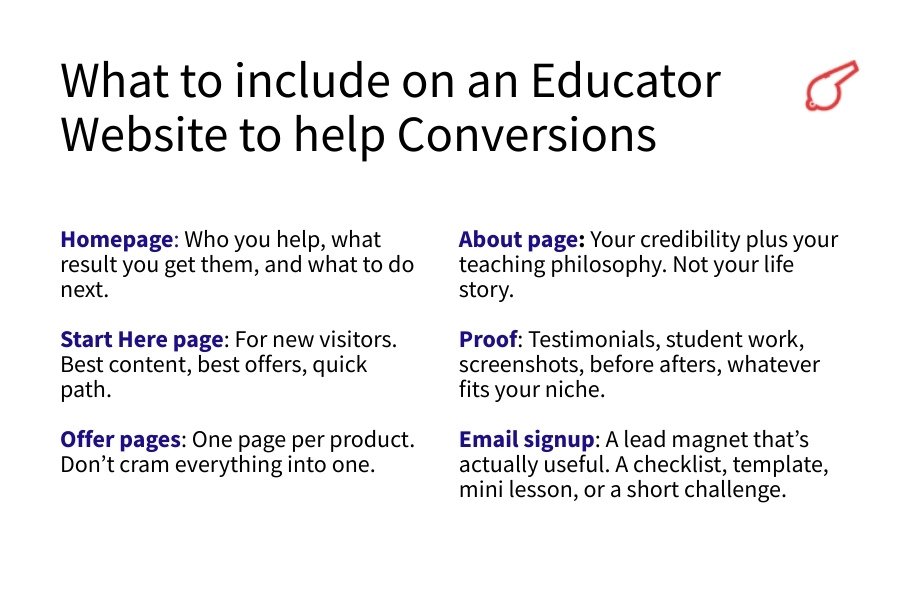
What to include on an educator website (that actually helps conversions)
Keep it simple, but not vague. You want clarity fast.
- Homepage: Who you help, what result you get them, and what to do next.
- Start Here page: For new visitors. Best content, best offers, quick path.
- Offer pages: One page per product. Don’t cram everything into one.
- About page: Your credibility plus your teaching philosophy. Not your life story.
- Proof: Testimonials, student work, screenshots, before afters, whatever fits your niche.
- Email signup: A lead magnet that’s actually useful. A checklist, template, mini lesson, or a short challenge.
In 2026, “having a website” isn’t a differentiator.
Having a website that makes your teaching easy to understand. That is.
For instance, educators in the digital age might want to consider creating a virtual classroom website to enhance their online teaching experience. Such platforms can host interactive learning tools and resources that traditional websites cannot.
Moreover, having an online training website with well-designed offer pages can significantly increase conversions. Each product should have its own dedicated page that clearly outlines its benefits and features.
Additionally, incorporating advanced technologies like AR and VR into your educational business could be a game-changer. This investment in AR/VR can provide immersive learning experiences that engage students more effectively.
Lastly, if you’re focusing on niche areas like kids coaching, it’s essential to have a kids coaching website that speaks directly to your target audience’s needs and expectations.
Also Read
Course formats that work right now (and why)
There isn’t one best format for online education courses. It depends on your topic, your audience, and how much support your students need to get results. However, these are the formats educators are leaning into in 2026.
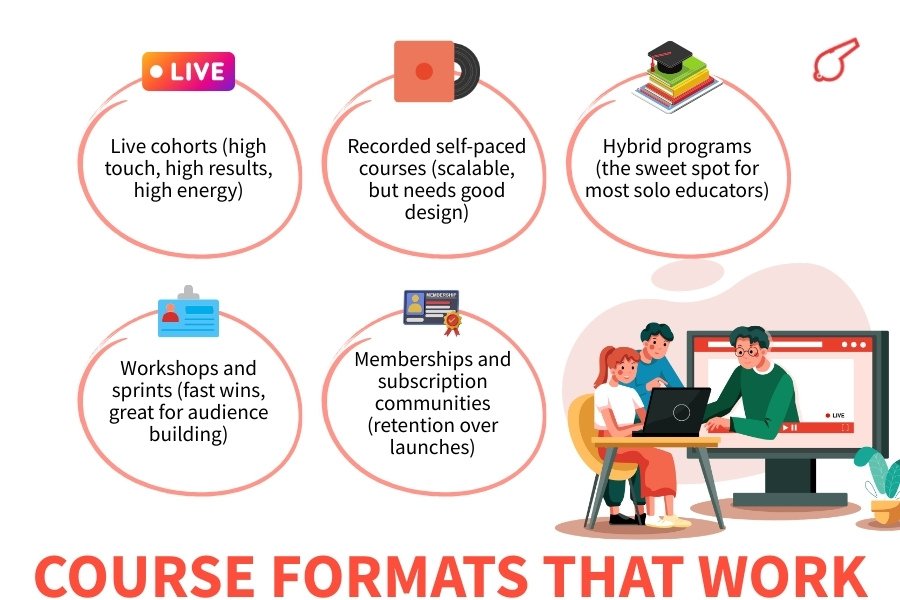
1. Live cohorts (high touch, high results, high energy)
Cohort-based courses are still strong because they create momentum. These cohort-based learning formats have several advantages:
Fixed start and end dates.
Community pressure in a good way.
Live sessions for Q&A and coaching.
Higher completion rates than self-paced.
They’re also great for pricing higher because the experience is more premium. This format is ideal for career transitions, skill building with accountability, or any situation where students might struggle alone.
2. Recorded self-paced courses (scalable, but needs good design)
Self-paced courses scale beautifully, but only if they’re built well. Most recorded courses fail because they’re just a dump of videos.
What works better:
- Short lessons, 5 to 12 minutes.
- Clear milestones.
- Worksheets, templates, example walkthroughs.
- A “path” through the material, not a library.
These recorded self-paced courses are best for foundational skills, repeatable methods, or audiences that want flexibility.
3. Hybrid programs (the sweet spot for most solo educators)
Hybrid is basically: recorded core curriculum plus live support. So you record the main teaching once, and then you run:
weekly office hours
monthly Q&A calls
a private community
assignment reviews in batches
This tends to be the most sustainable model for a solo educator who wants scale but still cares about outcomes. It’s especially beneficial for coaching adjacent topics.
Moreover, as we delve deeper into the digital age, it’s worth exploring how the metaverse can play a role in K-12 education. The integration of such advanced technologies could redefine course formats and learning experiences entirely.
For those seeking additional insights into course creation and selling strategies, an education resource library can serve as an invaluable tool.
4. Workshops and sprints (fast wins, great for audience building)
Short experiences are everywhere in 2026:
- 2 hour workshops
- weekend intensives
- 5 day sprints
- 14 day challenges
They work because they give quick wins, and they make it easier for someone to pay you the first time.
They also feed your bigger offers.
Best for: top of funnel paid offers, lead generation, testing a topic before building a full course.
5. Memberships and subscription communities (retention over launches)
Memberships are tricky. They can also be amazing.
What’s working now is not “pay me $20 for random stuff each month”.
It’s memberships tied to a specific ongoing need:
- weekly practice sessions
- monthly critique calls
- continuing education
- content libraries plus live support
- templates and updates for fast changing industries
Best for: skills that require practice, industries that change, people who want community.
Also Read
The solo educator tool stack in 2026 (keep it boring)
The best stacks are not the fanciest. They’re the ones you can actually run without a tech meltdown every week.
Here’s the core stack most solo educators end up with.
1. Website platform
Pick one you can maintain.
WordPress (flexible, powerful, more setup)
Webflow (design control, less plugin chaos)
Squarespace (simple, limited)
Framer (fast, modern, more common with creators)
If you’re reading this on WordPress. You already know what I’d lean toward for long term control.
However, if you’re considering a more tailored approach to your online presence, partnering with a web design agency for education website development could be beneficial.
2. LMS or course delivery
Common choices in 2026:
- Kajabi (all in one)
- Teachable
- Thinkific
- Podia
- Circle (community plus courses)
- Notion plus video hosting (scrappy, works for early stage)
- WordPress LMS plugins (LearnDash, LifterLMS) if you want full ownership
Don’t over optimize. Choose based on the experience you want students to have.
3. Payments and checkout
Stripe is still the default.
PayPal still matters in some markets.
For higher ticket offers, payment plans are basically expected.
Clean checkout pages matter more than you think. Fewer fields, clear guarantee, clear next steps.
4. Email marketing (still the money channel)
Email is where you sell without begging an algorithm.
Popular picks:
- ConvertKit
- Beehiiv (more newsletter focused)
- MailerLite
- ActiveCampaign (more advanced automation)
- Klaviyo (if you’re doing heavy ecommerce style flows)
Your list becomes your safety net. And your main launch lever.
5. Video and community
Zoom is still everywhere for live.
Vimeo, YouTube unlisted, or built in hosting for recorded lessons.
Circle, Discord, Slack for community depending on vibe. Circle is very educator friendly.
A quick note. Community is not required to scale. It’s optional. But if your topic benefits from peer support, it can boost results a lot.
How educators are using AI in 2026 (without turning into robots)
AI is baked into everything now. But the educators doing it well are not using AI to replace teaching. They’re using it to reduce friction. Here are the use cases that actually matter. Moreover, with the advent of cloud computing, educators now have access to a plethora of resources that can further enhance their teaching methodologies and streamline administrative tasks. As noted in a recent article from EdWeek, more teachers are using AI in their classrooms.
1. Content repurposing, without losing your voice
A single lesson can become:
- a blog post
- a newsletter
- 5 short clips
- a carousel script
- a podcast outline
- a lead magnet
AI helps with first drafts and reformatting. You still do the final pass so it sounds like you, not like generic internet mush. This is where content repurposing comes into play, allowing for maximum utilization of your original content.
2. Lesson planning and curriculum structure
This is underrated.
AI is good at:
generating module outlines
creating quiz questions
proposing progression paths
spotting missing prerequisites
You can feed it your rough syllabus and ask it to reorganize by difficulty, or by time available, or by common student mistakes. This approach is similar to how AI-powered MVPs can be utilized to create effective solutions in various sectors.
3. Q&A bots for student support
This one is getting popular fast.
Educators are training simple knowledge base bots on:
- course transcripts
- FAQs
- worksheets
- policies
- community guidelines
So students can ask, “Where is the lesson on X” or “How do I submit assignment 2” and get an instant answer at 2am.
Important. You still need a way for students to escalate to a human when it matters. But for repetitive questions, bots save hours. These AI-powered solutions not only streamline communication but also enhance the overall learning experience.
4. Faster feedback drafts (with human final review)
Some educators use AI to draft feedback based on rubrics:
- “Here’s what you did well”
- “Here’s what to improve”
- “Here’s the next exercise”
Then they edit it quickly and personalize.
This keeps quality high while making support scalable.
Also Read
Pricing models and monetisation strategies that are working
Pricing is emotional. People pretend it’s math. It’s not.
In 2026, buyers are cautious but willing to pay for outcomes and clarity.
Here are common monetisation models educators are using.
1. Tiered offers (good, better, best)
A simple structure:
Self paced: lower price, minimal support
Hybrid: mid price, group support
Cohort or group coaching: higher price, live access, feedback
This lets different buyers choose based on time, budget, and confidence.
2. Payment plans (reduce friction, increase conversions)
If your core offer is $800 to $2,000, payment plans are not optional anymore.
Just be clear:
- number of payments
- total cost
- what happens if they miss a payment
- access rules
3. Subscriptions for retention
Memberships work when there’s a clear ongoing reason to stay.
If the value is “new content every month”, people churn.
If the value is “weekly practice and coaching so I stay consistent”, retention improves.
4. Licensing and B2B deals (the quiet scalability move)
This is the one more educators are discovering.
Instead of selling to individuals only, they sell to:
- schools
- teams
- companies
- training departments
- nonprofits
You license your curriculum, run a workshop, or bundle seats.
It’s not as sexy as a big online launch. But it can be stable and high revenue.
5. Digital products as feeders, not the main thing
Templates, swipe files, mini courses, toolkits.
They work best as:
audience builders
list builders
tripwire offers
credibility boosters
For most educators, the main income still comes from a core program. Digital products support it.
Also Read
Common mistakes solo educators make when going online
I see the same patterns over and over. Even from smart people.
1. They build the course before they validate the offer
They spend 3 months recording.
Then they launch and hear crickets.
Better approach:
- pre sell a cohort
- run it live
- record as you go
- turn it into a hybrid or self-paced later
You get paid while building, and you build what people actually need.
2. They try to teach everything they know
Online courses are not encyclopedias.
They need constraints.
A tight promise, a clear start point, a clear end point. Extra modules feel generous, but they often reduce completion.
3. They rely on social media only
This is the big one.
If your entire business lives on one platform, you do not own your distribution.
Your website and email list are what make your teaching business durable. This is why it’s crucial to invest in online marketing strategies that enhance visibility and reach of your core offerings.
4. They underprice, then over deliver to compensate
Low prices attract people who don’t commit. Then you work harder to get them results, then you burn out.
Price based on:
the result
the support level
the time it saves
the risk you’re removing
Not based on your impostor syndrome.
In addition to these common pitfalls, educators should also consider exploring various online education business ideas that can diversify their income streams. Furthermore, leveraging digital marketing strategies can significantly increase online course subscriptions and overall success of their digital products.
5. They skip onboarding, then wonder why students disappear
Onboarding is not fluff.
A simple onboarding flow can double completion:
- welcome email with exactly what to do first
- how to get support
- how long it takes each week
- where to introduce themselves
- what success looks like in week 1
People don’t quit because they’re lazy. They quit because they feel lost.
What this looks like in practice (a simple scalable model)
If you want a clean, sustainable setup as a solo educator in 2026, this structure is common:
- Publish content weekly (blog, YouTube, newsletter, pick one)
- Drive to a lead magnet on your website
- Nurture with email
- Sell a low cost workshop monthly
- Convert a portion into your hybrid core program
- Offer an advanced cohort 2 to 3 times per year
- Keep a small number of premium 1:1 clients if you want, but not as the foundation
Nothing fancy. Just leverage.
However, having a well-structured personal website is crucial in this process as it serves as your online hub for content, lead magnets, and sales.
FAQ (Frequently Asked Questions)
How long does it take to build a scalable teaching business online?
Most educators can validate an offer in 2 to 6 weeks with a live cohort or workshop. Building a more stable system with a website, email list, and repeatable sales flow usually takes 6 to 12 months of consistent effort.
Do I need a huge audience to sell courses in 2026?
No. A small, focused audience converts better than a big vague one. Many educators do fine with a few hundred engaged email subscribers if the offer is specific and outcome driven.
What’s the best course format for a beginner educator?
A live cohort or a short paid workshop is usually the best start because it validates demand fast and gives you real student questions to build the curriculum around.
Should I host my course on my own website or use an LMS?
If you want speed and simplicity, use a dedicated LMS like Teachable, Thinkific, Kajabi, Podia, or Circle. However, if you want maximum control and ownership, a WordPress LMS can be worth it, but it needs more setup and maintenance.
How are educators using AI without making their content feel generic?
They use AI for structure and speed, outlines, repurposing, quizzes, draft feedback, and support bots. But they keep the human parts human: stories, examples, opinions, and the final edit for voice and clarity.
What pricing works best for solo educators right now?
Tiered pricing works well: self paced at a lower price, hybrid in the middle, and cohort or group coaching at the top. Payment plans are increasingly expected for mid to high ticket programs.
What’s the biggest mistake to avoid when moving from 1:1 to scalable offers?
Trying to convert your entire 1:1 process into a massive course. Start with one clear transformation, teach it live, tighten it, then productize it into a hybrid or self paced format.
 Rethinking Interior Design Website Experience...







Informative blog