



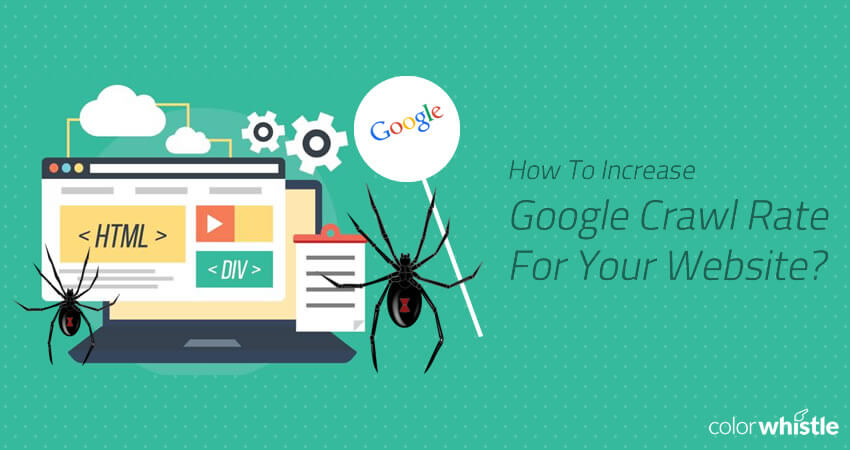
Increase Google Bot Crawl Rate Of Your Website

Powered by an expert content team, this blog blends SEO precision with compelling storytelling. Every insight is supported by data-driven research, ensuring content that ranks, engages, and drives conversions.

Our authors are proven experts in their fields, writing on topics where they have demonstrated expertise. Every piece of content undergoes peer review and validation by industry professionals.
AI Summary
A Quick Summary of Increasing Google Bot Crawl Rate
This serves as a practical guide for website owners and SEO professionals seeking to boost their Google bot crawl rate. The key insight: improving crawl frequency depends on enhancing site quality and freshness rather than forcing Googlebot to visit more often. The blog details 12 actionable strategies such as regularly adding quality content, optimizing load times, using sitemaps, improving server response, avoiding duplicate content, and building quality backlinks. These methods help Googlebot crawl and index pages more efficiently, ultimately increasing organic traffic and search visibility. Readers are encouraged to implement these steps patiently for sustained SEO growth.
All these time, you’ve been waiting for Google to Crawl your website.
You tried to woo Google but, sadly, your efforts had gone unnoticed.
I’ve got some good news! You can put your mind at ease.
The secret formula to increase Google bot crawl rate of your website . We ColorWhistle can also help you with our exclusive SEO services to keep your growth inclined.
Drum rolls….and the formula is…
Regular crawls + Frequent crawls = Google love.
What is Google Crawl Rate ?
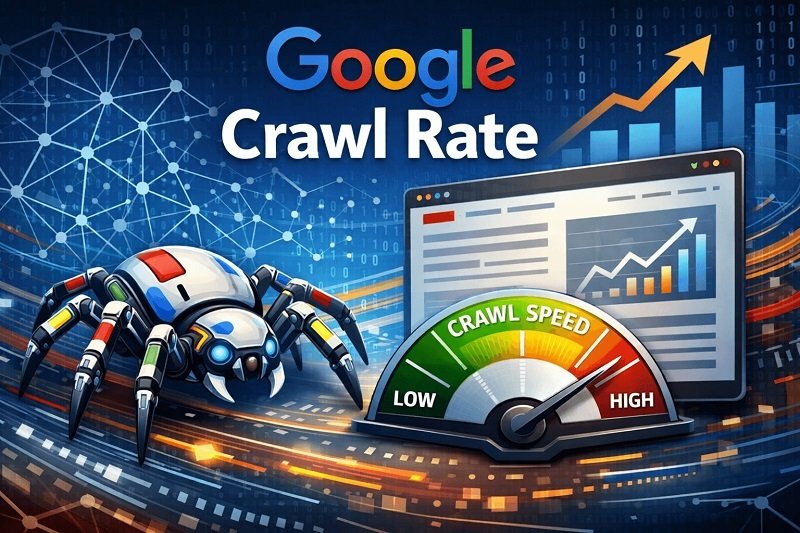
Google crawl rate refers to how frequently Googlebot visits and scans your website. This frequency varies based on the type of website, the quality of content, overall technical health, and how efficiently Google can navigate your site. When Googlebot has trouble crawling your pages, indexing becomes slow and inconsistent. Rather than forcing Google to crawl your website more often, the goal is to make crawling easier by improving site quality and signaling freshness.
12 Effective Steps to Increase Google Crawl Rate Of Your Website
Without further adieu, here are some of the measures you can take to increase Google crawl rate.
1. Add New Content To Your Website Regularly
Publishing content consistently helps search engines understand that your website is active and worth revisiting. You don’t need daily posts, but regular updates such as weekly or biweekly blog posts, refreshed landing pages, or updated product pages encourage Googlebot to crawl your website more frequently. Quality matters more than quantity, so focus on depth, relevance, and originality.
2. Improve Your Website Load Time
Google allocates limited crawl resources to each website. If your pages load slowly, Googlebot spends too much time retrieving files and may crawl fewer pages overall. Improving loading speed through image optimization, caching, minification, and server enhancements helps Google crawl deeper and faster. Fast websites also improve Core Web Vitals performance, which indirectly supports better indexing.
3. Include Sitemaps To Increase Google Crawl Rate
An XML sitemap helps Google discover and understand all the important pages on your website. It acts as a roadmap for crawlers, ensuring new or updated pages are indexed faster. Submitting your sitemap through Google Search Console helps Google prioritize which URLs should be crawled first, especially for websites with many pages.
Also Read
4. Improve Server Response Time
Google recommends keeping server response time under 200ms for optimal crawling. If your server is slow or frequently overloaded, Googlebot reduces its crawl rate to avoid stressing your server. Upgraded hosting, CDN integration, caching layers, and stable backend performance all help improve how quickly Googlebot can fetch your pages.
5. Avoid Duplicate Content
Duplicate or thin content can confuse search engines and waste crawl budget. When Google sees many similar pages, it reduces the number of times it crawls your site because it assumes the content is not valuable. Using canonical tags, consolidating duplicate pages, and maintaining unique content ensures crawl efficiency and SEO consistency.
6. Block Unwanted Pages with Robots.txt
If your website contains backend folders, admin sections, or parameter-based pages that don’t need to be indexed, you can block them using robots.txt. This allows Googlebot to spend its time crawling the pages that matter. Since mistakes in robots.txt can unintentionally block your entire website, always test your file in Google Search Console before publishing it.
7. Optimize Images And Videos
Search engines cannot understand images and videos unless you provide proper metadata. Including descriptive alt tags, structured data where applicable, optimized file sizes, and modern formats like WebP helps Google crawl and index your visual assets faster. Avoid Flash or outdated media formats that Google cannot index reliably.
8. Interlink your Blog Posts
Internal linking helps Google understand how your content is connected. Linking older articles to newer ones (and vice versa) distributes authority across the website and encourages deeper crawling. Structured and meaningful interlinking guides Googlebot to pages that might otherwise be overlooked.
9. Use Ping Services
When new content is published, ping services notify search engines that updates are available. While pinging doesn’t guarantee immediate crawling, it helps search engines discover new URLs sooner. Combined with backlinks and strong internal linking with the guidance of a well-reputed SEO agency, ping notifications improve overall crawl responsiveness.
Also Read
10. Get Rid Of Black Hat SEO Outcomes
Any form of deceptive optimization harms your crawl rate and rankings. Practices like keyword stuffing, doorway pages, unnatural backlinks, spun content, and hidden text damage your site’s trustworthiness. Removing these signals and focusing on ethical SEO helps Googlebot recrawl your website more frequently and improves long-term performance.
SEO Packages offered by reputable SEO firms can help you implement a safe and effective SEO strategy that adheres to search engine guidelines and builds a strong foundation for long-term success. Here are some best SEO case studies that actually worked.
11. Build Quality Links
High-quality backlinks will improve Google crawl rate and indexation speed of your website. It is also the most effective way to rank better and drive more traffic.
Backlinks naturally attract Googlebot to your website. When authoritative websites link to your content, you earn crawl priority and faster indexing. Focus on trusted link-building methods such as guest posts, resource link outreach, and updating broken external links. Avoid buying links or using automated link schemes that can lead to penalties.
12. Encourage Social Sharing
Social shares don’t directly improve rankings, but they help new pages get discovered faster. When content is widely shared, Googlebot encounters more external links, increasing the chances of faster crawling. Publicly accessible social posts, especially from platforms like Facebook and LinkedIn, can help new content appear in Google’s crawl path.
Looking for SEO Services?
Seize and experience the transformative impact of SEO Services & Solutions with ColorWhistle.

Summing Up Our Google Crawl Rate Optimization Techniques
According to Google, Crawl rate is not a ranking factor.
Google wrote, “an increased crawl rate will not necessarily lead to better positions in Search results. Google uses hundreds of signals to rank the results, and while crawling is necessary for being in the results, it’s not a ranking signal.”
You will get more organic search if your website is in a good place on SERPs. This will happen if you have a decent Google crawl rate. So every search engine marketing strategy must consider a website’s crawl rate.
It is possible to increase Google crawl rate but, it will not happen overnight. You have to be patient.
Apply the above recommendations to your entire website and with time, the love will be mutual. You will definitely get more traffic for your individual pages too.
What are the techniques you follow to improve Google crawl rate for your website? Feel free to comment below.
/imIn quest of the Perfect SEO Services & Solutions Buddy?
Be unrestricted to click the other trendy writes under this title that suits your needs the best!
 Top Charter School Website Functionalities - ...








Hi
Thank you for sharing such valuable insights. I’ve been implementing all of these strategies on my website –. Despite consistently publishing content and optimizing various elements, I’m still not seeing sufficient traffic. Additionally, I often have to manually submit my pages for indexing. I’d really appreciate your guidance on what more I can do.
Everyone loves it when people come together and share views. Great blog, keep it up!
Thanks for this post it is really superb and amazing post it is very informative post. They are really so amazing article shared! I like your content.
Thanks for providing lots of information for increase google crawl rate this help me to grow my website.
Nice Article Buddy . this Information Help me to Grow my website. Thank you
thanks for this guide. i want to get google crawl more pages in my site, how should i do that? i couldn’t find crawl stats
This blog has given lots of information about the Google crawling. This is going to help many in the link building activity.
Thanks for this information, it is very interesting to read this blog on Google bot crawling.
Hi Anjana,
Thanks for this information, it is very interesting to read this blog on Google bot crawling.
Hi guys! Just wanted to drop you a line to say that I really enjoyed reading your article! Great perspective. Have an awesome day!
Hi, good content.
Hi Anjana,
Thanks for providing lots of information for increase google crawl rate your every points are interesting.