




Credits Based Monetization for Cloud and Compute Intensive SaaS Products

Anusha is a digital strategy expert with deep expertise in branding, UI/UX, and performance-focused content. She brings advanced insight into brands to scale intelligently, blending creativity with conversion-focused thinking.

Our authors are proven experts in their fields, writing on topics where they have demonstrated expertise. Every piece of content undergoes peer review and validation by industry professionals.
AI Summary
Key Highlights of Credits-Based Monetization for SaaS Computing
This post explores credits-based monetization as a flexible pricing model for compute-intensive SaaS products, designed to align costs with actual resource usage. The key insight: combining credits with subscription tiers enables transparent, scalable billing for unpredictable workloads like AI, rendering, and simulations. It details system architecture, resource-to-credit mapping, real-time metering, and cloud-native billing integrations using tools like Prometheus and Datadog. The content serves SaaS founders and product managers, promising improved cash flow, customer fairness, and operational efficiency. Readers gain actionable strategies for implementing hybrid pricing models that balance predictability with usage-driven flexibility.
Credits-based monetization is a flexible pricing model where customers buy or earn credits to pay for using computational resources on a SaaS platform. This approach has become popular in cloud SaaS billing systems, especially for compute intensive SaaS applications with widely varying resource usage among users and tasks.
The traditional subscription-only model often falls short for applications with unpredictable compute demands. A hybrid approach combining credits and subscription tiers addresses this gap by aligning costs directly with actual resource utilization. This alignment proves essential for platforms processing AI workloads, rendering video, executing complex simulations, or handling large-scale data transformations, scenarios where compute costs can fluctuate significantly.
DevOps tools and high-performance computing (HPC) platforms are crucial in this ecosystem. Technologies like Kubernetes, Prometheus, and container orchestration systems enable precise measurement of resource usage, making detailed credit-based billing technically possible. These tools provide the infrastructure needed to monitor CPU hours, GPU minutes, memory allocation, and network bandwidth in real-time.
Interestingly, the ideas behind credits-based monetization aren’t just limited to the tech industry. For example, in education, the Metaverse is upgrading K-12 education, enhancing learning through immersive virtual environments and innovative teaching methods. Similarly, industries like travel are using unique strategies such as inspiring and creative travel marketing campaigns to effectively engage customers.
Additionally, the significance of digital marketing strategies like SEO for IT services companies cannot be overlooked. This long-term marketing investment is vital for achieving growth returns even beyond 2026.
This article explores the architecture, implementation strategies, and business implications of credits-based monetization for compute-heavy SaaS products. We delve into technical aspects, pricing approaches, real-world examples including potential uses in various industries such as education and travel, platform solutions, and emerging trends influencing this billing model.
Understanding Credits-Based Monetization in Cloud SaaS
Credits serve as a flexible digital currency that simplifies the complex costs of underlying infrastructure into easily understandable units. Instead of directly charging customers for raw computing resources like CPU cycles or memory allocation, credits offer a standardized measurement system that converts technical resource usage into business-friendly metrics. This simplification allows SaaS providers to package computational power in ways that align with customer value perception while still making a profit.
1. The Role of Credits in Pricing Models
The combination of cloud compute credits with traditional subscription plans creates pricing models that cater to various customer needs. For example:
A basic subscription may include a monthly allocation of credits, let’s say 1,000 credits for the standard tier.
Higher-tier subscriptions offer larger credit pools or better conversion rates.
Customers have the option to purchase additional credit bundles as required, adding a consumption-based element on top of predictable recurring revenue.
This structure enables organizations to maintain steady cash flow through subscriptions while also generating extra income from power users who exceed their base allocations.
2. How Credits Represent Resource Usage
Credits as usage units correspond to specific computational tasks based on how resource-intensive they are:
CPU hours: Standard compute operations where one credit equals a defined amount of processing time on virtual cores.
GPU minutes: Accelerated computing for AI model training or rendering, typically consuming credits at higher rates due to specialized hardware costs.
RAM load: Memory-intensive operations measured by gigabyte-hours of active allocation.
API calls: Discrete service invocations that trigger backend processing, often bundled in blocks of thousands per credit. For more information on how to develop high-quality APIs for your business, refer to this API Development Guide.
Storage operations: Read/write transactions and data persistence measured by volume and duration.
Network bandwidth: Data transfer costs for ingress and egress traffic across cloud regions.
This detailed approach ensures customers only pay for the resources they actually use, creating transparency in hybrid pricing models that strike a balance between predictability and flexibility based on usage.
In the world of website design and development, there are many myths that can mislead businesses. To avoid these mistakes, it’s important to debunk these common misconceptions. For example, many people think that website design and development is an easy task, but it involves much more than just making things look good. Likewise, it’s quite common to encounter problems while using WordPress, but luckily there are solutions available for these common WordPress issues.
Additionally, if you need professional help with website design or digital marketing, consider contacting some of the top website design agencies in Indiana or exploring the services offered by some of the best digital marketing agencies in Canada.
Also Read
Core Components of a Scalable Credits System
Building a robust scalable credits system requires careful architectural decisions that balance accuracy, performance, and cost efficiency. The foundation lies in establishing clear mappings between infrastructure resources and credit consumption patterns.
Mapping Infrastructure Cost Drivers to Credit Units
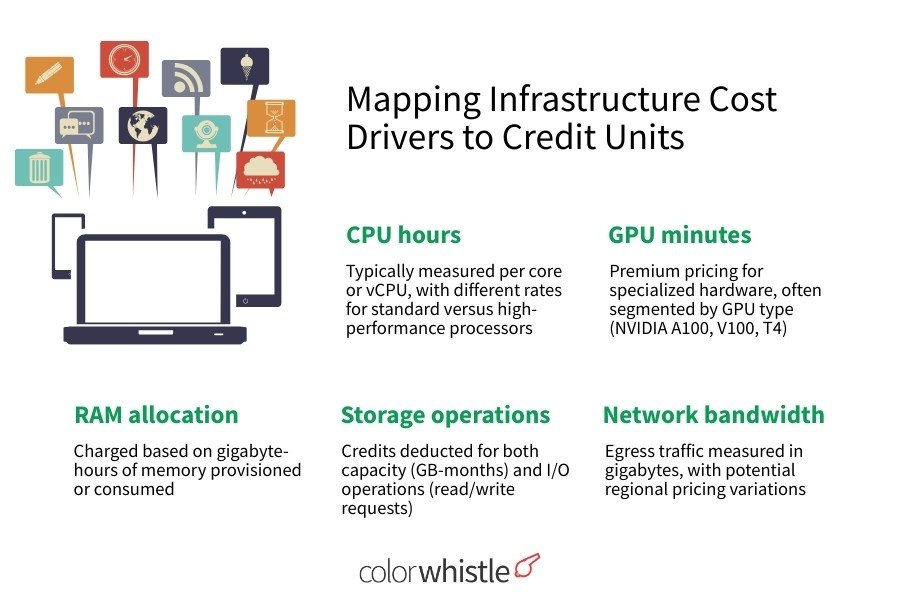
The translation of raw infrastructure metrics into consumable credit units demands precise calibration. Each resource type carries distinct cost characteristics:
- CPU hours: Typically measured per core or vCPU, with different rates for standard versus high-performance processors
- GPU minutes: Premium pricing for specialized hardware, often segmented by GPU type (NVIDIA A100, V100, T4)
- RAM allocation: Charged based on gigabyte-hours of memory provisioned or consumed
- Storage operations: Credits deducted for both capacity (GB-months) and I/O operations (read/write requests)
- Network bandwidth: Egress traffic measured in gigabytes, with potential regional pricing variations
The credit-to-resource ratio should reflect actual cloud provider costs plus margin, enabling predictable unit economics. Many SaaS platforms apply multipliers to high-demand resources, ensuring GPU-intensive workloads consume credits proportionally faster than basic compute tasks.
Resource Throttling Based on Credit Balance
Resource throttling serves as the enforcement mechanism for credit-based limits. When account balances approach depletion, the system implements graduated restrictions:
- Warning notifications at configurable thresholds (80%, 90%, 95%)
- Reduced priority for batch jobs and non-critical workloads
- Hard limits preventing new resource allocation at zero balance
- Grace periods for enterprise accounts with established payment history
This approach protects infrastructure costs while maintaining service quality for paying customers.
Real-Time Granular Metering and Tracking
Granular metering infrastructure captures resource consumption at sub-minute intervals, aggregating data streams from multiple sources. Modern implementations leverage time-series databases to store consumption events with millisecond precision, enabling accurate billing even for ephemeral workloads like serverless functions that execute for seconds. The metering pipeline must handle high-velocity data ingestion while supporting complex queries for usage analytics, anomaly detection, and customer-facing dashboards that display credit burn rates in real-time.
In addition to these technical aspects, it’s essential to consider the user experience in educational platforms utilizing such a scalable credit system. Education ads design ideas can play a crucial role in attracting users by effectively communicating the value proposition of the platform’s services.
Integration with Cloud Native Billing and Monitoring Tools
Building a robust credits-based monetization system requires seamless integration between billing infrastructure and monitoring platforms. The accuracy of credit consumption tracking depends on real-time visibility into resource utilization across your entire cloud environment. Without this integration, SaaS providers risk billing discrepancies, customer disputes, and revenue leakage.
Prometheus Monitoring for Granular Metrics
Prometheus monitoring serves as a foundational tool for capturing granular metrics from containerized workloads and microservices architectures. Its pull-based model collects time-series data on CPU utilization, memory consumption, network traffic, and custom application metrics. By exposing these metrics through standardized endpoints, Prometheus enables billing systems to query actual resource consumption at configurable intervals, whether every second for high-precision tracking or every minute for standard usage patterns.
Datadog Integration for Enhanced Monitoring
Datadog integration extends monitoring capabilities with pre-built dashboards and alerting mechanisms specifically designed for cloud infrastructure. Its agent-based architecture captures metrics from diverse sources including Kubernetes clusters, serverless functions, and database instances. The platform’s API allows billing systems to retrieve aggregated usage data, making it possible to correlate infrastructure costs with credit consumption in near real-time.
Technical Implementation of Cloud Native Billing Integration
The technical implementation of cloud native billing integration typically involves:
Webhook endpoints that receive usage events from monitoring platforms as they occur
Message queues (like Kafka or RabbitMQ) that buffer high-volume metric streams before processing
Data transformation pipelines that convert raw infrastructure metrics into billable credit units
Reconciliation processes that validate billing accuracy against source monitoring data
API-Driven Automation for Efficient Workflows
API-driven automation eliminates manual intervention in billing workflows. When a customer’s containerized job completes, monitoring tools automatically push execution metrics to the billing system, which calculates credit consumption, updates account balances, and triggers notifications if thresholds are approached. This automation reduces billing cycle times from days to minutes while maintaining audit-ready precision in usage tracking.
Also Read
Pricing Strategies for Compute Usage in SaaS Products
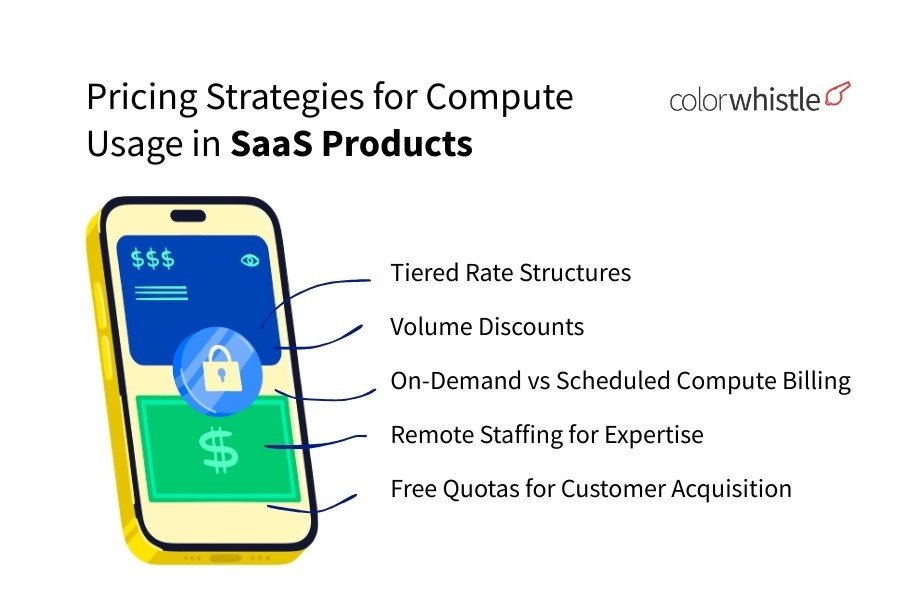
Establishing effective compute usage pricing requires careful consideration of how different customer segments consume resources. Here are some key strategies to consider:
1. Tiered Rate Structures
Tiered rate structures provide a foundation where unit costs decrease as consumption increases, incentivizing larger commitments while maintaining profitability across customer sizes. A typical implementation might charge $0.10 per credit for the first 1,000 credits, $0.08 for credits 1,001-10,000, and $0.06 for usage beyond 10,000 credits monthly.
2. Volume Discounts
Volume discounts operate on similar principles but can be structured as retroactive or prospective models:
- Retroactive discounts apply reduced rates to all consumption once a threshold is reached.
- Prospective models only discount usage above specific breakpoints.
The choice between these approaches impacts both revenue predictability and customer perception of value.
3. On-Demand vs Scheduled Compute Billing
The distinction between on-demand and scheduled compute billing creates opportunities for sophisticated pricing optimization:
On-demand workloads command premium rates due to their immediate resource requirements and unpredictable nature.
Scheduled compute jobs, which can be queued and executed during off-peak infrastructure periods, justify discounted credit rates, often 30-50% lower than on-demand equivalents.
DevOps tools like Kubernetes enable this differentiation through intelligent workload scheduling, pod priority classes, and resource quota management that automatically route jobs based on urgency and available capacity.
4. Remote Staffing for Expertise
In this context, remote staffing could be an advantageous strategy. By hiring remote staff with expertise in areas such as Kubernetes management or pricing optimization, SaaS companies can streamline their operations and make more informed decisions regarding their pricing strategies.
5. Free Quotas for Customer Acquisition
Free quotas serve multiple strategic purposes within credit systems:
New customers receive starter credits to experience the platform without financial commitment, reducing friction in the adoption process.
Monthly allocations of complimentary credits can be tied to subscription tiers, ensuring base-level access while establishing clear boundaries for additional consumption.
When customers exceed their allocated quotas, overage charges activate at predetermined rates, typically matching or slightly exceeding standard credit pricing to encourage appropriate tier selection.
This pricing architecture transforms infrastructure costs into transparent, scalable revenue streams that align directly with the computational resources each customer consumes.
Industry Variations in Effectiveness
However, it’s also important to note that the effectiveness of these strategies can vary across industries. For instance:
- The fashion industry could leverage YouTube lookbook strategies for better engagement and sales conversion while using these pricing strategies.
- In sectors like education where digital marketing services are crucial for growth, integrating user-generated content into video marketing strategies could significantly enhance brand communication and influence.
Also Read
Use Cases: Credits-Based Models in AI and Compute Intensive SaaS with DevOps Tools Support
AI SaaS platforms have emerged as prime adopters of credits-based monetization, where computational demands fluctuate dramatically based on user activity. For instance, Runway, a platform that charges credits for video generation tasks, consumes a predetermined amount of credits tied to the underlying GPU processing time for each second of AI-generated content. Similarly, Copy.ai implements a model where credits correspond to API calls and text generation volume, allowing users to scale their content production without committing to rigid subscription tiers. Synthesia’s approach links credits directly to video rendering minutes, accounting for factors like resolution quality and avatar complexity that drive compute costs.
Container execution credits
Container execution credits provide granular billing for workloads running in containerized environments. Each container instance consumes credits based on:
vCPU allocation and active processing timeo
Memory reservation and actual RAM utilization
Network egress and inter-service communication bandwidthx
Persistent volume storage attached to containers
Serverless functions billing
Serverless functions billing through credits offers particular advantages for event-driven architectures. Functions triggered by user actions, scheduled tasks, or external webhooks consume credits proportional to execution duration and allocated memory. This model eliminates idle compute costs while maintaining precise cost attribution to specific business operations.
Batch job processing
Batch job processing represents another critical application where credits align costs with value delivery. Machine learning training runs, data pipeline executions, and rendering tasks consume credits based on job duration and resource intensity. Users can queue jobs when credit balances are sufficient, creating natural resource management without manual intervention.
DevOps tools integration
DevOps tools like Kubernetes enable sophisticated workload management within credit-constrained environments. Pod autoscaling policies can reference available credit balances, automatically adjusting replica counts to prevent budget overruns. Namespace-level resource quotas tied to credit allocations ensure fair distribution across teams or projects, while admission controllers can reject deployments that would exceed credit thresholds.
Understanding the Total Addressable Market (TAM) is crucial for SaaS companies looking to maximize their growth potential. This metric not only helps in scaling but also impresses investors leading towards achieving success.
Furthermore, the rise of AI-driven marketing automation is revolutionizing sectors such as education. Institutions are leveraging AI-powered marketing automation strategies to improve student engagement and boost enrollment rates.
In the realm of Android devices, users can now experience enhanced Google AI features, which offer smarter assistance and improved productivity through personalized interactions powered by the latest AI advancements from Google.
Also Read
Benefits of Combining Credits with Subscription Models in Cloud SaaS Environment
The hybrid approach of Credits and Subscription models creates a pricing framework that addresses the inherent variability in cloud resource consumption while maintaining predictable baseline revenue. This combination delivers distinct advantages for both providers and customers in compute-intensive environments.
Aligning Costs with Actual Consumption
Traditional subscription models often force customers to overprovision resources to avoid service interruptions during peak usage periods. By layering credits atop base subscriptions, organizations pay for their baseline needs through fixed fees while consuming additional resources as required. A development team might maintain a standard subscription for continuous integration pipelines while purchasing credits for intensive machine learning training jobs that occur sporadically throughout the quarter.
Eliminating Contract Renegotiation Friction
Scalable usage billing removes the administrative burden of contract amendments when resource needs fluctuate. Customers can instantly access additional compute capacity by consuming credits rather than initiating procurement processes for subscription upgrades. This elasticity proves particularly valuable for seasonal businesses or projects with unpredictable computational demands, such as rendering farms during production cycles or data processing during quarterly financial closes.
Driving Resource Efficiency Through Visibility
Cost transparency inherent in credit systems encourages teams to optimize their resource utilization patterns. When developers can observe the credit cost of running specific workloads, they naturally gravitate toward more efficient architectures. Real-time dashboards showing credit burn rates enable engineering teams to identify wasteful processes, such as idle GPU instances or oversized container allocations, prompting immediate corrective action.
Reducing Acquisition Barriers
Hybrid subscription pricing benefits extend to customer acquisition strategies through risk-free evaluation periods. Providing 100-500 free credits alongside trial subscriptions allows prospects to test compute-intensive features, video transcoding, AI inference, or data transformations, without financial commitment. This approach converts significantly better than feature-limited trials, as users experience the full product capabilities within their credit allocation.
Additionally, this model can be effectively utilized in various sectors including retail. For instance, Mizzen+Main, a menswear brand, leveraged Shopify POS to seamlessly connect their online and offline stores, thereby enhancing customer experiences and driving growth in their business.
Moreover, these principles can also be applied when designing SaaS websites. By adopting cutting-edge trends and sleek interfaces that facilitate seamless user interactions, businesses can significantly improve their online presence and customer engagement.
Challenges and Considerations in Implementing Credit-Based Billing Systems for Cloud SaaS Providers
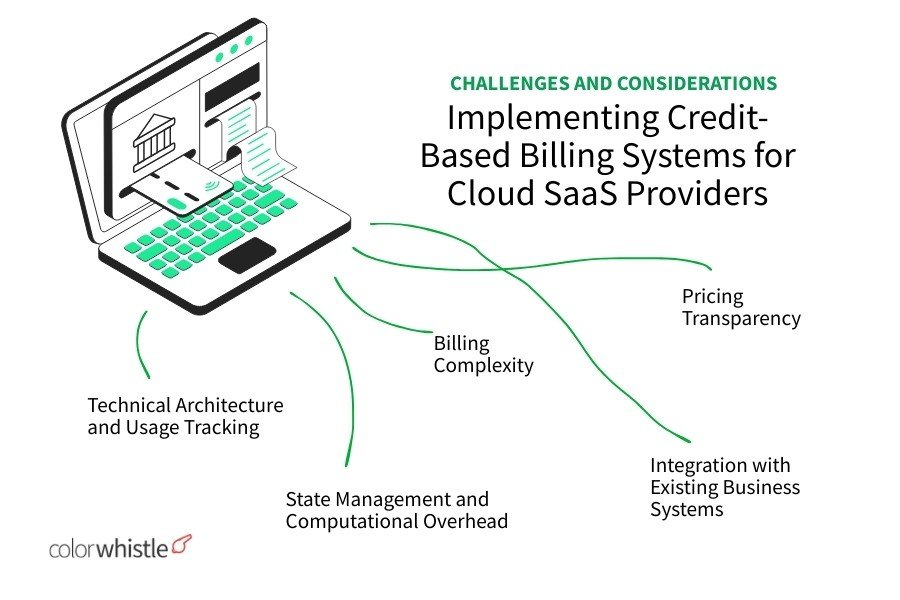
Implementing credit-based billing systems for cloud SaaS providers comes with its own set of challenges and considerations. Here are some key factors to keep in mind:
1. Technical Architecture and Usage Tracking
The technical architecture required for accurate usage tracking presents significant operational hurdles. Cloud providers must:
Instrument their entire stack to capture granular consumption data across multiple dimensions, CPU cycles, memory allocation, network egress, and storage operations.e
Ensure precise measurement of each compute resource at intervals that balance accuracy with system overhead.
Avoid miscalculations in tracking GPU minutes or API calls, as these can lead to substantial revenue leakage or customer disputes.
2. Billing Complexity
Billing complexity challenges multiply when translating raw infrastructure metrics into customer-facing credit deductions. The system must handle:
- Variable pricing tiers that adjust based on consumption volume
- Time-based rate modifications for peak versus off-peak usage
- Multi-tenant resource sharing where isolation and attribution become critical
- Retroactive adjustments when infrastructure costs fluctuate
- Proration logic for mid-cycle plan changes or credit purchases
3. State Management and Computational Overhead
Advanced billing logic requires sophisticated state management to track credit balances, expiration dates, rollover policies, and priority consumption rules. The computational overhead of processing millions of metering events daily while maintaining real-time accuracy strains database architectures and requires careful optimization.
4. Pricing Transparency
Pricing transparency becomes crucial when customers scrutinize invoices reflecting complex usage patterns. Detailed breakdowns must clearly map consumed resources to credit deductions without overwhelming users with technical jargon. Ambiguous line items or unexplained charges erode trust rapidly, particularly for enterprise customers managing departmental budgets.
In this context, ensuring model routing transparency is essential. It allows customers to understand how their usage translates into billing, fostering trust and reducing disputes.
5. Integration with Existing Business Systems
Integration with existing business systems introduces additional friction points. Credit-based billing platforms must:
- Synchronize bidirectionally with CRM systems for account management
- Integrate accounting software for revenue recognition
- Connect payment gateways for automated top-ups
Data consistency across these systems requires robust API contracts and error handling mechanisms. The absence of standardized protocols for credit-based billing means custom integration work for each enterprise tool in the stack, extending implementation timelines and increasing maintenance burden.
To enhance the overall user experience amidst these challenges, creating a mobile-friendly travel website could be a viable solution. This would not only optimize user engagement but also streamline the process of managing complex billing structures.
Moreover, considering the rising trend of mobile usage, developing Android and iOS apps could further simplify the billing process by offering users a more accessible platform to manage their accounts.
Additionally, leveraging Flutter app technology could provide a customized solution that meets specific business needs while also enhancing user experience through its popularity among users.
Also Read
Regulatory and Compliance Implications for Compute Metering in Cloud SaaS Billing Context
Regulatory compliance cloud billing requires strict adherence to financial reporting standards, especially when implementing usage-based pricing models. SaaS providers must align their credit-based systems with accounting principles such as ASC 606 (Revenue from Contracts with Customers) and IFRS 15, which dictate how revenue should be recognized from performance obligations. Metered billing adds complexity to revenue recognition timing, as providers must accurately track when compute resources are used versus when payment is received.
Metering standards are crucial in establishing credibility with enterprise customers who require precise, verifiable usage data. Organizations must implement measurement systems that comply with industry-specific regulations:
SOC 2 Type II compliance for demonstrating secure handling of customer usage data
ISO/IEC 27001 certification for information security management during metering processes
PCI DSS requirements when processing payment transactions tied to credit consumption
GDPR and CCPA obligations for protecting personal data collected during usage tracking
Audit trails are essential for both regulatory compliance and customer trust. Every credit transaction, from allocation to consumption to billing, requires comprehensive logging that captures:
- Timestamp and duration of resource usage
- User identity and authorization level
- Specific compute resources consumed (CPU cores, GPU instances, memory allocation)
- Credit deduction calculations and remaining balance
- System-generated alerts for threshold breaches
Enterprise customers conducting financial audits need access to detailed usage reports spanning multiple billing cycles. These audit trails enable accurate spend forecasting and budget reconciliation, particularly when managing complex multi-tenant environments where cost allocation must be tracked across departments or projects.
Data security concerns increase when metering systems collect detailed usage patterns that could reveal sensitive information about customer operations, product development cycles, or business strategies. Providers must implement encryption for data in transit and at rest, establish strict access controls for metering databases, and conduct regular security assessments to prevent unauthorized access to consumption data.
Leveraging Monetization Platforms for Credit-Based Billing Automation in Cloud SaaS
Building credit-based billing infrastructure from scratch presents significant engineering overhead for SaaS providers. Specialized monetization platforms have emerged to address this complexity, offering pre-built solutions that handle the intricate mechanics of usage tracking, credit allocation, and revenue recognition.
1. Alguna: AI-Native Billing for Compute-Intensive Workloads
Alguna specializes in AI-native billing scenarios, providing granular metering capabilities designed specifically for compute-intensive workloads. The platform tracks GPU minutes, model inference calls, and token consumption with precision, automatically converting these metrics into credit deductions. Its architecture supports real-time balance updates, preventing resource overruns while maintaining seamless user experiences.
2. Orb: API-First Pricing Configuration for Hybrid Models
Orb delivers flexible pricing configuration through its API-first approach, enabling SaaS providers to define custom credit packages and consumption rules without extensive development work. The platform excels at handling hybrid models that combine fixed subscriptions with variable usage charges. Its revenue recognition engine automatically calculates deferred revenue for prepaid credit bundles, ensuring compliance with accounting standards like ASC 606.
3. Metronome: Enterprise-Grade Billing Automation
Metronome focuses on enterprise-grade billing automation, offering sophisticated features for managing complex credit hierarchies across organizational units. The platform integrates directly with cloud infrastructure monitoring tools, ingesting usage data from Kubernetes clusters, serverless platforms, and container orchestration systems. Its forecasting capabilities help enterprise customers predict monthly spend based on historical consumption patterns.
These platforms provide essential integrations with established payment processors through Stripe Billing APIs and Chargebee integrations, creating unified billing workflows that span from usage collection to invoice generation. The automation extends to subscription lifecycle management, handling credit renewals, package upgrades, and proration calculations without manual intervention.
For monetization platforms AI SaaS providers, these solutions eliminate the need to build custom billing logic for tracking training runs, inference requests, or data processing jobs. The platforms abstract the complexity of converting raw infrastructure metrics into customer-facing credit consumption, allowing engineering teams to focus on core product development rather than billing infrastructure.
To further enhance their offerings and streamline development processes, many SaaS providers are also leveraging advanced technologies like React.js, known for its flexibility and efficiency in building user interfaces. By integrating such technologies into their platforms, these companies can create more resilient and business-specific solutions that cater to their unique needs.
Also Read
Future Trends in Credits-Based Monetization for Cloud SaaS Products
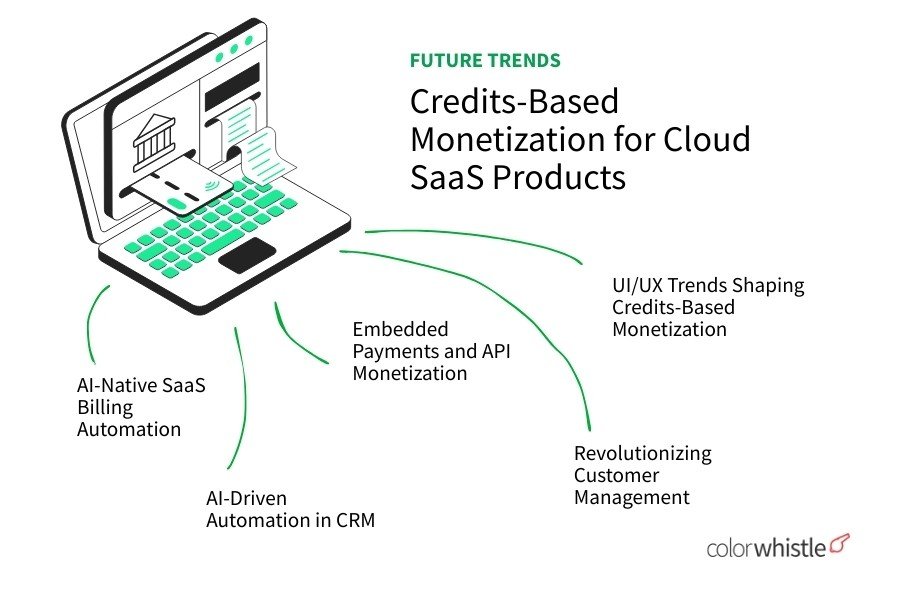
The shift toward usage-based pricing models continues to accelerate as enterprise buyers demand greater cost transparency and alignment between their spending and actual resource consumption. Recent market research indicates that over 60% of SaaS buyers prefer usage-based pricing over traditional seat-based models, particularly for compute-intensive applications where workload patterns vary significantly across time periods and business cycles.
1. AI-Native SaaS Billing Automation
AI-native SaaS billing automation represents the next frontier in credits-based monetization. Machine learning platforms, generative AI tools, and computer vision services require sophisticated billing systems capable of processing millions of micro-transactions per hour. These systems must calculate costs across multiple dimensions simultaneously:
- GPU compute time with variable instance types
- Model inference requests and token consumption
- Training job duration and resource allocation
- Data processing pipeline execution costs
Real-time billing automation tied directly to infrastructure costs enables providers to maintain healthy margins while offering competitive pricing. Advanced platforms now support dynamic credit pricing that adjusts based on underlying cloud provider costs, spot instance availability, and regional data center pricing variations.
2. Embedded Payments and API Monetization
The expansion of embedded payments and API monetization through credits extends beyond traditional SaaS boundaries. Vertical-specific platforms increasingly embed credit-based billing into their core workflows, allowing customers to consume third-party services without leaving their primary application environment. Healthcare platforms meter diagnostic algorithm executions, financial services platforms charge per risk calculation, and manufacturing systems bill for simulation runs, all using unified credit frameworks.
API-first architectures facilitate this expansion by enabling seamless credit deductions across service boundaries. Developers can now build composite applications that aggregate compute resources from multiple providers, with credits serving as the universal currency for cross-platform resource consumption. This interoperability drives new business models where credits purchased from one provider can be applied to partner services within an ecosystem.
3. UI/UX Trends Shaping Credits-Based Monetization
In addition to these trends, the latest UI/UX trends in automotive websites are also shaping how credits-based monetization is implemented in various sectors including automotive. These modern design elements not only enhance user experience but also improve website performance which is crucial for any online service including those utilizing a credits-based system.
4. AI-Driven Automation in CRM Revolutionizing Customer Management
Furthermore, the integration of AI-driven automation in CRM such as that provided by GoHighLevel is revolutionizing customer management. This transformation boosts efficiency and scales businesses with smart workflows, making it easier for companies to manage their resources and spending in line with the credits-based monetization model.
Conclusion
The evolution of cloud SaaS markets demands pricing models that reflect actual resource consumption while maintaining predictable revenue streams. Credits and subscription hybrid approaches represent the optimal solution for compute-intensive platforms, enabling providers to align billing with infrastructure costs while offering customers transparent, flexible pricing.
Organizations implementing credit-based monetization gain significant competitive advantages:
Accurate cost attribution that maps directly to CPU hours, GPU minutes, and storage consumption
Scalable infrastructure that grows seamlessly with customer usage patterns
Enhanced customer trust through transparent metering and real-time balance visibility
Reduced churn by eliminating the friction of rigid subscription tiers
The credits subscription synergy summary reveals a clear path forward: successful SaaS providers must embrace usage-based components within their pricing architecture. This approach proves particularly vital for AI-driven platforms, HPC applications, and DevOps tools where compute demands fluctuate significantly.
Adopting credit-based monetization isn’t merely a billing decision, it represents a strategic imperative for staying competitive. As buyers increasingly expect consumption-based pricing, providers who delay implementation risk losing market share to more agile competitors. The scalable SaaS pricing future outlook points unequivocally toward hybrid models that combine subscription predictability with usage-based flexibility, positioning forward-thinking organizations for sustained growth in dynamic cloud markets.
FAQs (Frequently Asked Questions)
What is credits-based monetization in cloud SaaS and why is it important?
Credits-based monetization in cloud SaaS refers to using credits as flexible currency units that represent compute resources such as CPU hours, GPU minutes, or API calls. This model allows for granular tracking and billing of resource consumption, enabling scalable usage billing and aligning customer costs directly with actual resource use. It is particularly relevant for compute-intensive SaaS products and supports hybrid pricing models combining subscriptions with usage-based charges.
How does a scalable credits system work in managing cloud compute resources?
A scalable credits system maps infrastructure cost drivers like CPU, RAM, storage, and bandwidth to credit units. It incorporates resource throttling based on credit balances to control usage and employs real-time granular metering to track consumption accurately. This ensures efficient allocation of compute resources while providing transparency and control over costs in a cloud SaaS environment.
What role do DevOps tools and monitoring platforms play in credits-based billing for SaaS?
DevOps tools such as Kubernetes facilitate efficient resource allocation by balancing on-demand versus scheduled compute billing approaches. Monitoring platforms like Prometheus and Datadog integrate with billing systems to provide accurate real-time usage data through APIs. This integration automates billing workflows, enhances metering precision, and supports dynamic pricing strategies essential for compute-intensive SaaS applications.
What are effective pricing strategies for compute usage in SaaS products using credits?
Effective pricing strategies include dynamic models like tiered rates and volume discounts that incentivize higher usage while managing costs. Incorporating free quotas allows customers to trial services before incurring charges, while overage fees ensure fair compensation beyond allocated credits. These strategies balance customer flexibility with predictable revenue streams in a hybrid subscription and credit-based monetization framework.
What challenges do cloud SaaS providers face when implementing credit-based billing systems?
Providers encounter technical challenges such as accurately tracking and reporting precise usage metrics, implementing complex billing logic, and ensuring seamless integration with CRM and accounting systems. Additionally, maintaining pricing transparency and clear communication in invoicing is critical to building customer trust. Addressing these challenges requires robust infrastructure and thoughtful design of the credit system.
How do regulatory compliance and audit requirements impact credit-based metering in cloud SaaS billing?
Compliance with financial regulations mandates maintaining detailed audit trails for metered billing to support enterprise spend forecasting and accountability. Providers must also address privacy and data security concerns during usage tracking to protect customer information. Adhering to metering standards ensures legal compliance, fosters customer confidence, and mitigates risks associated with cloud SaaS billing operations.
 Best SaaS Credits System Guide and How Tech B...