


Astro vs Next.js: Which Should You Choose for Performance-First Web Apps?

Phurvishaa specializes in crafting travel tech and marketing content, leveraging deep research, SEO expertise, and AI-driven insights. Her strategic approach ensures content that educates, engages and delivers knowledge.

Our authors are proven experts in their fields, writing on topics where they have demonstrated expertise. Every piece of content undergoes peer review and validation by industry professionals.
AI Summary
Key Highlights of Astro vs Next.js for Web Performance
This post explores the critical differences between Astro and Next.js to help business owners choose the right framework for their website’s performance needs. The key insight: Astro excels at delivering ultra-fast, SEO-optimized static content sites, while Next.js is ideal for complex, data-driven applications requiring dynamic interactivity and server-side rendering. It serves content-heavy businesses prioritizing speed and SEO, and data-heavy businesses needing robust backend integration. Readers will learn which framework aligns with their goals, reducing maintenance overhead and enhancing growth potential through AI-assisted development or optimized content delivery.
Think of building your website like setting up a physical office space.
Next.js is like leasing a full corporate floor conference rooms, server rooms, reception, the works. Powerful, scalable, ready for anything. Astro is like a sharp co-working space built exactly for the work you do fast to set up, nothing wasted, everything optimized for output.
Both are professional. Both get the job done. But choosing the wrong one for your business is like renting that corporate floor when all you need is a quiet desk and fast Wi-Fi.
So, before you let a developer make this call for you, here’s what you as a business owner actually need to know.
TL; DR
- Astro vs Next.js — two frameworks, two very different business fits.
- Data-heavy business? (portals, dashboards, fintech) → Next.js wins.
- Content-heavy business? (education, coaching, blogs) → Astro wins.
- Your business needs to pick the framework. Not the other way around.
A Quick Lay of the Land: What are Astro and Next.js?
Astro and Next.js are both modern JavaScript frameworks used to build fast, production-grade websites. But they were designed with fundamentally different goals in mind.
Astro, launched in 2021, was built with one obsession: deliver content as fast as humanly possible. It does this through what’s called “Islands Architecture” pages are served as pure HTML with zero JavaScript by default, and only the interactive parts of a page (think a search bar or a pricing toggle) load any JavaScript at all.
Next.js, maintained by Vercel since 2016, is a full stack React framework. It supports multiple rendering modes of static, server-side, and hybrid, making it the go-to choice for complex applications that need dynamic data, user-specific content, or API integrations at scale.
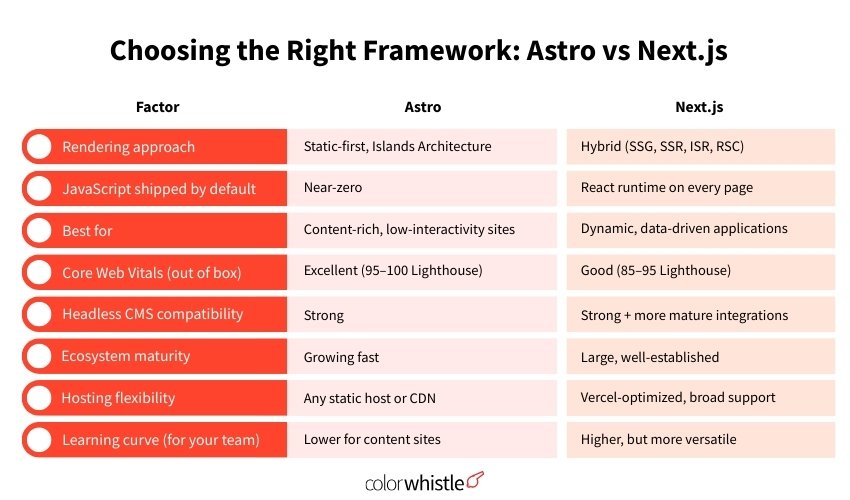
Here’s how they compare at a glance:
| Factor | Astro | Next.js |
|---|---|---|
| Rendering approach | Static-first, Islands Architecture | Hybrid (SSG, SSR, ISR, RSC) |
| JavaScript shipped by default | Near-zero | React runtime on every page |
| Best for | Content-rich, low-interactivity sites | Dynamic, data-driven applications |
| Core Web Vitals (out of box) | Excellent (95–100 Lighthouse) | Good (85–95 Lighthouse) |
| Headless CMS compatibility | Strong | Strong + more mature integrations |
| Ecosystem maturity | Growing fast | Large, well-established |
| Hosting flexibility | Any static host or CDN | Vercel-optimized, broad support |
| Learning curve (for your team) | Lower for content sites | Higher, but more versatile |
The Two Scenarios – Setting the Stage
To make this real, let’s walk through two business environments that represent a large slice of the web today.
Scenario A: A data-heavy business: think a real estate listings portal, a financial comparison tool, or a healthcare provider directory. High in structured, dynamic data. Users come to search, filter, compare, and act. The site needs to handle real-time queries, user-specific results, and frequent data updates.
Scenario B: A content and education-heavy business: think an online learning platform, a coaching or consulting brand, or a professional services firm with a content marketing engine. High in long-form written content. Users come to read, learn, and trust. The site needs to rank well on search, load fast, and publish new content frequently.
These two are not just different businesses. They have genuinely different performance needs, and that difference is exactly where the Astro vs Next.js decision lives.
Scenario A – The Data-Heavy Business
What This Business Needs from a Web Stack
A real estate portal or financial comparison site lives and dies by data freshness and interactivity. Users expect filters that respond instantly, listings that update daily, personalized results, and dashboards that reflect live information. A slow or stale experience here doesn’t just frustrate — it kills trust.
This business needs a framework that can handle server-side rendering, API integrations, authentication, and dynamic routing without breaking a sweat.
Why Next.js Fits Here
Next.js was built for exactly this complexity. Its hybrid rendering model means individual pages can be server-rendered, statically pre-generated, or incrementally regenerated sometimes all three within the same application. The App Router and React Server Components allow data-heavy pages to be rendered on the server before they reach the user, reducing the client-side load while still delivering dynamic, up-to-date content.
Built-in API routes mean your backend logic lives within the same codebase. User authentication, session management, and role-based access control all have mature solutions within the Next.js ecosystem.
Did You Know?
As of 2025, over 17,900 verified companies globally use Next.js, making it the most used meta-framework on the web today. For businesses, that means a deep talent pool, strong long-term support, and a framework built to scale.
Performance in This Context
For dynamic, data-driven sites, Next.js holds its own. Lighthouse scores in the 85–95 range are achievable with proper optimization. Incremental Static Regeneration (ISR) allows frequently accessed pages like popular property listings or top financial products to be pre-rendered and served at CDN speed, while still refreshing on a schedule.
The performance gap with Astro narrows significantly when the site requires interactivity. Astro’s advantage shrinks once JavaScript is needed anyway and for this business, it always is.
Hosting and Infrastructure
Next.js deployments are most powerful on Vercel, which offers edge functions, draft mode, and ISR natively. It also runs well on AWS, Netlify, and containerized environments. Expect moderate ongoing server to compute costs that scale with traffic a manageable trade-off for the dynamic capabilities you’re getting.
Maintenance Reality
Next.js codebases are React-based, which means a wide talent pool and long-term maintainability. Updates from Vercel are regular and well-documented. For a business expecting to evolve features, add user-facing tools, or integrate with third-party data providers over time, Next.js is a stable long-term bet.
Marketing and Growth Implications
SEO is achievable with Next.js, especially with server-side rendering ensuring that search crawlers receive fully formed HTML. Structured data, dynamic metadata, and Open Graph tags are all well-supported. For a listings-based business, this matters each listing page is a potential organic landing page, and Next.js handles this at scale through dynamic routing.
Futureproofing: The Agentic Development Advantage
This is where Next.js paired with a headless CMS becomes particularly compelling for forward-thinking businesses.
Headless CMS platforms like Contentful, Sanity, or Strapi expose content through clean APIs. Next.js, being API-first and component-driven, is structured in a way that modern AI development tools Cursor, GitHub Copilot, v0 by Vercel can read, understand, and build efficiently.
What this means practically: when your development team uses AI-assisted coding workflows, a well-structured Next.js + headless CMS codebase allows those tools to scaffold new features, generate new page templates, and automate repetitive build tasks far more effectively than a loosely structured codebase. The modularity that makes Next.js maintainable today is the same modularity that makes it agent-friendly tomorrow.
If you’re planning to scale your web presence with AI-assisted development workflows or anticipate integrating intelligent features down the line Next.js development with a headless CMS architecture positions your business for that future without requiring a rebuild.
Also Read
Scenario B – The Content and Education-Heavy Business
What This Business Needs from a Web Stack
An online learning platform or coaching brand lives on trust, discoverability, and reading experience. Users arrive from search engines, read long-form content, explore course pages, and eventually convert, but that journey is slow-burning and SEO-dependent.
The technical priority here is different: pages need to load instantly, rank well in search, and support a publishing team that produces content regularly without needing a developer for every update.
Why Astro Fits Here
Astro’s fundamental design ship HTML, skip the JavaScript unless absolutely necessary maps perfectly to this use case. Every course page, blog post, and resource article is pre-rendered as clean, lightweight HTML. Search for crawlers to index it without hesitation. Users on slow mobile connections get the content immediately.
Astro’s native Markdown and MDX support means content teams can write and publish directly without touching code. Its framework-agnostic nature means interactive elements (an embedded quiz, a course of progress widget) can be built in React or Vue and loaded only on the pages that need them.
Performance in This Context
The numbers are meaningful here. Astro delivers up to 40% faster load times and ships 90% less JavaScript compared to Next.js for static content sites, and Astro consistently scores between 95–100 on Lighthouse for content sites, compared to 85–95 for Next.js. For a business where organic search is the primary acquisition channel, this performance difference translates directly into better rankings and lower bounce rates.
On mobile, where the majority of educational content is consumed, the gap widens further. On slow network simulations, Astro’s performance score stays above 95, while Next.js drops to around 75.
Hosting and Infrastructure
Astro sites are static by default, which means they can be hosted on any CDN Cloudflare Pages, Netlify, Vercel, GitHub Pages at very low cost. There is no server compute cost per request. For a content business scaling hundreds of thousands of monthly visitors, this is a meaningful operational advantage.
Maintenance Reality
Content sites built in Astro are simple to maintain. The codebase is lean, and with headless CMS integration, most day-to-day updates don’t require developer involvement at all. A content manager can add a new course module, publish a blog post, or update a landing page through the CMS, and the site rebuilds automatically.
Marketing and Growth Implications
For a content-heavy business, Astro is an SEO-native choice. Clean HTML output, fast Core Web Vitals, and full support for structured data mean search engines have everything they need to rank and index pages effectively. 60% of Astro sites pass Core Web Vitals, compared to 38% for WordPress or Gatsby sites, a significant edge in competitive content niches.
Frequent publishing is also structurally supported. As content volume grows, Astro’s build process handles large sites efficiently, making it a sustainable platform for a business that treats content as a long-term growth channel.
Astro vs Next.js: Head-to-Head Comparison -When to Pick Which
| Business Decision | Choose Astro | Choose Next.js |
|---|---|---|
| Content update frequency | Frequent (daily publishing) | Real-time or user-generated |
| Dynamic data needs | Low to moderate | High (live data, user sessions) |
| Primary SEO priority | Organic content, blog-driven | Listing pages, dynamic routes |
| Team / agency maintenance | Small team, CMS-driven | Developer-maintained, scalable |
| Hosting budget sensitivity | Cost-sensitive, high traffic | Willing to pay for server compute |
| Interactive features needed | Minimal (forms, toggles) | High (dashboards, filters, auth) |
| AI / agentic dev plans | Not a current priority | Planning AI-assisted workflows |
| Long-term scalability | Content volume growth | Feature and product growth |
So, Which One Is Right for Your Business?
Here’s the honest answer: it depends on what your website is fundamentally doing.
If your website’s primary job is to attract, educate, and build trust through content, courses, thought leadership, or organic search, Astro is very likely to be your better foundation. It was designed for this. The performance advantages are real, the maintenance overhead is low, and the SEO benefits are built in, not bolted on.
If your website’s primary job is to process, personalize, and deliver dynamic experiences, filter data, manage users, integrate live feeds, or power a portal, Next.js is the more capable and future-proof choice. The ecosystem is mature, the developer’s talent pool is large, and the architecture supports the kind of growth and complexity that data-heavy businesses eventually need.
And if you’re building something that lives between both worlds say, a content-led brand that also has a client portal or a dashboard the answer is often Next.js as the core, with Astro-inspired performance principles baked in through server components, smart caching, and a headless CMS layer.
The framework shouldn’t drive the business decision. The business need should drive the framework decision.
Let’s Build It Right
Choosing between Astro and Next.js is only the first decision. How the framework is architected, what CMS it’s paired with, how it’s deployed, and how it evolves with your business, that’s where the real performance gains are won or lost.
At ColorWhistle, we help businesses navigate exactly this. Whether you’re starting fresh, migrating from a slow legacy stack, or planning a web presence built for both performance and long-term growth, we bring the technical depth to match the right architecture to your specific goals.
Explore our Web App Development Services and discover the right solution for your business. Get in touch with ColorWhistle and let’s build something that works for you.
 Is Headless CMS Right for Your Business - K...