


Cold Email Statistics That Changed How We Build Campaigns

Phurvishaa specializes in crafting travel tech and marketing content, leveraging deep research, SEO expertise, and AI-driven insights. Her strategic approach ensures content that educates, engages and delivers knowledge.

Our authors are proven experts in their fields, writing on topics where they have demonstrated expertise. Every piece of content undergoes peer review and validation by industry professionals.
AI Summary
Key Highlights of Cold Email Statistics Changing Campaigns
This post explores 2026 cold email statistics transforming campaign strategies. The key insight: open rates are misleading due to Apple Mail's privacy features; reply rates better measure success. It reveals average reply rates at 3.43%, with top performers exceeding 15% through precise targeting and genuine personalization. The article emphasizes follow-up persistence, noting nearly half of replies come after the first email, and highlights deliverability as foundational, with mandatory authentication crucial for inbox placement. Marketers learn to send fewer, well-targeted emails with strong personalization and follow-up sequences, optimizing pipeline impact and campaign effectiveness.
Cold email still works. But the version of it that worked in 2019 with high volume, low personalization, fingers crossed on deliverability is quietly dying. The statistics coming out of 2026 are forcing a rethink of some of the most held assumptions about how cold email campaigns should be built. Here’s what the data actually says and what it changes.
TL; DR
A data-backed look at what cold email benchmarks in 2025–2026 actually reveal covering why open rate is the wrong metric to chase, what reply to rates top performers are hitting, how personalization is being underused despite clear evidence it works, where most campaigns give up too early, and why deliverability has become the foundation everything else sits on.
This blog is for: SDRs, sales managers, growth marketers, and B2B agencies building or auditing cold email campaigns and outbound sequences.
- Why open rate is an unreliable metric in 2026 and what to track instead
- What average, good, and excellent reply to rates look like by industry
- How personalization drives 2–3x better results yet only 5% of senders do it properly
- Why 42% of all possible replies are abandoned by teams that don’t follow up
- How SPF, DKIM, and DMARC went from best practice to non-negotiable infrastructure
Open Rate Is the Wrong Metric to Optimize For
Most cold email dashboards lead to open rates. Most cold email advice centers on subject line optimization for opens. And most of it is now misleading you.
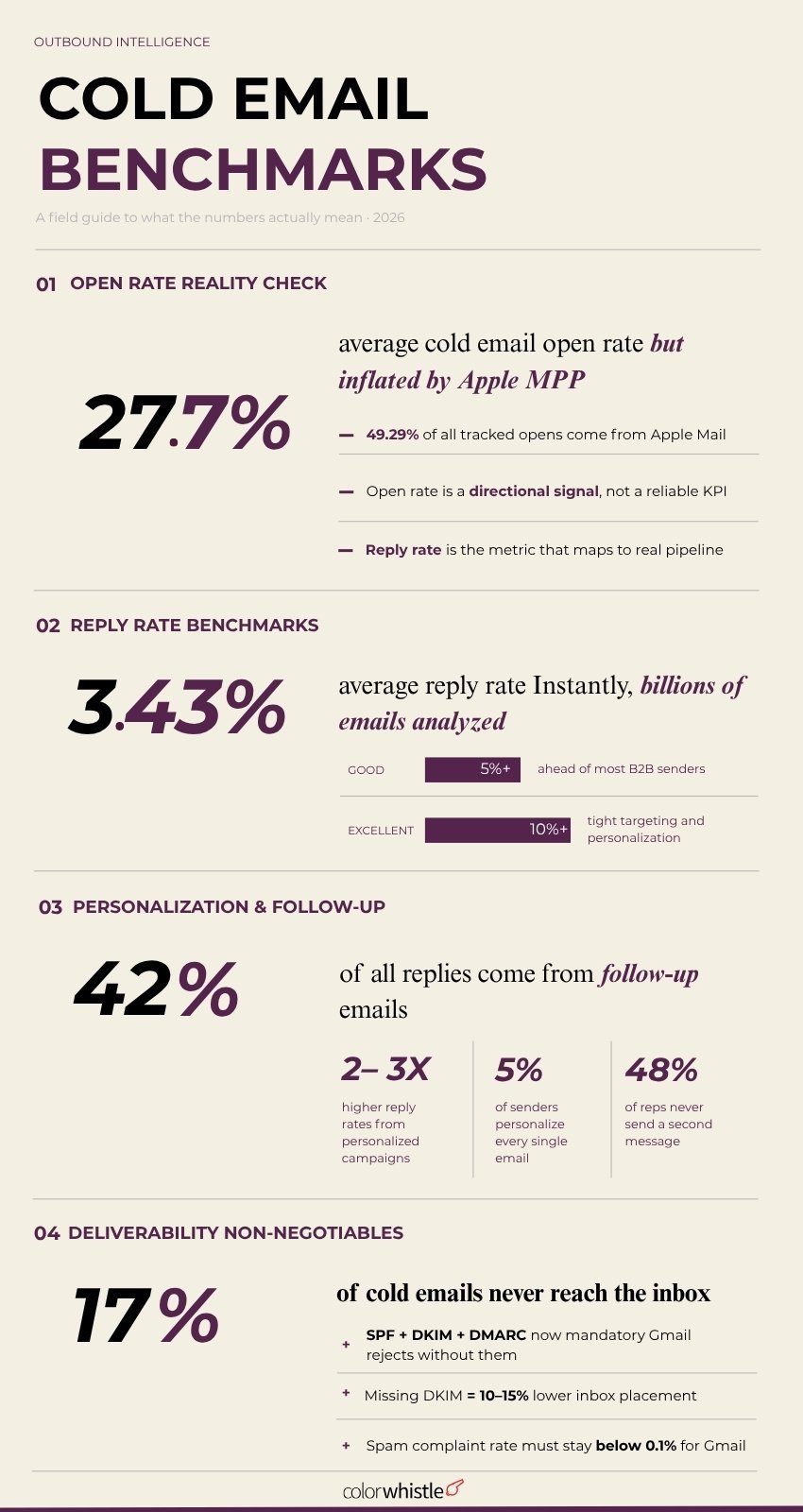
The average B2B cold email open rate in 2026 sits at 27.7% ut that number is significantly inflated by Apple Mail Privacy Protection (MPP), which pre-loads tracking pixels automatically for Apple Mail users. Apple Mail accounts for 49.29% of all tracked email opens, which means a large share of your “opens” are phantom opens triggered by Apple’s servers, not actual human eyes on your email.
What to track instead: Reply rate. It’s the only metric that requires a human to read and respond to your email, and it’s the one that maps directly to the pipeline.
Reply Rate Benchmarks: What Good Actually Looks Like
The honest numbers on cold email reply to rates in 2026 are sobering and clarifying:
- Average reply rate: 3.43% across billions of emails analyzed (Source: Instantly Benchmark Report 2026)
- Good: above 5% puts you ahead of the majority of B2B senders
- Excellent: 10%+ achievable with tight ICP targeting, genuine personalization, and strong deliverability
- Top performers: 15–25% typically narrow niches, intent signals, and pristine sender reputation
The gap between average and top performers isn’t copywriting. It’s the difference between emailing someone with no context and emailing someone who visited your pricing page yesterday, recently posted about a problem you solve, or just moved into a new role with a fresh budget.
Industry also matters more than most teams account for. Legal services lead all categories with up to a 10% reply rate, while SaaS and software the most common cold email senders sit at the bottom, often under 2%. (Source: Cleverly)
Did you know?
Smaller, highly targeted campaigns of 50 recipients or fewer average a 5.8% response rate, compared to just 2.1% for larger broadcast lists which means sending less to the right people consistently outperforms sending more to everyone.
(Source: Mailforge)
Personalization: The Gap Between Knowing and Doing
Everyone knows how personalization works. Almost nobody does it properly.
- Campaigns with genuine personalization beyond first name and company achieve reply to rates 2–3x higher than generic templates (Source: Woodpecker)
- Personalized subject lines achieve a 20.79% open rate vs 14.96% for generic ones (Source: Snov.io)
- Emails tailored to recipients see a 32% higher response rate, while customized subject lines improve open rates by 50% (Source: Mailforge)
- Only 5% of cold email senders personalize every message (Source: Woodpecker)
That last figure is the opportunity. With AI-generated outreach flooding inboxes in 2026, prospects have gotten very good at distinguishing a real research-backed email from a merged template. The emails that get replies are the ones that reference something genuinely specific a post the prospect wrote, a product launch they made, a challenge specific to their role or industry not just their first name dropped into an otherwise identical message.
Personalization also helps deliverability. Unique copy across a campaign reduces the likelihood of identical messages triggering spam filters, which means it improves both engagement and inbox placement at the same time.
The practical guideline from Woodpecker’s analysis of 20M+ emails: 3 custom snippets per email, drawing on something genuinely specific and publicly available. (Source: Woodpecker)
Also Read
Follow-Up Is Where Most Campaigns Give Up Too Early
The single most common cold email mistake in 2026 isn’t a bad subject line. It stopped after one message.
- 58% of all replies come from the first email in a sequence (Source: Instantly)
- The remaining 42% of replies come from follow-ups meaning nearly half of all possible responses are abandoned by teams that don’t follow up (Source: Instantly)
- 48% of sales reps never send a second email, despite follow-ups generating nearly half of total campaign replies (Source: Martal)
- 60% of prospects respond only after the second follow-up the first follow-up alone is rarely enough (Source: Woodpecker)
- The optimal sequence length is 4–7 touchpoints, spaced 3–5 days apart and widening as the sequence progresses (Source: Instantly)
- “Break-up” emails a final message acknowledging you won’t follow up again generate a 33% response rate due to FOMO (Source: HubSpot via ApolloTechnical)
The best follow-up emails don’t read like reminders they feel like natural continuations of a conversation. Instantly’s 2026 benchmark report notes that Step 2 emails framed as replies rather than new messages outperform formal follow-ups by roughly 30%.
Timing benchmarks: Tuesday through Thursday consistently see the highest reply to rates, with Wednesday peaking. Morning sends between 8 AM and noon outperform all other time slots in 2026. A reversal from prior years when evening sends dominated, likely because AI-assisted inbox filtering now deprioritizes evening messages before recipients see them.
Deliverability: The Foundation Everything Else Sits On
You can have perfect copy, tight personalization, and a well-structured sequence and still fail if your emails aren’t reaching inboxes. Deliverability has become the most consequential variable in cold email performance in 2026.
- Google and Yahoo enforced mandatory bulk sender authentication requirements in February 2024
- Microsoft followed with equivalent enforcement in May 2025
- Gmail outright rejects unauthenticated mail at the SMTP level as of November 2025
What this means in practice: SPF, DKIM, and DMARC are no longer optional. They’re infrastructure requirements. Missing DKIM alone costs 10–15% lower inbox placement. Properly configuring all three reduces spam flags by 50%. (Source: TrulyInbox, ApolloTechnical)
Additional deliverability benchmarks worth knowing:
- Around 17% of cold emails never reach the inbox, often from poor domain authentication, high bounce rates, or spam-triggering language (Source: Martal)
- Spam complaint rates must stay below 0.1% for Gmail not the commonly cited 0.3% (Source: Instantly)
- Bounce rates should stay below 2% exceeding this triggers sender reputation damage that compounds across future sends
- New sending domains should start at 5–10 emails per day, ramping gradually over 4–6 weeks (Source: Instantly)
- Sending from your primary business domain for cold outreach risks your company’s entire email sender reputation a dedicated secondary domain is now standard practice
Did you know?
Google reported 265 billion fewer unauthenticated messages after enforcing authentication requirements which means the inbox is genuinely cleaner for authenticated senders, and the competition for attention among properly set-up campaigns is lower than it’s been in years.
(Source: TrulyInbox)
What the Data Points To
Across all five areas open rates, reply rates, personalization, follow-ups, and deliverability the same pattern keeps appearing: the gap between average campaigns and top-performing ones is widening. AI has made it easy to send a lot of mediocre emails fast. The teams winning in 2026 are doing the opposite, sending fewer, better emails to more precisely targeted people, on properly authenticated domains, with follow-up sequences that don’t give up too early.
The benchmarks are the map. The work is in execution.
If you’re building outbound infrastructure for your B2B business or thinking through how your website and digital presence supports the leads your cold email generates web design and development services and see what a properly built B2B website costs to build.
Want to talk about how your outbound stack and digital presence work together? Get in touch with ColorWhistle.
FAQ’s
What is a good cold email reply rate in 2026?
The average reply rate across cold email campaigns sits at 3.43% in 2026 a reply rate above 5% puts you ahead of most B2B senders, 10%+ is considered excellent, and top-quartile performers in narrow niches with strong personalization and deliverability can reach 15–25%.
Why is cold email open rate unreliable as a metric in 2026?
Apple Mail Privacy Protection pre-loads tracking pixels automatically for Apple Mail users, who account for nearly half of all tracked email opens meaning a significant share of reported opens are phantom opens triggered by Apple’s servers, not actual human engagement with your email.
How much does personalization actually affect cold email performance?
Campaigns with genuine personalization beyond first name and company achieve reply rates 2–3x higher than generic templates, and personalized subject lines get a 20.79% open rate compared to 14.96% for generic ones yet only 5% of cold email senders personalize every message.
 Our Outbound Automation Stack: Sales Navigato...