


AI Was Tested for Prospecting. Here’s What Worked and What Didn’t

Phurvishaa specializes in crafting travel tech and marketing content, leveraging deep research, SEO expertise, and AI-driven insights. Her strategic approach ensures content that educates, engages and delivers knowledge.

Our authors are proven experts in their fields, writing on topics where they have demonstrated expertise. Every piece of content undergoes peer review and validation by industry professionals.
AI Summary
AI Was Tested for Prospecting. Here's What Worked and What Didn't
This post explores the real-world effectiveness of AI in sales prospecting workflows, revealing what genuinely works and what falls short. The key insight: AI excels as a time-saving multiplier but cannot fully replace human judgment. It tested AI-generated prospect lists, email personalization, and research automation, finding lists useful as drafts needing human review, personalization effective only for narrow segments, and research automation a clear win. The article advises maintaining human checkpoints to preserve quality and cautions against relying solely on volume. It serves sales teams aiming to integrate AI wisely for faster, scalable, yet high-quality outbound prospecting.
AI prospecting tools have been aggressively marketed to sales teams for the past two years. The pitch is consistent: automate your list building, personalize at scale, cut research time by 80%, close more pipeline with less effort. It sounds compelling. And some of them are true.
But some of it isn’t, and the gap between what AI prospecting promises and what it delivers in a real workflow is wide enough to trip up teams that adopt it without thinking carefully about where it fits and where it doesn’t.
This is an honest account of what happened when AI was put to work across different parts of a prospecting workflow what held up, what fell apart, and what the experience changed about how outbound gets built.
TL; DR
An honest, experience-based look at what actually happened when AI was put to work across a B2B prospecting workflow covering where it saved real time, where it fell short of the promise, and what it changed about how outbound gets built.
This blog is for: SDRs, sales managers, RevOps leads, and B2B teams evaluating where AI fits and where it doesn’t in their outbound prospecting workflow.
- Why AI-generated prospect lists are a useful first draft but not a finished deliverable
- Where AI personalization works well and where human judgment still wins
- Why research automation was the clearest, least complicated win of the whole test
- What the non-negotiable human review checkpoints are and why skipping them costs you
- The honest lessons that changed how the workflow gets built going forward
The Starting Point: Why AI Got Brought In
The decision to test AI across the prospecting workflow wasn’t strategic. It was reactive.
The list building was slow. Research was eating hours that should have been spent on conversations. Personalization was being skipped not because no one valued it, but because doing it properly at scale was taking too long. The math wasn’t working: the time required to build a quality list, research each prospect, and write a genuinely personalized first line was incompatible with the volume needed to generate consistent pipeline.
AI seemed like the obvious lever to pull. The tools existed, the use cases were documented, and the upside if even half of it was real would meaningfully change the economics of outbound. So, it got tested, methodically, across each stage of the workflow.
AI-Generated Prospect Lists: Useful Starting Point, not a Finished Product
The first test was a list of generations. Could AI build a prospect list that matched a defined ICP without a human spending hour in Sales Navigator manually filtering and reviewing? The short answer: partially.
AI tools that pull from structured data sources company databases, LinkedIn data, firmographic filters can generate a list that looks right at a surface level. The job titles match. The company sizes fit the criteria. The industries are correct. Hand this list to someone who hasn’t seen it before, and it looks like solid prospecting work.
Look closer and the problems appear. Outdated roles contacts who’ve moved companies since the data was last refreshed. Mis-categorized companies with a consultancy appearing in a SaaS filter because their LinkedIn description mentioned software. Contacts at the right companies but the wrong level of seniority. Edge cases that a human would catch immediately, but that an algorithm doesn’t have the judgment to flag.
The conclusion from this test: AI-generated lists are a useful first draft, not a deliverable. They cut the time to an initial list significantly, but they require a human review pass before anything gets added to a sequence. Skipping that review and running the list straight into outreach is where teams get burned: bounces, irrelevant contacts, and the reputation damage that comes from emailing people who have nothing to do with your ICP.
The workflow that emerged: AI builds the list, a human reviews and cleans it, then it goes into outreach. The time saving is real it’s just at the list-building stage, not the review stage.
Also Read
AI-Generated Email Personalization: Where the Gap Is Widest
This was the test with the highest expectations and the most complicated results.
The promise of AI personalization is that it reads a prospect’s LinkedIn profile, recent posts, company news, and role history and generates a first line that feels genuinely specific to them. At its best, it’s supposed to replicate what a skilled SDR does when they spend ten minutes researching a prospect before writing.
What it actually produces, most of the time, is something that references the right surface-level details without capturing anything genuinely insightful. It mentions that someone recently posted a topic. It notes that their company recently raised funding. It observes that they’ve been in their role for eight months. All accurate. None of them are particularly compelling.
The issue isn’t that the AI gets the facts wrong. It’s that it doesn’t know which facts matter. A skilled human researcher reads a prospect’s LinkedIn activity and picks the one detail that’s genuinely relevant to the outreach not the most recent thing, but the most resonant thing. AI, in its current form, optimizes recency and availability, not relevance.
Did you know?
Only 5% of cold email senders personalize every message, yet campaigns with genuine, research-backed personalization achieve reply rates 2–3x higher than generic templates. The opportunity is real; the execution is where most teams fall short.
Where AI personalization did work well: high-volume sequences targeting a narrow, well-defined segment where the relevant hook was consistent across contacts. If every prospect in a list had recently done the same thing posted about the same topic, worked at a company in a specific funding stage, hired for a specific role AI could generate a first line that felt specific without requiring individual research. The narrower the segment, the better the output.
Where it didn’t work, senior decision-makers, complex sales, and any situation where the relevant hook required genuine judgment about what would resonate with a specific person rather than a category of people.
The workflow that emerged: AI handles first-line drafts for high-volume, narrow-segment sequences. A human writes or rewrites first lines for high-value, senior, or complex targets. The line between the two gets drawn based on deal size and seniority, not convenience.
Research Automation: The Clearest Win
Of all the stages tested, research automation produced the clearest, least complicated result: it works, and it saves significant time.
Using AI to pull together a pre-call or pre-email summary of a prospect recent company news, funding history, hiring trends, leadership changes, relevant content they’ve published is genuinely faster and more consistent than doing it manually. The output isn’t always perfectly organized, but the raw information is accurate, comprehensive, and takes a fraction of the time.
This held up across different types of research: account-level research before a sales call, contact-level research before writing a sequence, and signal monitoring tracking job changes, funding announcements, and hiring spikes across a saved list of target accounts.
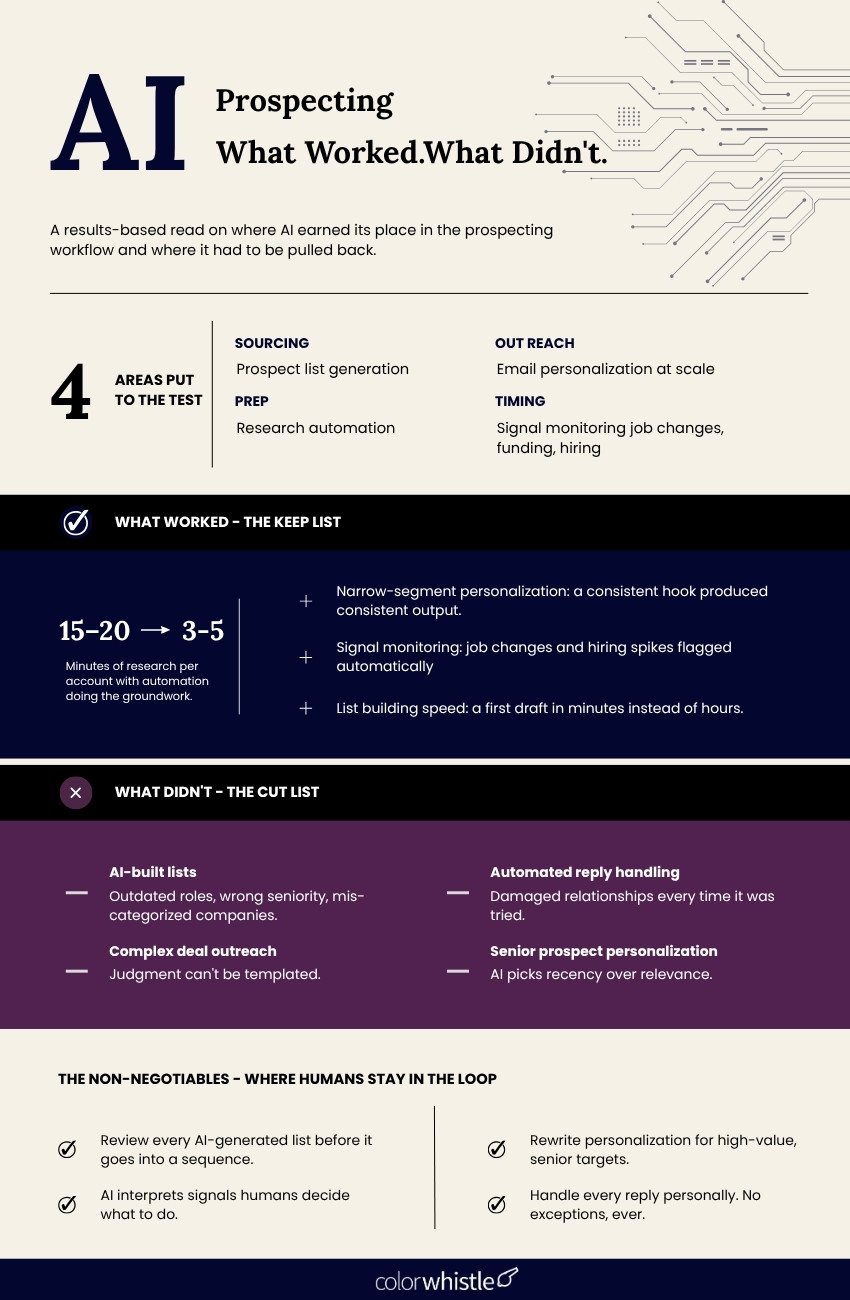
The practical impact: the research that used to take 15–20 minutes per account came down to 3–5 minutes, with the AI handling the information gathering and a human handling the interpretation deciding which signals were worth acting on and how.
That division AI gathers; human interprets turned out to be the most consistently effective pattern across all the tests. It showed up in list building, personalization, and most clearly in research.
Human Review Checkpoints: The Part That Can’t Be Automated
Every stage of the workflow that went through AI produced better results when a human reviewed the output before it moved forward. This wasn’t a surprise in theory. In practice, it was easy to skip under time pressure and every time it got skipped, something went wrong.
The checkpoints that matter most:
List review before outreach catching outdated contacts, wrong seniority, or ICP mismatches before they become bounced or irrelevant sends.
Personalization review before sending reading AI-generated first lines for the ones that are technically accurate but tonally off, factually wrong, or just don’t say anything interesting.
Signal interpretation before acting deciding which of the job changes, funding rounds, and hiring spikes flagged by research automation are actually worth building a sequence around, versus noise.
Reply handling, always the moment a prospect responds, AI exits the workflow entirely. Every reply gets handled by a human. This is non-negotiable, and every team that has tried to automate reply handling has either damaged relationships or missed opportunities that required judgment to recognize.
The checkpoints add time back into the workflow. But they’re not undoing the efficiency gains; they’re the quality control layer that makes the efficiency gains usable.
Did you know?
2 in 3 B2B marketers now use generative AI as part of their LinkedIn outreach workflow up 20% year-over-year with the most effective teams using AI for research and drafting while humans manage the actual conversations.
Lessons Learned
A few things that changed after running AI across the prospecting workflow for a sustained period:
AI is a multiplier, not a replacement. Every stage where it produced good results was a stage where a skilled human was still in the loop. Where results were poor, a human had been removed from the process to save time.
The tools move faster than the advice about them. What was true about a specific AI prospecting tool six months ago may not be true today. The space is changing fast enough that any specific tool recommendation ages poorly the principles about where AI fits and where it doesn’t age better.
Volume is not the goal. The easiest thing AI does for prospecting is to increase volume. The hardest thing and most important is maintaining quality at that volume. Teams that adopt AI to send more emails without maintaining quality standards end up with more noise in the market and worse results than before.
Expectation-setting matters. The results from AI-assisted prospecting are better than purely manual outreach in some ways and worse in others. Being honest about that with the team and with clients, if you’re doing this on their behalf, is what prevents disappointment when the tool doesn’t deliver what the vendor promised.
The honest verdict: AI made the prospecting workflow faster, more consistent, and more scalable in specific areas and introduced new failure modes in others. The teams getting the best results from it aren’t the ones who automated the most. They’re the ones who were most deliberate about where the automation stopped, and the human judgment started.
Thinking through how your outbound workflow and digital presence work together? Check out our web design and development services or see what a properly built B2B website costs.
FAQs
Can AI fully automate B2B prospect list building?
Not reliably AI-generated lists are a strong starting point but consistently surface outdated roles, mis-categorized companies, and seniority mismatches that require a human review to pass before anything goes into a sequence. The time saving is real at the list-building stage; the review stage still needs a human.
Does AI-generated email personalization improve reply rates?
It depends on how narrowly the segment is defined as AI personalization works well for high-volume sequences targeting a consistent, narrow ICP where the relevant hook is the same across contacts. For senior decision-makers or complex deals where the right hook requires genuine judgment, human-written personalization consistently outperforms it.
Where should human review checkpoints sit in an AI-assisted prospecting workflow?
At minimum: after list generation, before sequences launch, and at every reply no exceptions on the last one. The moment a prospect responds with genuine interest, AI should exit the workflow entirely, and a human should take over, since reply to handling is where relationships either start or fall apart.
 Cold Email Statistics That Changed How We Bui...