


PropTech Trends & Statistics 2026: How Digital Transformation Is Reshaping Real Estate

Anusha is a digital strategy expert with deep expertise in branding, UI/UX, and performance-focused content. She brings advanced insight into brands to scale intelligently, blending creativity with conversion-focused thinking.

Our authors are proven experts in their fields, writing on topics where they have demonstrated expertise. Every piece of content undergoes peer review and validation by industry professionals.
AI Summary
PropTech Trends & Statistics 2026: How Digital Transformation Is Reshaping Real Estate
This post explores the rapid digital transformation reshaping real estate through Property Technology (PropTech). The key insight: PropTech adoption, including AI, IoT, blockchain, and virtual tours, is driving major efficiency and engagement gains. Real estate firms are leveraging cloud platforms, automation, and immersive tech to enhance customer experience and streamline operations. Market growth projections exceed $100 billion by 2030, with AI-powered tools optimizing property management and investment decisions. Virtual tours and smart buildings are mainstream, while consumer demand shifts toward mobile-first, transparent, and remote transactions. The blog serves real estate professionals seeking to adopt technology to boost efficiency and market responsiveness.
The real estate industry is undergoing one of its biggest technological shifts in history. From AI-powered property recommendations and virtual tours to blockchain transactions and smart buildings, Property Technology (PropTech) is transforming how properties are bought, sold, managed, and experienced.
Digital transformation in real estate is no longer optional. Real estate agencies, developers, investors, and property management companies are increasingly adopting cloud platforms, automation tools, AI-driven analytics, and immersive technologies to improve customer experiences and operational efficiency.
This blog explores the latest Property Tech statistics and trends shaping the future of real estate.
What is PropTech?
PropTech, short for Property Technology, refers to the use of digital technologies and software solutions to improve the real estate ecosystem.
It includes technologies such as:
- Artificial Intelligence (AI)
- Big Data Analytics
- Internet of Things (IoT)
- Virtual Reality (VR)
- Augmented Reality (AR)
- Blockchain
- Cloud-Based Property Management Platforms
- Smart Building Technologies
PropTech solutions help automate workflows, improve decision-making, enhance tenant experiences, and create smarter real estate operations.
Global PropTech Market Statistics
Rapid Growth of the Global PropTech Industry
The global PropTech market continues to expand rapidly as digital adoption accelerates across residential, commercial, and industrial real estate sectors.
Key Statistics
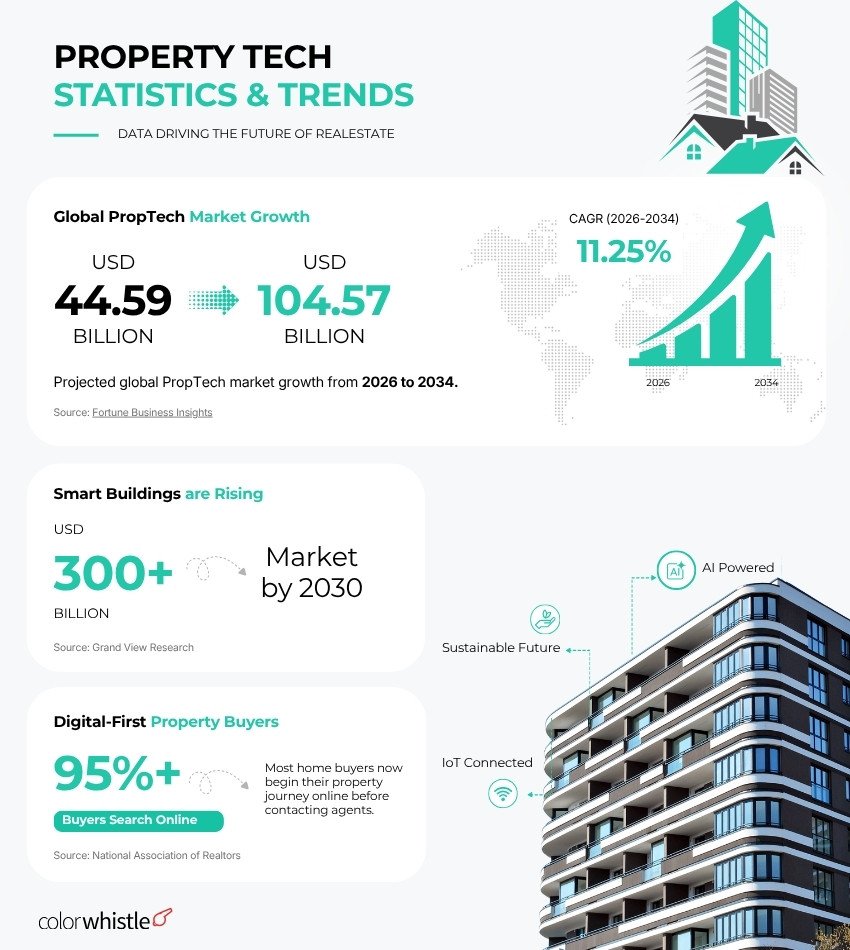
- The global PropTech market is projected to grow from USD 44.59 billion in 2026 to USD 104.57 billion by 2034, at a CAGR of 11.2%.
- Another market report estimates the PropTech industry will grow from USD 54.66 billion in 2026 to USD 209.43 billion by 2035.
- Grand View Research estimated the global PropTech market could reach USD 94.2 billion by 2030 due to increasing adoption of AI, IoT, machine learning, and VR technologies.
- India’s PropTech market is projected to grow from USD 1.3 billion in 2025 to USD 3.8 billion by 2034.
Key Market Drivers
- Increased digital property search behavior
- Rising demand for smart buildings
- AI-powered real estate analytics
- Growth of remote property transactions
- Smart city initiatives worldwide
- Sustainability and energy-efficiency requirements
Did You Know?
As per McKinsey & Company, AI-powered real estate platforms can personalize property recommendations based on buyer behavior, budget, and preferences.
Digital Transformation Statistics in Real Estate
Real estate firms are rapidly digitizing operations to improve customer engagement, streamline workflows, and optimize property management.
- 90% of real estate companies believe automated processes are essential for long-term business sustainability. Source: EXPO REAL Digitalization Study
- 95% of home buyers use the internet during their property search journey. Source: Uptech Real Estate Digital Transformation
- Real estate agencies implementing digitalization reported 35% improvement in operational efficiency within six months. Source: Technova Partners
- 41% of real estate companies have accelerated technology adoption to redefine business processes. Source: Uptech Real Estate Digital Transformation
- The global digital transformation market is expected to reach USD 1.86 Trillion by 2031. Source: MarketsandMarkets Report
Important Digital Transformation Trends
- Real estate companies are increasingly investing in CRM systems, cloud platforms, automation tools, and AI-powered lead management solutions.
- Mobile-first property discovery has become the dominant consumer behavior across global real estate marketplaces.
- Digital documentation and e-signature adoption have accelerated remote transactions and faster property closures.
- Smart property management platforms are reducing manual operational costs through automation.
Emerging Technologies Transforming Real Estate
- AI-based property valuation
- Predictive analytics for investment decisions
- Digital mortgage processing
- Automated tenant communication systems
- Smart access management systems
- Cloud-based property management software
AI in Real Estate Statistics & Trends
Artificial Intelligence is becoming one of the most influential technologies in modern real estate. AI tools are helping companies automate lead qualification, personalize property recommendations, forecast property prices, and improve operational efficiency.
Did You Know?
As per National Association of realtors, most home buyers now start their property search online using mobile apps and real estate marketplaces before contacting an agent.
AI Trends in Property Technology
AI-Powered Property Recommendations
AI algorithms analyze user behavior, budgets, preferences, and browsing history to recommend relevant properties.
AI Chatbots & Virtual Assistants
Real estate chatbots are increasingly handling:
- Property inquiries
- Appointment scheduling
- Lead qualification
- Customer support
- Mortgage pre-screening
Predictive Analytics in Real Estate
Predictive analytics tools help investors identify:
- High-growth locations
- Rental yield opportunities
- Future property appreciation
- Occupancy trends
Generative AI in Real Estate Marketing
Generative AI is being used to:
- Create listing descriptions
- Generate property marketing copy
- Build virtual staging visuals
- Create personalized customer communication
Virtual Tours, AR & VR Statistics
Virtual property experiences are reshaping how buyers evaluate properties.
- Listings with 3D virtual tours receive 43% more views and 55% more saves compared to standard listings.
- The global virtual tour market is projected to grow from USD 11.06 Billion in 2024 to USD 74.35 Billion by 2030.
- Virtual tours in real estate generate nearly 40% more listing engagement compared to photo-only listings.
- Around 67% of homebuyers prefer virtual tours while searching for properties online.
- Virtual tours have been shown to drive 40% more leads and 72% more net leases in rental real estate.
Major Trends
Buyers increasingly prefer viewing properties online before visiting physically.
Virtual walkthroughs are reducing the need for multiple site visits.
International buyers rely heavily on immersive property visualization technologies.
AR and VR technologies improve customer confidence during remote transactions.
Benefits of Virtual Tours
- Faster decision-making
- Better buyer engagement
- Increased listing conversions
- Reduced sales cycle duration
- Higher international buyer participation
Industry Innovation
Research initiatives such as automated digital tour systems are helping create scalable virtual property walkthrough experiences. AI-powered virtual real estate agents are also emerging to automate professional-quality property tours.
Smart Buildings & IoT Statistics
Smart building technologies are transforming residential and commercial properties through automation and connected infrastructure.
Key Smart Building Trends
Energy Efficiency & Sustainability
IoT-enabled buildings help optimize:
- Energy consumption
- HVAC systems
- Lighting systems
- Water usage
- Security operations
AI-Driven Smart Buildings
Artificial intelligence is increasingly being integrated into smart buildings to improve automation and operational intelligence. Research on AI-enabled smart building architectures highlights the growing role of autonomous building management systems.
Occupant Experience & Data Collection
Smart commercial buildings increasingly use IoT devices to monitor occupancy, improve security, and enhance tenant experiences. Research shows growing awareness and concerns regarding data privacy and IoT-based monitoring in smart buildings.
Blockchain in Real Estate
Blockchain technology is helping improve transparency, trust, and transaction efficiency in real estate.
Blockchain Use Cases in Property Technology
Smart Contracts
Smart contracts help automate:
- Property sales agreements
- Rental agreements
- Escrow management
- Payment processing
Property Tokenization
Blockchain enables fractional ownership of real estate assets, making property investment more accessible.
Digital Land Registries
Governments and private firms are exploring blockchain-powered land registration systems to reduce fraud and improve transparency.
Property Management Technology Statistics
Property management software solutions are becoming essential for modern real estate operations.
- According to Coherent Marketing Insights, the global property management software market is expected to grow from USD 30.8 Billion in 2026 to USD 60.35 Billion by 2033.
- SNS Insider says, property managers using AI increased from 21% in 2020 to 34% in 2023, showing rapid adoption of automation tools.
- Cloud-based rental property management platforms account for over 67% of market share due to growing demand for remote access and automation.
- The property management automation market is projected to more than double by 2032 as companies automate leasing, maintenance, and rent collection.
- AI-powered property management tools now automate tasks like rent collection, tenant screening, and maintenance requests.
Key Trends
Automation in Property Management
Automation tools are helping companies manage:
- Rent collection
- Maintenance requests
- Tenant onboarding
- Lease renewals
- Accounting workflows
Cloud-Based Property Management Platforms
Cloud software allows property managers to:
- Access data remotely
- Improve collaboration
- Automate reporting
- Centralize tenant communication
Tenant Experience Platforms
Modern tenant portals now provide:
- Online rent payment
- Service requests
- Community announcements
- Smart access controls
- Digital documentation
Consumer Behavior Trends in Digital Real Estate
Consumer expectations in real estate are shifting rapidly toward digital-first experiences.
Key Consumer Trends
Mobile Property Search Growth
Most property searches now begin online using smartphones and mobile apps.
Demand for Instant Information
Consumers expect:
- Real-time property updates
- Instant chat support
- Online booking systems
- Virtual walkthroughs
- Transparent pricing information
Rise of Remote Transactions
Remote property buying is becoming increasingly common due to:
- Digital verification systems
- E-signatures
- Online mortgage approvals
- Video consultations
- Virtual tours
Challenges Slowing PropTech Adoption
Despite strong growth, several challenges continue to impact digital transformation in real estate.
Major Challenges
Data Privacy & Cybersecurity
Real estate companies handle sensitive customer and financial information, increasing cybersecurity concerns.
Legacy Systems
Many traditional real estate firms still rely on outdated operational systems.
High Technology Costs
Advanced AI and IoT implementation can require significant upfront investments.
Resistance to Digital Change
Traditional real estate workflows can slow technology adoption.
Future Trends in Property Technology
The future of PropTech will be driven by automation, intelligence, sustainability, and immersive experiences.
Future PropTech Trends
- AI-Powered Autonomous Property Management: AI systems will increasingly automate maintenance, tenant communication, leasing, and energy optimization.
- Smart Cities Integration: Real estate technology will become closely integrated with broader smart city infrastructure.
- Digital Twins in Real Estate: Digital twin technology will help developers simulate and optimize building performance.
- ESG & Sustainable Real Estate Technology: Environmental sustainability will continue driving demand for smart building systems and energy-efficient technologies.
- Blockchain-Powered Real Estate Ecosystems: Blockchain could simplify property ownership verification, cross-border transactions, and investment accessibility.
Key Takeaways
- PropTech is rapidly transforming the real estate industry through AI, IoT, blockchain, cloud software, and immersive technologies.
- The global PropTech market is expected to experience strong double-digit growth over the next decade.
- AI-powered automation and predictive analytics are improving property management and investment decision-making.
- Virtual tours and smart buildings are becoming mainstream expectations in modern real estate.
- Digital transformation is reshaping how buyers, tenants, developers, and investors interact with properties.
FAQs
What is PropTech?
PropTech refers to the use of technology to improve real estate operations, transactions, property management, and customer experiences.
How big is the PropTech market?
The global PropTech market is projected to exceed USD 100 billion over the next decade.
How is AI used in real estate?
AI is used for property recommendations, lead generation, predictive analytics, chatbots, price forecasting, and automated property management.
What are smart buildings?
Smart buildings use IoT devices, sensors, and AI systems to improve energy efficiency, security, automation, and occupant comfort.
Why are virtual tours important in real estate?
Virtual tours help buyers explore properties remotely, improve engagement, and accelerate decision-making.
How does blockchain help real estate?
Blockchain improves transparency, automates contracts, reduces fraud, and enables tokenized property ownership.
 Why Websites Are Now Data & API Layers, Not J...