


Why Your Website’s Architecture Today Decides Its AI Capabilities Tomorrow

Phurvishaa specializes in crafting travel tech and marketing content, leveraging deep research, SEO expertise, and AI-driven insights. Her strategic approach ensures content that educates, engages and delivers knowledge.

Our authors are proven experts in their fields, writing on topics where they have demonstrated expertise. Every piece of content undergoes peer review and validation by industry professionals.
AI Summary
Why Your Website's Architecture Today Decides Its AI Capabilities Tomorrow
This post explores why website architecture is critical for unlocking AI capabilities today. The key insight: your site’s data structure and system integration directly determine AI effectiveness. It addresses business owners needing to assess and upgrade their website’s architecture to support AI tools like personalized experiences, predictive analytics, and intelligent search. The blog explains problems like siloed data, unstructured content, and monolithic platforms, then outlines AI-ready features such as API-first design and headless CMS. Readers gain a strategic roadmap to future-proof their digital infrastructure, ensuring competitive advantage through accessible, clean data foundations.
Artificial intelligence is no longer a future consideration for business owners. It is a present-day competitive advantage. From AI-powered customer service and personalized user experiences to intelligent search, lead scoring, and predictive analytics the capabilities businesses are deploying today are directly dependent on one foundational element most overlook: website architecture.
The decisions you made (or didn’t make) when building your website, how data is structured, where it is stored, how systems communicate will determine whether you can adopt AI tools effectively or spend the next two years rebuilding from the ground up. This is not a technology problem. It is a business strategy problem.
TL; DR
- Your website is not just a digital storefront it is the data infrastructure that will power your AI capabilities.
- Business owners who invest in modern, well-structured web architecture today are building a competitive moat.
- Those who don’t risk being locked out of AI-driven growth entirely.
- This article breaks down what that means for your business and what you should be doing right now.
What Is Website Architecture, Really?
Website architecture refers to how your website is built at a structural level the way content is organized, how data flows between your CMS, CRM, analytics tools, and databases, and whether your systems follow modern standards like headless architecture, API-first design, and structured data schemas.
For most small and mid-sized businesses, websites were built to look good and convert visitors. That was enough five years ago. Today, AI tools need to read, process, and learn from your website’s data to function. If your data is scattered, siloed, or poorly structured, AI cannot do its job regardless of which tool you buy or how much you invest.
Think of it this way: AI is only as intelligent as the data it is trained on. If your website feeds it chaos, it will produce chaos.
The Three Architecture Problems Holding Businesses Back
Siloed Data Across Incompatible Systems
Many businesses run their website, CRM, e-commerce platform, and analytics tools as separate, disconnected systems. Customer interactions happen in one place, purchase history in another, content taxonomy in a third. AI tools require unified, accessible data to generate insights, personalize experiences, or automate decisions. Fragmented systems make this nearly impossible without expensive custom integrations.
Unstructured or Inconsistent Content
Legacy websites often lack consistent metadata, content tagging, and semantic structure. When an AI tool or an LLM like ChatGPT or Google’s AI Overviews tries to crawl, understand, and surface your content, it needs clean, structured signals. Websites without proper schema markup, clear content hierarchies, and consistent naming conventions are invisible to AI-driven search and discovery tools.
Monolithic, Tightly Coupled Platforms
Older content management systems and custom-built platforms are rigid. Adding new capabilities AI chatbots, recommendation engines, dynamic personalization requires tearing apart existing code. Modern headless or composable architectures, by contrast, allow you to plug in new AI-powered services without rebuilding the entire platform.
Did You Know?
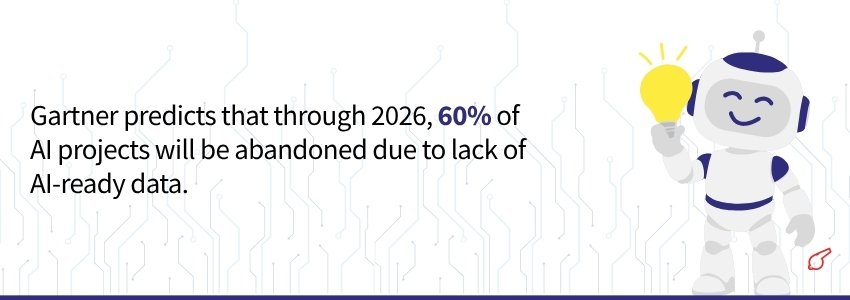
Gartner predicts that 40% of enterprise applications will include task-specific AI agents by the end of 2026, up from less than 5% in 2025.
If your website infrastructure cannot support agent-based integrations, your competitors who have modernized will move significantly faster.
What AI-Ready Website Architecture Actually Looks Like
Businesses that are well-positioned for AI adoption share a few common architectural characteristics:
- API-first design. Their website communicates via APIs, making it easy to connect to AI services, third-party tools, or custom models without rebuilding core infrastructure.
- Structured, consistent data. Content is tagged, categorized, and stored in a way that both humans and machines can interpret. Schema markup is in place. Customer data follows consistent formats across touchpoints.
- Headless or composable CMS. Content is decoupled from presentation, allowing AI tools to access and serve content dynamically across channels website, chatbot, voice, app without manual duplication.
- Centralized data layer. A single source of truth for customer, content, and behavioral data means AI tools are working from complete, accurate information not fragments.
- Clean, documented integrations. Each tool in the tech stack connects through documented, maintainable integrations rather than fragile custom workarounds.
Looking for more insights on web development strategies? Explore the ColorWhistle blog or request a free consultation with our team.

The Business Case: This Is About Competitive Advantage, Not Just Technology
For business owners, the conversation about website architecture often stalls on cost and complexity. It should not. The right frame is return on investment and competitive positioning.
Consider what becomes possible with an AI-ready architecture:
- Personalized user experiences that adapt in real time to visitor behavior, increasing conversion rates
- AI-powered search and recommendations that surface the right product or content at the right moment
- Automated customer support via intelligent chatbots that actually understand your business context
- Predictive analytics that help you make better inventory, marketing, and operations decisions
- LLM and AIO visibility as AI-powered search (Google’s AI Overviews, ChatGPT, Perplexity) becomes the dominant discovery channel, structured and semantically rich websites are the ones that get surfaced
None of these are possible if your underlying data architecture is fragmented, unstructured, or locked inside a monolithic platform. AI plugins and bolt-on tools cannot overcome fundamental data architecture limitations if your underlying data is scattered across incompatible systems, AI tools will produce unreliable outputs regardless of the tool’s sophistication.
The investment in modern architecture is not a technology upgrade. It is a strategic asset that compounds in value as AI capabilities expand.
Also Read
What Business Owners Should Do Right Now
You do not need to rebuild everything overnight. What you need is a clear-eyed assessment of where your current architecture stands and a phased roadmap toward AI readiness.
Start by asking these questions:
- Where do our customer and behavioral data currently live, and can AI tools access it cleanly?
- Does our CMS support structured content and API-based integrations?
- Are we using schema markup to help AI-driven search tools understand our content?
- How many manual, fragile integrations are holding our tech stack together?
- If we wanted to add an AI feature tomorrow, how long would it realistically take?
The answers will tell you a great deal about your current position and your exposure to being outpaced by competitors who have already made the shift.
Also Read
The Bottom Line
The businesses that will win with AI over the next three to five years are not necessarily the ones with the biggest budgets or the most advanced AI tools. They are the ones with the cleanest, most structured, most accessible data foundations built into their websites and digital infrastructure today.
Your website architecture is not a technical detail. It is a strategic decision with long-term consequences. The time to address it is before your AI ambitions are blocked by the infrastructure that was supposed to support them.
Ready to assess your website’s AI readiness? Whether you are planning your first AI integration or evaluating a full platform modernization, our team can help you identify the gaps and build a roadmap that aligns with your business goals.
Get in touch today and let’s talk about where your website stands and where it needs to go.
FAQ
Q1. How do I know if my website is AI-ready?
If your customer data lives across disconnected tools and adding new integrations requires heavy development work, it likely isn’t. An architecture audit is the best place to start.
Q2. Do I need to rebuild my entire website?
Not always. Many businesses get AI-ready through phased upgrades of structured data, API integrations, and CMS improvements without a full rebuild.
Q3. How does website architecture affect AI search visibility?
Tools like Google’s AI Overviews and ChatGPT prioritize structured, semantically rich content. Poorly organized websites simply don’t get surfaced as often.
Q4. What should I do first?
Start with an audit. Map where your data lives and how your systems connect, then you’ll know exactly what needs fixing before investing in any AI tools.
 AI Chatbot for Chefs and Recipe Businesses wi...