




API-Based Credits Billing for Scalable Tech Startup Growth

Anusha is a digital strategy expert with deep expertise in branding, UI/UX, and performance-focused content. She brings advanced insight into brands to scale intelligently, blending creativity with conversion-focused thinking.

Our authors are proven experts in their fields, writing on topics where they have demonstrated expertise. Every piece of content undergoes peer review and validation by industry professionals.
AI Summary
Key Highlights of API Credits Billing for Scalable Startups
This post explores how API-based credits billing empowers tech startups to create scalable monetization strategies aligned with actual usage. The key insight: shifting from fixed subscriptions to usage-based credits billing enhances revenue accuracy and customer retention. It covers core features like pay-per-use, tiered, and hybrid pricing models, real-time tracking, and automated billing processes. Benefits include transparent consumption metrics, reduced billing disputes, and improved financial compliance. The article targets API-first startups and platform builders seeking flexible, scalable billing architectures, offering integration examples with tools like Kong, Apigee, and AWS API Gateway. Readers learn to implement efficient, growth-ready billing systems that scale with demand.
Tech startups building API-first products face a critical decision: how to monetize their services in a way that scales alongside customer growth. Traditional subscription models often fall short when usage patterns vary dramatically between customers. API-based credits billing offers a solution that directly ties revenue to actual consumption, creating a fair and transparent pricing structure that resonates with modern developers.
This article explores how usage-based billing through credits systems enables tech startups to build scalable product architectures that grow with their customers. When an AI platform charges per API call, a data processing service bills by compute cycles, or a messaging API meters by request volume, the billing infrastructure becomes as important as the product itself.
The shift from fixed subscriptions to consumption-based pricing represents more than a billing preference, it fundamentally changes how startups approach product development, customer acquisition, and revenue forecasting. Companies implementing credits and subscription hybrid models report stronger alignment between customer value and revenue, reduced friction in the sales process, and improved retention rates.
For API-first SaaS businesses, the right billing architecture determines whether you can efficiently serve both small developers testing your product and enterprise clients processing millions of requests daily. The following sections examine the technical foundations, integration strategies, and best practices that make credits billing systems work at scale.
Understanding API-Based Credits Billing
API credits billing is a payment model where customers buy or earn credits that are used based on how much they use API resources. Each time an API is called, a certain number of credits are deducted from the customer’s account. This system makes it easier for both providers and consumers to understand and manage technical operations by turning them into measurable units.
The main function works through a usage metering API that tracks every billable action in real-time. When a developer makes an API request, the system records important information such as the endpoint accessed, payload size, processing time, and computational resources used. These details are then sent to a billing engine that calculates credit deductions based on predetermined pricing rules. The remaining balance is updated instantly, providing transparency into consumption patterns.
Static Subscriptions vs. Usage-Based Models
Traditional subscription pricing offers predictable monthly or annual fees regardless of consumption levels. A startup paying $99/month receives the same service whether they make 100 API calls or 100,000. This model creates misalignment between value delivered and revenue captured.
Developer API monetization through credits billing eliminates this disconnect:
Elastic pricing: Customers pay proportionally to their actual usage, making entry costs lower for new users while capturing more revenue from power users
Value alignment: Heavy consumers who extract more value from the platform contribute proportionally higher revenue
Cost predictability for users: Developers can estimate expenses based on expected traffic patterns and adjust consumption to stay within budget
Revenue scalability: Platform revenue grows automatically as customer usage increases without requiring plan upgrades or sales interventions
Also Read
Strategic Advantages for Platform Builders
API platform billing through credits delivers compelling benefits for both sides of the marketplace. Platform founders gain granular visibility into which features drive the most usage, enabling data-driven product decisions. This is particularly useful when exploring opportunities such as calculating the Total Addressable Market (TAM) for SaaS companies, which can maximize growth potential and impress investors.
Developers appreciate the flexibility to scale usage up or down without contract renegotiations. Experimentation becomes less risky when costs remain proportional to actual testing volume. Teams can allocate credits across different projects or environments, optimizing resource distribution based on business priorities rather than subscription constraints.
The credits abstraction also simplifies complex pricing structures. Instead of maintaining separate rate cards for dozens of endpoints with varying computational costs, providers can normalize everything to a single credit currency. A lightweight GET request might cost 1 credit while a machine learning inference consumes 50 credits, but customers interact with one unified balance.
In addition to these technical benefits, platforms can also leverage digital marketing strategies to enhance their online presence and attract more users. For example, collaborating with one of the best digital marketing agencies in Canada could significantly boost visibility and user acquisition.
Moreover, educational platforms can explore innovative online education ads design ideas to effectively reach their target audience and increase enrollment rates.
Key Features of API-Based Credits Billing Solutions
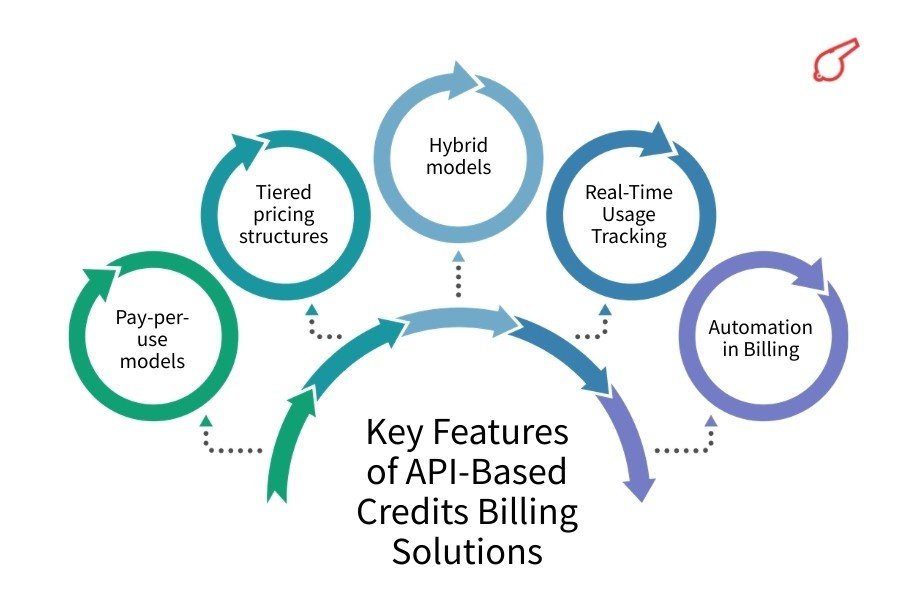
Modern usage-based pricing models form the foundation of effective credits billing systems, offering startups the flexibility to align their monetization strategy with actual customer consumption. Leading providers like Stripe and Orb support three primary pricing architectures:
1. Pay-per-use models
Pay-per-use models charge customers for each API call, compute cycle, or data transfer operation. This granular approach works exceptionally well for platforms with variable usage patterns, such as image processing APIs or machine learning inference services. Customers appreciate the direct correlation between their spending and value received.
2. Tiered pricing structures
Tiered pricing structures introduce volume-based discounts, encouraging higher consumption while maintaining predictable cost structures. A typical implementation might charge $0.01 per API call for the first 100,000 requests, $0.008 for the next 400,000, and $0.005 for volumes beyond 500,000. This model incentivizes growth while protecting high-volume customers from excessive costs.
3. Hybrid models
Hybrid models combine base subscription fees with usage charges, providing startups with predictable recurring revenue while capturing additional value from power users. A developer platform might charge $99 monthly for basic access plus $0.005 per API call beyond the included 50,000 requests.
Real-Time Usage Tracking
Real-time usage tracking capabilities distinguish modern billing solutions from legacy systems that rely on batch processing. Contemporary platforms ingest usage events through high-throughput APIs, processing millions of data points per hour without latency. This immediate visibility serves multiple purposes:
- Enables customers to monitor their consumption patterns throughout the billing cycle
- Allows businesses to identify usage anomalies before they escalate into billing disputes
- Supports dynamic rate limiting based on current credit balances
- Facilitates instant notifications when customers approach spending thresholds
Orb’s event-driven architecture, for example, processes usage data with sub-second latency, ensuring that both the platform and its customers maintain accurate, up-to-date consumption metrics. This capability becomes critical when managing burst traffic scenarios where usage can spike unexpectedly.
Automation in Billing
Automation in billing operations eliminates manual intervention across the revenue lifecycle. Modern solutions handle complex scenarios that would otherwise require significant engineering resources:
Invoice generation
Invoice generation occurs automatically based on configured billing periods, incorporating multiple pricing dimensions such as API calls, storage consumption, and bandwidth usage into unified statements. The system calculates prorated charges when customers upgrade or downgrade mid-cycle, ensuring fair billing without manual calculations.
To enhance this automation further, integrating a CRM like GoHighLevel, which utilizes AI-driven automation to streamline customer management and scale businesses through smart workflows is a game-changer.
Payment retry logic
Payment retry logic implements intelligent algorithms that attempt failed transactions at optimal times, reducing involuntary churn. These systems analyze payment failure patterns and adjust retry schedules accordingly, often recovering 20-30% of initially failed payments.
Revenue recognition
Revenue recognition automation ensures compliance with accounting standards like ASC 606, automatically deferring and recognizing revenue based on service delivery. This feature proves invaluable for startups navigating financial audits or preparing for funding rounds.
Our article, Top Payment Gateways in Europe,” helps you compare and understand the region’s most preferred payment service providers.
Also Read
Integration with API Gateways and Platforms
API gateway integration is a crucial part of any strong credits billing system. It acts as a control point where usage tracking meets request processing, allowing startups to collect detailed consumption data before it reaches their backend services.
Kong: Custom Metering Logic
Kong’s plugin architecture allows developers to inject custom metering logic directly into the request-response cycle. The platform’s rate limiting and request transformer plugins can be extended to track credit consumption per API call, capturing metadata such as payload size, compute intensity, and endpoint-specific pricing multipliers. Kong’s declarative configuration approach simplifies the deployment of metering rules across multiple environments while maintaining consistency in billing logic.
Apigee: Complex Billing Requirements
Apigee excels in enterprise-grade API management scenarios where complex billing requirements demand sophisticated policy enforcement. Its analytics services provide native support for custom dimensions, enabling startups to track usage across multiple axes simultaneously. The platform’s quota management system can be configured to enforce credit limits in real-time, preventing overconsumption while maintaining service availability for paying customers.
AWS API Gateway: Serverless Metering Pipelines
AWS API Gateway integrates seamlessly with CloudWatch and Lambda functions to create serverless metering pipelines. Usage plans within AWS API Gateway map directly to credit-based pricing tiers, while API keys provide the foundation for per-customer tracking. The gateway’s native throttling mechanisms complement credit-based billing by establishing hard limits on request volumes independent of financial constraints.
Multi-Key Billing Segmentation Architecture
Modern API platforms require billing granularity that extends beyond simple per-customer metering. Multi-key billing segmentation addresses this complexity by enabling distinct tracking across organizational hierarchies:
User-level keys attribute API consumption to individual developers within an organization, supporting internal chargeback models
Team-level keys aggregate usage across project groups, facilitating departmental budget allocation
Application-level keys isolate consumption by specific products or services, enabling accurate cost attribution for multi-tenant architectures
Implementing this segmentation requires careful schema design in your metering database. Each API request must carry contextual metadata identifying the user, team, and application simultaneously. Gateway middleware intercepts these identifiers from authentication tokens or custom headers, enriching usage events before they enter the billing pipeline.
The technical challenge lies in maintaining query performance as event volumes scale. Partitioning strategies based on time windows and customer identifiers prevent database hotspots, while materialized views pre-aggregate common reporting dimensions. Stream processing frameworks like Apache Kafka enable real-time aggregation of usage metrics without introducing latency into the critical request path, ensuring that metering infrastructure never becomes a bottleneck for API performance.
Emerging Trends Influencing Various Sectors
In addition to these technical aspects, it’s essential to consider how emerging trends are influencing various sectors including education. One such trend is the Metaverse which is reshaping K-12 education with immersive virtual environments and creating opportunities for innovative teaching methods.
Moreover, businesses looking to expand their digital footprint should explore the potential of mobile apps, considering the growing reliance on smartphones for various tasks. This aligns well with the trend towards SaaS website designs which are becoming increasingly popular due to their user-friendly interfaces and seamless interactions.
Lastly, leveraging user-generated content in video marketing strategies can significantly enhance brand communication by making it more influential and relatable.
Also Read
Scalability Considerations for Tech Startups Using Credits Billing Solutions
Building a scalable product architecture that handles credits billing requires careful planning around data ingestion, storage, and processing capabilities. Tech startups must design systems that can process millions of API events per hour without creating bottlenecks that degrade user experience or compromise billing accuracy. The architecture should leverage event-driven architectures where each API call generates a lightweight event that gets queued for asynchronous processing, allowing the primary API response to remain fast while metering happens in the background.
Handling High-Volume Usage Data
The foundation of scalable credits billing lies in separating the hot path (serving API requests) from the cold path (processing usage data). Startups should implement:
Stream processing frameworks like Apache Kafka or AWS Kinesis to buffer incoming usage events
Time-series databases optimized for high write throughput such as ClickHouse or TimescaleDB
Batch aggregation strategies that consolidate granular events into hourly or daily summaries
This separation ensures that billing calculations never block API responses, maintaining sub-100ms latency even during peak traffic periods.
Metering Burst Traffic Without Infrastructure Compromise
Burst traffic metering presents unique challenges when customers suddenly spike their API usage by 10x or 100x their normal patterns. The billing system must accurately capture these events while protecting infrastructure from overload. Implementing a multi-layered approach helps maintain both accuracy and stability:
- Rate limiting at the gateway level provides the first line of defense, rejecting requests that exceed configured thresholds before they consume backend resources. This differs from credit limits, which track cumulative consumption over time rather than instantaneous request rates. For more on effective rate limiting strategies, refer to this comprehensive guide.
- Adaptive throttling mechanisms can dynamically adjust based on current system load, temporarily slowing non-critical billing events during extreme spikes while ensuring customer-facing APIs remain responsive. Queue-based architectures with backpressure handling prevent cascading failures when downstream billing services cannot keep pace with incoming events.
Balancing Rate Limits and Credit Limits
The relationship between internal rate limits and credit limits requires strategic calibration. Rate limits protect infrastructure by capping requests per second, while credit limits govern total consumption over billing periods. Startups must decide whether to:
Allow customers to exhaust credits rapidly through burst usage (prioritizing flexibility)
Enforce rate limits that spread credit consumption over time (prioritizing infrastructure stability)
Implement hybrid models where premium tiers receive higher rate limits alongside larger credit allocations
However, it is essential to note that there are several myths surrounding website design and development that could mislead tech startups in their journey towards building scalable solutions. These myths often stem from misconceptions about what is feasible within the realms of web development and application design. Understanding these myths can empower startups to make more informed decisions as they navigate their growth trajectory.
Service Level Agreements (SLAs) for high-volume customers often guarantee specific throughput levels, requiring reserved capacity.
Also Read
Transparency and Developer Control Through Dashboards in API-Based Credits Billing Systems
Real-time dashboards are crucial for building trust between API providers and their developer customers. These interfaces turn complex usage data into easy-to-understand insights, enabling developers to:
- Monitor their consumption patterns
- Track spending trajectories
- Make informed decisions about resource allocation
A well-designed dashboard eliminates the confusion that often comes with usage-based billing models, replacing uncertainty with clarity.
However, creating such effective dashboards often requires advanced web development techniques. For instance, leveraging React JS can significantly enhance the user interface of these dashboards, providing a more interactive and responsive experience for developers.
Essential Dashboard Components for Usage Visibility
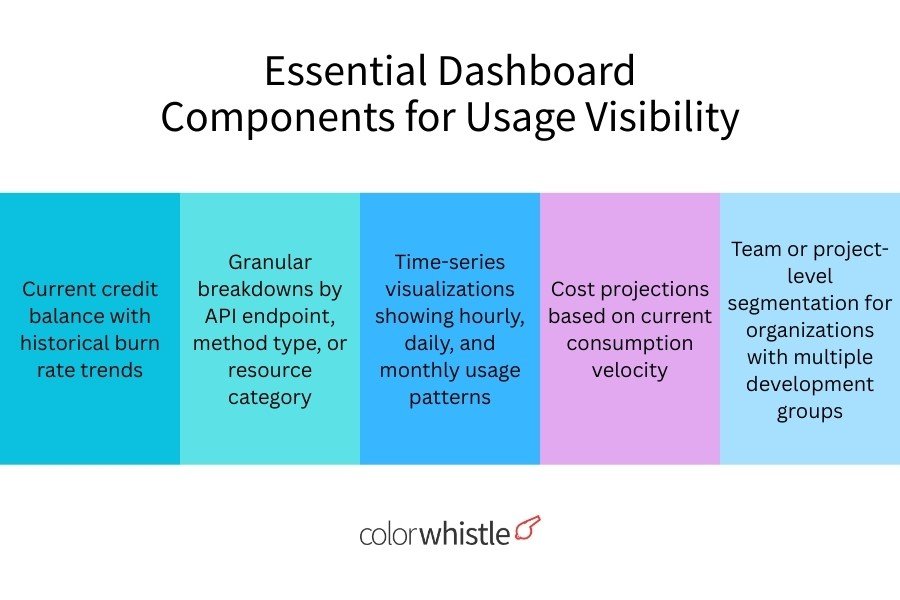
Effective dashboards must display multiple dimensions of consumption data simultaneously:
- Current credit balance with historical burn rate trends
- Granular breakdowns by API endpoint, method type, or resource category
- Time-series visualizations showing hourly, daily, and monthly usage patterns
- Cost projections based on current consumption velocity
- Team or project-level segmentation for organizations with multiple development groups
The dashboard architecture should support drill-down capabilities, enabling developers to investigate specific time periods or unusual spikes in usage. This level of detail empowers teams to identify optimization opportunities, such as inefficient API calls or redundant requests that inflate costs unnecessarily.
Proactive Alerting Mechanisms for Cost Control
Bill shock remains one of the primary concerns developers express about usage-based pricing. Sophisticated billing systems address this through configurable alert thresholds that notify users before they exceed budget expectations. These notifications can trigger at multiple levels:
Percentage-based warnings (e.g., 50%, 75%, 90% of allocated credits)
Absolute spending thresholds tied to budget constraints
Anomalous usage patterns detected through baseline comparisons
Projected month-end costs exceeding historical averages
The most effective implementations offer multiple notification channels, email, SMS, webhook integrations, or in-dashboard banners, ensuring developers receive alerts through their preferred communication methods. Some platforms extend this functionality by allowing customers to set automatic spending caps or request approval workflows when usage approaches predetermined limits.
Monetization Strategies Enabled by Credits Billing Models in Developer Platforms or Marketplaces
Credits billing systems unlock sophisticated developer API monetization strategies that extend far beyond simple per-request pricing. Tech startups can architect complex monetization streams that adapt to diverse customer needs while maximizing revenue potential across different market segments.
Hybrid Pricing Models: The Powerhouse for API-First Businesses
Hybrid pricing models represent the most powerful approach for API-first businesses. By combining base subscription fees with usage-based charges, platforms create predictable revenue foundations while capturing additional value from high-volume consumers. A startup might offer a $99/month base plan that includes 100,000 API calls, then charge $0.0005 per additional request. This structure provides entry-level customers with cost certainty while ensuring enterprise users pay proportionally for their consumption.
Revenue Optimization Tactics Enabled by Credits and Subscription Combinations
The flexibility of credits and subscription combinations enables multiple revenue optimization tactics:
- Prepaid credit packages: offer volume discounts (e.g., purchase 10 million credits for 15% off standard rates)
- Committed use discounts: where customers commit to minimum monthly spending in exchange for reduced per-unit costs
- Rollover credits: prevent waste and encourage larger upfront purchases
- Tiered subscription levels: with different credit allocation rates and feature access
The Dual Benefits of Prepayment Models for Startups and Customers
Prepayment models serve dual purposes for startups. They improve cash flow by collecting revenue upfront while reducing payment processing overhead. Customers benefit from predictable budgeting and often receive better effective rates. A developer platform might offer annual prepayment options that provide 20% more credits compared to monthly billing cycles.
Incentivizing Long-Term Partnerships through Commitment-Based Pricing Structures
Commitment-based pricing structures incentivize long-term partnerships by rewarding customer loyalty. These agreements typically involve minimum spend thresholds over specified periods, creating revenue predictability for the startup while offering customers preferential pricing. API marketplaces frequently implement graduated commitment tiers where larger commitments unlock progressively better rates, enterprise support levels, and dedicated infrastructure resources.
Exploring AI Pricing Models for Enhanced Monetization
In addition to these monetization strategies, tech startups should also consider incorporating AI pricing models into their business strategy. These models leverage data-driven insights and machine learning algorithms to optimize pricing strategies further, leading to increased conversion rates and improved customer satisfaction.
Investing in SEO as a Long-Term Marketing Strategy
It’s crucial for tech startups to invest in SEO as a long-term marketing strategy. This is particularly relevant for IT services companies seeking compounding growth returns beyond 2026.
Leveraging Digital Marketing Strategies Tailored for Specific Sectors
Moreover, leveraging digital marketing strategies tailored for specific sectors such as education can drive transformative growth in those fields. Similarly, fashion brands can benefit from adopting YouTube lookbook strategies which enhance visual storytelling and SEO for lasting video engagement and sales.
Also Read
Fraud Prevention Measures in Usage-Based Billing Systems Powered by Anomaly Detection Techniques
Usage-based billing systems face unique security challenges that can directly impact revenue streams and system reliability. Fraudulent API usage manifests in various forms: credential theft leading to unauthorized consumption, deliberate abuse of free tiers, distributed attacks designed to generate excessive charges, and sophisticated scripts that exploit pricing loopholes. Each scenario threatens both financial stability and infrastructure performance.
How Anomaly Detection Works
Anomaly detection models serve as the first line of defense against these threats. Machine learning algorithms analyze historical consumption patterns to establish baseline behaviors for each account, team, or application key. When usage suddenly spikes beyond statistical norms, whether in request volume, payload sizes, or endpoint distribution, the system flags these deviations for immediate review. Modern detection frameworks examine multiple dimensions simultaneously:
Temporal patterns: Unusual activity during off-hours or sudden changes in request frequency
Geographic anomalies: API calls originating from unexpected regions or rapid location switching
Behavioral shifts: Dramatic changes in endpoint usage ratios or authentication patterns
Volume thresholds: Consumption rates that exceed historical maximums by predefined margins
Preventive Measures Against Fraud
Secure API monetization practices extend beyond detection to include preventive measures. Implementing progressive rate limiting creates friction for potential abusers while maintaining service quality for legitimate users. When an account approaches suspicious usage levels, the system can automatically throttle requests, require additional authentication, or trigger manual review before processing continues. This layered approach protects infrastructure while preserving the developer experience.
Operational Insights and Feedback Loops
Real-time monitoring dashboards equipped with anomaly visualization help operations teams distinguish between genuine growth spurts and malicious activity. Integration with payment systems enables automatic suspension of billing for flagged accounts, preventing chargebacks and disputes. Advanced platforms incorporate feedback loops where confirmed fraud cases refine detection algorithms, creating increasingly accurate fraud prevention measures that adapt to evolving attack vectors.
Popular Tools & Providers Supporting Startup-Friendly Implementation of Usage-Based Billing Solutions
The billing infrastructure landscape offers several robust platforms designed specifically for API-driven businesses seeking to implement credits-based monetization models. Each solution brings distinct architectural advantages that address different startup needs.
1. Stripe Billing
Stripe Billing stands as the most widely adopted payment infrastructure for API-first companies, processing billions in usage-based revenue annually. The platform’s metering API captures consumption events in real-time, automatically aggregating them into billable units. Stripe’s architecture supports complex pricing scenarios including tiered pricing, volume discounts, and graduated billing structures. The system handles proration calculations automatically when customers upgrade or downgrade mid-cycle, eliminating manual reconciliation work. Machine learning capabilities within Stripe’s ecosystem help optimize payment retry logic and reduce involuntary churn through intelligent dunning management.
2. Orb billing platform
Orb billing platform specializes in event-driven billing architectures built for high-volume API businesses. The platform ingests millions of usage events per second through its distributed ingestion layer, making it particularly suitable for startups experiencing rapid growth. Orb’s pricing engine supports sophisticated billing models including custom aggregation functions, lookback windows, and multi-dimensional pricing matrices. The platform provides granular control over how usage gets measured, whether by API calls, compute time, data transfer, or composite metrics combining multiple dimensions. Revenue recognition automation ensures compliance with ASC 606 and IFRS 15 standards without requiring manual journal entries.
3. Lago open-source solution
Lago open-source solution delivers flexibility for startups requiring customizable billing logic without vendor lock-in. The self-hosted architecture gives engineering teams complete control over data residency and processing logic. Lago supports hybrid monetization models combining subscriptions with usage-based components, enabling startups to experiment with pricing strategies without migration costs. The platform’s webhook system integrates seamlessly with existing tech stacks, pushing billing events to data warehouses, CRM systems, and analytics platforms. Open-source transparency allows developers to audit billing calculations and customize rating engines for industry-specific requirements.
In addition to these platforms, startups can also leverage scalable AI-powered MVPs which can significantly enhance their operational efficiency by offering seamless integration and growth potential. Furthermore, incorporating AI-driven marketing automation strategies can revolutionize their marketing efforts by improving customer engagement and driving conversion rates.
On the technological front, the adoption of Flutter apps is gaining traction due to their popularity among users and the customized solutions they offer to meet specific business needs. These advancements can further empower startups in their journey towards successful implementation of usage-based billing solutions while ensuring optimal user experience.
Moreover, as businesses increasingly rely on digital tools and platforms powered by advanced technologies like Google’s AI, it’s crucial to understand how to maximize these AI capabilities across various applications such as Android devices for improved productivity and personalized interactions.
Overcoming Common Challenges Faced by Tech Startups During Implementation Phase Of Their Chosen Credit Billing Solution With Practical Tips And Best Practices From Industry Experts
Managing High-Volume Event Data Without Performance Bottlenecks
Handling large volumes of data represents one of the most critical technical challenges when implementing credits billing systems. Startups processing millions of API calls daily need architectures that prevent metering from becoming a bottleneck.
Serverless computing frameworks like AWS Lambda or Google Cloud Functions provide elastic scalability for processing usage events. These platforms automatically scale based on incoming traffic, eliminating the need for capacity planning. Distributed systems design principles such as event streaming through Apache Kafka or AWS Kinesis enable asynchronous processing of metering data, decoupling billing calculations from real-time API responses.
Key architectural patterns include:
- Implementing write-ahead logs to buffer usage events during traffic spikes
- Using time-series databases like InfluxDB or TimescaleDB optimized for high-throughput writes
- Deploying edge computing nodes to aggregate usage data closer to API gateways before centralized processing
- Batching events in configurable intervals (every 5-10 seconds) rather than processing individual requests
Addressing Revenue Unpredictability Management
Revenue unpredictability management poses significant challenges for financial planning and investor relations. Pure usage-based models create cash flow volatility that many early-stage startups struggle to manage.
Implementing minimum spend commitments provides baseline revenue predictability while maintaining usage-based flexibility. Contracts might specify $5,000 monthly minimums with overage charges, giving finance teams reliable forecasting data. Annual prepayment discounts (typically 10-20%) incentivize customers to commit larger amounts upfront, improving cash position.
Credits and Subscription hybrid models offer another solution. Customers pay a base subscription fee for platform access plus usage-based charges for consumption above included allowances. This structure balances predictable recurring revenue with growth potential from high-usage customers.
Also Read
Customer Education on Pricing Structures
Complex pricing structures create friction in the sales process and increase support burden. Customer education on pricing structures requires multi-faceted approaches beyond traditional documentation.
Interactive pricing calculators embedded in signup flows help prospects estimate monthly costs based on anticipated usage patterns. These tools should allow users to input expected API call volumes, data transfer amounts, and feature usage to generate realistic cost projections.
Comprehensive documentation should include:
Real-world usage examples with cost breakdowns
Video walkthroughs demonstrating how credits accumulate and expire
Comparison tables showing different pricing tiers side-by-side
FAQ sections addressing common billing questions
Proactive communication through in-app notifications when customers approach credit thresholds prevents bill shock. Sending alerts at 50%, 75%, and 90% consumption levels gives users time to adjust usage or upgrade plans before unexpected charges occur.
In addition to these strategies, it’s essential for tech startups to consider the user experience across their digital platforms. For instance, adopting mobile-friendly travel website design practices can significantly enhance user engagement and streamline the customer journey in travel-related applications.
Moreover, understanding the nuances between remote staffing and outsourcing can also play a vital role in resource management during the implementation phase of their chosen credit billing solution.
Lastly, staying abreast of the latest UI/UX trends can help tech startups optimize their website.
FAQs (Frequently Asked Questions)
What is API-based credits billing and how does it benefit tech startups?
API-based credits billing is a usage-based billing model that charges customers based on their API consumption, aligning revenue with actual usage. This approach benefits tech startups by providing scalable product architectures, enabling flexible monetization strategies, and driving growth for API-first SaaS businesses.
How do usage-based pricing models differ from traditional subscription pricing in API monetization?
Usage-based pricing models charge customers according to their actual API usage (pay-per-use, tiered, or hybrid), unlike traditional static subscription pricing which charges a fixed fee regardless of consumption. This flexibility allows developers and platform founders to better match costs with customer value and encourage efficient API use.
What are the key features to look for in an API-based credits billing solution?
Key features include flexible usage-based pricing models (pay-per-use, tiered, hybrid), real-time usage tracking through APIs for accurate metering, automation in invoicing and payment processes such as retries and proration, and integration capabilities with popular billing providers like Stripe and Orb.
How can API gateways like Kong or Apigee integrate with credits billing systems effectively?
API gateways such as Kong, Apigee, and AWS API Gateway play a crucial role by enabling multi-key billing segmentation per user, team, or app for granular chargebacks. They facilitate seamless metering functionality integration within the gateway infrastructure to ensure precise usage data collection and reporting.
What scalability considerations should tech startups keep in mind when implementing credits billing solutions?
Startups should design scalable backend systems capable of handling large volumes of usage data efficiently without performance degradation. They need to manage burst traffic metering while maintaining service level agreements (SLAs), balance internal rate limits versus credit limits on APIs to ensure fair customer usage, and consider event-driven architectures for optimal scalability.
How do real-time dashboards enhance transparency and control in API-based credits billing systems?
Real-time dashboards provide developers and customers with immediate visibility into consumption patterns and associated costs. They help prevent bill shock through proactive alerts and clear reporting interfaces, empowering users to monitor usage closely and manage costs effectively within the credits billing framework.
 Credits-Based Monetization and Pricing for Cl...