



Online Travel Agencies (OTAs) – A Practical Introduction

Powered by an expert content team, this blog blends SEO precision with compelling storytelling. Every insight is supported by data-driven research, ensuring content that ranks, engages, and drives conversions.

Our authors are proven experts in their fields, writing on topics where they have demonstrated expertise. Every piece of content undergoes peer review and validation by industry professionals.
AI Summary
Online Travel Agencies (OTAs) - A Practical Introduction
This serves as a practical guide to understanding Online Travel Agencies (OTAs) and their critical role in the accommodation industry. The key insight: OTAs offer vast exposure and convenience by enabling travelers to compare and book accommodations online instantly. The blog covers OTA business models, benefits, drawbacks, and strategies for launching an OTA platform. It highlights major players like Booking.com, Expedia, and Airbnb, emphasizing the 'billboard effect' that boosts direct bookings. Readers learn the importance of a balanced sales strategy using OTAs alongside direct marketing to maximize revenue and customer loyalty in a growing market.
Online Travel Agencies (OTAs) have become a permanent layer in the accommodation and travel distribution ecosystem. In 2026, OTAs are no longer just booking websites. They are high-visibility demand generators that influence pricing perception, discovery, and traveler trust long before a booking occurs.
For travelers, OTAs offer convenience: price comparison, instant booking, reviews, and flexible policies – all from a single interface. For hotels and travel businesses, OTAs provide reach and demand, but at the cost of commissions and reduced control over the customer relationship.
This article takes a practical view. Instead of debating whether OTAs are “good” or “bad,” it explains what OTAs are, how they work, their advantages and limitations, and how businesses should use them alongside direct channels. The goal is clarity: so you can decide how OTAs fit into a balanced, profitable distribution strategy.
Ready? Let’s go.
What Are Online Travel Agencies?
An Online Travel Agency (OTA) is a third-party platform that sells travel services, such as accommodations, tours, transportation, and packages on behalf of service providers through an online interface.
OTAs typically provide:
- Self-service search and comparison
- Built-in booking and payment systems
- Reviews and ratings
- Customer support and post-booking communication
They act as distribution partners, not inventory owners (with limited exceptions).
How Do Online Travel Agencies Work?
OTAs generally operate using one (or a mix) of the following models:
1. Merchant Model
The OTA purchases rooms at a discounted wholesale rate and resells them at a markup. The OTA controls pricing and collects payment from the traveler.
2. Agency (Commission) Model
The OTA lists availability and pricing, but the hotel collects payment directly from the guest. The OTA earns a commission after the stay is completed.
Trade-off:
- Merchant model = higher control for OTA
- Agency model = more control for hotels
Also Read
Why Partner with Online Travel Agencies?
The primary benefit is exposure. OTAs attract millions of travelers through strong brand recognition and heavy marketing investment. For many properties, especially small or independent hotels, OTAs serve as a discovery engine.
Another important effect is the “billboard effect”: visibility on an OTA increases brand awareness, which can later convert into direct bookings on the hotel’s own website.
Advantages and Disadvantages of Selling Through OTAs
Advantages
- Lower upfront marketing cost
- Global reach and demand generation
- Built-in reviews increase booking confidence
- Easy comparison for travelers
Disadvantages
- Commission fees (typically 10–15% per booking)
- Reduced ownership of guest data
- Restrictive cancellation and pricing policies
- Dependence on third-party platforms
Key Takeaway: OTAs are most effective when used to complement, not replace, direct booking efforts.
Do You Need an OTA Strategy? (Decision Guide)
| Business Goal | OTA Fit |
|---|---|
| Increase occupancy quickly | Strong |
| Enter new markets | Strong |
| Reduce marketing spend | Partial |
| Maximize long-term margins | Alone |
| Own the customer relationship | Alone |
Why Do Travelers Prefer OTAs?
Travelers commonly choose OTAs because they:
- Offer rewards and loyalty programs
- Surface exclusive or time-limited rates
- Provide generous cancellation policies (on select platforms)
- Simplify comparison across many properties
- Are familiar and trusted brands
Leading OTA Platforms You Should Know
1. Booking.com

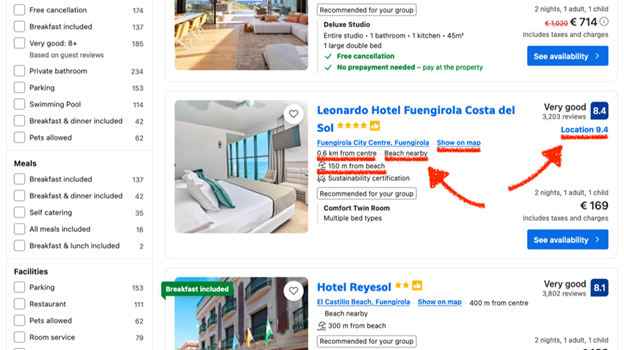
Booking.com is one of the largest accommodations websites which has now expanded to smaller markets such as family-operated bed and breakfast, vacation rentals and self-catering apartments.
Interesting statistics
- Every day, 1,550,000 nights are booked
- 68% of nights booked came from families and couples
- 42% of nights booked came from unique places such as homes and apartments
- 38% of reviews are given by guests which are useful for other travelers
- 75% of nights booked come from guests who booked more than 5 times
2. Expedia’s Hotels.com

Expedia’s Hotels.com is a popular brand which has a global audience and attracts diverse travelers. The company gained more power in the industry by acquiring Travelocity.
Interesting statistics
- Gets over 675 million monthly site visits
- Operates in 70+ countries and 40+ languages
- Attracts 75 million monthly flight shoppers
Also Read
3. Airbnb
Airbnb revolutionized the travel accommodation industry by introducing home-sharing. The website has diverse listings and travelers get a sense of safety as they can know their guest’s identity.
Interesting statistics
- 2.9 million hosts are present on Airbnb
- Average of 800k stays each night
- 14k new hosts join every month
Apart from these major OTAs, there are many small ones such as OneTravel, Vayama, Tripsta, TravelMerry, ExploreTrip, Kiss&Fly, Webjet, GoToGate, Travelgenio, Bookairfare, Fareboom, Skybooker, Travel2be, OneTwoTrip!, and eBookers.
Drive Conversions and Boost your Business with Expert Travel Website Development.

The Future of Online Travel Agencies
OTAs are not going away. Instead, they are adapting:
- Stronger loyalty programs
- Better personalization
- Deeper integration with metasearch and AI-driven discovery
Accommodation providers increasingly use OTAs for demand while working to convert repeat guests into direct bookers protecting margins over time.
Younger travelers, in particular, continue to favor OTAs for convenience and trust, ensuring sustained growth for these platforms.
Online Travel Agencies remain a powerful distribution channel, but not a standalone strategy. They excel at visibility and demand generation, while direct channels excel at margins and long-term relationships.
Hotels and travel businesses that succeed in 2026 use OTAs strategically:
- To fill inventory
- To enter new markets
- To support direct booking growth
If you need any help to design, develop or market an OTA website, contact our travel web design and development experts at ColorWhistle.
We can create an amazing website with beautiful designs combined with dynamic content such as live rates and special offers. Contact us today for your free business analysis and consultation.
In quest of the Perfect Travel Tech Solutions Buddy?
Be unrestricted to click the other trendy writes under this title that suits your needs the best!
 What Are Travel Meta Search Engines and How i...







Very good knowledges
it is good webiste to search and i really enjoy reading about it
Thank you for making this available
The is worth visiting. I enjoyed everything I read
You made it so easy to understand.
is a very good website and I love it
thanks so much it so much helpful to study this
I learned a lot through this web.
It is a good website and I need more information for learning
i think it is a great website i love it so much but i need more information about what am looking for. thanks
its a good website i love it