


Frontend Modernization with APIs | No Backend Changes

Phurvishaa specializes in crafting travel tech and marketing content, leveraging deep research, SEO expertise, and AI-driven insights. Her strategic approach ensures content that educates, engages and delivers knowledge.

Our authors are proven experts in their fields, writing on topics where they have demonstrated expertise. Every piece of content undergoes peer review and validation by industry professionals.
AI Summary
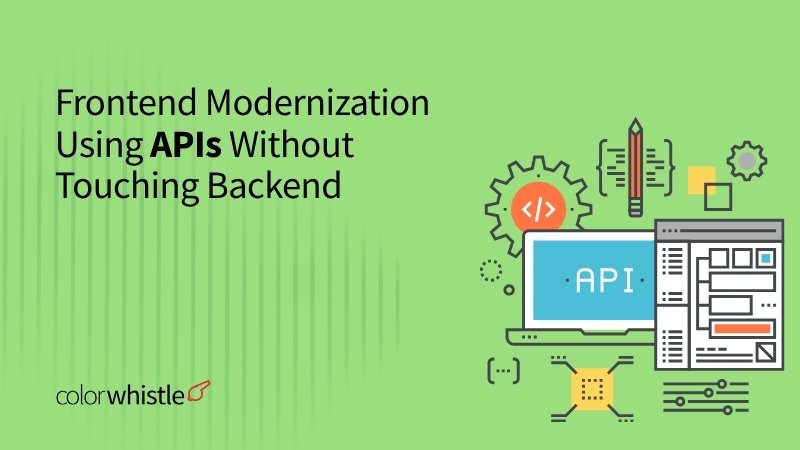
Frontend Modernization with APIs | No Backend Changes
This post explores how engineering leaders can modernize frontend experiences without backend changes. The key insight: API-driven frontend modernization enables rebuilding user interfaces with React or Vue.js by consuming stable backend APIs, avoiding risky backend rewrites. It serves CTOs and engineering managers needing faster, cost-effective upgrades. The approach decouples frontend from legacy systems, using REST, GraphQL, API gateways, or BFF patterns to maintain production stability. Benefits include reduced risk, accelerated delivery, better UX, and improved developer retention. Organizations can incrementally replace old frontends while preserving backend integrity, achieving competitive, multi-channel digital products efficiently.
Every engineering leader eventually faces the same uncomfortable truth: your frontend looks like it was built during the Flash era, your users are abandoning sessions because the UX is sluggish, and your competitors just shipped a slick, app-like experience that your product can’t match.
The obvious answer? Modernize. But the moment “modernize” gets mentioned in a planning meeting; someone points to the backend of the sprawling monolith, the legacy database, the proprietary ERP system that’s been running since 2008 and that nobody fully understands anymore. Suddenly, a frontend refresh becomes a multi-year, multi million-dollar replatforming project.
There is a better way to go. Frontend modernization using APIs lets you rebuild the user experience from scratch adopting modern frameworks, component libraries, and design systems without writing a single line of changes to your backend. Here’s how it works, and why it’s becoming the preferred strategy for technology leaders who need results without risk.
Why Businesses Avoid Backend Rebuilds During Modernization
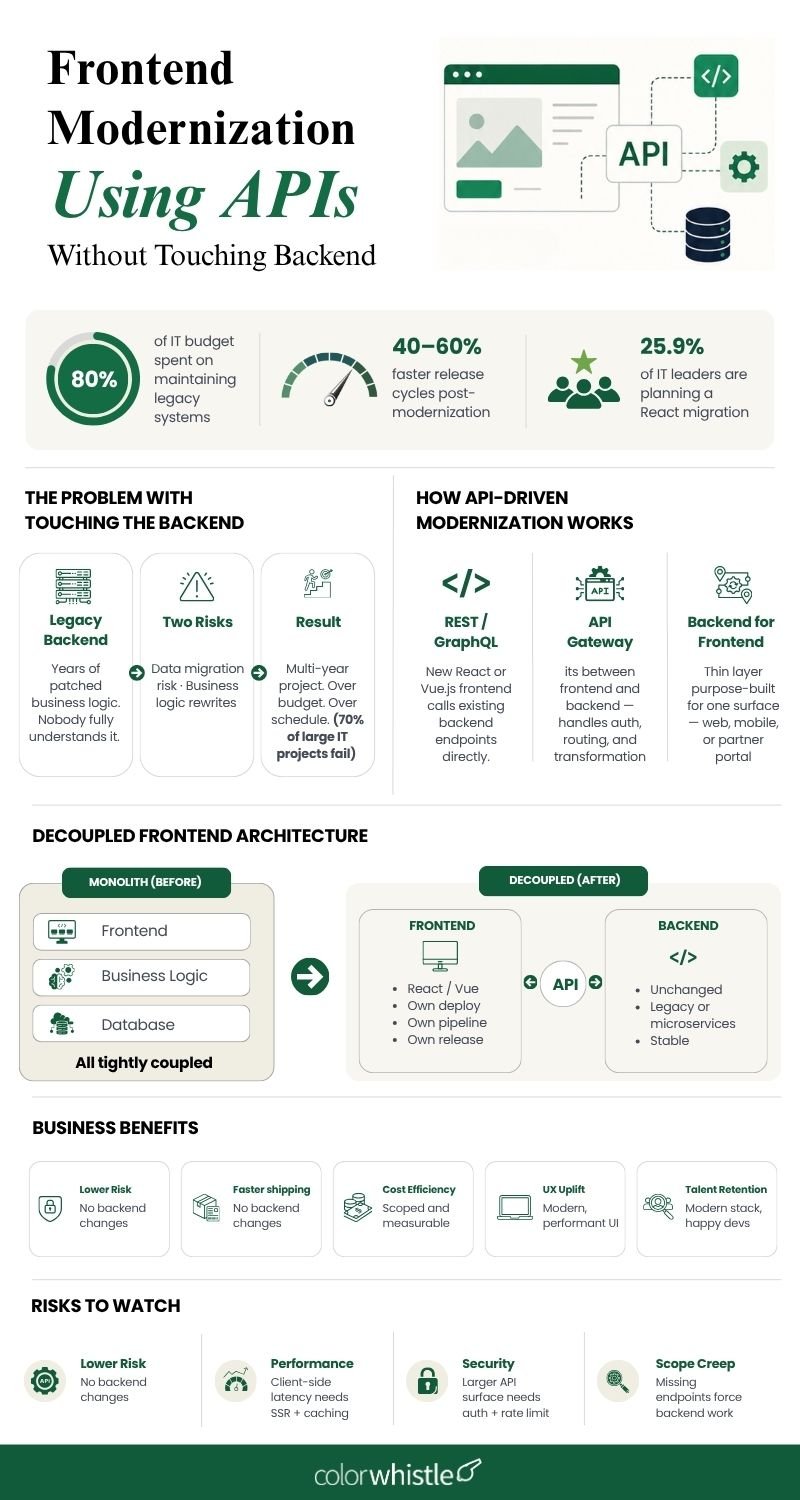
The backend of most enterprises isn’t just code; it’s business logic that has been tuned, patched, and hardened over years. Touching it introduces risks that most organizations simply cannot absorb.
Consider what a full replatforming involves: migrating data without loss, rewriting business logic with zero regressions, coordinating across teams that all have different priorities, and keeping the lights on in production while the rebuild happens in parallel. Research from McKinsey consistently shows that large-scale IT transformations run over budget and over schedule more often than not.
Beyond cost, there’s a human factor. The engineers who understand your legacy backend may no longer be at the company. Documentation is often incomplete. In many cases, the safest thing you can do with a working backend is leave it alone.
API-first development solves this by drawing a clear boundary. The backend keeps doing what it does well in processing data, enforcing business rules, and managing transactions. The frontend is liberated to evolve at its own pace.
Did You Know?
Organizations that completed legacy system modernization report 40–60% faster release cycles and a 20–40% reduction in total cost of ownership over three years.
How API-Driven Frontend Modernization Works
The core principle is straightforward: expose your backend capabilities as APIs, then build a completely new frontend that consumes those APIs. The two systems communicate through well-defined contracts rather than being tangled together in a single codebase.
In practice, this usually involves one of three approaches:
Direct REST or GraphQL Integration, if your backend already exposes REST endpoints or can be wrapped in a GraphQL layer, your new React or Vue.js frontend can call those APIs directly. GraphQL integration is particularly powerful, here it lets the frontend request exactly the data it needs, reducing over-fetching and under-fetching that plagues older REST implementations.
API Gateway as an Abstraction Layer, an API gateway sits between your new frontend and your existing backend systems. It handles authentication, rate limiting, request routing, and response transformation. This is especially useful when the backend is a patchwork of microservices, third-party systems, or legacy endpoints with inconsistent response formats. The gateway presents a clean, unified API surface to the frontend team.
Backend for Frontend (BFF) Pattern A BFF is a thin service layer purpose-built to serve a specific frontend for your web app, mobile app, or partner portal. It aggregates data from multiple backend services and returns exactly what the frontend needs. This removes the burden of complex data stitching from the client side and keeps the frontend code clean.
Regardless of the approach, the result is the same: your frontend team can work with a stable API contract and build without waiting for backend changes.
Also Read
Rebuilding UX While Preserving Backend Systems
One of the most powerful aspects of this approach is the ability to do a complete React migration or Vue.js modernization while the existing system continues to serve production traffic.
Teams typically use a strangler fig pattern routing certain pages or user journeys to the new frontend while others remain on the legacy system. Over time, the new frontend “strangles” the old one, handling more of the surface area until the old system can be fully decommissioned or reduced to a backend-only service.
This approach has several practical advantages:
Incremental rollout: You can ship the new experience to a percentage of users, gather feedback, and iterate before full migration.
Lower blast radius: If something goes wrong with the new frontend, traffic can be routed back to the legacy system instantly.
Team autonomy: Frontend engineers work on a decoupled codebase with their own CI/CD pipeline, deployment cadence, and tech stack without coordination overhead from backend teams.
Modern component-driven frameworks like React and Vue.js are built for exactly this kind of work. Combined with design systems and tools like Storybook, teams can build consistent, accessible, and performant interfaces that are miles ahead of what most legacy frontends offer.
Also Read
Decoupling Frontend Experiences from Legacy Architecture
The broader strategic shift here is the move toward a decoupled frontend and headless architecture. In a traditional monolithic stack, the frontend and backend are tightly coupled templates are rendered server-side; business logic leaks into the presentation layer, and changing one often breaks the other.
In a decoupled model, the frontend is a standalone application. It has no knowledge of how data is stored or processed on the backend. It simply consumes APIs. This decoupling unlocks a range of capabilities that are impossible in a monolithic architecture:
- Multi-channel delivery: The same API layer can power a web app, a mobile app, a voice interface, and a partner portal simultaneously.
- Independent deployments: Frontend releases don’t require backend deployments, which dramatically accelerates release of velocity.
- Technology flexibility: Teams can adopt new frontend frameworks as the ecosystem evolves without any backend changes.
- Microservices frontend alignment: In organizations already moving toward microservices on the backend, a decoupled frontend is the natural complement each service exposes its own API, and the frontend orchestrates them through a gateway or BFF.
This is the architecture that powers the most competitive digital products today. It’s not a future-state aspiration; it’s achievable incrementally, starting with the surfaces that matter most to your users.
Did You Know?
Legacy system maintenance consumes up to 80% of IT budgets in some sectors, leaving little room to invest in innovation or new digital capabilities.
Business Benefits of API-Led Modernization
For technology leaders making the case to stakeholders, the business argument for API-driven frontend modernization is compelling:
- Risk reduction. You are not touching the systems that process your revenue, store your customer data, or enforce your business rules. The risk surface is limited to the presentation layer.
- Speed to the market. Frontend teams move significantly faster when they’re not blocked on backend changes. Decoupled teams ship more frequently, with fewer coordination bottlenecks.
- Cost efficiency. A full replatforming project can run for years and cost many times more than estimated. Frontend modernization using APIs is scoped, deliverable, and measurable you can define clear milestones and show results quickly.
- User experience uplifting. The immediate beneficiary of this work is your end user. Modern frameworks, faster load times, responsive design, and accessible interfaces translate directly into better conversion rates, lower bounce rates, and higher customer satisfaction scores.
- Talent retention and recruitment. Engineers want to work with modern tools. A React or Vue.js codebase backed by a clean API layer is far more attractive to skilled frontend developers than a legacy templating system tied to a monolith.
Risks and Limitations of Frontend-Only Modernization
This approach is not without trade-offs, and being clear-eyed about the limitations is part of a sound strategy.
API versioning and stability. The frontend dependency on backend APIs means that any breaking changes to those APIs can disrupt the frontend. Establishing strong API versioning conventions and change management processes is non-negotiable.
Performance overhead. Client-side rendering and multiple API calls can introduce latency if not managed well. Teams need to invest in strategies like server-side rendering (SSR), edge caching, and efficient data fetching patterns to avoid trading one set of performance problems for another.
Security exposure. A decoupled frontend that calls APIs directly over the internet increases the attack surface. API gateways with proper authentication (OAuth 2.0, JWT), rate limiting, and input validation are essential, not optional.
Organizational misalignment. Frontend modernization without backend collaboration can lead to APIs that don’t serve the frontend’s actual needs, forcing workarounds that accumulate technical debt. Backend and frontend teams need a shared understanding of the API contract and a process for evolving it.
Scope creeps. Starting with “just the frontend” can surface issues with data model limitations, missing endpoints, and inconsistent backend behavior that eventually require backend changes. Having a plan for those dependencies before you start prevents the project from stalling.
Final Thoughts
Frontend modernization using APIs is not a shortcut; it’s a deliberate architectural strategy that respects the complexity of your existing systems while creating space for rapid innovation on the surfaces your users see.
Technology is mature. The patterns are proven. Organizations across financial services, retail, healthcare, and SaaS have successfully shipped modern frontend experiences on top of backends that haven’t changed in years.
The question isn’t whether this approach can work for your business. It’s whether you’re ready to treat your frontend as a product that deserves its own architecture, its own team, and its own roadmap independent of the legacy systems underneath.
If you’re a CTO, Engineering Manager, or Solutions Architect evaluating your modernization options, API-first frontend development deserves a place at the top of your strategy of conversation.
At ColorWhistle, we help businesses design and execute frontend modernization strategies that deliver real results without unnecessary risk. Whether you’re evaluating a React migration, exploring headless architecture, or looking to build an API gateway that unifies your backend services, let’s talk.
FAQ’s
Can we modernize our frontend without breaking existing backend integrations?
Yes, by consuming your backend through stable APIs, the frontend operates as a fully independent layer. As long as the API contract is maintained, your backend integrations remain completely untouched.
Which frontend framework works best for API-driven modernization React or Vue.js?
Both React and Vue.js are well-suited for API-first development, and the right choice depends on your team’s existing skills and ecosystem. Either framework integrates cleanly with REST, GraphQL, or an API gateway layer.
How long does a typical API-led frontend modernization project take?
Timelines vary based on scope, but most teams can ship a modernized frontend for a key user journey within 8–16 weeks using an incremental strangler fig approach. Full migration across all surfaces typically follows in phased releases over 6–12 months.
 Prepare Your Website for AI, Automation & Gen...