


How Content Creation Enables Successful Online Educators

Anusha is a digital strategy expert with deep expertise in branding, UI/UX, and performance-focused content. She brings advanced insight into brands to scale intelligently, blending creativity with conversion-focused thinking.

Our authors are proven experts in their fields, writing on topics where they have demonstrated expertise. Every piece of content undergoes peer review and validation by industry professionals.
AI Summary
Key Highlights of Content Creation for Online Educators
This post explores how consistent content creation empowers online educators to grow sustainably and teach effectively. The key insight: content acts as pre-teaching, building trust, reducing learner uncertainty, and serving as both marketing and market research. It helps educators attract the right students, clarify their teaching, and scale support without burnout. The article outlines a practical content system emphasizing a long-form home base, repurposing, and building a lasting content library. By treating content as an operating system rather than a chore, educators can improve course offerings, student engagement, and predictable income. Next steps involve adopting this system to enhance teaching and business success online.
Online education looks “simple” from the outside. You record a few videos, upload a course, run some ads, and students magically show up. Right.
In reality, the educators who do well online usually aren’t winning because they have the fanciest platform or because they’re the world’s best lecturer. They win because they create content consistently, and that content does a lot of heavy lifting for them. It attracts the right learners, builds trust before a sale, supports students after they enroll, and quietly becomes the engine behind referrals, partnerships, and predictable income.
That’s what this article is about. Not “become a creator” as a trendy idea. But content creation as a practical system that enables online educators to grow, teach better, and not burn out.
Also yes, the title says “Content Creatorion”. I’m assuming we mean content creation. We’re going with it.
The Uncomfortable Truth About Online Teaching
If you teach in a classroom, you’re given a built in advantage: distribution. Students are already there. A school, a university, a company. The institution provides the pipeline.
Online, you don’t get that for free. Even if your material is excellent.
So the problem for an online educator is not only:
Can I teach this well?
Can I structure a course?
Can I help people get results?
It’s also:
- How do people find me?
- Why should they trust me?
- How do I explain what I do in a way that makes sense fast?
- How do I keep students engaged after they enroll?
- How do I stand out in a market where everyone claims they have the “complete guide”?
Content creation answers those questions. Over and over. In public. With proof.
And once you see content as an operating system, not a marketing chore, the whole online educator thing becomes way more controllable.
To further enhance your online teaching experience and reach more students effectively, consider exploring advanced options like creating and selling online courses or utilizing WordPress LMS websites for your educational content. Moreover, embracing AR and VR technologies could significantly elevate your online education delivery by providing immersive learning experiences.
Also Read
Content is the bridge between expertise and trust
Expertise alone does not travel.
You can be brilliant, but if nobody understands what you do, or if they can’t tell whether you’re legit, it doesn’t matter. Online, learners have endless choices, endless tabs open. Trust becomes the currency.
Content is how you convert:
What you know into what people believe you can help them with.
That conversion doesn’t happen in one post. It happens through repetition and clarity.
A good content library does a few things at once:
Makes your knowledge visible. Not just “I’m good at Excel.” But, “Here’s a 30 second technique to clean messy data, here’s why people mess it up, and here’s how to fix it.”
Signals teaching ability. Knowing something is different from explaining it. When people see you explain clearly, they assume you can teach them.
Shows your thinking process. This is huge. Learners trust educators who show how they think, not just what they know. Content lets you model reasoning.
Creates familiarity. People buy from people they feel they already know. Not personally, but mentally. Like, “I like how she explains things. I get it.”
You can call it personal branding if you want. But in practice it’s more like… instructional proof in public.
Why content creation is basically pre-teaching
A lot of educators separate “teaching” and “marketing”. Teaching is noble. Marketing is annoying. This mindset creates a weird split where you feel like you become a different person when you post online.
A healthier model is to treat content as pre-teaching. Before someone becomes your student, they need mini wins:
- A concept that finally clicks
- A mistake they stop making
- A framework that organizes their mess of information
- A feeling of “oh, I can do this”
That is teaching. Just smaller.
When your content consistently produces small wins, you’re not “convincing” people to buy. You’re letting them experience your teaching. Then buying becomes a logical next step.
This is why successful online educators often sound like they’re teaching all the time. Because they are. Even in their marketing.
Content reduces the biggest friction online educators face: uncertainty
Learners hesitate for predictable reasons:
- Will this course be too advanced?
- Will it be too basic?
- Will I actually finish it?
- Will this educator explain things clearly?
- Is this just recycled stuff I can find for free?
- Will I get support?
- Has this worked for people like me?
Good content addresses uncertainty without sounding defensive. Some examples of content that reduces uncertainty include:
- “Here’s who this course is for, and who it is not for.”
- “Here’s a common misconception and why it slows you down.”
- “Here’s what to do when you feel stuck halfway.”
- “Here’s a student’s before and after, and the actual steps they took.”
- “Here’s my approach, and why I don’t teach it the usual way.”
This is one reason educators who post consistently can charge more. Not because they’re louder. Because they remove confusion. They make the path feel clearer.
Clarity is value.
Incorporating effective content marketing services into your strategy can significantly enhance the clarity and effectiveness of your online courses. By doing so, you not only provide valuable information to potential students but also increase online course subscription via digital marketing.
Moreover, understanding current online marketing trends can help tailor your content to better suit the needs of your target audience. It’s also essential to have an online business model checklist in place to ensure that all aspects of your online education business are covered.
Finally, it’s crucial for digital agencies to invest in online marketing as part of their overall strategy. This investment can lead to substantial growth and success in the competitive online education market.
You do not need to be everywhere. But you do need a content system.
Let’s make this practical.
A lot of online educators burn out because they try to do content like influencers do it.
Daily posts. Trending sounds. Constant platform changes. Trying to be funny, viral, polished, perfect.
You don’t need that. You need a system that fits teaching.
A basic educator friendly content system looks like this:
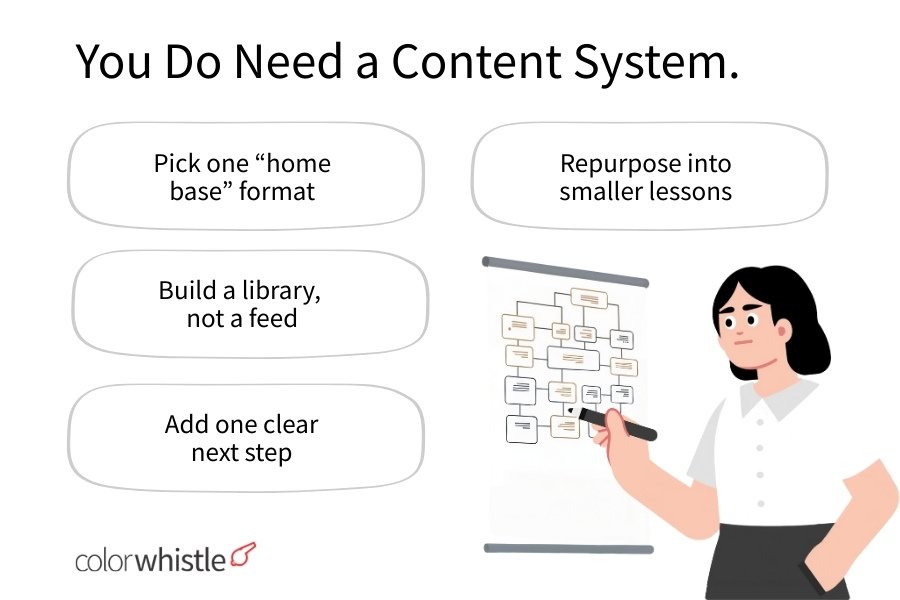
1) Pick one “home base” format
Something sustainable that you can create weekly or biweekly.
- A YouTube video
- A newsletter
- A blog post (yes, still works)
- A podcast episode
- A live workshop recording
This is your long form pillar. The place where you explain things properly. Where your best thinking lives.
2) Repurpose into smaller lessons
From one pillar, extract:
- 3 to 5 short clips or short posts (LinkedIn, Reels, TikTok, Shorts)
- 5 to 10 quote style insights or mini frameworks
- 1 checklist or template
- 1 Q and A post pulled from comments
Now you’re not “creating more”. You’re distributing the same lesson in multiple shapes.
3) Build a library, not a feed
A feed disappears. A library compounds.
The goal is that a student can discover you today and still find relevant lessons you created 6 months ago.
This is why educators who blog or do YouTube often have a strong long term advantage. Search and recommendation engines reward depth and consistency.
4) Add one clear next step
Every piece of content should offer a path forward:
Join your email list
Download a guide
Take a free mini course
Attend a workshop
Apply for coaching
Enroll in the full course
It does not need to be pushy. But it needs to exist. Otherwise your content educates people… and then they leave. Which is fine sometimes. But it won’t sustain a business.
Also Read
Content creation makes your offer easier to sell (and easier to improve)
Here’s something most people miss.
Content is not just for attracting students. It’s also market research.
When you post lessons and ideas, people tell you:
- what they’re confused about
- what they want next
- what they already know
- what language they use to describe their problems
- what objections they have
That feedback is gold. It helps you:
- shape your curriculum
- create better examples
- simplify your explanations
- price your course more confidently
- build the right bonuses and support
Educators who don’t create content often build offers in isolation. They guess what students need. Then they wonder why the course doesn’t sell or why students drop off.
Educators who create content get to “test” concepts in public first.
If a short post about a certain topic gets a strong response, that topic is probably a module. If people keep asking the same question, that question needs a lesson, a checklist, or a walkthrough. If nobody responds to a topic you thought was important, maybe it’s not urgent for the market. Or maybe your framing is wrong.
Either way, content gives you data.
Moreover, repurposing content can further enhance this process. By reusing existing content in different formats or platforms, you can reach wider audiences and gather even more valuable feedback that can inform your course development.
Content helps you teach better inside the course too
This is a big one, especially if you care about student outcomes.
When you consistently create content, you get better at:
- explaining complex ideas simply
- anticipating confusion
- structuring lessons with a clear beginning middle end
- using analogies and examples that actually land
- keeping attention without filler
It’s practice. Public practice.
Also, content creation forces you to clarify your thinking. If you can’t explain a concept in a short post, you probably don’t fully understand where students get stuck. Or you’re trying to teach too much at once.
So content becomes a skill builder. Not just a growth tool.
And yes, over time, your “teaching voice” gets stronger. You find your rhythm. The way you naturally explain. The phrases you repeat. The metaphors that work.
That becomes your signature.
Content is how you scale support without scaling yourself
Every educator hits the same wall.
You enroll more students, which is good. But now:
you answer the same questions repeatedly
you spend more time troubleshooting
you repeat the same encouragement
you rewrite the same explanation in DMs and emails
Content lets you scale support.
Instead of answering a question 50 times, you create:
- a short video response
- a help article
- a “start here” checklist
- a quick Loom walkthrough
- a troubleshooting guide
Then you can point students to it. Or better, build it into the course.
This makes your program feel more supportive, even though you’re spending less time repeating yourself. Everyone wins.
A lot of high performing online educators have a hidden asset: a deep content based support library. Some of it public, some of it internal.
And once you have that, you stop feeling like the only support channel is… your brain, live, at all times.
The compounding effect: content is an asset, not a task
The big reason content enables successful online educators is that it compounds.
A good course can generate income, yes. But a course alone is not always discoverable.
Content is discoverable.
A blog post can rank in search for years. A YouTube video can keep getting suggested. A helpful LinkedIn post can bring in clients months later because someone saved it and finally came back. A newsletter archive can turn new subscribers into buyers without you doing anything new that day.
This is what people mean when they say “evergreen content”.
It is not passive income. It is stored effort.
You do the work once. It keeps working.
Not forever, sure. But long enough that it changes your business.
Over time, content can become your main acquisition channel, which means:
less reliance on paid ads
less panic when a launch flops
more predictable enrollment
a stronger brand moat
And honestly, more calm.
Also Read
Different types of educator content (and what each one does)
If you’re thinking, “Ok, but what do I actually post?”, this section will help.
Most successful online educator content falls into a few buckets. You don’t need all of them, but you should understand what they do.
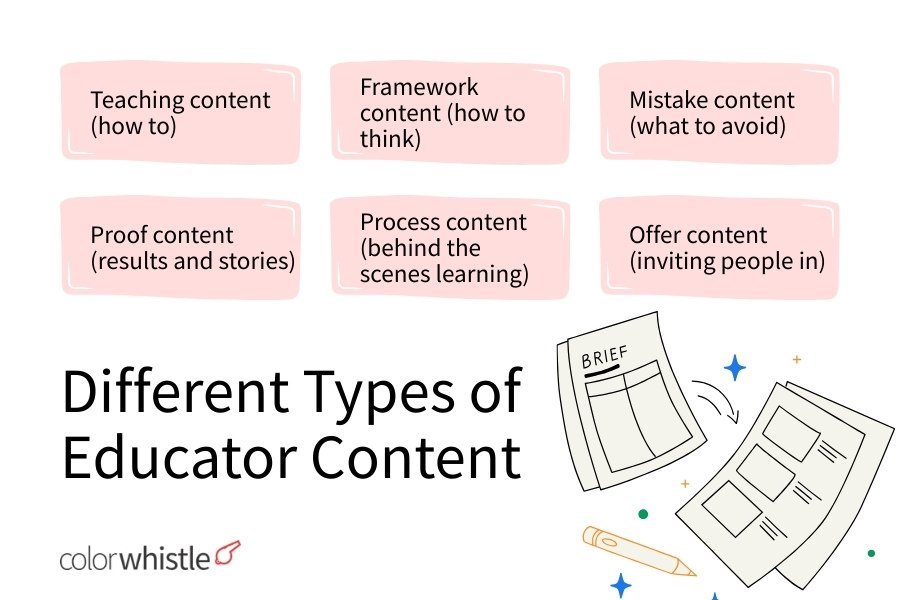
1) Teaching content (how to)
This is the core.
- tutorials
- walkthroughs
- step by step processes
- “do this, not that”
- mini lessons
Purpose: demonstrate expertise and teaching ability. Create small wins.
2) Framework content (how to think)
This is the “teacher brain” content.
- models
- mental maps
- decision trees
- checklists
- “here’s the 3 part system I use”
Purpose: help learners organize information and feel progress quickly.
Frameworks are also incredibly shareable because they compress complexity.
3) Mistake content (what to avoid)
common pitfalls
myths and misconceptions
beginner errors
“why you’re stuck”A
Purpose: reduce frustration, build trust, show you understand real problems.
This content works well because it speaks to pain. But it should still be constructive. Nobody likes being scolded.
4) Proof content (results and stories)
- student case studies
- before and after
- testimonials, but with context
- your own journey, selectively
Purpose: reduce uncertainty. Provide evidence. Make transformation believable.
The best proof content is specific. Not “John loved the course”. More like “John went from X to Y in Z weeks using these steps.”
5) Process content (behind the scenes learning)
how you design lessons
how you practice a skill
how you review student work (with permission)
how you think about progress
Purpose: build familiarity and credibility. Also helps students feel like the work is doable.
6) Offer content (inviting people in)
- what your program includes
- who it’s for
- when to join
- what happens after purchase
Purpose: make the next step clear. This is where many educators get awkward, and then they never sell.
Offer content is not “salesy” if it is accurate and helpful. It’s just information. People need it.
Also Read
Content creation enables better positioning (so you stop competing on price)
Positioning is basically: why you, and why this approach.
Without content, you often end up positioned as “another course on X”.
With content, you can shape your category.
For example, instead of:
- “I teach English pronunciation”
You can position as:
- “I help advanced English speakers sound clear in professional meetings, without losing their accent.”
Instead of:
- “I teach coding”
You can position as:
- “I teach non technical founders how to build simple internal tools in a weekend so they stop waiting on engineers.”
This kind of positioning is hard to establish with a landing page alone. It takes repetition. Examples. Contrast.
Content lets you repeat your positioning in different ways without it feeling repetitive.
And when your positioning is clear, you stop competing with cheap courses. You attract people who want your approach.
A realistic content workflow for online educators
Let’s build a workflow that doesn’t make you hate your life.
Here’s a simple weekly system that works for a lot of educators.
Step 1: Keep a running question list
Where do questions come from?
- student emails
- comments
- DMs
- live workshop chat
- your own course community
- calls with clients
- even your own past confusion when learning the skill
Every question is content.
If you have 50 real questions, you have 50 content ideas that are guaranteed to be relevant.
Step 2: Pick one question and answer it deeply (pillar content)
This becomes:
one blog post, or
one video, or
one newsletter issue
Teach it properly. Add an example. Add a mini exercise. Include mistakes.
This is the main creation step.
Step 3: Slice it into 5 smaller pieces
From the pillar, create:
- one “quick tip” version
- one myth busting version
- one checklist version
- one example or case study snippet
- one call to action invite
Now your week has content without you brainstorming from scratch.
Step 4: Send people to one place you own
This matters.
Platforms change. Reach changes. Algorithms do whatever they want.
So your content should steadily move people to:
- your email list, and/or
- your community, and/or
- your website
Some educators resist email because it feels old. It’s not. Email is still one of the few channels you own. For educators, it’s especially powerful because you can teach in sequence, like a mini curriculum.
Step 5: Review what worked monthly
Once a month:
Which posts got saves or long comments?
Which posts brought email subscribers?
Which topics led to course inquiries?
Which lessons confused people?
Then adjust.
Educators who treat content like a feedback loop improve fast.
Content creation also protects you from platform risk
This is the boring business part, but it’s real.
If your entire business depends on one platform:
- one algorithm change can cut your reach
- one account issue can block your income
- one trend shift can make your content style feel outdated
A content system that includes evergreen assets reduces risk.
Evergreen assets include:
- blog posts (especially SEO focused, but even non SEO can help)
- YouTube videos
- a newsletter archive
- downloadable guides and templates
- a lead magnet that consistently converts
This doesn’t mean “avoid social media”. It means use social media as distribution, not as your only foundation.
Successful educators usually build at least one stable channel plus one fast channel.
The Role of a Virtual Classroom Website
Incorporating a virtual classroom website into your content strategy provides a stable channel for delivering educational content. This platform allows for seamless integration of various teaching resources and aids in building an online community where students can interact and learn effectively.
Leveraging Education Website Design Services
To maximize the effectiveness of your online education platforms, consider utilizing professional education website design services. These services ensure that your website is user-friendly, visually appealing, and optimized for search engines, thereby attracting more visitors and potential students.
Utilizing EdTech Platforms with Data AI Personalization
Furthermore, integrating EdTech platforms with data AI personalization into your strategy can significantly enhance the learning experience. These platforms utilize advanced data analytics and AI technology to personalize
What “successful” educators are actually doing differently
Let’s zoom out.
Successful online educators tend to do a few things repeatedly, and content is woven through all of them.
They make the outcome concrete
They don’t just promise “learn marketing”. They promise a specific transformation.
Content is how they show what the transformation looks like in real life. This could include leveraging user-generated content in video marketing to showcase real-life transformations.
They speak to a specific student
Not everyone. Not “beginners and advanced learners and professionals and hobbyists”.
A clear student profile makes content easier to create because you know what to explain and what to skip.
They teach the same core ideas in multiple ways
This is not redundancy. It’s good teaching.
Learners need repetition with variation.
Content gives you the space to repeat your core ideas as:
- stories
- analogies
- examples
- step by step demos
- checklists
- Q and A
For example, live streaming content can be an effective way to teach core ideas while also engaging with students in real-time.
They build trust before asking for a sale
They don’t hide behind a paywall and expect people to buy blind.
They give enough value that learners think, “If this is free, the paid thing must be solid.”
They document student success
They collect stories, screenshots, measurable outcomes.
Not for bragging. For clarity. For proof. For momentum.
And yes, content is where those stories live. This is where documenting success becomes crucial.
Content improves retention, not just acquisition
Most educators focus on getting students. But retention matters too.
If students don’t complete your course or don’t get results, you’ll struggle long term, even with great marketing.
Content helps retention because you can:
remind students of key lessons
answer common questions publicly
share success stories that motivate others
teach “support lessons” that keep people moving
Some educators run a weekly newsletter that serves both prospects and current students. The prospect sees value and trust. The student gets reminders and encouragement. Same content, two functions.
Also, content can reduce refund requests, because people are more informed before they buy. They know your style, your pacing, your expectations.
The best customers are educated customers. Content does that education.
Common mistakes educators make with content (and how to avoid them)
Mistake 1: Trying to sound like a corporate brand
Education content works best when it’s clear and human.
You don’t need to write like a textbook. You also don’t need to write like an influencer. Somewhere in the middle.
Simple language. Real examples. Short paragraphs. Directness.
Mistake 2: Teaching everything for free without a boundary
This is tricky because educators are generous by nature.
But if your content contains the entire course, in order, with all templates, feedback, and support… then there’s no reason to buy.
A good boundary is:
- teach the “what” and “why” freely
- teach the “how” with depth and support in the paid offer
You can still share “how” publicly, but not the complete system with personalization and structure.
Think of your free content as lessons. Your paid offer is the curriculum plus support.
Mistake 3: Being inconsistent, then restarting from zero
The stop start cycle kills momentum.
It’s better to publish one piece weekly for a year than ten pieces in a week and then disappear for two months.
Consistency builds:
- audience expectation
- your teaching skill
- platform signals
- your content library
Mistake 4: Making content too broad
“Today I’m going to talk about productivity.”
Ok, but which kind, for who, for what goal.
Better:
- “How to plan a 90 minute study session when you have a full time job”
- “A simple revision method for language learners who forget everything after a week”
- “How to practice piano when you only have 15 minutes”
Specificity is kindness.
Incorporating effective education digital marketing strategies can help avoid these common pitfalls. Additionally, leveraging tailored WordPress solutions for the education industry can enhance your online presence and make your content more accessible and engaging.
Mistake 5: Never inviting people to take the next step
Educators often fear being annoying.
But if someone loves your content and wants to learn from you, they need a clear next step. Make it easy.
Even a simple line helps:
“If you want the full system, I teach it inside X.”
“If you want feedback, join Y.”
“If you want the templates, download Z.”
Be direct. Not dramatic.
Also Read
Making content creation sustainable (without burning out)
Sustainability is the whole game.
Here are a few practical approaches that help educators keep going.
Batch your creation, not your posting
Create 2 to 4 pieces in one sitting. Schedule them out.
This reduces the daily mental load.
Use templates for recurring content
For example:
- Problem: “Here’s the mistake”
- Why it happens
- Fix: “Do this instead”
- Example
- Next step
Same structure, different topic. This makes content faster and clearer.
Teach what you already taught
If you’ve answered something in a call, in a student email, in a workshop… turn it into content.
You are allowed to repeat yourself. In fact you should.
Keep production quality appropriate
If you teach math, coding, design, or business skills, you do not need cinematic lighting.
Clear audio. Clear visuals. Clear structure.
The point is learning.
Build a small “idea inbox”
A note on your phone. A Notion page. A Google Doc. Whatever.
Whenever you think, “People get this wrong a lot,” or “This explanation worked,” add it.
That list becomes your next 3 months of content.
Content creation and credibility: what actually builds authority
Authority online is not about being loud or controversial. Not for educators.
It’s mostly built through:
- clear explanations
- consistency over time
- student outcomes
- specificity
- intellectual honesty
That last one matters more than people think.
If you occasionally say:
“This is what I know, and here’s what I’m still testing.”
“This method works for these cases, not for those.”
“Here’s a tradeoff you should be aware of.”
People trust you more. Because it sounds like a real educator, not a marketer.
Content gives you a place to demonstrate that honesty.
A simple blueprint: turning content into an education business
Here’s a straightforward flow that many successful online educators end up with, even if it looks different on the surface.
- Free content that attracts the right learners
- Email list where you teach in sequence and build trust
- Low friction offer (workshop, mini course, template pack)
- Core offer (full course, cohort program, coaching)
- Ongoing content that supports students and attracts new ones
- Proof loop where student results become content
- Back to step 1, but stronger
This is not a funnel in a sleazy sense. It’s a learning pathway.
Content is the connective tissue.
Exploring various online education business ideas
There are numerous business models for online industries that can be explored to generate revenue while providing value to learners.
Final thoughts (because this is the part people skip)
If you want to be a successful online educator, you have to accept that teaching and content creation are now linked.
Not because you need to be famous.
But because content is how your teaching travels. It’s how people find you, trust you, understand your approach, and stick with your program long enough to win.
And once you build a content system that fits your life, something shifts. You stop relying on luck. You stop feeling invisible. You start building assets that compound.
You’re still teaching. You’re just teaching out loud.
That’s the job now. And honestly, it can be a good one.
By keeping abreast of the latest content marketing trends, leveraging platforms from the top online learning platforms available today, and implementing strategies from this member-only content guide to retention, you’ll be well on your way to establishing yourself as an authority in your field while also effectively reaching and educating your target audience.
 Online Education Platforms for Coaching Insti...