


Online Learning Statistics for Working Professionals: Adoption & Engagement Insights

Anusha is a digital strategy expert with deep expertise in branding, UI/UX, and performance-focused content. She brings advanced insight into brands to scale intelligently, blending creativity with conversion-focused thinking.

Our authors are proven experts in their fields, writing on topics where they have demonstrated expertise. Every piece of content undergoes peer review and validation by industry professionals.
AI Summary
Key Highlights of Online Learning Statistics for Professionals
This post explores how online learning is transforming skill development for working professionals, emphasizing role-specific and AI-driven education. The key insight: professionals increasingly blend technical AI skills with critical human capabilities like leadership and judgment. It covers current participation trends, the growing importance of credentials, and the shift toward learning integrated within work tasks. Benefits include more personalized, modular, and relevant learning experiences that address time constraints. Supported by 2026 data, it predicts AI tutors, granular credentials, and continuous skill development ecosystems. The article serves EdTech creators and employers aiming to build future-ready professional learning platforms.
Online learning has increasingly become part of how working professionals acquire new skills, stay relevant in changing industries, and prepare for new career opportunities. The shift is no longer limited to taking an occasional online course. Professionals are increasingly learning around their existing work, building role-specific capabilities, developing AI skills, and using credentials to demonstrate what they can do.
The latest data also shows an important change in professional learning. AI is accelerating demand for technical skills, but learners are simultaneously developing critical thinking, judgment, leadership, communication, and other human capabilities.
In this article, we look at the latest statistics available through 2026 to understand how working professionals are participating in online and non-formal learning, what they are learning, how engagement is changing, and what these trends could mean for the future of online learning platforms.
1. Working Professionals Are Already Major Participants in Adult Learning
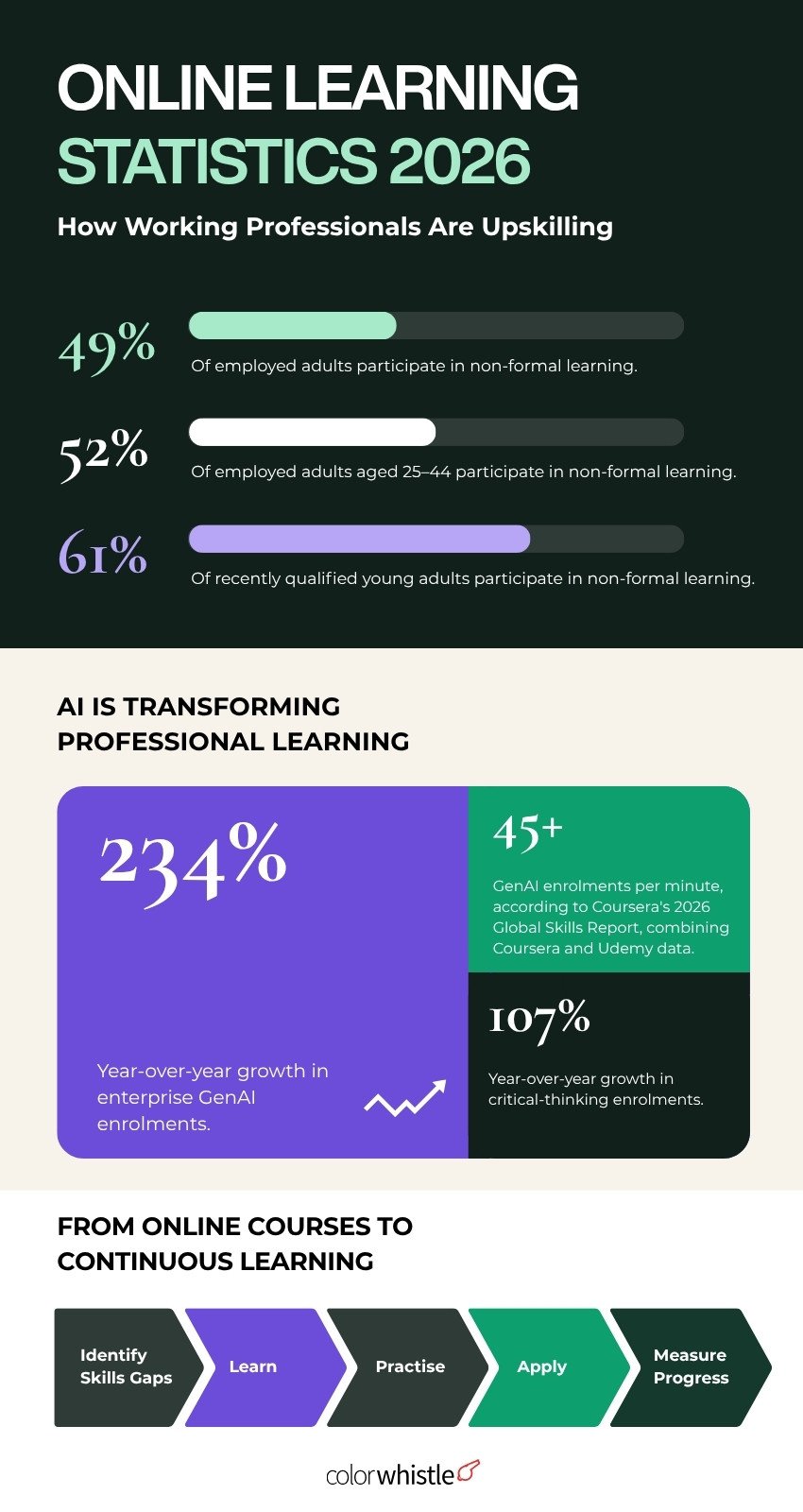
49% of employed adults participate in non-formal learning
According to the OECD’s Education at a Glance 2026, an average of 49% of employed adults across OECD countries participated in non-formal learning. This compares with 34% of unemployed adults and 17% of adults outside the labour force.
What this means
Professional learning is not a niche activity. Nearly half of employed adults are participating in some form of non-formal learning.
For online learning businesses, this suggests that the opportunity is not only in traditional degree programmes. There is a substantial audience for:
- Short professional courses
- Certification programmes
- Role-based learning
- Corporate training
- Skill-specific modules
- AI training
- Continuing professional education
The opportunity is particularly strong when learning can fit around an existing work schedule.
52% of employed adults aged 25 to 44 participate in non-formal learning
The OECD reports that 52% of employed adults aged 25 to 44 participated in non-formal learning in 2023, compared with 45% among employed adults aged 45 to 64.
What this means
The working professional audience is not uniform.
Younger professionals may be more actively building skills early in their careers, while experienced professionals may have different motivations such as leadership development, career transition, technology adoption, or maintaining professional relevance.
Online learning platforms can therefore benefit from role and career-stage based learning pathways, rather than offering the same course catalogue to everyone.
2. Learning Is Becoming More Closely Connected to Work
61% of recently qualified young adults participate in non-formal learning
The OECD found that 61% of young adults who completed their highest qualification within the previous five years participated in non-formal learning, compared with 46% among those whose highest qualification was earned more than five years earlier.
What this means
Learning appears to reinforce further learning.
People who have recently completed formal education may be more accustomed to structured learning and more likely to continue building skills.
For EdTech platforms, this creates an opportunity to connect:
Formal education → first job → professional learning → advanced skills → career progression
Rather than treating education and professional development as separate experiences, platforms can build continuous learning journeys.
79% of learners who improved work performance did so within three months
Coursera’s 2025 Learner Outcomes Report, based on responses from more than 52,000 learners across 179 countries, found that 79% of learners who reported improving their performance at work did so within three months of completing their course or programme.
For working professionals, the value of learning is increasingly measured by application, not simply course completion.
This supports a shift from:
“Complete this course”
to:
“Learn this skill and apply it to your work.”
Online learning platforms can reinforce this through projects, simulations, workplace assignments, assessments, practical exercises, and role-based learning.
3. AI Is Becoming a Major Driver of Professional Learning
Enterprise GenAI enrollments increased 234%
Coursera’s Job Skills Report 2026, based on data from approximately 6 million enterprise learners across nearly 7,000 organizations, reports a 234% year-over-year increase in GenAI enrollments among enterprise learners.
What this means
AI learning has moved beyond specialist technology teams.
Professionals in marketing, finance, operations, HR, sales, customer service, product management, and other functions increasingly need to understand how AI affects their daily work.
This creates demand for learning platforms that offer:
- AI literacy
- Prompt engineering
- AI-assisted workflows
- AI agents
- Automation
- AI governance
- Industry-specific AI applications
The opportunity is therefore shifting from “learn AI” to “learn how AI applies to your role.”
GenAI learning is now happening at more than 45 enrollments per minute
The 2026 Coursera Global Skills Report, which combines Coursera and Udemy data from more than 300 million learners across 98 countries, reports that learners are enrolling in GenAI content at a combined rate of more than 45 enrollments per minute, up from 25 per minute in 2025.
What this means
AI learning is moving at a pace that traditional curriculum cycles may struggle to match.
This creates a challenge for EdTech companies. Course catalogues cannot simply be created once and left unchanged for several years.
Future professional learning platforms will need:
- Faster content updates
- Modular courses
- Continuously refreshed examples
- AI-assisted learning recommendations
- Current industry use cases
- Skills-based pathways
4. Professionals Are Learning Human Skills Alongside AI
Critical thinking enrollments increased 107%
The 2026 Global Skills Report found that critical thinking enrollment grew 107% year over year. Coursera identifies critical thinking and judgment as leading human skills alongside AI-related capabilities.
What this means
The data points toward an interesting change in professional learning.
AI is not simply creating demand for more technical knowledge. It is also increasing the importance of skills needed to evaluate, validate, question and apply AI-generated outputs.
This creates a new learning model:
AI skills + human judgment
rather than:
AI skills instead of human skills
For EdTech platforms, this could mean combining technical modules with critical thinking, decision-making, communication, ethics, leadership, and problem-solving.
Critical thinking growth is also visible across enterprise career areas
Coursera’s 2026 Job Skills Report found year-over-year critical-thinking enrollment growth of 168% among Data learners, 101% among Software and Product learners, and 91% among IT learners. GenAI learners showed an even higher increase of 185%.
What this means
The ability to validate AI-assisted work is becoming a learning priority in technical professions.
This could influence how professional courses are designed.
Instead of teaching only:
“How to use an AI tool”
courses can increasingly teach:
“How to use AI, evaluate its output, identify errors, and make the final decision.”
5. Professional Credentials Are Becoming More Important
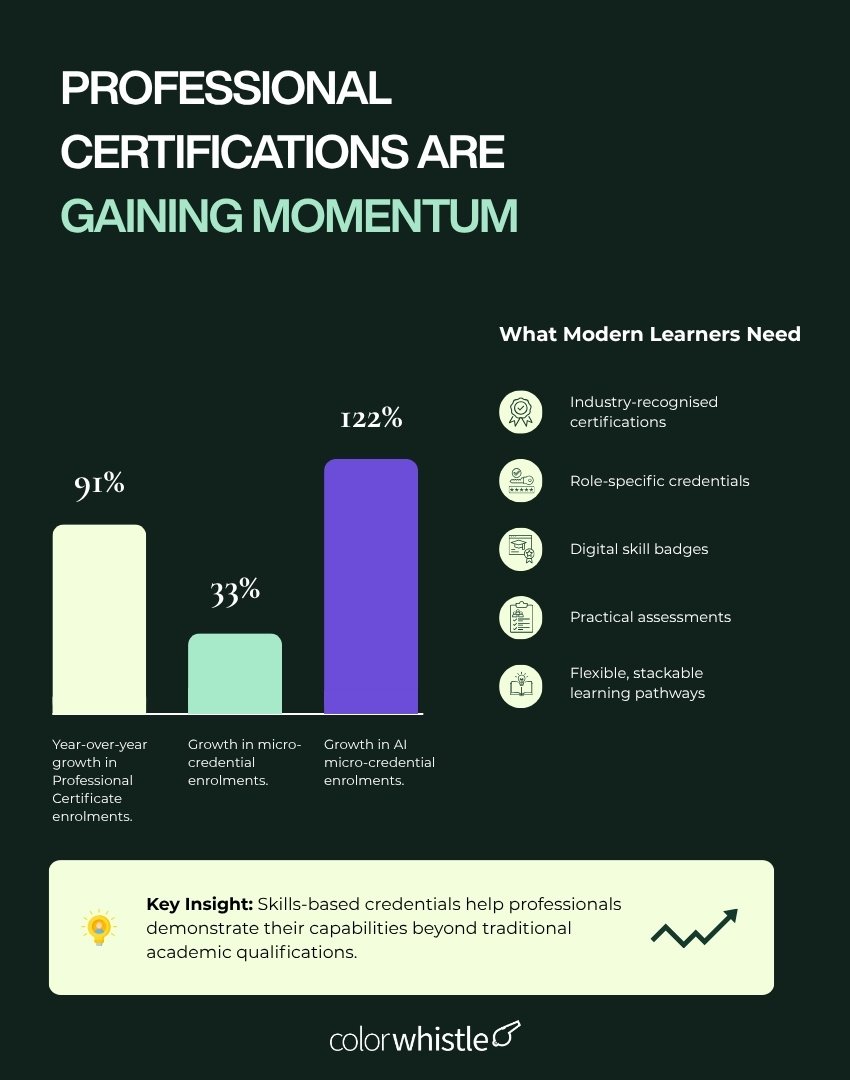
Professional Certificate enrollments increased 91%
Coursera’s 2026 Job Skills Report reports a 91% year-over-year increase in Professional Certificate enrollments across the career areas analysed.
What this means
Working professionals often have a different requirement from traditional students.
They need to demonstrate:
What can I do?
rather than only:
What did I study?
This is helping move online learning towards skills-based credentials, professional certificates, micro-credentials, and portfolio-based evidence.
For EdTech businesses, credentialing can therefore become an important part of the platform experience rather than simply an add-on after course completion.
Micro-credential enrollments grew 33%
The 2026 Coursera Global Skills Report reports that micro-credential enrollments grew 33% year over year, while AI micro-credential enrollments grew 122%.
What this means
The shorter credential may increasingly become useful for professionals who want to demonstrate a specific capability without committing to a long academic programme.
This creates opportunities for:
- Stackable credentials
- Skill badges
- Role-based certifications
- Industry certifications
- AI-specific credentials
- Professional development pathways
6. Time Is Still One of the Biggest Barriers
Lack of time remains a major obstacle to adult learning
The OECD’s 2025 Trends in Adult Learning report found that one in four adults encountered a barrier to participating in adult learning. The most commonly cited barriers included lack of time due to work or family commitments and cost.
What this means
For working professionals, the biggest competitor to an online course may not be another course.
It may simply be their job and personal responsibilities.
This makes learning experience design extremely important.
Platforms can reduce friction through:
- Short learning modules
- Mobile-friendly learning
- Self-paced courses
- Flexible schedules
- Progress saving
- Learning reminders
- Bite-sized assessments
- Learning recommendations
- Learning in the flow of work
Only 15% of employed adults participate in job-related learning lasting more than a week
OECD data shows that only 15% of employed adults participated in non-formal job-related learning activities lasting longer than a week, compared with 38% of unemployed adults.
What this means
Working professionals generally need learning formats that respect limited time.
This supports the growth of modular and stackable learning rather than requiring employees to step away from work for long periods.
An online learning platform designed for professionals therefore needs to make progress possible in small, meaningful increments.
7. Learning Platforms Are Moving Toward Learning in the Flow of Work
Udemy reports more than 10 AI course enrollments per minute
Udemy’s 2026 Global Learning & Skills Trends Report says AI upskilling on its platform is showing strong growth, with more than 10 enrollments in AI courses per minute. The report also emphasizes learning through practice and application in real-world work environments.
What this means
The direction of professional learning is shifting from:
Course → Certificate
towards:
Learn → Practice → Apply → Measure → Improve
This is particularly relevant for corporate training platforms.
Learning systems can become more valuable when they connect training with actual workplace tasks, simulations, projects, assessments, and performance feedback.
8. The Professional Learning Market Is Becoming More Enterprise-Focused
6 million enterprise learners are represented in Coursera’s 2026 Job Skills data
Coursera’s 2026 Job Skills Report analyses learning behaviour from 6 million enterprise learners across nearly 7,000 organizations.
What this means
Professional online learning is increasingly becoming an organizational capability rather than an individual consumer activity.
Businesses need platforms that can help them:
- Identify skill gaps
- Recommend learning
- Track employee progress
- Build role-specific pathways
- Measure skills development
- Support internal mobility
- Prepare employees for AI adoption
This opens opportunities for EdTech businesses to build B2B learning ecosystems, not just consumer course marketplaces.
9. The Need for Upskilling Will Continue Through 2030
59 out of 100 workers may need training by 2030
The World Economic Forum’s Future of Jobs Report 2025 estimates that if the global workforce were represented by 100 people, 59 would require reskilling or upskilling by 2030.
World Economic Forum Future of Jobs Report 2025
What this means
Professional learning is likely to remain a long-term requirement rather than a temporary response to AI.
The challenge for EdTech companies will be keeping learning relevant as skills change.
This points towards platforms that continuously assess:
Current skills → Skill gaps → Recommended learning → Demonstrated capability → Next skill
rather than static course libraries.
What These Statistics Tell Us About the Future of Online Learning
Taken together, the latest statistics point towards five major changes in professional learning.
1. Learning will become more role-specific
Professionals do not necessarily want to learn everything about AI or technology. They want to know how it applies to their job.
2. Shorter learning experiences will remain important
Time constraints make modular, self-paced and stackable learning attractive to working professionals.
3. AI learning will become mainstream
The rapid growth in GenAI learning indicates that AI skills are moving beyond specialist technology roles.
4. Human skills will become more valuable
Critical thinking, judgment, leadership, communication and problem-solving will complement AI skills.
5. Credentials will increasingly demonstrate capability
Professional certificates and micro-credentials can help learners make newly acquired skills more visible to employers.
Predictions for Online Learning for Working Professionals
Based on the current 2026 learning data, these are reasonable forward-looking predictions rather than established statistics.
Prediction 1: Online learning will move from course libraries to skill platforms
Instead of asking:
“Which course should I take?”
professionals will increasingly expect platforms to answer:
“Which skills do I need for my role, and what should I learn next?”
Prediction 2: AI tutors will become part of professional learning
AI can provide explanations, practice questions, feedback, simulations and personalized learning recommendations while the core curriculum provides structure.
Prediction 3: Learning will increasingly happen inside the workflow
Rather than leaving work to complete a long training course, professionals may learn through contextual recommendations, simulations, AI assistants and short modules while completing actual tasks.
Prediction 4: Credentials will become more granular
A single degree or certificate may not communicate enough about a professional’s current capabilities. Skills-based credentials, badges and verified micro-credentials could become more important.
Prediction 5: Human validation will become part of AI education
As AI generates more content and performs more tasks, professional learning will increasingly need to teach people how to evaluate AI output, identify errors, manage risk and make decisions.
Conclusion
Online learning for working professionals is moving beyond the traditional model of watching courses and collecting certificates.
The latest data shows a more dynamic learning environment. Nearly half of employed adults across OECD countries participate in non-formal learning, enterprise GenAI enrollments on Coursera have grown 234% year over year, critical-thinking learning is accelerating, and micro-credential participation continues to grow.
At the same time, time remains one of the biggest barriers to adult learning. This means the next generation of professional learning platforms needs to make learning shorter, more relevant, more personalized and easier to apply at work.
The bigger opportunity is to move from an online course platform to a continuous professional development ecosystem where technology identifies skill gaps, recommends learning, supports practice, tracks progress and helps professionals demonstrate what they can actually do.
For EdTech companies, corporate training providers, universities and professional learning businesses, this creates an opportunity to rethink how learning platforms are designed.
ColorWhistle helps EdTech and education businesses design and develop learning platforms, LMS solutions, AI-powered learning experiences, professional certification portals and custom education technology ecosystems.
If you are planning an online learning platform for working professionals, talk to ColorWhistle about building a learning experience designed around your learners, business model and future technology needs.
Online Learning Statistics FAQs
Is online learning becoming more popular among working professionals?
Yes. OECD data shows that 49% of employed adults across OECD countries participate in non-formal learning, while Coursera’s enterprise learning data shows strong growth in AI skills, professional certificates and critical thinking.
What are working professionals learning online in 2026?
AI and GenAI skills are among the fastest-growing areas. Other important areas include critical thinking, data, IT, software and product development, leadership, project management and other role-specific professional skills.
Why do working professionals prefer flexible online learning?
Time is a major barrier to adult learning. OECD research identifies lack of time due to work or family commitments as one of the most common barriers to participation. This makes self-paced, modular and flexible learning formats particularly relevant to working professionals.
Will AI replace professional learning platforms?
AI is more likely to change how professional learning platforms work than eliminate them. Current data shows growing demand for AI learning alongside critical thinking and other human capabilities. This suggests future platforms will combine AI-assisted personalization with structured content, assessment, credentials and human expertise.
Will micro-credentials become more important?
The current trend points in that direction. Coursera reported 33% year-over-year growth in micro-credential enrollments and 122% growth in AI micro-credential enrollments in its 2026 Global Skills Report.
What should an online learning platform offer working professionals?
A strong professional learning platform should consider short-form learning, role-based pathways, AI-powered recommendations, practical projects, assessments, progress tracking, credentials, mobile access and integration with workplace workflows. These features align with the current shift toward skills-based and applied learning.
 AI Agency Industry Statistics: Market Size, G...