




How is AI Revolutionizing Website Development

Powered by an expert content team, this blog blends SEO precision with compelling storytelling. Every insight is supported by data-driven research, ensuring content that ranks, engages, and drives conversions.

Our authors are proven experts in their fields, writing on topics where they have demonstrated expertise. Every piece of content undergoes peer review and validation by industry professionals.
AI Summary
Key Highlights of AI Revolutionizing Website Development
This post explores how AI transforms website development by integrating machine learning, natural language processing, and automation into design, coding, and testing. The key insight: AI accelerates workflows without replacing developers, enhancing precision and personalization. It supports front-end design with tools generating wireframes and optimizing UX, aids back-end coding with AI-assisted code generation, bug detection, and security, and automates comprehensive QA testing to ensure functionality and accessibility. This guide serves developers and teams aiming to harness AI responsibly, promising faster builds, reduced costs, and smarter user experiences, while preparing readers for future AI-driven web innovations.
Artificial Intelligence has moved from being a buzzword to becoming a core part of how modern websites are designed, built, tested, and maintained. The combination of AI, machine learning, natural language processing, and automation is reshaping workflows for developers and improving the digital experience for users.
This updated guide walks you through how AI fits into today’s website development process, what real value it brings, how teams can use it responsibly, and where the future is heading.
Let’s embark on the scope of AI in website design and development.
1. How AI Has Become Part of Modern Website Development
AI is now embedded across everyday tools developers use. It analyzes large volumes of data, learns user patterns, predicts performance issues, and automates repetitive development tasks.
AI-powered workflows now show up in areas like:
- Chatbots for instant customer support
- Personalized shopping and content recommendations
- Predictive search suggestions
- Geolocation-driven experiences
- Voice-enabled interactions
- Automated testing and accessibility evaluations
AI does not replace developers. Instead, it improves accuracy, speeds up development, and helps teams focus on high-impact decisions instead of routine tasks.
2. Why AI Is a Game Changer in Website Development
AI has become the most influential shift in web development because it assists teams across the entire lifecycle. It improves speed, reduces manual work, increases personalization, and helps ensure consistent performance.
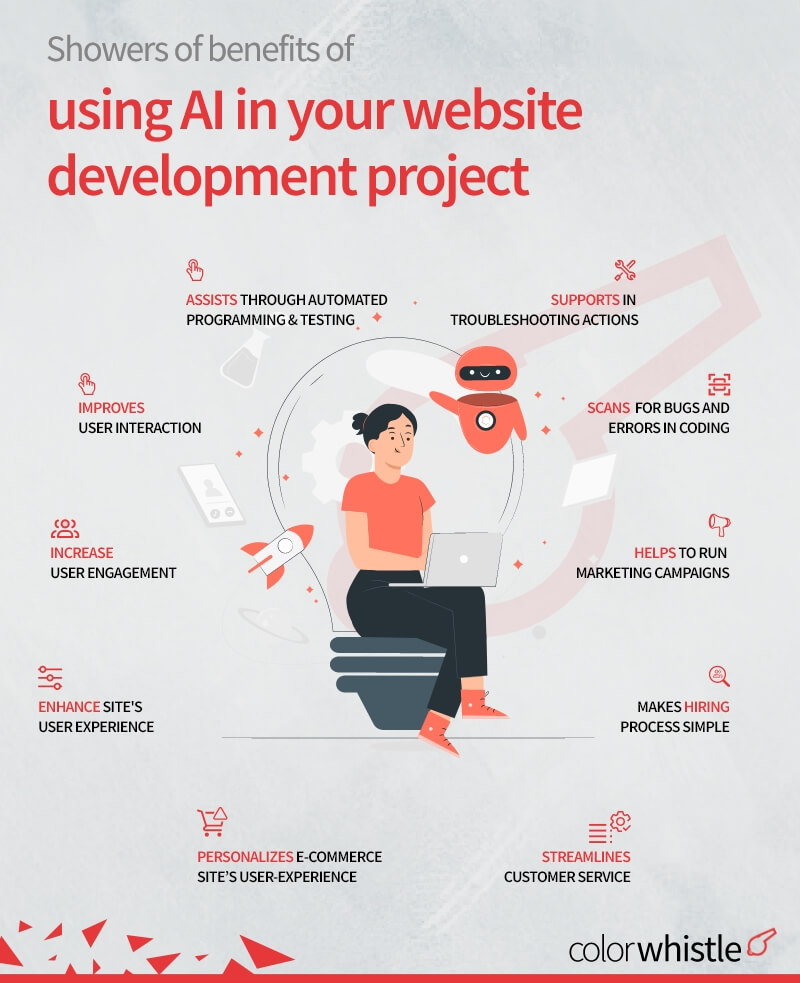
Additional benefits include:
- Better data-driven decision making
- Insights into user behavior
- Lower development and maintenance costs over time
- Higher conversion rates from smarter UX
- Ability to build and iterate faster
AI is now considered a foundational skill for development teams, not an optional add-on.
3. How AI Is Used Across the Web Development Lifecycle
Below is an updated, practical breakdown of how AI supports front-end, back-end, and QA processes in 2026.
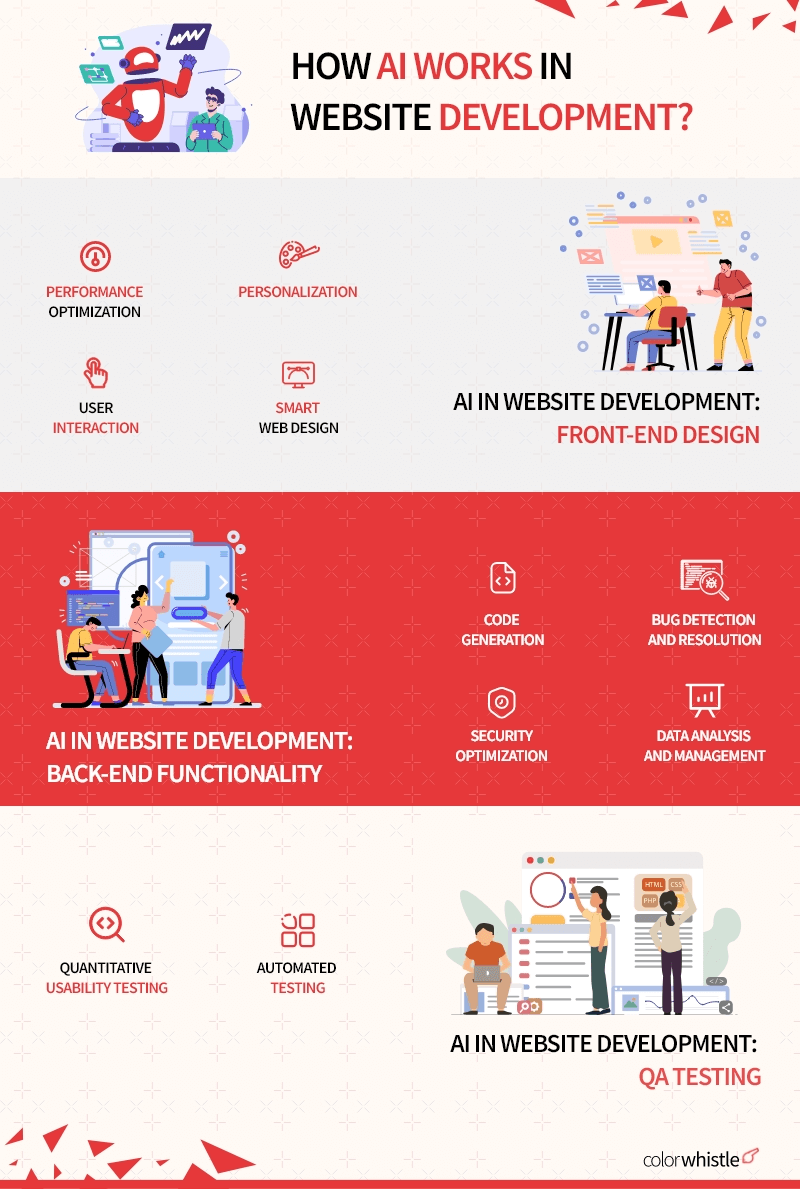
1) AI in Front-End and UI/UX Design
1) Wireframes, Layouts, and Prototypes
AI tools can now convert rough sketches or text prompts into ready-to-edit wireframes or layout mockups. Designers use these tools to speed up early ideation.
Useful capabilities:
- Turn hand-drawn wireframes into HTML or React components
- Auto-generate layout variations
- Suggest alternate versions for A/B testing
- Adjust spacing, alignment, and readability automatically
Front-end of a website is what users view and interact with. Using HTML, CSS, and JavaScript, developers & designers will optimize the look-and-feel of the website. AI-built software like Sketch2Code, Bubble, etc., are capable of generating code from simple web design wireframe sketches.
Did you know?
The Taobao team from Alibabacloud converted 90% of wireframes into code using AI implementation, surprisingly, the code efficiency was about 68%. If you want to read more, check out the link.
2) Performance Optimization
AI flags elements that slow down a page, including:
- Oversized images
- Inefficient animations
- Render-blocking scripts
- Heavy page components
Some tools automatically optimize assets or recommend fast-loading alternatives.
AI-managed caching improves second-page load speeds by 40% or more for returning users.
Source: Fastly Edge AI Performance Report
3) Personalization
AI evaluates how users scroll, click, search, and navigate. With this data, it adjusts:
- Product recommendations
- Section ordering
- Content variations
- Calls to action
4) User Interaction
AI supports designers by optimizing:
- Color combinations
- Typography readability
- Image compression and enhancement
- Contrast and accessible UI elements
This helps deliver modern, inclusive experiences without compromising brand identity.
AI Tools for Front-end/UI/UX Designers/Developers
AI-based Website Builders
AI-based Graphic Design Tools
2) AI in Back-End Development
Back-end is the server-side programming, involving, database, APIs, integrations, login portals, and so on. AI technology with the help of programmers is capable of improving server performance, detecting bugs, fixing code issues, managing security breaches, streamlining redundant tasks, and whatnot.
This doesn’t mean that back-end developers are jobless, AI can be a trained software assisting the developers, minifying their time & manual efforts. Here, we’ve curated a few back-end website operations that AI assists.
1) AI-Assisted Code Generation
Programming is the foundation on which a website can be erected. You might have incorporated multiple features, but to make all those function, coding is essential. Writing multiple lines of coding for an entire site manually will not happen overnight.
Did you know?
Developers using AI code assistants report up to 55% faster task completion compared to coding without AI.
Source: GitHub Copilot research page
Developers either out of their previous experience or coding expertise or internet sources create code. But, with the blooming of AI tools including Chatgpt, OpenAI Codex, Copilot, and many more, programmers can take assistance.
Developers use AI tools to:
- Convert human instructions into working code
- Create API endpoints
- Auto-generate database structures
- Produce boilerplate code
This speeds up development, but still requires human review to ensure security and quality.
2) Bug Detection and Debugging
Detecting bugs in a few lines of code manually is not a tedious process, however, based on features and other integrations, there will be more than thousands of lines. With the help of trained AI tools, you can easily resolve errors.
AI-based debugging tools now scan codebases continuously. They highlight:
- Syntax issues
- Logical errors
- Deprecated functions
- Security vulnerabilities
They also offer direct code fixes or suggestions that developers can apply or refine.
Code Defect AI is a bug detection tool by Microsoft and Altran. To know more about the tool, check out the link.
3) Security Optimization
Website users submit personal details like email, phone numbers, and others for newsletter subscription or enquiry form submissions. Any security malfunctions should not misuse users’ data. And also, you’ll have a lot of hosting details, databases, and so on, all these need to be prevented from threatening data hacks too. It’s the responsibility of developers to produce robust security for user and website data.
AI-based firewalls and behavioral analysis systems detect:
- Suspicious login attempts
- Unexpected API calls
- Malware injections
- Unusual traffic spikes
- Bot attacks
These systems can automatically respond or block threats in real time.
4) Database and Data Handling
Normally, a website has to deal with numerous data. But, all these data will be piled up in a place without any purpose. As you implement AI tech, you can extract insights from various sources.
AI helps streamline:
- Query optimization
- Duplicate data detection
- Pattern recognition across large datasets
- Predictive analytics for business logic
This helps build smarter dashboards and personalized content.
AI Tools Back-End Developers Commonly Use
AI-based Tools
Purpose
Bug detection, code improvement suggestions, code quality checks.
Deepcode (now Snyk Code)
Security-focused code analysis.
Converts natural-language instructions into optimized SQL queries.
Real-time security monitoring for servers, networks, and applications.
Helps developers write code faster by predicting the next line or entire functions.
Amazon CodeWhisperer
AI coding assistant similar to GitHub Copilot, but optimized for AWS-heavy projects.
Tabnine
AI autocomplete focused on speed and privacy.
3) AI in Website Development: QA Testing
A developer job doesn’t complete with development, the website should undergo several testing phases for verifying the working of UI/UX elements and functionalities. Testing can be done in different types, such as, manual and automated.
Did you know?
AI-based code review tools catch 20 to 30 percent more bugs compared to manual review alone
Source: Google AI Engineering research
Quality assurance is one of the biggest beneficiaries of AI. Automated test suites now handle complex testing scenarios that previously needed manual effort.
Automated Functional and Regression Testing
AI runs test cases across:
- Browsers
- Devices
- Network conditions
It identifies breakages early in the development cycle.
Visual Testing
AI detects layout shifts, spacing issues, and UI inconsistencies by comparing versions pixel by pixel.
Performance and Accessibility Testing
AI evaluates speed, Core Web Vitals, and accessibility compliance. It highlights areas that need optimization and often suggests fixes.
Here are a few AI tools for testing,
The AI-powered tools can perform optimal testing of the websites. As you program the AI tool with testing checklist, it can perform automated testing. While you run the QA testing using the AI tool, you can focus on other complex tasks efficiently. These AI-built tools can identify quality issues and improvise.
Also Read
What will be the Future of AI in Web Development?
To know more about an organization/product/service, people look out for websites, the first point-of-contact. With AI-based software, creating a website is now a cup of tea. From design mockups, code generation, automated testing, to SEO enhancement, AI is rapidly evolving. By 2026, the AI market is expected to reach $126 billion.
AI is rapidly evolving. Based on 2026 trends, here’s what the near future looks like:
- Fully AI-generated page templates guided by prompts
- Voice-first and gesture-based navigation
- Emotion-aware UX that adapts based on feedback
- Auto-correcting accessibility violations
- AI agents handling complete modules or flows
- No-code platforms enhanced with powerful AI copilots
- More personalized experiences that adjust in real time
The exponential growth of AI will not replace the band of web developers entirely. Many website development operations cannot be handled by AI tools, they need human intelligence. One thing to make a note of is, learning the new technology models will empower web developers to survive on the grounds and website owners to leave a better user experience to visitors.
Interested in implementing AI services in your website design and development operations? Feel free to reach our ColorWhistle team for AI consultation or integration services. Drop us a message or give us a call at +1 (210) 787 3600 anytime. We can cater to your AI in web development requirements.
What’s Next?
Now that you’ve had the chance to explore our blog, it’s time to take the next step and see what opportunities await!
 How Tutor LMS features help to build a member...







It was such a great article which was on AI Web Development companies in India. Here, I would like to add some easy points in your blog which are as follows.
1.Personalized User Experience
2.Smart Chatbots
3.Design Suggestions
4.Faster Website Development
5.Image and Video Optimization
I hope these points might help your readers.
Impact of AI on web development was easily understandable.
Web design is more important than ever for building a brand’s online identity. A digital marketing agency can help create a website that not only reflects your brand but also drives meaningful engagement.
Investing in professional web design can set your business apart from competitors. A well-designed website builds credibility, enhances brand identity, and provides a seamless experience that encourages visitors to explore your products or services.
Your blog is so informative. I know it involves designing, building, and maintaining websites for individuals and businesses. But I like your writing about Web Development. Keep sharing such helpful information.