


AI in Education Statistics for Schools & Universities: Usage & Future Trends

Anusha is a digital strategy expert with deep expertise in branding, UI/UX, and performance-focused content. She brings advanced insight into brands to scale intelligently, blending creativity with conversion-focused thinking.

Our authors are proven experts in their fields, writing on topics where they have demonstrated expertise. Every piece of content undergoes peer review and validation by industry professionals.
AI adoption in education has moved rapidly from experimentation to everyday use. Students are using AI for research, writing, explanations and learning, while teachers and institutions are increasingly using it for lesson planning, content creation, assessment and administration.
But the numbers also reveal a significant gap between AI adoption and AI readiness.
1. AI Adoption Among Students and Educators
90% of higher education students use AI in class
A 2026 Instructure survey found that 90% of higher education students use AI in class at least occasionally.
Source: Instructure, 2026
68% of K-12 educators use AI in class
The same study found that 68% of K-12 educators use AI in class at least occasionally.
Source: Instructure, 2026
61% of higher education educators use AI
Among higher education educators surveyed by Instructure, 61% reported using AI in class at least occasionally.
Source: Instructure, 2026
95%+ of students and educators surveyed use AI
Coursera’s 2026 survey of more than 4,200 university faculty and students across five countries found that more than 95% use AI tools in an educational context.
Source: Coursera, AI in Higher Education Report 2026
4 out of 5 US high school and college students use AI for schoolwork
Stanford HAI’s 2026 AI Index reports that four out of five US high school and college students now use AI for schoolwork.
Source: Stanford HAI, AI Index 2026
2. What Students Are Actually Using AI For
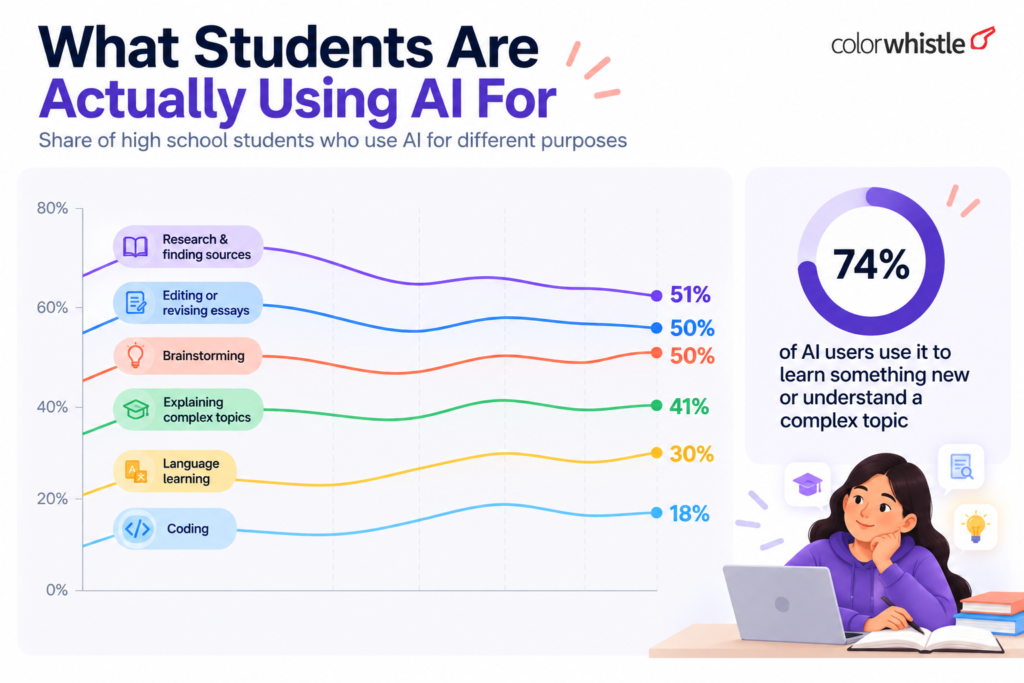
51% of high school students use AI for research and finding sources
Among high school students surveyed by the College Board in 2025, 51% used GenAI for conducting research and finding sources.
Source: Stanford AI Index 2026, College Board data
50% use AI for editing or revising essays
50% of high school students reported using GenAI for editing or revising essays.
Source: Stanford AI Index 2026
50% use AI for brainstorming
Half of surveyed high school students use GenAI for brainstorming ideas.
Source: Stanford AI Index 2026
41% use AI to explain complex topics
41% of high school students use GenAI to understand or explain complex topics.
Source: Stanford AI Index 2026
30% use AI for language learning
30% of high school students surveyed use GenAI for learning languages.
Source: Stanford AI Index 2026
18% use AI for coding
18% of high school students reported using GenAI for writing code.
Source: Stanford AI Index 2026
74% of AI users use it to learn something new or understand a complex topic
Google’s 2025 global survey found that 74% of AI users use AI to learn something new or understand a complex topic.
Source: Google, Our Life with AI 2025
3. AI Adoption Is Moving Into Schools and Universities
63% of higher education institutions in the UK have adopted AI
The UK Government’s 2025/26 Cyber Security Breaches Survey found that 63% of higher education institutions had already adopted AI tools.
Another 22% were in the process of adopting AI, including pilots.
Source: UK Government, Cyber Security Breaches Survey 2025/26
53% of primary schools have adopted AI
The same survey found that 53% of primary schools had adopted some AI tools, while another 11% were in the process of adopting them.
Source: UK Government, 2025/26
53% of secondary schools have adopted AI
53% of secondary schools had already adopted AI tools, with another 23% in the process of adopting or piloting them.
Source: UK Government, 2025/26
40% of Indian higher education institutions use AI-powered tutoring and chatbots
An EY and FICCI study of Indian higher education institutions found that 40% were using AI-powered tutoring and chatbots, while 39% had introduced adaptive learning platforms.
Source: EY India, 2025
92% of higher education professionals report using AI tools
UNESCO reports that 92% of higher education professionals use AI tools, although only 23.6% feel very confident using them.
Source: UNESCO, AI and Technologies in Education
4. The AI Readiness Gap Is Becoming Clear
45% of K-12 educators have received no formal AI training
Instructure found that 45% of K-12 educators surveyed had received no formal AI training.
Source: Instructure, 2026
41% of higher education educators have received no formal AI training
The figure was 41% among higher education educators.
Source: Instructure, 2026
Only 8% of K-12 educators report comprehensive AI training
Just 8% of K-12 educators surveyed said they had received comprehensive AI training.
Source: Instructure, 2026
Only 11% of higher education educators report comprehensive AI training
Among higher education educators, only 11% reported receiving comprehensive AI training.
Source: Instructure, 2026
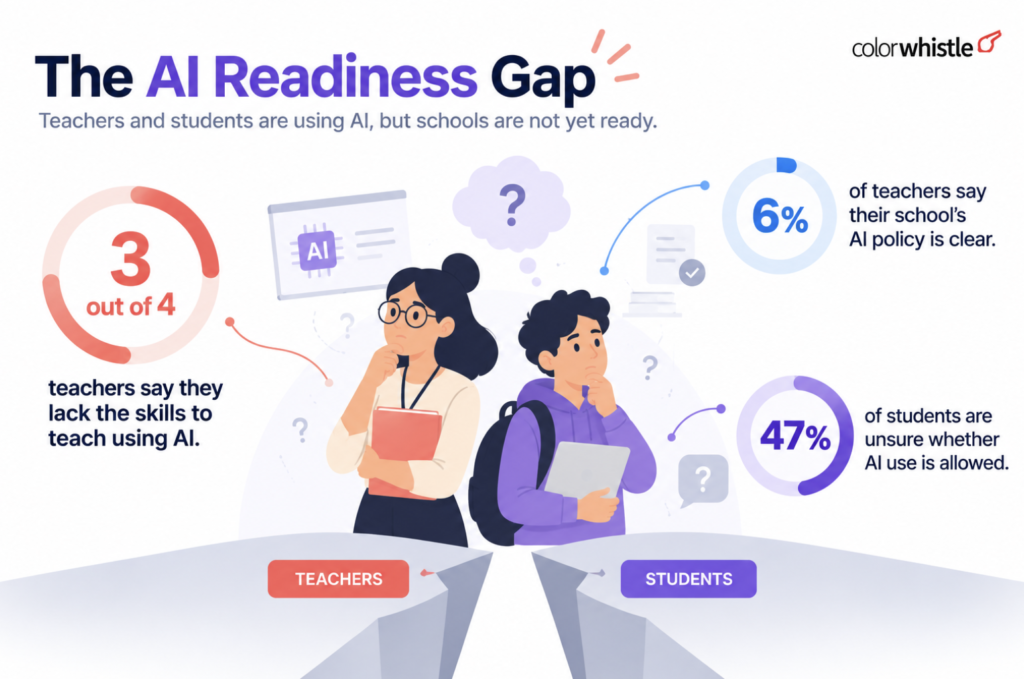
3 out of 4 teachers say they lack the skills to teach using AI
OECD TALIS 2024 data shows that around three in four teachers report lacking the knowledge or skills to teach using AI.
Source: OECD, TALIS 2024
Only 6% of teachers say their school’s AI policy is clear
Stanford’s 2026 AI Index reports that only 6% of teachers say their school’s AI policies are clear and comprehensive.
Source: Stanford HAI, AI Index 2026
47% of students are unsure whether AI use is allowed
Among students surveyed in the Stanford AI Index, 47% said they had wanted to use AI for schoolwork but were unsure whether it was allowed.
Source: Stanford HAI, AI Index 2026
72% of teachers believe AI can compromise academic integrity
OECD’s 2026 Digital Education Outlook reports that 72% of lower secondary teachers believe AI can enable students to pass off others’ work as their own.
Source: OECD, Digital Education Outlook 2026
5. AI in Education Is Moving Toward Structured, Responsible Use
57% of teachers say AI helps create or improve lesson plans
OECD reports that 57% of lower secondary teachers agree that AI helps them write or improve lesson plans.
Source: OECD, Digital Education Outlook 2026
68% of AI-using teachers use it to learn or summarize a topic
Among teachers who use AI, 68% use it to efficiently learn about or summarize a topic.
Source: OECD, TALIS 2024
64% use AI to generate lesson plans or activities
64% of teachers who use AI report using it to generate lesson plans or activities.
Source: OECD, TALIS 2024
Only 25% use AI to review student participation or performance
Just 25% of AI-using teachers report using AI to review student participation or performance.
Source: OECD, TALIS 2024
40% of teachers believe AI helps support students individually
Around 40% of teachers agree that AI helps them support students individually.
Source: OECD, TALIS 2024
Nearly two-thirds of universities have or are developing AI guidance
A UNESCO survey across 90 countries found that 19% of participating higher education institutions already had a formal AI policy, while another 42% were developing AI guidance.
Source: UNESCO, 2025
What These Statistics Predict About the Future of AI in Education
The numbers point to a fairly clear direction.
1. AI will become an expected layer of the education experience
When 80% of US high school and college students are already using AI for schoolwork and 90% of surveyed higher education students report classroom AI use, institutions are unlikely to treat AI as an optional technology for much longer.
Prediction: The question will shift from “Should students use AI?” to “How should students use AI to learn effectively?”
2. AI tutors will become more valuable than generic AI access
Students are already using AI to research, edit, brainstorm and understand complex topics. The next opportunity is to turn these isolated activities into structured learning journeys.
Prediction: AI tutor platforms will increasingly connect student profiles + curriculum + assessments + adaptive practice + AI tutoring + teacher intervention.
The winning platforms will not necessarily have the most powerful AI model. They will have the strongest learning architecture around the model.
3. Teacher AI literacy will become a major EdTech market
There is a striking gap between adoption and preparation:
68% K-12 educator usage vs 45% receiving no formal training
and
61% higher education educator usage vs 41% receiving no formal training.
Prediction: AI professional development will become a substantial part of education technology. Schools and universities will need platforms that teach teachers not only how to use AI, but when to use it, when not to use it, and how to evaluate its output.
4. AI policies will evolve into AI operating frameworks
Policies are currently struggling to keep pace with usage.
Students are using AI faster than institutions are establishing clear rules.
Prediction: Schools and universities will move beyond simple “AI allowed / AI not allowed” policies toward detailed AI operating frameworks covering:
- Assessment
- Coursework
- Research
- Privacy
- AI literacy
- Academic integrity
- Teacher usage
- Student usage
- AI disclosure
- Human review
- Data governance
5. Adaptive learning could become one of the biggest opportunities
Only 25% of AI-using teachers currently use AI to review student participation or performance, while 40% believe AI can help support students individually.
That suggests that one of the more valuable future applications is still relatively underdeveloped.
Prediction: AI will increasingly move from creating educational content to understanding individual learners.
The next generation of EdTech platforms will increasingly use AI to identify:
What does this student know? → Where are they struggling? → What should they learn next? → What intervention will help? → Did it work?
6. Human-led education will not disappear, but the teacher’s role will change
The evidence does not point toward AI simply replacing teachers.
Instead, AI is increasingly taking over tasks around preparation, explanation, content generation and routine support, while teachers remain responsible for judgment, motivation, relationships, context and complex learning decisions.
Prediction: The strongest education platforms will be designed around a human + AI operating model, not an AI-only model.
Conclusion
The numbers tell a simple story: AI adoption in education is no longer the future. It is already happening.
Students are using it. Teachers are using it. Schools and universities are adopting it. But training, governance and effective learning design are still catching up.
The next phase of AI in education will therefore be less about putting AI into classrooms and more about designing better learning experiences around AI.
The biggest opportunity is likely to be the shift from generic AI assistance to curriculum-aware, personalized, adaptive and measurable learning systems.
For schools, universities and EdTech companies, the question is no longer whether AI belongs in education. The more important question is:
How can AI be designed to improve learning without taking away the thinking, judgment and human connection that make education effective?
FAQs About AI in Education
How widely is AI being used in schools and universities?
AI adoption is already substantial. Stanford reports that four out of five US high school and college students use AI for schoolwork. Instructure found that 90% of surveyed higher education students use AI in class at least occasionally.
What are students mainly using AI for?
Research, finding sources, essay editing, brainstorming and explaining complex topics are among the most common uses. AI is therefore already functioning as an informal learning assistant for many students.
Are schools ready for AI?
Not completely. Adoption is considerably ahead of institutional readiness. Teacher training, policy clarity, AI literacy and academic integrity remain significant gaps.
Will AI replace teachers?
AI is more likely to change teachers’ work than eliminate the teaching role. It can automate repetitive tasks and provide additional learning support, while teachers remain important for judgment, motivation, relationships and complex instruction.
What is the biggest opportunity for AI in education?
Personalized and adaptive learning is one of the strongest opportunities. AI can potentially use learner performance and behavior to determine what a student needs to learn next and provide targeted support.
What will AI education platforms need to provide in the future?
Beyond an AI chatbot, successful platforms will likely need curriculum alignment, learner profiles, adaptive learning, assessments, analytics, teacher dashboards, AI governance, privacy controls and clear human escalation mechanisms.
 AI Tutor Platform Statistics & Adoption T...