
Mental Health App & Therapy Platform Statistics: Usage & Market Insights

Anusha is a digital strategy expert with deep expertise in branding, UI/UX, and performance-focused content. She brings advanced insight into brands to scale intelligently, blending creativity with conversion-focused thinking.

Our authors are proven experts in their fields, writing on topics where they have demonstrated expertise. Every piece of content undergoes peer review and validation by industry professionals.
Mental health apps and online therapy platforms have become an increasingly important part of the digital healthcare ecosystem. From meditation and mindfulness apps to therapist-led platforms, digital mental health solutions are expanding access to support, enabling remote care, and creating new ways for users to manage mental wellbeing.
The opportunity is significant because the global demand for mental health services remains high. The World Health Organization reported in 2025 that more than 1 billion people live with mental health conditions globally, while most people still do not receive adequate care. This gap is creating demand for more accessible and scalable digital mental health solutions.
This article brings together statistics covering mental health app market size, user adoption, online therapy usage, engagement, and future digital mental health trends.
Mental Health App Market Size and Growth Statistics
The mental health app market has evolved from a niche wellness category into a growing digital health market. Apps now cover depression and anxiety management, stress management, mindfulness, sleep, emotional wellbeing, mood tracking, and therapist-assisted care.
Mental Health App Market Statistics
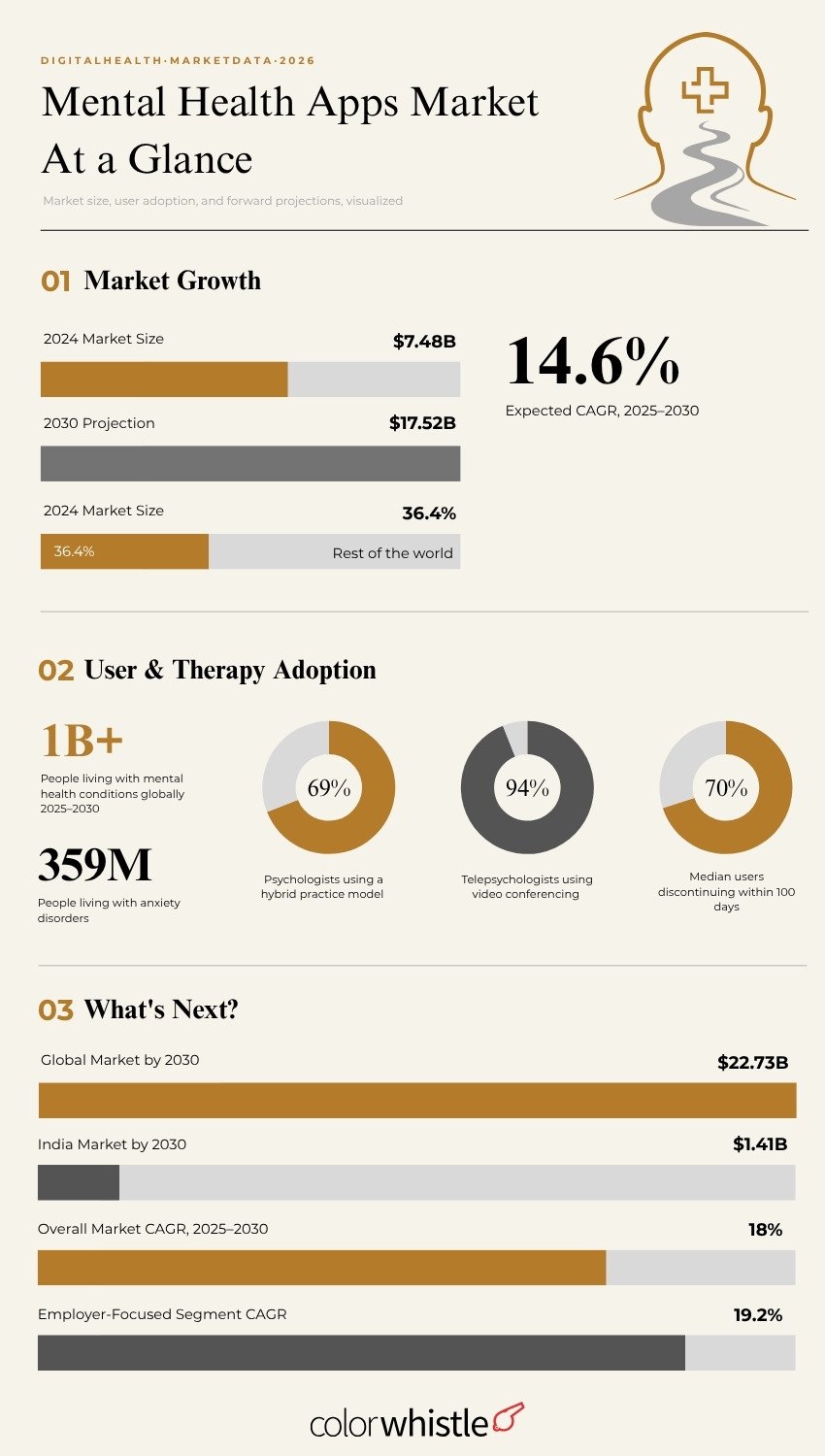
- The global mental health apps market was valued at approximately $7.48 billion in 2024 and is projected to reach $17.52 billion by 2030.
- The global mental health apps market is expected to grow at a CAGR of approximately 14.6% between 2025 and 2030.
- The mental health apps market is estimated to reach approximately $8.87 billion in 2025.
- North America accounted for approximately 36.4% of global mental health app market revenue in 2024, making it the largest regional market.
- Depression and anxiety management represented 28.7% of mental health app market revenue in 2024, making it the largest application segment.
Mental Health App Usage and User Engagement Statistics
Market growth does not automatically translate into sustained user engagement. Mental health apps face a unique challenge because users may download an app when they need support but stop using it once their immediate need changes. Retention, usability, personalization, privacy, and meaningful engagement are therefore critical metrics for digital mental health platforms.
Mental Health App Usage Statistics
- A 2024 systematic review found that 70% of digital mental health intervention studies focused on web-based apps or programs, showing the strong presence of web and mobile technologies in digital mental healthcare research.
- 88% of the digital mental health interventions reviewed in a 2024 systematic review were considered positively acceptable by patients with depression or anxiety.
- A systematic review covering 18 studies and 525,824 participants found that a median of 70% of users discontinued health app use within the first 100 days.
- Research has found that fewer than 4% of users who downloaded some mental health apps engaged with them for at least 15 to 30 days.
- In one study of an employer-sponsored digital mental health platform, 55.9% of participants engaged with at least one available service, including digital resources, coaching, or teletherapy.
- Among participants in the same study, 24.7% used both self-directed digital resources and one-to-one care such as teletherapy or coaching.
Online Therapy and Teletherapy Statistics
Online therapy has become an established component of modern behavioral healthcare. Therapy platforms now combine video sessions, telephone consultations, secure messaging, coaching, self-guided content, and digital assessments. The growth of hybrid care is particularly important because many patients want flexibility without completely replacing traditional therapy.
Online Therapy Statistics
- In 2024, 69% of psychologists reported practicing through a hybrid model that combined remote and in-person services.
- In 2024, 19% of psychologists reported practicing fully remotely, while 12% practiced entirely in person.
- Video conferencing was used by 94% of telepsychologists in the APA’s 2024 practitioner survey.
- Secure messaging usage among telepsychologists increased from 19% in 2023 to 31% in 2024.
- Mental health and substance use outpatient visits represented 40% of all outpatient telehealth visits in 2020, compared with 9% to 11% in 2019.
- In 2024, behavioral health accounted for 67% of telehealth encounters among commercially insured patients in the Trilliant Health analysis cited by the American Hospital Association.
- Behavioral health telehealth visits declined from nearly 50 million in 2023 to just under 40 million in 2024, while behavioral health still represented the majority of virtual visits.
Mental Health Demand, Accessibility and Digital Care Opportunity
The demand for digital mental health solutions is closely connected to the size of the global mental health treatment gap. Mental health apps and therapy platforms are not simply technology products. They are increasingly being positioned as tools that can improve accessibility, provide earlier support, and extend the reach of mental health professionals.
Mental Health Demand Statistics
- More than 1 billion people worldwide are living with mental health conditions, according to the World Health Organization’s 2025 data.
- Depression and anxiety together cost the global economy an estimated $1 trillion every year.
- Nearly 1 in 7 people globally were living with a mental disorder in 2021, equivalent to approximately 1.1 billion people.
- 359 million people were living with an anxiety disorder in 2021, including approximately 72 million children and adolescents.
- The WHO reports that most people with mental disorders do not have access to effective care, highlighting the potential role of scalable digital mental health services.
- In the WHO European Region, telepsychiatry had become established in 35% of Member States surveyed in 2024.
Mental Health App Features, Engagement and Platform Trends
The next generation of mental health platforms is moving beyond simple content libraries. Successful platforms increasingly combine self-guided resources with human support, personalized recommendations, therapy, coaching, assessments, secure messaging, and other digital care features.
Mental Health Platform Statistics
- 71% of the digital mental health interventions analyzed in a 2024 systematic review were based on cognitive behavioral therapy, making CBT the most common therapeutic approach in the research reviewed.
- In a 2024 systematic literature review of digital mental health technologies, engagement style was identified in 88% of the 26 included studies as an important factor in how users valued digital mental health technologies.
- Privacy concerns, limited internet access, and poor technical literacy were identified as important barriers to digital mental health technology use.
- In a real-world study of a digital mental health platform, 67.4% of participants engaged with the level of care recommended to them.
- Among participants recommended therapy in that study, 85% met with a therapist at least once.
- The same study found that 20.2% of participants initially recommended for coaching intensified their care to meet with a therapist.
Mental Health App & Therapy Platform Predictions: 2026 to 2030
- AI-powered mental health support will become a standard platform feature. Source
- The global mental health apps market could reach $22.73 billion by 2030, growing at an estimated 18% CAGR from 2025 to 2030. Source
- Hybrid mental healthcare will become more common, combining self-guided apps, AI support, coaching, teletherapy, and clinical care. Source
- Personalized mental health apps will gain traction as AI, behavioral data, and real-time monitoring to enable more individualized support. Source
- Employer-sponsored mental health platforms will be a major growth segment, with the employer segment projected to grow at 19.2% CAGR through 2030. Source
- Mental health apps will increasingly move toward clinically supported care, including screening, consultation, treatment, monitoring, and coaching. Source
- India’s mental health apps market is projected to reach $1.41 billion by 2030, growing at an 18.5% CAGR from 2025 to 2030. Source
- Privacy, security, and responsible AI will become key competitive factors as mental health platforms handle increasingly sensitive personal and behavioral data. Source
- Mental health platforms will increasingly connect with broader digital healthcare ecosystems, including telehealth, wearables, healthcare software, and remote monitoring technologies. Source
- Mental health apps will shift from download-focused products to outcome-focused platforms, with greater emphasis on engagement, treatment effectiveness, personalization, and measurable improvements. Source
The mental health app and therapy platform market is moving rapidly from basic wellness tools toward AI-powered, personalized, hybrid, and clinically connected digital care. Growing mental health needs, increasing teletherapy adoption, and continued investment in digital healthcare are creating significant opportunities for businesses building solutions in this space.
For organizations planning to build or scale a mental health app, therapy platform, AI-powered wellness solution, or teletherapy product, having the right technology partner is essential.
Looking to build a digital mental health solution? Contact ColorWhistle to explore AI-powered app development, healthcare technology solutions, integrations, and scalable digital platforms.
 100+ AI Tools for Work, Marketing, Creativity...