


Email Validation: Why It Matters More Than Writing Great Emails

Phurvishaa specializes in crafting travel tech and marketing content, leveraging deep research, SEO expertise, and AI-driven insights. Her strategic approach ensures content that educates, engages and delivers knowledge.

Our authors are proven experts in their fields, writing on topics where they have demonstrated expertise. Every piece of content undergoes peer review and validation by industry professionals.
Most cold email advice leads with copy. Subject lines, personalization, follow-up cadence, send timing the assumption being that if the email is good enough, the results will follow.
That’s not wrong. But it’s incomplete in a way that quietly kills campaigns before they have a chance to prove anything.
The most beautifully written cold email in your stack is worthless if it never reaches an inbox. And in 2026, the variable that determines whether your emails reach inboxes more than any other is not your subject line. It’s the quality of your list and whether you validated it before sending it.
Here’s why email validation deserves more attention than it gets, and what happens when it doesn’t.
TL; DR
This blog is for: SDRs, sales managers, RevOps leads, and B2B marketers running cold email campaigns, especially teams hitting deliverability issues or scaling outbound volume for the first time.
- Why bounce rate damages campaigns far beyond the send it happens on
- How wide the inbox placement gap is between strong and weak sender reputation
- What email validation tools check and when standalone tools matter
- The best practices that consistently separate high-performing senders from average ones
- The common omissions that compound into serious deliverability problems over time
What Bounce Rate Actually Does to Your Campaign
A bounce happens when an email can’t be delivered either because the address doesn’t exist (hard bounce) or because of a temporary issue like a full inbox (soft bounce). Hard bounces are the ones that matter about validation because they’re permanent, and mailbox providers treat them as a direct signal about the quality of your list.
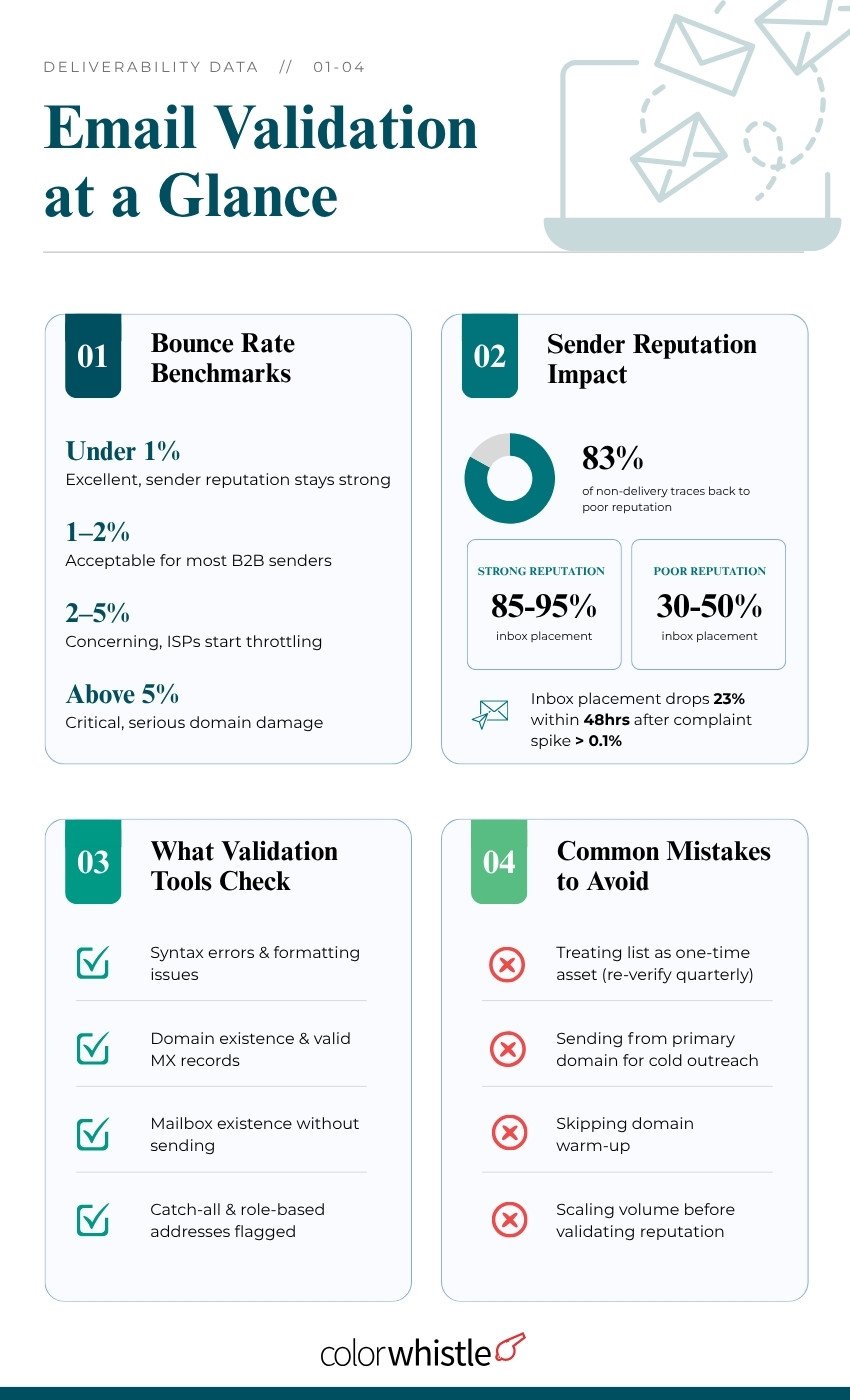
The benchmarks in 2026 are clear
- Under 2% acceptable for most B2B senders; sender reputation stays intact
- 2–5% concerning; ISPs start throttling future sends and filtering aggressively
- Above 5% critical; serious, compounding damage to domain and IP reputation
- Above 3% on cold outreach specifically pause the campaign immediately (Source: Warmforge, Verified Email)
The average cross-industry bounce rate for well-maintained lists is approximately 1.2%. Cold email senders who skip list verification see bounce rates 3–5x higher than that benchmark. (Source: Warmforge)
The compounding effect is what makes bounce rate more damaging than it appears in isolation. A single high-bounce campaign doesn’t just hurt that campaign; it degrades the reputation that every future sends runs on. By the time you notice your open rates dropping, the damage is often weeks old.
The compounding effect is what makes bounce rate more damaging than it appears in isolation. A single high-bounce campaign doesn’t just hurt that campaign; it degrades the reputation that every future sends runs on. By the time you notice your open rates dropping, the damage is often weeks old.
Did you know?
83% of all non-delivery in cold email traces back to poor sender reputation, not content, not subject lines, not send timing. Sender reputation is the primary deliverability variable, and bounce rate is one of its strongest inputs.
(Source: Saleshandy, 53M+ emails analyzed)
Sender Reputation: What It Is and Why It’s Hard to Rebuild
Sender reputation is the behavioral profile that mailbox providers Gmail, Outlook, Yahoo build from your full sending history. Every bounce, complaint, and unengaged send chips away at it. Every reply and positive interaction builds it.
The gap between strong and weak sender reputation is not marginal:
- Fully authenticated senders with clean lists achieve 85–95% inbox placement
- Unauthenticated senders with poor list hygiene land between 30–50% (Source: Saleshandy)
- A strong reputation can lift inbox placement by up to 40% over an average sender
- Inbox placement rates drop by an average of 23% within 48 hours of spam complaint rates spiking above 0.1% (Source: Validity 2025 Email Deliverability Report via Mailvalid)
The spam complaint thresholds from Gmail matter here: the recommended target is below 0.1%. Hitting 0.3% just 3 complaints per 1,000 emails triggers enforcement actions that can block your domain from Gmail inboxes entirely. (Source: Warmforge)
Reputation takes months to build and days to damage. The senders hitting 95%+ inbox placement consistently share one practice above all others: they validate addresses before they enter the sending system, not after bounce rates start climbing. (Source: Mailvalid)
70% of senders don’t monitor their reputation at all relying on ESP dashboards instead of tools like Google Postmaster Tools or Microsoft SNDS. By the time open rates visibly drop, the reputation damage is weeks old. (Source: Saleshandy)
Also Read
Validation Tools: What They Actually Do
Email validation tools check whether an address is deliverable before you send it. The best ones do several things simultaneously:
- Syntax checking – catching formatting errors before anything else
- Domain verification – confirming the domain exists and has valid MX records
- Mailbox verification – pinging the mail server to confirm the specific address exists without sending an email
- Catch-all detection – flagging domains that accept all emails regardless of whether the mailbox exists (a common source of false confidence in enriched lists)
- Role address detection – identifying addresses like info@, support@, or admin@ that are likely filtered, shared, or managed by a team rather than an individual
The tools most used in B2B outbound stacks NeverBounce, ZeroBounce, Bouncer, and Snov.io’s built-in verification all handle the core job reliably. The differences are in API speed for large lists, how they handle catch-all domains, and how they integrate with enrichment and sequencing tools upstream and downstream.
Some enrichment tools include a verification step in their workflow Apollo and Snov.io both do this to varying degrees. The standalone validation tools become more valuable when enrichment data is coming from older sources, multiple combined databases, or when the list has been sitting unused for more than a few weeks.
The workflow that makes sense: enrich → validate → sequence. Skipping the validation step to save time or cost is a false economy. A burned sending domain costs significantly more to recover from in time, in reputation rebuild, and in disrupted campaigns than a year of validation credits.
Best Practices That Hold in 2026
A few things that are consistently true across the data and across team experience:
Validate at collection, not just before sending. Address: decay. A list that was 97% accurate when collected can drop meaningfully in quality over weeks if contacts change roles, companies restructure, or domains change. The right practice is validating at the point of collection and re-verifying the full list quarterly. (Source: Saleshandy)
Keep bounce rate targets tighter than the published thresholds. The 2% benchmark is the ceiling, not the goal. High-performing cold email senders aim for below 1% because of the gap between 1% and 2% compounds over multiple campaigns in ways that accumulate faster than most teams anticipate.
Authentication is a non-negotiable infrastructure. SPF, DKIM, and DMARC are not optional for deliverability improvements; they’re the baseline that Gmail and Microsoft now require. Missing DKIM alone costs 10–15% lower inbox placement. DMARC adoption has increased by more than 11% between 2023 and 2025, but only 35% of senders have it set to enforcement level. (Source: DataPartners, Digital Applied)
Never send to purchased lists. Purchased lists contain spam traps, invalid addresses, and contacts who never opted in. The complaint rates they generate can permanently damage a domain.
Set a sunset policy for inactive contacts. Contacts with zero engagement over 6–12 months should move to a suppression list automatically rather than continuing to receive sends. Sending to unengaged contacts consistently doesn’t hurt directly, but it signals to mailbox providers that your emails aren’t wanted, which degrades placement over time.
Did you know?
16.9% of all emails never reach the intended inbox 10.5% land in spam and 6.4% disappear entirely. A deliverability rate above 95% is considered excellent; below 80% means one in five messages never reaches a subscriber at all.
Source: DataPartners
Common Mistakes That Compound Over Time
The mistakes that damage email programs most aren’t dramatic errors they’re small omissions that compound:
Treating the list as a one-time asset. A list isn’t built and then used indefinitely. It’s perishable that around 25% of B2B contact records go stale within a year. Teams that build a list once and run campaigns against it for months without re-validating are running on increasingly degraded data.
Conflating delivery rate with deliverability rate. Delivery rate measures emails accepted by receiving servers. Deliverability rate measures actual inbox placement. Nearly 88% of senders can’t correctly define the difference and optimizing the wrong metric produces misleading campaign data. (Source: DataPartners)
Sending from the primary business domain. Using the company’s main domain for cold outreach puts the entire organization’s email sender reputation at risk. A dedicated secondary domain for outbound warmed up properly and kept separate from internal communications is standard practice for a reason.
Scaling volume before validating reputation. Increasing send volume on a domain with an unmonitored or degraded reputation accelerates the damage rather than the results. Volume is only an advantage when the foundation underneath it is solid.
Skipping domain warm-up on new sending domains. New domains should start at 5–10 emails per day and ramp gradually over 4–6 weeks. Sending at full volume immediately from a new domain is one of the fastest ways to land in spam before a single qualified prospect has seen your message.
The Bigger Point
The outbound teams consistently hitting strong inbox placement in 2026 are not the ones with the best subject lines. They’re the ones who treat email infrastructure validation, authentication, list of hygiene, reputation monitoring as the first priority, not an afterthought.
Great copy on a well-maintained, validated list with strong sender reputation outperforms great copy on a dirty list every time. The email doesn’t get read if it doesn’t reach the inbox. And it doesn’t reach the inbox if the infrastructure isn’t right.
Validation isn’t the unglamorous part of the outbound. It’s the part that makes the rest of it work.
A clean email list gets you opens. A high-performing website turns those opens into conversations and customers. Discover how ColorWhistle builds B2B websites designed to support every stage of your outbound strategy.
FAQs
What bounce rate should B2B cold email senders target in 2026?
Below 1% is the goal for high-performing senders; the published 2% threshold is the ceiling, not the target. Above 3% on cold outreach is a signal to pause the campaign immediately, as the reputation damage compounds across every future send on that domain.
What’s the difference between delivery rate and deliverability rate?
Delivery rate measures emails accepted by receiving servers. It looks healthy even when emails land in spam. Deliverability rate measures actual inbox placement, which determines whether a prospect ever sees your message. Nearly 88% of senders can’t correctly define the difference, which leads to optimizing the wrong metric entirely.
Do you need a standalone email validation tool if your enrichment tool already verifies emails?
Not always tools like Apollo and Snov.io include a verification step that’s sufficient for recently enriched lists. Standalone validation tools like NeverBounce or ZeroBounce become more valuable when data is coming from older sources, multiple combined databases, or lists that have been sitting unused for more than a few weeks.
 Manual Prospecting vs Automated Prospecting: ...