


Manual Prospecting vs Automated Prospecting: A Practical Comparison

Phurvishaa specializes in crafting travel tech and marketing content, leveraging deep research, SEO expertise, and AI-driven insights. Her strategic approach ensures content that educates, engages and delivers knowledge.

Our authors are proven experts in their fields, writing on topics where they have demonstrated expertise. Every piece of content undergoes peer review and validation by industry professionals.
AI Summary
Key Highlights of Manual vs Automated Prospecting Comparison
This post explores the operational decision between manual and automated prospecting in B2B sales. The key insight: neither method is universally superior; both have strategic roles depending on deal size, team scale, and ICP clarity. Manual prospecting excels in quality and personalization for high-value targets but is time-intensive and costly at scale. Automated prospecting enables massive volume and cost efficiency but depends heavily on data accuracy and configuration quality. The recommended approach is a hybrid model—automated list building combined with human personalization and reply handling—to maximize efficiency and maintain relationship depth, ultimately optimizing pipeline growth and sales outcomes.
Manual prospecting isn’t dead. Automated prospecting isn’t a silver bullet. The teams making the most noise about one or the other are usually either defending a workflow they’ve already built or selling a tool that fits one side of the argument.
The honest reality is that both approaches have a place in 2026 and the decision between them isn’t ideological, it’s operational. It comes down to your deal size, your team size, your ICP breadth, and how much of your pipeline is contingent on volume versus relationship depth.
Here’s a practical, comparison-by-comparison breakdown of where each approach wins and where it doesn’t.
A no-fluff, comparison-by-comparison breakdown of manual and automated prospecting covering where each approach genuinely wins, where it falls short, and how most mature B2B teams end up combining both rather than choosing one over the other.
- Why the time gap between manual and automated prospecting compounds far beyond the obvious
- How the cost comparison flips depending on volume and where the breakeven sits
- Why accuracy cuts both ways and why automated prospecting is only as good as its data layer
- Where automation has no real competitor and what its scalability limits are
- A clear decision framework for when manual, automated, or hybrid is the right call
Time: The Gap Is Real and It Compounds
The time difference between manual and automated prospecting isn’t marginal; it’s structural.
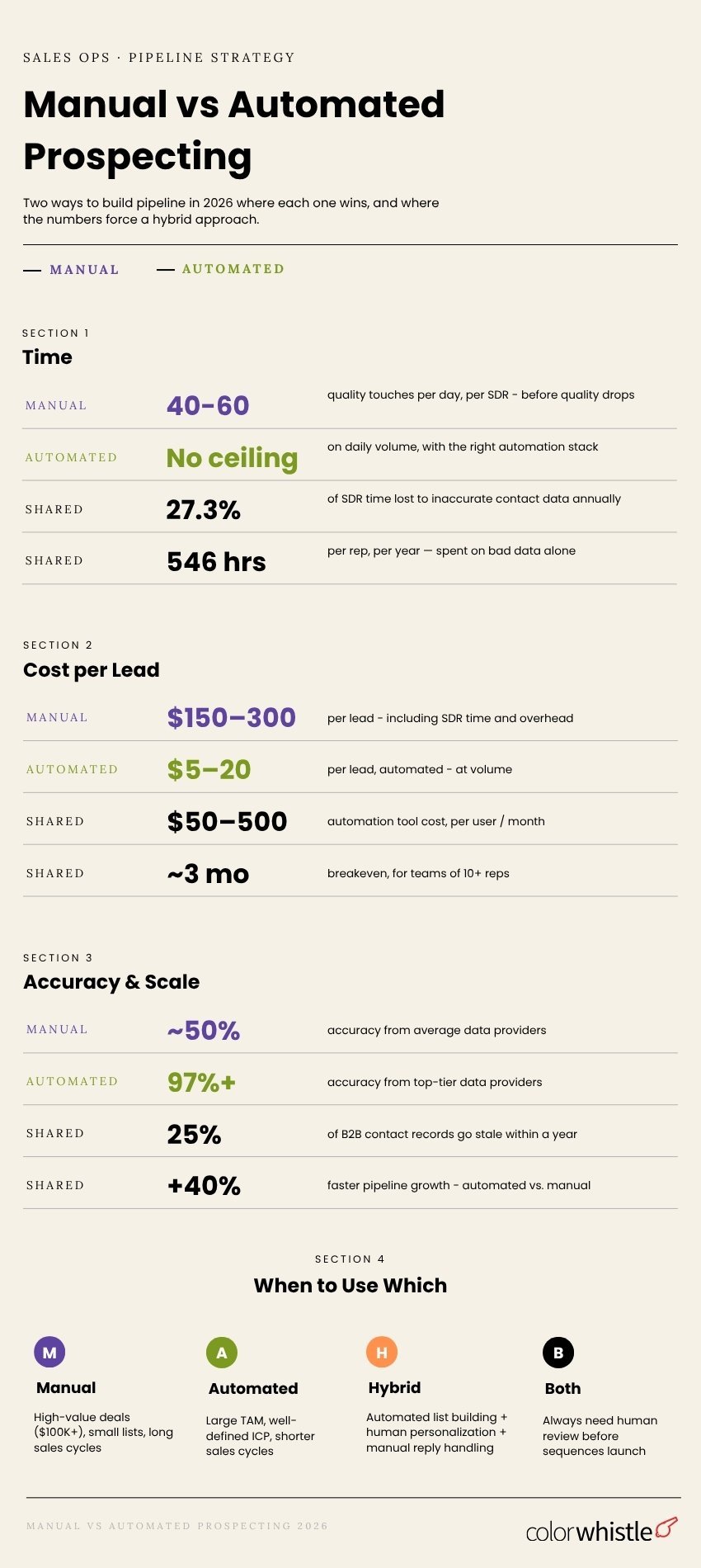
A trained SDR doing manual prospecting averages 40–60 quality touches per day before output quality starts to degrade. Research, writing, sending, and following up, it’s a high-attention workflow that hits a ceiling fast. At that rate, building a list of 200 qualified prospects is a week’s work for one person.
Automated prospecting removes the ceiling on volume. List building that takes hours manually happens in minutes with the right tooling. Follow-up sequences run on schedule without anyone monitoring them. Email verification happens in bulk rather than one contact at a time.
The compounding effect is the part most comparisons understate. Manual prospecting doesn’t just take longer per task; it occupies the cognitive bandwidth that should be going toward conversations. SDRs running fully manual workflows spend a disproportionate share of their time on research and admin rather than on the actual selling.
Where manual wins on time: senior, high-value targets where 20 minutes of genuine research produces a message that gets a reply, versus 20 automated sends that don’t. Time invested per contact goes up; wasted sends go down.
Cost: Depends Entirely on Volume
The cost comparison between manual and automated prospecting is one of the most misrepresented in sales content because it looks different at different scales.
At low volume, manual prospecting is cheaper. An SDR, a LinkedIn account, and a spreadsheet cost less than a stack of automation tools. If your team is working through fewer than 100 prospects per month, the overhead of building and maintaining an automation workflow probably exceeds what you’d save.
At volume, the math inverts. Manual prospecting costs $150–$300 per lead when you factor in SDR time, management overhead, and the hidden cost of errors and missed follow-ups. Automated prospecting at scale brings that number down to $5–$20 per lead to a difference that compounds significantly as pipeline targets grow.
The cost of automation tools for enrichment platforms, sequencers, and validators typically runs $50–500 per user per month depending on the stack. Against an SDR salary of $60K–$100K annually, the breakeven point for teams running 10 or more reps is often around three months.
The hidden cost that neither calculation fully captures: SDR attrition. Manual prospecting roles have high turnover, and replacing an SDR recruitment, onboarding, ramp time costs significantly more than the salary differential between manual and automated workflows.
Did You Know?
Companies implementing quality data platforms as a core component of automated prospecting report 32% higher revenue and 50% reduction in prospecting time requirements compared to teams relying on manual research and static databases.
Accuracy: The Data Quality Problem Cuts Both Ways
This is where the comparison gets more nuanced than most people expect.
Manual prospecting done well is more accurate than automated prospecting done poorly. A skilled SDR researching 20 prospects individually will produce a more consistently relevant list than an automated tool pulling 500 contacts from a stale database with loose filters. The human judgment applied in manual research catching that a contact has moved companies, or that a firmographic match isn’t actually a good ICP fit is hard to replicate automatically.
The problem is that manual accuracy doesn’t scale. The quality of a manually researched list of 20 is high; the quality of a manually researched list of 500, built under time pressure, is not.
Automated prospecting accuracy is directly proportional to data source quality. Top-tier data providers deliver 97%+ accuracy on contact records. Average providers hover around 50%, meaning roughly half the contacts in an automated list could be outdated, misattributed, or simply wrong. (Source: RocketReach)
The practical implication: automated prospecting is only as accurate as the enrichment and validation layer underneath it. A well-configured automated stack with quality data sources and a validation step before sending can match or exceed the accuracy of manual research. A poorly configured one with cheap data amplifies errors at volume, sending wrong messages to wrong people faster than a human ever could.
Did You Know?
Around 25% of B2B contact records become outdated within a year and with average data providers, up to 50% of records may already be inaccurate at the time of purchase. Running automated lists through a validation step before outreach isn’t optional; it’s what keeps accuracy from becoming a liability at scale.
Scalability: Where Automation Has No Competitor
This one isn’t close. Manual prospecting scales linearly with headcounts. If you want to double your outreach volume, you hire another SDR. Automated prospecting scales with infrastructure in the same stack that handles 500 contacts a month can handle 5,000 with configuration changes, not headcount changes.
For teams working through a large total addressable market, or running outbound across multiple segments simultaneously, manual prospecting simply can’t keep up. Automated pipelines grow 40% faster than manually managed ones according to IDC’s 2026 Sales Tech report and Gartner predicts 75% of B2B sales interactions will be digital-first by end of 2026, a shift that structurally favors teams with automation in their outbound stack.
Where scalability has limits in automation: personalization quality. Scaling volume without scaling the thoughtfulness of outreach produces more noise, not more pipelines. The teams that scale automated prospecting successfully are the ones that maintain quality checks for ICP review, personalization standards, reply handling as volume grows, not the ones that remove those checks to move faster.
Also Read
Ideal Use Cases When to Use Which
Neither approach is universally right. Here’s where each one genuinely fits.
Manual prospecting makes sense when:
- Deal values are high enough that significant per-contact research time is justified typically $100K+ deals where one reply from the right person is worth a week’s effort
- The prospect list is small and highly specific niche industries, narrow geographies, or a defined set of named accounts where volume isn’t the goal
- Relationship depth matters more than reach complex sales cycles over six months where trust is built through genuine, individually researched outreach
- The team is early-stage and hasn’t yet validated ICP clearly enough to build reliable automation filters around
Automated prospecting makes sense when:
- Volume is the primary constraint large TAMs, high-frequency outreach, or teams needing to move through a market quickly
- The ICP is well-defined automation only performs well when the filters accurately represent who you’re trying to reach
- The sales cycle is shorter, and the ask is lower where a well-timed relevant message to the right person is sufficient to generate a conversation
- The team has the infrastructure to support it quality data, a validation layer, and human review checkpoints at the right stages
The hybrid that most teams land on: Automated list of building and research, human-written or human-reviewed personalization for high-value targets, automated sequencing with manual reply handling. The automation handles volume and consistency; the human judgment handles the moments where the relationship starts.
The Practical Conclusion
Manual and automated prospecting solve different problems. Manual is higher quality per contact, lower volume, and more expensive to scale. Automated is lower cost per contact, higher volume, and only as good as the data and configuration behind it.
The comparison isn’t really about which is better; it’s about which is right for your deal size, team size, and stage of ICP clarity. Most mature B2B outbound teams run a hybrid, and the balance between the two shifts as the business scales.
What doesn’t change regardless of which approach you use: the quality of your ICP definition, the relevance of your messaging, and what happens when a prospect actually responds.
Want your website to work as hard as your sales team? Explore ColorWhistle’s B2B web design and development services to build a stronger digital foundation.
FAQs
Is automated prospecting always better than manual for B2B teams?
Not always at low volume or high deal values, manual prospecting often produces better results per contact than automation. The decision comes down to ICP clarity, deal size, and volume requirements. Teams with well-defined ICPs, high outreach volume, and shorter sales cycles benefit most from automation; complex, high-value deals with long sales cycles often still warrant manual research.
What’s the real cost difference between manual and automated prospecting?
Manual prospecting costs $150–$300 per lead when SDR time and overhead are factored in; automated prospecting at volume brings that down to $5–$20 per lead. For teams running 10 or more reps, the breakeven on automation tooling is typically around three months after which the cost advantage of automation compounds as volume scales.
How do you maintain accuracy in automated prospecting?
By being deliberate about data source quality and adding a validation step before anything goes into a sequence. Top-tier data providers deliver 97%+ accuracy while average providers sit around 50%, meaning the enrichment tool choice directly determines how much of your automated outreach reaches real, current contacts versus bouncing or landing with the wrong person.
 Serper.dev vs Apollo vs Clay: Which Tool Fits...