




Why Websites Are Now Data & API Layers, Not Just UIs

Phurvishaa specializes in crafting travel tech and marketing content, leveraging deep research, SEO expertise, and AI-driven insights. Her strategic approach ensures content that educates, engages and delivers knowledge.

Our authors are proven experts in their fields, writing on topics where they have demonstrated expertise. Every piece of content undergoes peer review and validation by industry professionals.
AI Summary
Why Websites Are Now Data & API Layers, Not Just UIs
This post explores how modern websites have evolved from mere user interfaces to essential data and API layers powering multiple digital channels. The key insight: treating websites as digital infrastructure enables real-time omnichannel delivery, consistent business logic, and scalable integrations. It explains the API-first philosophy, microservices architecture, and structured data as strategic assets, illustrating how these elements reduce duplication and accelerate new channel launches. The article serves enterprise digital teams by guiding them to build composable, API-driven platforms that support AI agents and edge-native architectures, ultimately improving operational efficiency and future-proofing digital presence.
For most of the internet’s commercial history, a website has a clear job description: look good, load fast, and convert visitors. It was a storefront window built for human eyes, driven by visual design, measured in clicks and sessions. That job description has quietly been rewritten.
Today, a modern enterprise website is less a destination and more a backbone. It’s the system that feeds your mobile app, powers your partner API, delivers content to voice assistants, syncs with your CRM, and responds to requests from AI agents all in real time, all without a human ever loading a browser tab.
This shift isn’t cosmetic. It’s architectural. And businesses that continue to treat their web presence as purely a user interface are quietly falling behind those who treat it as digital infrastructure.
TL; DR
Who this is for: CTOs, Digital Strategy Directors, Enterprise Architects, Innovation Officers, Technology Consultants, and Product Leaders who are rethinking how their digital presence should be architected for scale, resilience, and multi-channel delivery.
What you’ll take away from this blog:
- The old web model is cracking – Websites built as monolithic front ends can’t keep up with the speed, scale, and multi-surface demands of modern digital ecosystems.
- API-first is the new default – Businesses are decoupling content, data, and logic from the visual layer, turning websites into programmable infrastructure.
- Websites now power far more than browsers – The same data layer feeds mobile apps, voice interfaces, IoT devices, partner portals, and third-party integrations.
- Structured data is a strategic asset – How you model and expose data internally determines how fast you can launch new channels, products, and experiences.
- Composable > monolithic – Microservices and composable commerce architectures let enterprises swap, scale, and iterate without tearing down the entire system.
- The next evolution is already here – AI agents, edge-native delivery, and real-time data orchestration are reshaping what “a website” even means.
The Visual-First Web and Its Breaking Point
The traditional web stack was designed with a simple mental model: a human opens a browser, your server sends back HTML, and the browser renders a page. Every layer from the CMS to the CDN was optimized for this flow.
This worked well enough when the browser was the only surface that mattered. But consider how that surface has exploded:
- Mobile apps that need the same content as your website, but formatted differently
- Voice interfaces that need data without any visual context
- Smart devices querying product or inventory data
- Third-party platforms consuming your catalog, pricing, or availability feeds
- Internal tools pulling the same structured content your customers see
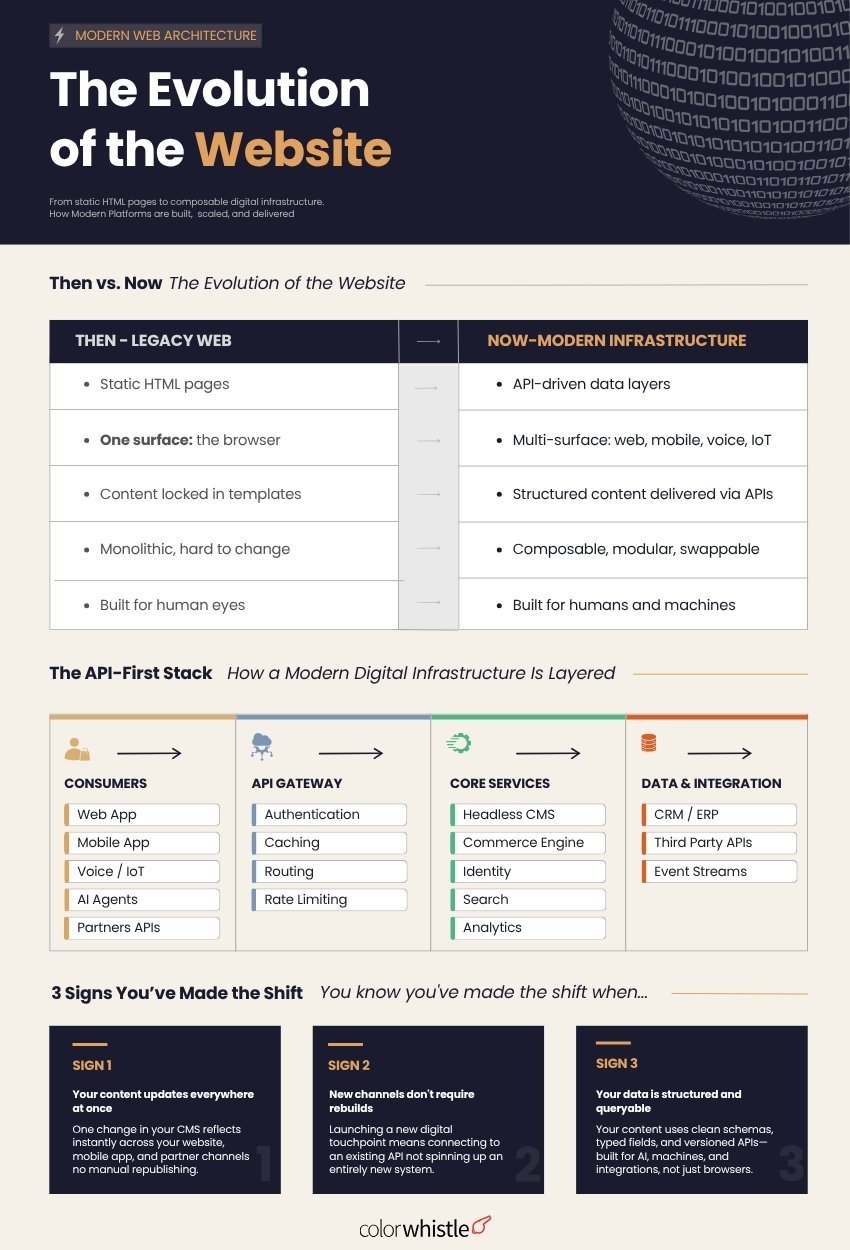
A traditional, tightly coupled website architecture has no clean answer to any of these. Content is embedded in templates. Logic is buried in the front-end. Business rules are scattered across the UI layer. To serve a new channel, you often must rebuild from scratch.
That’s the breaking point. And it’s why architectural conversation has fundamentally shifted.
The API-First Philosophy: Separating What from How
The API-first approach inverts the traditional web model. Instead of building a website that happens to expose some data, you build a data and logic layer first and then build experiences on top of it.
In practical terms, this means:
- Your content lives in a headless CMS that delivers via API, not in HTML templates
- Your business logic lives in microservices that expose endpoints, not in page controllers
- Your commerce engine handles transactions over API, with no assumption about what interface will consume the result
- Your front-end (whether a React app, a mobile client, or a chatbot) is just one consumer among many
This decoupling is the defining characteristic of API-driven architecture. It means your website isn’t a closed loop; it’s a platform. Any authorized consumer, internal or external, can interact with your data layer programmatically.
For enterprise teams, this translates to a dramatic reduction in duplication. The same product content, pricing rules, and inventory data that powers your website also powers your mobile app, your B2B portal, your retail partner feeds, and your internal dashboards all from a single source of truth.
Also Read
Websites as Omnichannel Infrastructure
Once you’ve made the architectural shift to API-first, something important becomes possible: your website becomes the orchestration layer for your entire digital presence, not just one channel within it.
This is the omnichannel architecture model. Rather than building separate systems for web, mobile, in-store, and partner integrations each with its own data model and update cycle, you build a unified real-time data layer that all surfaces draw from.
The benefits compound quickly:
Single update, multi-surface delivery. Change a product description or pricing rule in one place, and it propagates instantly to every touchpoint with no manual syncing, no versioning drift.
Consistent business logic everywhere. Personalization rules, inventory logic, and promotional conditions live in the platform layer, not in individual front-end implementations. Your mobile app behaves the same as your website, not because they share code, but because they share the same underlying API layer.
Third-party integrations that don’t require rebuilding. When a new platform partner, marketplace, or distribution channel needs access to your data, you expose a new API endpoint or grant access to an existing one. You don’t redesign the website.
This is why leading retail, media, and SaaS companies have quietly shifted toward what the industry calls composable commerce and composable digital architectures where every functional component (search, checkout, personalization, CMS) is a discrete, API-accessible service rather than a monolithic module.
Structured Data as a Strategic Asset
One of the most under-discussed implications of API-driven architecture is what it demands from your data. When your website was primarily a visual interface, data could be loosely structured; it just had to look right on the page. Now that your data layer is the product, the structure becomes a competitive differentiator.
Structured data in modern digital infrastructure means:
- Consistent content schemas that make content portable across surfaces without reformatting
- Typed APIs with clear contracts so consuming systems know exactly what to expect
- Semantic tagging that makes content findable by machines, not just humans (which also directly impacts SEO and AI discoverability)
- Versioned data models that let you evolve without breaking existing integrations
Companies that invest in structured data early find that launching new channels, building partner integrations, and feeding AI-driven experiences is dramatically faster. Those that don’t find themselves doing expensive data cleanup projects every time a new use case emerges.
The real estate, healthcare, and financial services industries provide instructive examples. Organizations that modeled their data properly years ago can now power AI-assisted search, regulatory reporting, and partner APIs from the same infrastructure. Those that didn’t are stuck extracting data from PDFs and reformatting CSVs for every new integration.
Did You Know?
According to Postman’s 2025 State of the API Report, 82% of organizations have adopted some level of an API-first approach, with 25% now operating as fully API-first a 12% increase from 2024.
Microservices and Composable Architecture: Building for Change
If API-first is the philosophy, microservices architecture is often the implementation pattern that makes it durable at scale.
Rather than building one large application that handles everything, content, identity, commerce, analytics, notifications, a microservices approach breaks the system into smaller, independently deployable services. Each service owns a specific domain, exposes a clean API, and can be updated, scaled, or replaced without touching the rest of the system.
For enterprise digital teams, this has concrete implications:
Scale where it matters. A product catalog service that receives millions of reads can be scaled independently of a checkout service that handles far fewer, more intensive transactions. You’re not over-provisioning the whole system to handle peak load on one component.
Swap without rebuilding. When a better search provider emerges, or a more capable CMS launches, or your commerce platform needs to be upgraded, you’re replacing one service not re-architecting the entire website.
Fail without cascading. In a monolithic system, one failure can bring down the whole website. In a microservices architecture, a failed recommendation engine means no personalization but the rest of the site keeps running.
Ship faster. Independent teams can own and deploy individual services on their own timelines. The content team doesn’t need to wait for the engineering team to ship a core platform to upgrade before pushing a new content schema.
This is why the terms composable commerce and MACH architecture (Microservices, API-first, Cloud-native, Headless) have moved from analyst whitepapers to enterprise procurement conversations. They describe a practical operating model for organizations that need their digital infrastructure to keep pace with their business.
The Content Delivery API: Your Website’s New Interface
If the website used to be the front door, the content delivery of API is increasingly the new primary interface through which the world interacts with your digital presence.
A content delivery API sits between your content store and every consuming surface. It handles:
- Querying and filtering returning only the content fields and records a given surface need
- Transformations resizing images, adjusting formats, or restructuring responses per consumer type
- Caching and edge delivery serving responses from geographically distributed nodes to minimize latency
- Access control ensuring the right consumers get the right data, with the right permissions
What this enables practically is profound. A single editorial team publishing to a headless CMS can have their content surface in a web app, a mobile app, a digital signage system, an AI-powered chatbot, and a voice interface all without publishing separately to each channel, and all with real-time updates.
For organizations managing large content operations of publishers, retailers, universities, healthcare systems, this isn’t a nice-to-have. It’s the difference between an editorial team that can operate at scale and one that’s constantly duplicating effort.
Also Read
Preparing for the Next Evolution: AI, Agents, and Edge-Native Architectures
The shift from visual interface to data infrastructure isn’t a destination. It’s a transition point toward what comes next, and what’s coming next is moving fast.
AI agents and LLM-powered interfaces are the most immediate frontier. These systems don’t browse websites; they query APIs, consume structured data, and generate their own responses. A website that isn’t exposing clean, structured, queryable data is effectively invisible to this class of consumers. Organizations building well-structured API layers today are positioning themselves to be natively AI-readable tomorrow.
Edge-native delivery is reshaping where computation happens. Rather than centralizing business logic in a single data center, forward-looking architectures are pushing logic to the edge closer to the end user for both performance and resilience. This only works cleanly when your architecture is already modular and API-driven.
Real-time data orchestration is becoming table stakes. Customers and systems expect data that reflects current reality, not a cache from six hours ago. Architecture built on event-driven microservices, and streaming data pipelines are far better positioned to deliver this than those built on batch-updated monolithic databases.
The organizations that will navigate this evolution most smoothly are the ones who’ve already started treating their website not as a visual product to be maintained, but as digital infrastructure to be engineered.
Your Website Is Infrastructure Engineer It That Way
The question isn’t whether websites will continue to evolve beyond visual interfaces. They already have. The question is whether your organization’s architecture is ready to support that reality.
If your content is trapped in templates, your business logic is embedded in front-end code, and your data isn’t structured for programmatic access, then every new channel, integration, and digital initiative becomes a custom engineering project. Expensive, slow, and fragile.
If your website is built as a proper website data infrastructure with clean APIs, structured content, composable services, and a real-time data layer, then new surfaces, integrations, and capabilities become configuration, not construction.
At ColorWhistle, we work with enterprises navigating exactly this transition from monolithic digital experiences to composable, API-driven architectures that scale with the business. Whether you’re evaluating a headless CMS migration, designing a microservices-based commerce platform, or mapping up your omnichannel data strategy, the architectural decisions you make today determine how fast you can move tomorrow.
The web is no longer just a place people visit. It’s an infrastructure that powers everything. Build it accordingly.
Looking to rearchitect your digital presence for the API-first era? Talk to the ColorWhistle team composable architecture, headless CMS strategy, and omnichannel digital infrastructure.
FAQ’s
Q1. What does it mean for a website to function as an API layer?
It means your website serves data and business logic to multiple surfaces of apps, devices, and partners, not just browsers. Content and functionality are exposed via APIs, making your digital presence programmable and platform-agnostic.
Q2. How is composable architecture different from a traditional website setup?
Traditional websites bundle content, logic, and presentation into one monolithic system that’s hard to scale or update independently. Composable architecture breaks these into modular, API-connected services that can be swapped or scaled without rebuilding the whole stack.
Q3. Do we need to rebuild our entire website to adopt API-driven architecture?
Not necessarily many businesses start by decoupling one layer at a time, such as migrating to a headless CMS or exposing a content delivery API alongside an existing front-end. A phased approach lets you modernize without disrupting what’s already working.
 B2B Website Modernization: Drive More Leads &...