


AI Chatbot Statistics Trends Market Growth Adoption ROI and Future Insights

Archana's passion for data analysis, statistics, and content creation makes her well-equipped to write insightful, data-driven blogs that transforms complex data into engaging content, helping readers gain deeper insights and take informed decisions.

Our authors are proven experts in their fields, writing on topics where they have demonstrated expertise. Every piece of content undergoes peer review and validation by industry professionals.
AI Summary
AI Chatbot Statistics Trends Market Growth Adoption ROI and Future Insights
This post explores the rapid growth and transformative impact of AI chatbots on business operations. The key insight: AI chatbots have evolved from basic automation tools to intelligent revenue drivers with a global market exceeding $11 billion in 2026 and projected exponential growth. It highlights adoption trends, ROI benefits such as significant cost savings and increased sales conversions, and the rise of advanced LLM-powered chatbots. Targeted at business leaders and technology adopters, it guides readers on leveraging AI chatbot solutions to enhance customer engagement, automate workflows, and gain competitive advantage through effective implementation and scaling.
AI chatbots are rapidly transforming how businesses handle customer support, sales automation, and digital engagement. From AI-powered customer service chatbots to LLM-based virtual assistants, organizations across industries are investing heavily in conversational AI to improve efficiency, reduce costs, and deliver 24/7 personalized experiences.
In 2026, the global AI chatbot market has already surpassed $11 billion and is projected to grow exponentially through 2035, driven by advancements in large language models (LLMs), automation, and enterprise AI adoption. Businesses are no longer using chatbots just for FAQs — they are deploying intelligent AI agents capable of handling complex queries, lead generation, workflow automation, and omnichannel communication.
If you’re planning to implement or scale AI-driven solutions, partnering with an experienced AI application development company can help you design, develop, and deploy chatbots tailored to your business goals.
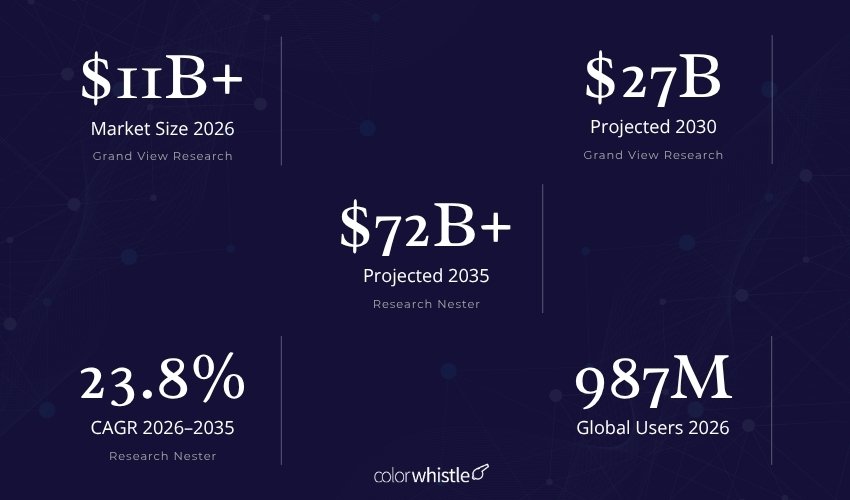
AI Chatbot Market Key Statistics
- As of 2026, the global AI chatbot market is valued at approximately $11 billion.
- The market is projected to reach $27.3 billion by 2030, growing at a 23.3% CAGR.
- By 2035 predictions, the chatbot market is forecast to exceed $72.47 billion at a 23.8% CAGR.
- 57% of businesses report significant ROI within the first year of chatbot deployment; average returns are 148–200%.
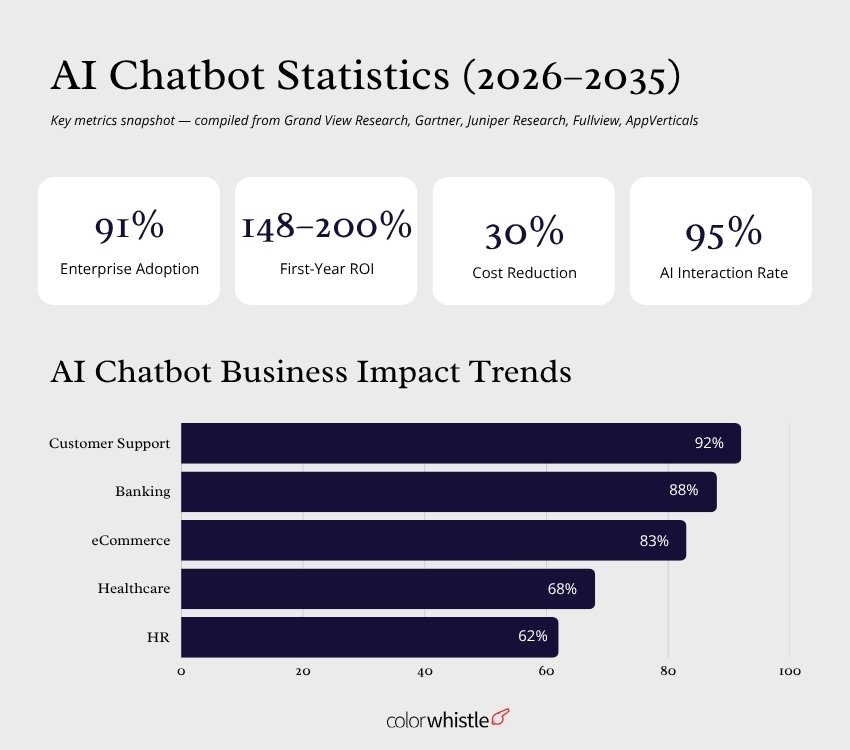
- Chatbots reduce customer support costs by up to 30%, saving businesses $8 billion annually.
- An estimated 95% of customer service interactions will involve AI by 2026, up from 30% resolved autonomously in 2025.
AI Chatbot Market Size Statistics Growth and Forecast
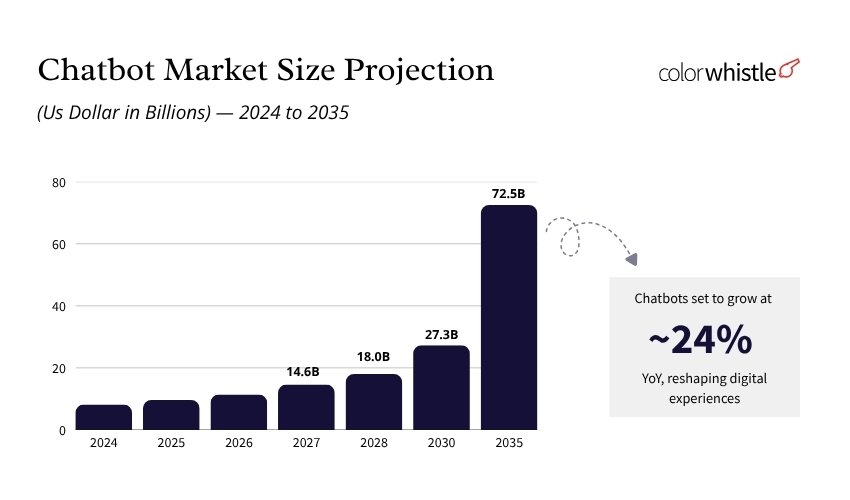
The chatbot market’s growth trajectory is one of the most consistent in technology. $7.76 billion in 2024. $9.57 billion in 2025. $11+ billion in 2026.
And every credible forecaster agrees: 23%+ annual growth is sustainable through at least 2030.
The generative AI chatbot segment bots built on LLMs rather than decision trees is growing even faster. Valued at $12.98–13.19 billion in 2026, this segment is forecast to reach $113.35 billion by 2034 at a 31.11% CAGR. That tells the real story: the market is not just growing, it is structurally upgrading from simple automation to intelligent conversation.
Three forces are driving this expansion:
LLM cost collapse. GPT-4 class inference that cost $0.03 per 1,000 tokens in 2024 now costs a fraction of that, making AI chatbots economically viable for small businesses for the first time.
Permanently shifted consumer expectations. After years of ChatGPT, consumers expect conversational AI from every brand — and penalize those that don’t deliver instant, accurate responses.
Proven ROI. Early adopters have published enough case studies that risk perception has collapsed. Gartner’s 2022 prediction that 25% of organizations would use chatbots as their primary service channel by 2027 is now tracking ahead of schedule.
| Year | Market Size | YoY Growth | Key Milestone |
|---|---|---|---|
| 2024 | $7.76 – $8.70B | — | AI bots become business standard |
| 2025 | $9.57 – $9.56B | +23% | Enterprise shift from pilot to production |
| 2026 | $11.0 – $11.8B | +23% | GenAI segment surpasses $13B |
| 2027 | ~$14.55B | +23% | 25% of orgs use chatbots as primary channel |
| 2028 | ~$17.95B | +23% | Multimodal AI mainstream |
| 2030 | $27.3 – $32.45B | +23% | Market triples from 2024 |
| 2035 | $72.47B+ | ~24% | Autonomous AI agents standard in enterprise |
AI Chatbot Adoption Statistics Usage Trends and Data
91%
Enterprises (50+ employees) using chatbots
Source: Thunderbit, 2026
67%
Fortune 500 companies with deployed AI chatbots
Source: Hyperleap AI, 2026
64%
Small businesses planning to adopt by 2026
Source: Thunderbit, 2026
34%
SMBs with chatbots already implemented
Source: Hyperleap AI, 2026
The adoption gap between enterprise and SMB is closing fast. LLM cost reductions and no-code platforms are dismantling the biggest historical barrier: deployment complexity. A business with no ML expertise can now deploy a production-grade AI chatbot in days, not months.
Geographically, North America leads with roughly 35% of global market share, driven by enterprise adoption and tech maturity.
Asia-Pacific is the fastest-growing region at 24.71% CAGR through 2031, with India’s chatbot segment alone growing 25% annually. Europe is expected to hold 27% of the global market by 2035 predictions.
AI Chatbot ROI Statistics Business Impact and Cost Savings
57% of businesses see significant ROI within the first year. The business case has never been clearer.
The financial case for chatbot deployment is no longer theoretical. 57% of companies report significant ROI within the first year, with average returns of 148–200% over 12 months. Leading implementations achieve cost savings of $300,000+ annually.
The mechanism is straightforward: chatbots eliminate the cost of human intervention for routine queries. Customer support costs fall by up to 30%. Each automated interaction saves an estimated $4.13. Gartner projects a $80 billion reduction in contact center labor costs by 2026.
$8:1
Average return per $1 invested
Source: Thunderbit / AppVerticals
30%
Reduction in customer support costs
Source: Juniper Research
148–200%
Typical ROI within first 12 months
Source: Fullview
$80B
Projected contact center labor savings by 2026
Source: Gartner
Beyond cost chatbots drive revenue.
AI chat qualifiers convert at 28–40% — compared to 2–3% for traditional web forms. Agentic chatbots deliver 3× higher conversion rates and up to 67% sales uplift. The chatbot is no longer just a cost center; it is a revenue engine.
AI Chatbot Use Case Statistics Industry Impact and Value
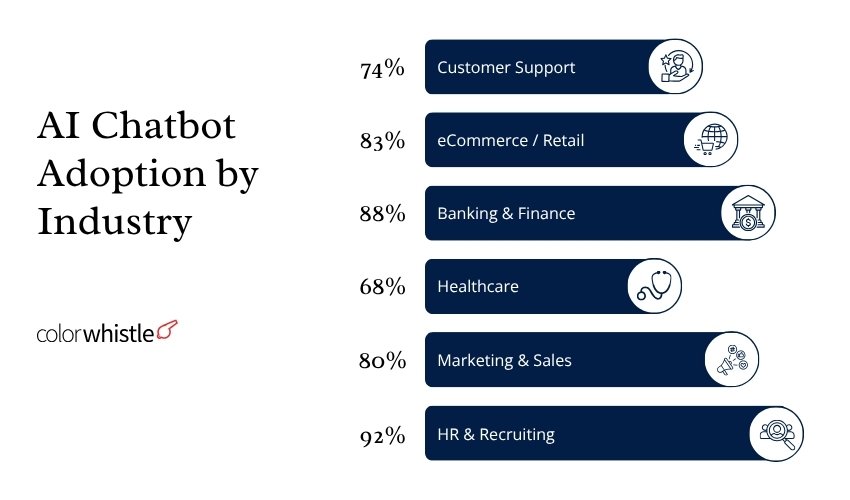
Chatbot adoption is not evenly distributed. Certain industries where interaction volume is high, use cases are well-defined, and ROI is measurable lead significantly. Here is a breakdown of the six highest-impact sectors.
Customer Support
95%
Of all customer interactions projected to involve AI by 2026. Today, AI already resolves 30% of service cases autonomously a number Salesforce projects will hit 50% by 2027. Contact center costs fall 30% on average.
Real-world case: Bank of America’s “Erica” has handled 2 billion interactions, resolving 98% of queries within 44 seconds and serving 56 million engagements per month.
eCommerce & Retail
12.3%
Conversion rate for chatbot-assisted shoppers vs. 3.1% without a 4× lift. Retail and eCommerce account for 30.34% of total chatbot market share. Chatbots reduce cart abandonment by up to 29% and are forecast to generate $112B+ in retail sales.
Real-world case: A $50M GMV ecommerce business deploying an AI chatbot can generate an additional $14.5M in annual revenue from improved conversion and reduced abandonment.
Healthcare
$150B
Projected annual savings for the U.S. healthcare economy by 2026 from conversational AI. 68% of healthcare organizations now incorporate AI. Chatbots reduce appointment no-shows by 35% and administrative time by 30%.
Real-world case: Practices using AI scheduling chatbots save an average of 15 minutes per patient appointment freeing clinicians for higher-value care
Banking & Finance
90%
Of banking interactions projected to be handled by chatbots. 88–92% of North American Tier 1 banks already use AI chatbots. Banks save $0.50–$0.70 per interaction, totaling $7.3B in global savings annually. 110.9M banking chatbot users projected in the US by 2026.
Real-world case: Generative AI spending in banking is forecast to hit $85B by 2030 at a 55% CAGR. 75% of banks with over $100B in assets plan to fully integrate AI strategies
Marketing & Sales
28–40%
Conversion rate for AI chat qualifiers vs. 2–3% for traditional forms. Marketing holds 17% of total chatbot market share. Sales chatbots turn 28% of website visitors into qualified leads. 80% of marketing and sales leaders have implemented or plan AI bots.
Real-world case: 23.7% of inquiries convert to sales without any human intervention when AI chatbots handle first-touch qualification
HR & Internal Ops
95%
More candidate leads generated by career sites using chatbots. 62% of employees use virtual assistants for HR needs. 92% of HR departments now guide new employees to chatbots. 73% of candidates cannot tell whether they are speaking to a bot or a human.
Real-world case: Organizations using HR chatbots for recruiting see 40% more completed job applications and 13% more job post clicks
| Industry | Adoption Rate | Primary Impact | Headline Metric |
|---|---|---|---|
| Customer Support | 74% of companies | 30% cost reduction | $80B labor savings by 2026 (Gartner) |
| eCommerce / Retail | 83% of e-commerce firms | 4× conversion lift | 12.3% vs 3.1% conversion rate |
| Banking & Finance | 88–92% of Tier 1 banks | 90% interactions automated | $7.3B annual savings globally |
| Healthcare | 68% of organizations | 35% fewer no-shows | $150B projected US savings/yr |
| Marketing & Sales | 80% of teams | 28–40% lead conversion | 28% of visitors converted to leads |
| HR & Recruiting | 92% of departments | 95% more leads | 40% more completed applications |
Generative AI Chatbot Statistics Trends and Evolution
The chatbot of 2026 is unrecognizable compared to 2019. The transition from rule-based if/then scripts to LLM-powered agents capable of nuanced reasoning, multi-step task completion, and real-time web interaction represents a categorical shift not an upgrade.
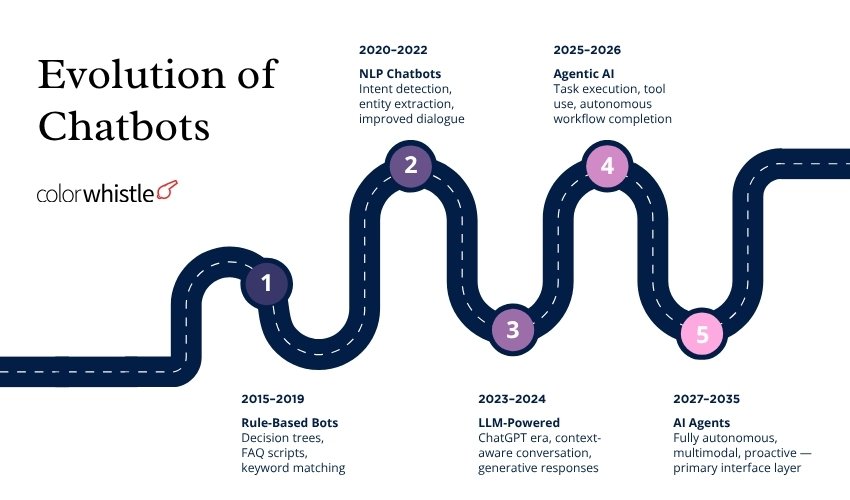
By 2026, 40% of enterprise applications embed task-specific AI agents up from under 5% in 2025 (Gartner). Voice AI has gone mainstream: 45% of new chatbot deployments include voice capabilities, expected to hit 78% by 2026. Multimodal bots understanding text, images, documents, and audio are becoming the enterprise default.
The rise of RAG (Retrieval-Augmented Generation) is particularly significant. RAG-based chatbots achieve 95–98% accuracy with near-zero hallucination rates directly addressing the top consumer concern (72% worry about AI misinformation). As accuracy improves, human fallback rates decrease, driving cost savings further.
Also Read
Future AI Chatbot Statistics Growth and Predictions
If the 2024–2026 period was about proving chatbots work, the 2027–2035 period will be about redefining what businesses look like when every customer interaction, internal workflow, and decision-support function is AI-augmented.
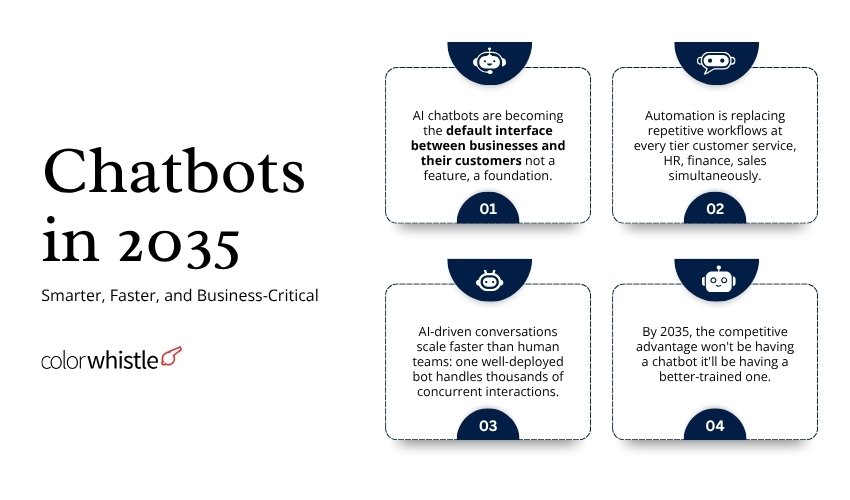
By 2030: The market will exceed $27–32 billion. The majority of customer service interactions in banking, retail, healthcare, and telecom will be handled entirely by AI without human intervention. Personalization at scale becomes a reality: chatbots will use complete customer histories, behavioral signals, and real-time context to deliver interactions indistinguishable from those with an expert human advisor.
By 2035: The market crosses $72 billion. Autonomous AI agents systems that can independently complete multi-day, multi-system tasks become standard enterprise infrastructure. The chatbot interface itself dissolves: AI becomes embedded across every digital touchpoint browsers, operating systems, enterprise software, physical spaces rather than existing as a standalone application. The question will no longer be “does this business use AI?” but “where in this business does AI not operate?”
The New Reality of AI Chatbots
- Chatbots have become revenue drivers, not just cost-cutters. The shift from customer service automation (cost reduction) to sales and lead generation (revenue creation) is the most significant strategic development of 2025–2026. AI chat qualifiers converting at 28–40% versus 2–3% for forms is a structural commercial advantage.
- AI is now a competitive necessity, not a differentiator. When 91% of enterprises and 80% of marketing teams are deploying chatbots, the early-adopter advantage has evaporated. The competitive question has shifted to: “How well-implemented is your chatbot?” accuracy, personalization, and integration depth now determine outcomes, not mere deployment.
- Automation is solving the scalability problem that human teams cannot. Consumer expectations of instant response, 24/7 availability, and personalized interaction are fundamentally incompatible with human-only support at scale. Chatbots are the only viable solution and at $4.13 saved per automated interaction, the economics compound rapidly.
- The GenAI chatbot segment is growing nearly twice as fast as the broader market. At a 31.11% CAGR versus 23.8% overall, the intelligence upgrade cycle is accelerating. Businesses on legacy rule-based systems will face increasing capability gaps against competitors running LLM-based agents by 2027–2028.
- Healthcare and banking will experience the most disruptive AI transformation. The combination of high interaction volume, strong regulatory pressure to reduce costs, measurable ROI, and clear use cases (triage, scheduling, account management, fraud detection) makes these sectors the highest-impact deployment zones through 2030.
What These Statistics Mean for Businesses
Delay is now a competitive risk.
With 91% of enterprises already deploying chatbots, waiting is not a neutral position. Every quarter without AI-powered customer interaction is a quarter where competitors are compounding conversion advantages, reducing their cost bases, and training models on superior data.
Integration depth is the new differentiator.
The chatbots that outperform are those connected to CRM, order management, ERP, and customer history delivering contextual, personalized interactions at scale. Deploying a generic FAQ bot is table stakes. Deploying a deeply integrated AI agent is a competitive moat.
The GenAI transition is non-optional.
Legacy rule-based systems will become operationally uncompetitive by 2027–2028 as LLM-based agents achieve 95–98% accuracy and handle complex, multi-turn dialogue. The migration cost is real but so is the cost of falling behind.
ROI measurement must expand.
Businesses tracking only cost reduction are missing the revenue dimension. Conversion rate lifts, lead qualification rates, upsell recommendations, and customer lifetime value impact from AI interactions represent the majority of the financial case for leading implementations.
AI chatbots are no longer experimental they’re becoming core to how businesses operate, engage, and grow. As adoption accelerates and capabilities mature, the gap between basic automation and intelligent, revenue-driving systems will define market leaders. The next decade isn’t about whether to implement chatbots, but how effectively they are trained, integrated, and scaled.
Ready to turn AI insights into real business results? Get expert AI consulting services contact ColorWhistle today.
Data Sources
Grand View Research | Mordor Intelligence | Research Nester | Gartner | Salesforce | Juniper Research | Fullview.io | AppVerticals | Fortune Business Insights | Nextiva | Hyperleap AI | Azumo | MasterOfCode | Emulent | Thunderbit | McKinsey Global Institute
 Website Modernization vs Revamp: Cost, ROI & ...