




AI for NABL Documentation: Improve ISO 17025 Audit Compliance

With half a decade of experience in creating tech content for education, healthcare, hospitality, and real estate, Nandhini excels at turning complex insights into clear, credible, in-depth, research-backed, and engaging content that helps readers make informed decisions.

Our authors are proven experts in their fields, writing on topics where they have demonstrated expertise. Every piece of content undergoes peer review and validation by industry professionals.
AI Summary
AI for NABL Documentation: Improve ISO 17025 Audit Compliance
This post explores how AI can streamline NABL documentation for ISO/IEC 17025 compliance without compromising audit integrity. The key insight: AI accelerates repetitive drafting and clause mapping while preserving human oversight and traceability. Targeted at NABL consultancy firms burdened by manual, time-intensive documentation, it highlights AI's role in generating structured Quality Manuals, automating clause traceability, and enhancing assessment readiness. The article advocates purpose-built AI systems over generic tools, emphasizing controlled workflows that maintain compliance and audit trails. Ultimately, consultancies adopting AI-driven automation can boost efficiency, consistency, and scalability in managing multiple lab accreditations.
ABL documentation is not just paperwork. It is the backbone of accreditation. For every laboratory seeking compliance under ISO/IEC 17025 and accreditation from the National Accreditation Board for Testing and Calibration Laboratories, documentation determines whether competence is demonstrated or rejected.
And for NABL consultancy firms, documentation is the most time-intensive part of service delivery.
Quality Manuals. SOPs. Formats. Clause mapping. Internal audit reports. CAPA tracking. Surveillance documentation. Reassessments. Version updates. Client-specific customization.
Seventy percent of this work is repetitive. The structure rarely changes; only the context does.
That is precisely where AI-assisted workflows create operational leverage.
Using AI for NABL documentation does not mean auto-generating compliance. It does not mean bypassing technical validation. It does not mean risking audit integrity.
It means accelerating structured documentation processes while preserving control, traceability, and human oversight.
ColorWhistle’s custom software and automation solutions help embed workflow automation into structured systems that complement compliance frameworks:
TL; DR
This blog is for NABL consultants and ISO/IEC 17025-focused labs looking to use AI in documentation workflows without compromising audit integrity. It explains where AI adds operational value, such as structured drafting, clause mapping, traceability, version control, and assessment readiness, while clearly defining the boundaries AI must never cross in accredited environments.
- Why NABL documentation is the most time-intensive consultancy function
- Where AI adds value in ISO/IEC 17025 workflows
- AI-assisted clause traceability and compliance mapping
- Structured drafting for Quality Manuals and SOPs
- NC reporting and root cause documentation support
- Assessment readiness and evidence indexing automation
- What AI must never do in NABL documentation
- Why generic AI tools are insufficient
- The role of custom AI automation platforms for NABL consultants
- How ColorWhistle supports audit-safe documentation systems
The Real Problem NABL Consultancies Face
Most consultancy firms operate in a highly manual documentation environment. Word files are edited client by client. Templates are duplicated and modified repeatedly. Clause mapping is cross-checked manually. Version control depends on file naming discipline. Junior staff spend hours formatting, aligning clauses, and inserting repetitive text blocks.
As the number of client labs increases, documentation complexity multiplies.
Turnaround slows. Quality becomes inconsistent. Internal review cycles increase. And scaling becomes difficult.
Did you know?
30-50% faster accreditation prep via AI-drafted docs and automation.
Where AI Actually Adds Value in NABL Documentation?
AI’s strongest role in NABL documentation is structured drafting assistance.
Under ISO/IEC 17025, documentation must align with clause requirements. The structure is predictable. What changes is the lab’s scope, equipment, personnel matrix, and operational procedures.
AI can generate first-draft frameworks for Quality Manuals aligned to clause structure. It can adapt SOP skeletons based on whether the lab is testing or calibration based. It can normalize terminology across documents to ensure consistency. It can detect missing clause references during documentation updates.
The consultant still validates. The consultant still customizes. The consultant still signs off.
According to McKinsey, 60% of employees could save 30% of their time with workflow automation, a significant opportunity for consultants who spend the bulk of their hours on documentation rather than advisory work.
Clause traceability is another area where AI transforms efficiency.
During assessments, traceability between ISO clauses and internal documents is critical. Consultants often prepare manual compliance matrices to demonstrate coverage. This is time-consuming and error prone.
An AI assisted documentation system can automatically map clauses to corresponding SOPs, forms, and records. It can flag uncovered clauses, detect outdated references after standard revisions, and generate real-time compliance coverage reports.
This does not replace technical expertise. It enhances visibility.
Customization at scale is where AI-driven automation becomes strategic.
Consultancies managing dozens of labs per year cannot sustainably rely on static templates and manual editing. AI assisted systems can personalize Quality Manuals using structured client inputs. They can insert scope statements, equipment inventories, training matrices, and authorization structures dynamically, while maintaining standardized clause alignment.
This ensures consistency across all client projects without copy-paste risk.
Internal audit documentation and non-conformity reporting also benefit from intelligent assistance.
Non-conformities must be precise. Root cause analysis must demonstrate logical reasoning. Corrective actions must be measurable and aligned with clause intent.
AI can assist in structuring NC descriptions clearly, suggesting root cause analysis frameworks such as 5-Why or Fishbone models, and identifying vague corrective actions before documentation is finalized.
The technical reviewer remains responsible. AI simply strengthens the drafting process.
Assessment readiness is another pressure point.
Before pre-assessment or final assessment, consultants often spend days compiling evidence, training records, calibration logs, validation reports, and proficiency testing results.
AI-assisted indexing systems can scan, categorize, and tag documents against relevant clauses. They can build assessor-ready evidence matrices and create dashboards that provide structured document visibility.
This reduces preparation time dramatically without touching primary records.
What AI Should Never Do in NABL Documentation?
It is critical to draw boundaries.
AI must never modify raw test data. It must never generate calibration values. It must never fabricate records. It must never bypass document control systems. It must never operate without logging and traceability.
Audit integrity depends on original evidence remaining intact.
AI in NABL documenttion is a drafting and structuring assistant.
Why Generic AI Tools Are Not Enough?
Many consultancies experiment with public AI tools for drafting. While useful for ideation, they lack structured integration.
They do not maintain document repositories. They do not preserve clause traceability. They do not log changes. They do not integrate with internal version control. They do not scale across multiple clients systematically.
A purpose-built documentation automation system designed around ISO/IEC 17025 workflows is fundamentally different.
It centralizes documentation libraries. It controls versions. It tracks edits. It links clauses to documents dynamically. It creates audit trails. It standardizes delivery across all consultancy engagements.
That is where custom software development becomes a competitive advantage.
If you’re looking to understand how to structure and audit your digital NABL systems before introducing automation, read our detailed guide on auditing digital NABL workflows to ensure compliance integrity from the ground up.
Custom AI Automation for NABL Consultants
The NABL consultancy landscape is evolving.
Consultancies using structured automation will deliver faster, maintain consistency across clients, and handle higher volumes without expanding manpower proportionally.
Assessors increasingly expect digital traceability. Documentation quality will become a differentiator, not just a requirement.
AI will not replace NABL consultants. It will replace repetitive documentation labor.
The firms that integrate AI strategically within controlled, audit-safe frameworks will dominate the next growth cycle of accreditation services.
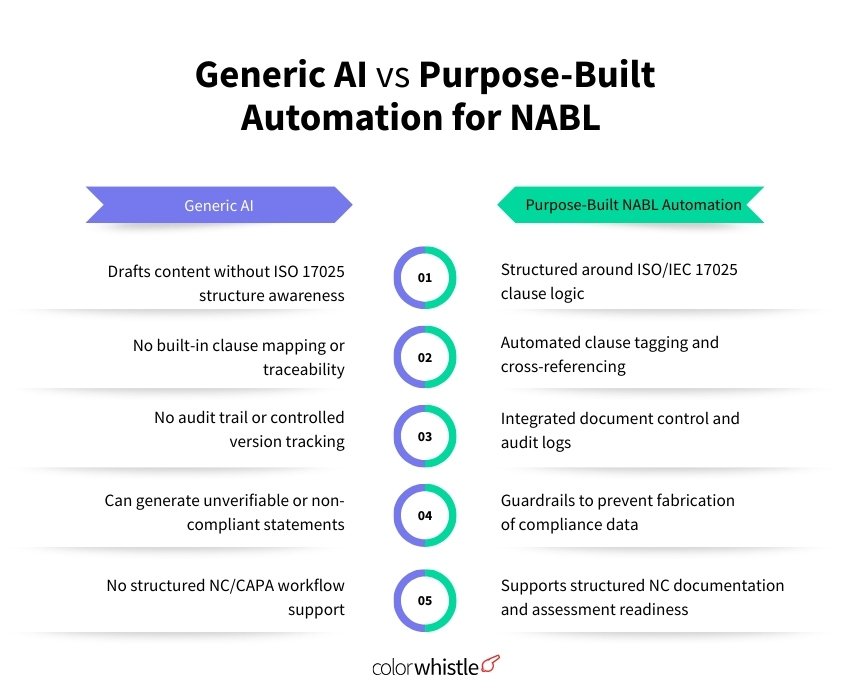
Generic AI vs Purpose-Built Automation for NABL
| Generic AI | Purpose-Built NABL Automation |
|---|---|
| Drafts content without ISO 17025 structure awareness | Structured around ISO/IEC 17025 clause logic |
| No built-in clause mapping or traceability | Automated clause tagging and cross-referencing |
| No audit trail or controlled version tracking | Integrated document control and audit logs |
| Can generate unverifiable or non-compliant statements | Guardrails to prevent fabrication of compliance data |
| No structured NC/CAPA workflow support | Supports structured NC documentation and assessment readiness |
If you’re exploring how AI can be implemented responsibly within regulated workflows, our AI consulting services can help you define the right architecture and compliance-first strategy.
Why Partner with ColorWhistle for NABL Documentation Automation?
ColorWhistle builds custom automation platforms tailored to structured documentation environments.
For NABL consultancies, that means systems designed around ISO/IEC 17025 workflows, not generic AI tools.
We develop centralized documentation engines that handle clause mapping, Quality Manual structuring, SOP version control, NC tracking, and audit-ready traceability.
Every workflow is built with governance in mind. Raw records remain protected. Human validation remains mandatory. Every action is logged.
Wrap-Up
AI can streamline NABL documentation by reducing repetitive drafting, improving clause alignment, and organizing evidence more efficiently. When implemented within a controlled workflow with proper review and version management, it strengthens consistency without affecting audit compliance. For consultancy firms handling multiple labs, structured automation simply makes documentation delivery more scalable and manageable.
If you’re looking to develop a purpose-built AI system for regulated environments, contact our team to discuss your requirements.
 The NABL Consultant’s Guide to Digital Scal...







A practical guide on leveraging AI to streamline NABL documentation while maintaining strict compliance and audit integrity.
This article does a great job explaining the value of an AI-powered documentation audit — it’s clear how much time and accuracy can be gained when AI tools help identify gaps, inconsistencies, and optimization opportunities. For businesses looking to present themselves professionally online or in print, solid documentation is just as important as strong visuals and user experience. Helpful read!