




YouTube Statistics 2026: Users, Revenue, Trends & Marketing Insights (India & Global)

Archana's passion for data analysis, statistics, and content creation makes her well-equipped to write insightful, data-driven blogs that transforms complex data into engaging content, helping readers gain deeper insights and take informed decisions.

Our authors are proven experts in their fields, writing on topics where they have demonstrated expertise. Every piece of content undergoes peer review and validation by industry professionals.
AI Summary
YouTube Statistics 2026: Users, Revenue, Trends & Marketing Insights (India & Global)
This post explores essential YouTube marketing statistics for 2026, aiming to educate marketers and creators on leveraging the platform's rapid growth. The key insight: YouTube's 2.85 billion monthly users and $36.1 billion revenue make it indispensable for impactful campaigns. Covering audience demographics, content trends like Shorts, and advertising performance, it reveals how to optimize strategies and expand reach. Insights include user behavior, monetization, and emerging trends supported by global data and top channel analytics. Readers will learn to adapt marketing efforts to evolving algorithms and capitalize on YouTube's vast, diverse audience for measurable business growth.
YouTube continues to dominate the digital video landscape, with over 2.85 billion monthly active users as of 2026, making it one of the most powerful platforms for brands, creators, and marketers worldwide. But beyond its massive scale, YouTube is evolving rapidly—driven by Shorts, AI-powered recommendations, and shifting audience behavior.
As competition intensifies, relying on outdated strategies is no longer enough. Businesses that understand the latest YouTube statistics, trends, and performance metrics are the ones winning attention, engagement, and conversions.
This report compiles the most important YouTube marketing statistics for 2026, covering user growth, advertising performance, revenue insights, and emerging trends across India and globally. More importantly, it breaks down what these numbers actually mean—so you can make smarter, data-driven marketing decisions.
Whether you’re planning campaigns, scaling a channel, or optimizing ROI, these insights will help you:
- Understand YouTube’s current reach and growth trajectory
- Identify key trends shaping content and advertising
- Benchmark performance and engagement metrics
- Build strategies aligned with where the platform is heading
YouTube Monthly Active Users (2026)
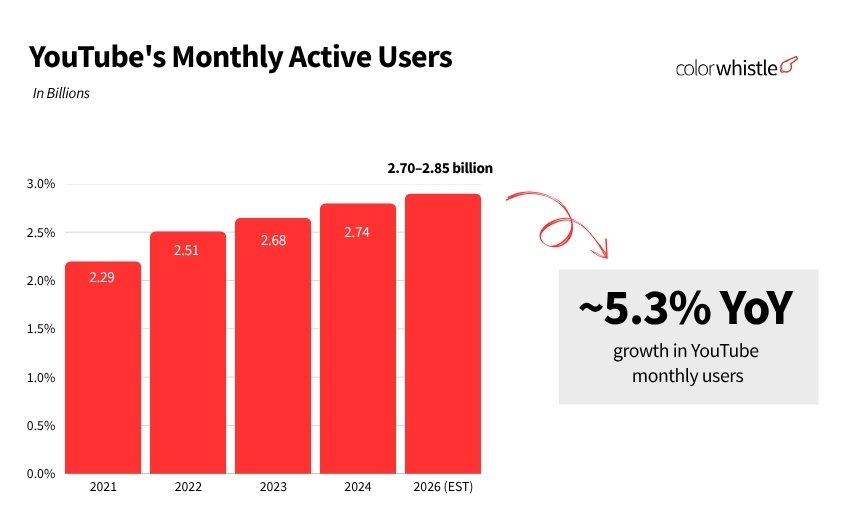
As of 2026, YouTube has between 2.70 and 2.85 billion monthly active users globally — making it the world’s second-largest social platform, behind only Facebook (3.07B). The platform reached roughly 1 in 4 humans on Earth every month.
Sources: GlobalMediaInsight (Feb 2026) · RecurPost · DemandSage (DataReportal, 2026) · Wytlabs
YouTube’s user base has grown steadily from approximately 2.29 billion in 2021 to its current range of 2.7–2.85 billion in 2026 — an increase of more than 500 million over five years. Growth has shifted from explosive to structural: the platform is in a maturity phase, but maturity at billions-of-users scale means near-universal penetration of the online-connected world.
2.7B+
Monthly active users globally
GlobalMediaInsight · Feb 2026
122M
Daily active users (website + app)
YouTube / Multiple sources, 2026
~50%
Share of global internet users on YouTube monthly
DemandSage · DataReportal, 2026
125M
YouTube Premium subscribers worldwide
YouTube / BusinessOfApps, 2026
Top YouTube Statistics
- YouTube is the Second Most Popular Social Media Network Worldwide
- In YouTube, more Than 500 Hours of Video Were Uploaded Every Minute
- YouTube Premium Had Roughly 125 Million Users as of 2026
- YouTube Generated $36.1 Billion in Revenue Last Year
- YouTube CEO Susan Wojcicki Stepped Down After 25 Years in the Company
As of 2026, YouTube has over 2.7 billion monthly active users, making it the second-largest platform on the internet globally — reaching roughly half of all internet users every single month.
GlobalMediaInsight, Feb 2026 · Wytlabs · RecurPost
| Year | Monthly Active Users | YoY Change | Daily Active Users |
|---|---|---|---|
| 2021 | 2.29 billion | — | ~95M |
| 2022 | 2.51 billion | +9.6% | ~105M |
| 2023 | 2.68 billion | +6.8% | ~113M |
| 2024 | 2.74 billion | +2.2% | ~120M |
| 2026 (est.) | 2.70–2.85 billion | +1–4% | 122M+ |
YouTube Platform Scale & Usage Statistics
As of 2026, users collectively consume over 1 billion hours of video on YouTube every single day. More than 500 hours of new content is uploaded every minute, and nearly 5 billion videos are watched daily.
Sources: YouTube Official Data (via GlobalMediaInsight, Wytlabs, Talks.co) · 2024–2026
Total videos, daily watch time & upload volume
| Hours of video uploaded per minute | 500+ hours |
| Hours of video uploaded per day | 720,000 hrs |
| Total videos on the platform (as of 2025) | ~20 billion |
| Videos watched per day globally | ~5 billion |
| Total watch time per day | 1B+ hours |
| Average video length | 11.7 minutes |
| Active channels on platform | 113.9 million |
| Mobile share of total watch time | 70%+ |
| Average daily time spent per user (global) | ~49 minutes |
| Average monthly time spent per user (global) | 27 hours |
Engagement context: YouTube has the highest session duration of any social platform — averaging 7 minutes 37 seconds per session. TikTok (5:52) and Facebook (3:44) trail significantly. This longer session depth makes YouTube uniquely valuable for mid-funnel and lower-funnel advertising.
(Source: DemandSage, DataReportal, 2026)
What this signals: The “1 billion hours/day” figure is a strategic imperative, not a vanity metric.
When YouTube absorbs 1 billion hours of daily watch time, it means users are choosing it over broadcast television, Netflix, and every competing platform — combined. For brands, this volume signals that YouTube is now a reach medium, not just a content library. A well-funded brand that ignores YouTube in 2026 is making the same mistake as one that ignored television in the 1990s. The difference is that YouTube’s targeting precision makes that reach measurable and attributable in ways television never was.
YouTube Revenue & Monetization Statistics
YouTube generated $36.1 billion in advertising revenue — a 14.6% increase year-on-year — making it the sixth-largest digital advertising platform globally. Total revenue including subscriptions reached approximately $50.6 billion.
Source: BusinessOfApps, Alphabet Q4 2024 earnings · SQ Magazine (2026 update)
YouTube Revenue Share Percentage 2026
YouTube’s monetization ecosystem extends far beyond advertising. Subscription revenue (YouTube Premium + YouTube Music) reached $14.5 billion, reflecting rapid growth from the platform’s 125 million paying subscribers.
$36.1B
Ad revenue
BusinessOfApps · Alphabet Earnings
$14.5B
Subscription revenue (Premium + Music)
BusinessOfApps, 2026
55%
Ad revenue share paid to creators (YouTube Partner Program)
YouTube Official · Stan.store, 2026
$20B+
Creator payouts via YouTube Partner Program (2024–2026 est.)
SQ Magazine · Whop.com, 2026
Creator revenue share & average earnings
YouTube’s revenue split is 55% to creators, 45% retained by YouTube — one of the most transparent payout structures among major platforms. However, earnings vary dramatically by niche, audience geography, and video type.
| YouTube's cut of ad revenue | 45% |
| Creator's share of ad revenue | 55% |
| Average US creator RPM (revenue per 1,000 views) | ~$12.03 |
| Finance/investing niche CPM (highest) | ~$25 CPM |
| Gaming niche CPM (lower range) | ~$5 CPM |
| Avg. annual creator salary in the US (ZipRecruiter, 2026) | $120,226 |
| Shorts payout per 1M views (approximate) | $30–$200 |
| Long-form payout per 1M views | $2,000–$5,000 |
Q4 seasonality matters: CPMs typically peak in Q4 (October–December) due to holiday advertiser spending, making it the highest-revenue quarter for most creators. Finance, legal, and B2B content consistently command 3–5× higher CPM rates than entertainment or gaming content. (Source: CreatorRevenueCalculator.com, 2026)
What this signals: YouTube’s 55/45 split is a deliberate moat — and creators are starting to notice it.
YouTube’s creator payout structure is openly generous compared to competitors: TikTok’s Creator Fund pays an estimated $0.02–$0.04 per 1,000 views, while YouTube’s long-form RPM averages $3–$12+ per 1,000 views — a 75–300× difference. This isn’t charity; it’s strategic. By making the creator economy financially viable, YouTube retains the best talent and keeps content quality high. For brands, the implication is clear: YouTube’s creator ecosystem is the most commercially mature of any platform, and influencer partnerships here come with a professionalism premium that TikTok and Instagram Reels still cannot match.
YouTube’s revenue share is 55% to creators and 45% to the platform. As of 2026, YouTube has distributed over $20 billion annually to creators through its Partner Program — the largest creator monetization fund in the digital video industry.
YouTube Partner Program disclosures · SQ Magazine · Whop.com, 2026
YouTube’s 2025 revenue: the world’s largest media company
YouTube’s total revenue (ads + subscriptions) for full-year 2025 — surpassing Disney’s total media revenue and making YouTube the largest media company in the world by annual revenue.
Alphabet Q4 2025 Earnings Report · Variety (Feb 4, 2026) · ALM Corp
Alphabet CEO Sundar Pichai confirmed the milestone in February 2026: YouTube’s 2025 revenue of $62.3 billion eclipsed Disney for the first time. This figure includes YouTube advertising, YouTube Premium, YouTube Music, and YouTube TV subscription revenues combined.
YouTube Statistics in India (2026)
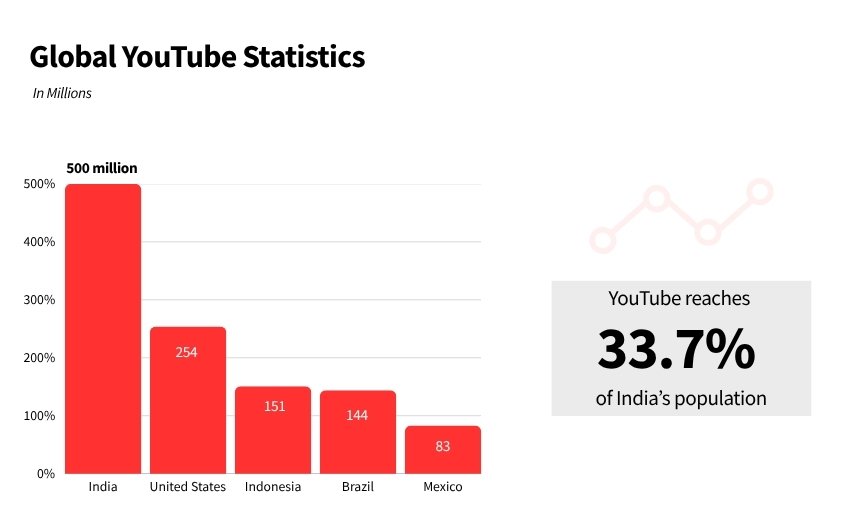
In India, YouTube has approximately 491–500 million monthly active users as of 2026 — the largest national user base on the platform, representing nearly double the United States’ 253 million users. India’s YouTube penetration stands at approximately 33.7% of total population and 60.9% of all internet users.
GlobalMediaInsight (Feb 2026) · RecurPost · DataReportal Digital 2026 India · Couponsly.in
India’s YouTube story is one of the most dramatic growth narratives in digital media history. From approximately 247 million users in mid-2023 to an estimated 500 million in 2026, the platform has added over 250 million Indian users in under three years — driven by affordable mobile data, smartphone proliferation, and an explosion of regional-language content.
~500M
YouTube users in India (2026 estimate)
GlobalMediaInsight · Statista · RecurPost
33.7%
YouTube penetration as % of India’s total population
Couponsly.in · DataReportal, 2026
60.9%
YouTube penetration among Indian internet users
Couponsly.in, Feb 2026
80%
Indian YouTube audience aged under 45
Couponsly.in, 2026
| Year | YouTube Users in India | YoY Growth | % of Internet Users |
|---|---|---|---|
| 2021 | ~225 million | — | ~50% |
| 2022 | ~350 million | +55% | ~54% |
| 2023 | ~462 million | +32% | ~58% |
| 2024 | ~476–491 million | +6% | ~60% |
| 2026 (est.) | 491–500 million | +2–4% | ~61% |
| 2029 (forecast) | ~859 million | Projected +72% | — |
Key India-specific insights
| India's rank globally by YouTube users | #1 |
| US users by comparison | ~253 million |
| India's YouTube ad reach (% of adult population) | 43.1% |
| YouTube Premium penetration in India | ~0.2% |
| Global YouTube Premium penetration (for comparison) | 4.95% |
| Largest age group: 25–34 years (India) | ~30% (147M) |
| Internet users in India (Oct 2025, DataReportal) | 1.03 billion |
| T-Series — most subscribed YouTube channel globally | 300M+ subs |
YouTube continues to dominate India’s digital video space with approximately 500 million users as of 2026 — making India the world’s largest YouTube market by user count, with a penetration rate of 60.9% among all internet users. Statista forecasts India’s YouTube user base to reach 859 million by 2029.
GlobalMediaInsight · DataReportal Digital 2026 India · Statista India Forecasts · Couponsly.in
Despite having 500M users, India’s YouTube Premium penetration is just 0.2% — versus 4.95% globally. This represents one of the largest untapped subscription monetization opportunities in digital media. As India’s disposable income rises and Jio/Airtel bundle Premium packages, this figure is expected to grow substantially post-2026. (Source: Couponsly.in, 2026)
Global YouTube Statistics (2026)
As of 2026, YouTube operates in over 100 countries, supports 80+ languages, and its potential advertising reach covers 3.35 billion users — roughly 95% of the global internet-connected population.
GlobalMediaInsight · DataReportal Digital 2026 Global Report
| Country | YouTube Users (2026 est.) | Penetration Rate | Rank |
|---|---|---|---|
| India | ~500 million | 33.7% of population | #1 |
| United States | 253–254 million | 75.2% of population | #2 |
| Indonesia | ~151 million | ~54% | #3 |
| Brazil | ~144 million | ~67% | #4 |
| Mexico | ~83 million | ~62% | #5 |
| Singapore (highest penetration) | ~5.5 million | 95.3% | — |
| Israel | ~9 million | 93.8% | — |
| Saudi Arabia | ~33 million | 93.8% | — |
| YouTube's rank among all websites globally | #2 (after Google) |
| Monthly web visits | ~80 billion |
| US: monthly YouTube viewers (2025–2026) | 249–253 million |
| US adults who use YouTube regularly | 82% |
| Gender split (global): Male / Female | 54% / 46% |
| Largest age group on platform (25–34) | 21.7% of users |
| US teens who use YouTube daily | 73% |
| US adults who get news from YouTube | 32% |
YouTube vs TikTok vs Instagram Reels (2026)
As of 2026, YouTube leads all three short-form and video platforms across total users (2.7B vs TikTok’s 1.59B vs Instagram’s 2B), session duration (7:37 vs 5:52 vs 4:10), and creator ad revenue share (55% vs ~8% vs ~0%). TikTok leads on Gen Z daily reach and content virality velocity; Instagram leads on e-commerce integration and branded content aesthetics.
DemandSage · Loopex Digital · Sprout Social · BusinessOfApps — Q1 2026
The three-platform comparison below is the most decision-relevant data for any marketer building a video budget in 2026. No single platform dominates every metric — understanding where each wins is the foundation of an effective multi-platform strategy.
| Metric | YouTube 2026 | TikTok 2026 | Instagram Reels 2026 |
|---|---|---|---|
| Monthly Active Users | 2.70–2.85 billion | 1.59 billion | ~2.0 billion (IG total) |
| Avg. Session Duration | 7 min 37 sec | 5 min 52 sec | ~4 min 10 sec |
| Short-form Daily Views | 200B+ (Shorts) | ~167B (est.) | Not disclosed |
| Short-form Engagement Rate | 5.91% (Shorts) | 4.07% | 1.94% |
| Ad Revenue Share to Creators | 55% | ~8% (Creator Fund est.) | ~0% (no formal split) |
| Creator Payout per 1M Views | $2,000–$5,000 (long-form) | $20–$40 (Creator Fund) | ~$0 (gifts/bonuses only) |
| Avg. Daily Time (US users) | ~35 min | ~55 min | ~30 min |
| Primary Age Demographic | 25–34 (21.7%) | 18–24 (Gen Z dominant) | 18–34 split |
| Ad Reach (Global) | 3.35 billion | ~1.58 billion | ~1.65 billion |
| ROI vs Linear TV (Nielsen) | +109% | Not independently reported | Not independently reported |
| Search Engine Function | Yes — #2 globally | Limited (in-app search) | No |
| SEO / Google SERP integration | Deep (owned by Google) | None | None |
| Max video length | Unlimited (livestreams) | 10 minutes | 90 seconds (Reels) |
| Strongest use case | SEO, long-form, full-funnel | Virality, Gen Z discovery | Brand aesthetics, shopping |
| Content shelf life | Evergreen (months–years) | 48–72 hours (trend-driven) | 24–72 hours |
Sources: DemandSage (Feb 2026) · Loopex Digital Q1 2026 · BusinessOfApps · Sprout Social · Nielsen Connected Video Report 2026 · Statista · DataReportal
As of 2026, YouTube outperforms TikTok and Instagram Reels on total reach (2.7B vs 1.59B vs 2B), session duration (7:37 vs 5:52 vs 4:10), creator payout (55% revenue share vs ~8% vs 0%), and global ad reach (3.35B vs 1.58B vs 1.65B) — making it the highest-ROI video marketing platform for most brand objectives in 2026.
DemandSage · Loopex Digital Q1 2026 · Nielsen 2026 · BusinessOfApps · DataReportal
What this signals: Platform selection is now a strategic budget decision, not a creative preference.
The data exposes a critical insight most marketing teams misapply: TikTok’s 55-minute US daily watch time advantage reflects addiction-loop mechanics, not buyer intent. YouTube’s 35-minute average includes more deliberate, search-initiated sessions — “how to fix my boiler,” “best laptop under $1000,” “HubSpot vs Salesforce review” — which carry dramatically higher purchase intent. Brands chasing reach metrics will gravitate toward TikTok; brands chasing conversion should weight YouTube more heavily. The right answer for most growth-stage companies is a 70/30 YouTube/TikTok split for video budget — with YouTube anchoring lower-funnel search traffic and TikTok funding top-of-funnel discovery.
YouTube Trends: Shorts, AI Content & Platform Growth
YouTube Shorts now generates over 200 billion views per day as of Q1 2026 — up from 70 billion in early 2024. With 2 billion monthly active users, Shorts is the largest short-form video platform globally, ahead of TikTok (1.59B) and Instagram Reels (1.8B).
YouTube Shorts statistics (2026)
| Shorts daily views | 200B+/day |
| Shorts monthly active users | 2 billion |
| Shorts engagement rate | 5.91% |
| Shorts engagement vs TikTok & Facebook Reels | Highest |
| Average watch time per Short | 14.3 seconds |
| Shorts views originating outside creator's country | 75% |
| Gen Z who purchased after seeing sponsored Shorts | 53% |
| Max Shorts length (updated Oct 2024) | 3 minutes |
| US ad buyers using Shorts in campaigns | 43% |
AI & platform evolution in 2026
YouTube CEO Neal Mohan’s 2026 annual letter redefined the platform’s direction: creators are now treated as the new “Prime Time” — competing directly with linear television networks. Key AI-driven changes underway as of 2026:
AI Feature
AI dubbing
Automatic multilingual dubbing enables creators to reach global audiences without manual translation, accelerating growth in non-English markets.
AI thumbnails
AI-generated thumbnail suggestions are being A/B tested against creator thumbnails. Early data shows 15–20% CTR improvement in some categories.
Safety
AI-disclosure labels
YouTube now mandates disclosure labels for AI-generated or AI-altered content. Over 1 million channels use AI tools for video production daily.
TV Strategy
Living room push
YouTube TV (10M+ subscribers) and smart TV usage are growing fastest of all devices. YouTube now rivals broadcast TV in total US watch time.
YouTube Shorts generates over 200 billion views per day in 2026, with 2 billion monthly active users — surpassing both TikTok and Instagram Reels to become the world’s most-used short-form video platform.
Loopex Digital Q1 2026 Shorts Statistics Report · SQ Magazine · BusinessOfApps
YouTube Future Forecast: 2027–2030
Analyst firm MoffettNathanson projects YouTube’s total revenue will exceed $75 billion by 2027 — maintaining low double-digit annual growth through 2028. User forecasts from eMarketer and Statista project the platform crossing 3 billion monthly active users by 2027–2028. India alone is forecast to reach 859 million users by 2029.
MoffettNathanson (via ALM Corp, Mar 2026) · eMarketer · Statista India Forecast · Loopex Digital Q1 2026
YouTube entered 2026 as the world’s largest media company by revenue. The question for marketers and investors is no longer whether YouTube is worth investing in — it’s how fast the platform will compound its dominance between now and 2030.
Revenue projections: 2024 actuals through 2030 estimates
| Metric | 2024 (Actual) | 2025 (Actual) | 2026 (Proj.) | 2027 (Proj.) | 2028–2030 (Proj.) |
|---|---|---|---|---|---|
| Total Revenue (Ad + Sub) | $50.6B | $62.3B | ~$68–71B | $75B+ | $90–100B (est.) |
| Ad Revenue Only | $36.1B | ~$43–44B | ~$48–50B | ~$54–58B | $65B+ (est.) |
| Subscription Revenue | $14.5B | ~$18B | ~$20–22B | ~$24B+ | $30B+ (est.) |
| YouTube Premium Subscribers | ~100M | 125M (confirmed) | ~143M (MoffettNathanson) | ~160–170M | 200M+ (est.) |
| YouTube TV Subscribers (US) | ~8M | ~10M | ~10.5–11M | 11.5M (MoffettNathanson) | #1 US pay-TV provider |
| Monthly Active Users (Global) | 2.74B | 2.70–2.85B | ~2.85–3.0B | ~3.0–3.1B (eMarketer) | 3.3B+ by 2029 (Statista) |
| YouTube Shorts — US Viewers | ~160M | 175.1M | ~183M | 192M (Statista) | ~220M+ (est.) |
| Short-form Video Ad Spend (Global) | ~$95B | ~$110B | ~$125B | ~$135B | $145.8B by 2028 (Statista) |
| India YouTube Users | ~491M | ~495–500M | ~510–525M | ~580M | 859M by 2029 (Statista) |
| Creator Economy Market Size | ~$250B | ~$300B | ~$350B | $480B (Goldman Sachs) | $1.18T by 2032 (SNS Insider) |
| YouTube US TV Viewing Share | ~11% | 12.5% (Jan 2026) | ~13–14% | ~15%+ | Potentially #1 TV network |
Sources: MoffettNathanson · Alphabet Q4 2025 Earnings · Statista · eMarketer · Goldman Sachs · SNS Insider · Nielsen Media Distributor Gauge (Jan 2026) · Loopex Digital Q1 2026 · AutoFaceless / DemandSage 2026 · Projected figures are analyst estimates; actuals may differ.
$75B+ Total Revenue by 2027
MoffettNathanson projects YouTube’s combined ad and subscription revenue will exceed $75 billion by 2027 — maintaining low double-digit annual growth through 2028. AI investment is cited as a key driver, lowering creator production costs and increasing content volume and ad inventory.
Source: MoffettNathanson · ALM Corp (Mar 2026) · Alphabet Investor Relations Q4 2025
YouTube TV: Largest US Pay-TV Provider by 2027
MoffettNathanson projects YouTube TV will reach 11.5 million US subscribers by 2027 — overtaking Charter (9.2M projected) and Comcast (8.4M projected). YouTube TV’s price has risen from $35/month at 2017 launch to $83/month in 2026, yet subscriber growth has accelerated — a rare pricing power signal.
Source: MoffettNathanson (via ALM Corp, Mar 2026)
Oscars Exclusively on YouTube from 2029–2033
YouTube signed an exclusive global deal with the Academy of Motion Picture Arts and Sciences for the Oscars ceremony starting 2029 — pulling it from ABC, which has broadcast it since 1976. This is YouTube’s most significant live television acquisition to date and signals a direct challenge to broadcast network advertising.
India: 859 Million YouTube Users by 2029
Statista forecasts India’s YouTube user base will reach 859 million by 2029 — growing from 500 million in 2026, an additional 359 million users in just three years. Driven by smartphone penetration, cheap mobile data, and 20+ regional language content ecosystems, India will account for roughly 1 in 4 global YouTube users by 2029.
Source: Statista India YouTube Forecast · Couponsly.in · DataReportal Digital 2026 India
AI features reshaping the platform: live now through 2028
- Live 2026: Veo 3 AI video-from-text generation for Shorts (with audio) — powered by Google DeepMind(YouTube Blog)
- Live 2026: “Edit with AI” — auto-assembles raw footage into polished videos with music, transitions, voiceover(PENNEP / YouTube)
- Live 2026: AI dubbing in 40+ languages — reduces localization cost by ~80%(YouTube CEO Letter 2026)
- Live 2026: BBC partnership — original content + children’s channels produced for YouTube(Alphabet Q4 2025)
- Rolling 2026–2027: AI thumbnail optimization — A/B tested against human thumbnails, +15–20% CTR in trials(Creator Insider)
- Rolling 2026–2027: “Add object/character by text” in Shorts — insert any visual element into footage by typing(PENNEP / YouTube)
- 2027–2028: AI-generated real-time ad creatives matched to video content context(Alphabet AI Strategy)
- 2027–2028: Personalized AI creator coaching — SEO, channel strategy, audience growth recommendations(YouTube CEO Letter 2026)
- 1 million+ channels already using AI tools for video production daily (confirmed March 2026) – YouTube CEO Letter 2026
- Alphabet 2026 capex: $175–185B — roughly double 2025’s $91.4B — AI infrastructure investment – Alphabet Q4 2025 Earnings
By 2027, YouTube’s total revenue is projected to exceed $75 billion (MoffettNathanson), its US TV viewing share stands at 12.5% as of January 2026 — more than any single cable network — and YouTube TV is forecast to become the largest pay-TV provider in the United States by 2027. India’s YouTube user base is forecast to reach 859 million by 2029 (Statista). YouTube signed exclusive global rights to the Oscars from 2029–2033, displacing ABC.
What this signals: YouTube is no longer a platform — it’s becoming the infrastructure of the entire media economy.
The convergence of three trajectories — TV audience capture (12.5% of all US viewing already), live premium events (Oscars from 2029), and AI-driven creator scalability (Veo 3, AI editing) — means YouTube will likely function as the primary content distribution layer for both independent creators and major studios by 2028–2030. For marketers, this has a single practical implication: brands that treat YouTube as a paid advertising platform in 2026 will be in catch-up mode by 2028. The compounding advantage goes to brands that build owned YouTube audiences now — before AI-native creators flood every niche and make discovery more competitive.
What These YouTube Statistics Mean for Marketers in 2026
YouTube delivers 23% higher ROI than other social channels and 109% higher ROI than linear television (Nielsen, 2026). Brands using AI-driven YouTube ad formats see an additional 17% higher return on ad spend.
YouTube Ads strategy insights
| YouTube ROI vs other social platforms (Nielsen) | +23% higher |
| YouTube ROI vs linear TV (Nielsen) | +109% higher |
| Mobile YouTube ads more likely to engage vs TV ads | 84% more |
| Users who purchased after seeing a brand on YouTube | 87% |
| US marketers confident YouTube drives conversions | 80% |
| B2B buyers who purchased after watching YouTube video | 46% |
| B2C marketers who find YouTube effective | 86% |
| US adults who use YouTube for product research | 55%+ |
| Potential ad reach via YouTube Ads (2026) | 3.35 billion |
Shorts growth opportunity
With Shorts delivering a 5.91% engagement rate — the highest of any short-form platform — and YouTube Select Shorts ads generating 90% longer ad view durations versus competing platforms, Shorts is the most underleveraged ad format in most brand playbooks as of 2026. 53% of Gen Z consumers report purchasing after seeing sponsored Shorts content, making it particularly effective for direct-response campaigns targeting under-35 demographics.
ROI expectations by format
| Format | Primary Use Case | Avg. Engagement Rate | Key Strength |
|---|---|---|---|
| Long-form (8–15 min) | Brand trust, SEO, tutorials | 1.5–3.5% of views | Highest ad revenue per view |
| YouTube Shorts (<3 min) | Discovery, Gen Z reach | 5.91% | Highest engagement rate |
| YouTube Live | Community, product launches | Varies widely | Real-time audience interaction |
| YouTube Ads (TrueView) | Awareness, conversions | +23% vs social avg. | Skippable + non-skippable options |
| YouTube Select Shorts Ads | Brand recall, mobile | 90% longer view duration | Gen Z + EMEA product discovery |
AI video trends for marketers
YouTube is rapidly integrating AI across both creator and advertiser toolsets. For marketers, three shifts are most consequential in 2026:
Trend #1
AI-enhanced targeting
YouTube’s AI-driven ad formats deliver 17% higher ROAS on average. Demand Gen and Performance Max campaigns now auto-optimize creatives for Shorts, in-feed, and long-form simultaneously.
Trend #2
Multilingual reach
AI dubbing unlocks reach to India’s 20+ regional languages. Brands targeting Tier 2/3 Indian cities and Southeast Asian markets should invest in localized YouTube-first strategies.
Trend #3
Creator-as-media-house
Top creators now operate like studios. Influencer partnerships on YouTube deliver a trust premium: 98% of US users report trusting YouTube creators more than creators on competing platforms.
In 2026, YouTube continues to dominate digital video advertising, delivering 109% higher ROI than linear TV and 23% higher ROI than other social media channels, while its Shorts platform attracts the highest short-form engagement rate of any competitor at 5.91%.
YouTube’s growth in 2026 makes one thing clear—it has become a critical growth channel for modern businesses. With billions of users, evolving content formats, and increasing competition, brands that rely on guesswork will struggle, while those guided by data will consistently outperform.
The statistics and insights in this report highlight a simple truth: success on YouTube today requires a strategic, data-driven approach—from content planning and audience targeting to ad optimization and performance tracking.
At ColorWhistle, we help businesses turn these insights into measurable results. Whether you’re looking to build a strong video presence, scale your campaigns, or improve ROI, our team specializes in crafting high-performing YouTube marketing strategies tailored to your goals.
 Helping Healthcare Businesses Organize Data t...









This blog post is incredibly useful and instructive. I want to thank you for sharing this information. I also have a website with a lot of useful information
This blog post is incredibly useful and instructive. I want to thank you for sharing this information. I also have a website with a lot of useful information.