



What Are Travel Meta Search Engines and How it Impacts Travel Agencies?

Powered by an expert content team, this blog blends SEO precision with compelling storytelling. Every insight is supported by data-driven research, ensuring content that ranks, engages, and drives conversions.

Our authors are proven experts in their fields, writing on topics where they have demonstrated expertise. Every piece of content undergoes peer review and validation by industry professionals.
AI Summary
A Quick Summary of Travel Meta Search Engines Impact
This serves as a practical guide for hoteliers and travel agencies to understand travel metasearch engines, a rising trend for price comparison and booking influence. The key insight: metasearch platforms like Google Hotel Ads boost online visibility and direct bookings by aggregating hotel rates and offering dynamic advertising options. The blog explains how these engines work, their global market presence, pros and cons, and the shift to voice search. Readers learn how to leverage metasearch to increase ROI, compete with OTAs, and adapt marketing strategies. Ultimately, it urges hotels to treat metasearch as vital advertising channels for growth.
Travel metasearch engines have moved from being optional comparison tools to becoming a core decision layer in the travel booking journey. By 2026, most travelers do not book immediately, they research first. Metasearch platforms sit squarely in this research phase, shaping price perception, brand trust, and ultimately where bookings happen.
For travel agencies and hotels, this shift changes the rules. Metasearch engines do not replace OTAs or direct booking channels, but they influence which channel wins. Pricing accuracy, bid strategy, and real-time availability now matter as much as brand reputation.
Market data consistently shows that metasearch platforms influence a majority of hotel booking decisions before users land on an OTA or hotel website. At the same time, advertising models such as CPC, CPA, and hybrid bidding have turned metasearch into a measurable performance channel rather than a passive listing tool.
This guide explains what travel metasearch engines are, how they work, why they matter to travel agencies and hotels, and the trade-offs involved so you can decide whether and how to invest in them strategically.
Also Read
What is a Travel Meta Search Engine?
A travel metasearch engine is a price comparison website that compares hotel rates from different sources across the internet, OTAs (online travel agents) or directly from hotels. It must be noted that these metasearch engines are not a booking channel. They are merely a platform through which booking channels can market themselves.
Unlike OTAs:
- Metasearch engines do not own inventory
- They do not usually complete the booking
- Users are redirected to a booking provider to finalize the transaction
How Metasearch Engines Make Money?
Their business model mirrors digital advertising platforms:
- CPC (Cost Per Click)
- CPA (Cost Per Acquisition)
- CPI (Cost Per Impression)
- Hybrid models (CPC + CPA)
Hotels and agencies pay for visibility and performance, not for simple listings.
Did You Know?
Meta search advertising has generated $6 billion in economic value over the past decade
According to Koddi, these are the top 10 metasearch markets in the world.
- US
- UK
- France
- Canada
- Germany
- Austria
- India
- Brazil
- Spain
- Mexico
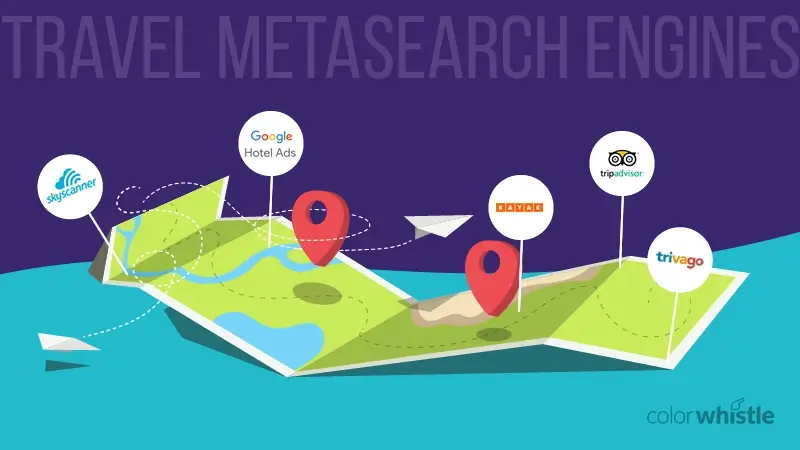
What Are the Top 5 Travel Meta Search Engines?
Here are some of the most famous travel metasearch engines.
Did You Know?
Up to 87% of users research hotels before booking, and meta-search engines are a popular tool
How Metasearch Engines Are Changing The Travel Industry?
Initially, metasearch platforms relied almost entirely on OTAs for inventory. Hotels avoided them due to:
- Complex setup
- Difficult bid management
- Poor attribution
Things have changed now.
Key Industry Shifts
- Direct Hotel Participation: Hotels can now list directly via booking engines, reducing OTA dependency
- Instant Booking Models: Some metasearch engines allow users to book without leaving the platform
- Google’s Dominance: Google Hotel Ads, integrated with Search and Maps, now drives a significant share of discovery traffic often outperforming traditional metasearch engines on CPC efficiency
- Voice & AI Search Readiness: Metasearch data feeds are increasingly used in voice assistants and AI-powered search experiences
Did You Know?
As per the current market research conducted by CMI Team, the global Online Travel Booking Market is expected to record a CAGR of 12.6% from 2026 to 2032.
Why Should Hotels and Agencies Use Travel Metasearch Engines?
Metasearch platforms help travelers validate pricing before committing—something nearly every traveler does today.
Key Benefits
- Higher brand visibility at the research stage
- Better control over pricing presentation
- Opportunity to compete with large OTAs
- Improved ROI through bid-based advertising
- Increased potential for direct bookings
Industry studies show metasearch platforms account for a substantial share of global travel research traffic often exceeding standalone OTA visits in certain markets.
Also Read
Did You Know?
According to an Eye for Travel survey, 94% of travelers use metasearch engines to compare hotel rates
Pros and Cons of Travel Meta Search Engines?
Travel Metasearch Engines have its fair share of advantages and disadvantages. Let’s find out about them.
Pros
- Strong visibility and measurable ROI
- Price transparency builds traveler trust
- Supports direct booking growth
- Centralized review and rate comparison
Cons
- Campaign management complexity
- Costs can escalate without optimization
- Limited customer service control
- Overchoice can overwhelm users
Decision Guide: Should You Invest in Metasearch?
| If your goal is… | Metasearch Fit |
|---|---|
| Increase brand visibility | Strong |
| Reduce OTA dependency | Good |
| Hands-off marketing | Poor |
| Direct booking growth | With effort |
| Minimal marketing ops | Risky |
Metasearch works best when treated as a performance marketing channel, not a passive listing
How Agencies Should Approach Metasearch Strategically
Success requires:
- Active bid management
- ROAS tracking
- Daily or weekly budget optimization
- Alignment with pricing and availability
Without marketing resources, agencies and hotels often outsource campaign management to specialists to maintain profitability.
Drive Conversions and Boost your Business with Expert Travel Website Development.

Conclusion, Metasearch is a Game Changer – if used Correctly
Travel metasearch engines are reshaping how travelers discover and compare options, but they are not a guaranteed booking engine. They reward strategy, pricing discipline, and consistent optimization.
Hotels and travel agencies that treat metasearch as a dynamic advertising channel gain:
- Greater control over distribution
- Improved pricing visibility
- Long-term competitiveness against OTAs
However, metasearch alone does not replace strong reviews, service quality, or customer trust. Those remain critical.
ColorWhistle’s agility in learning travel tech helps to keep our consumers ahead of the curve. If you need any help in travel website development for your travel agency don’t hesitate to contact us. We are always happy to help.
Which travel metasearch engines are you using to advertise your hotel? Share your experience in the comments section below.
More Resources
- Online Travel Agencies – A Brief Introduction
- How to Build a Travel Aggregator Website?
- Best Travel Website Design Ideas And Inspirations For 2026
In quest of the Perfect Travel Tech Solutions Buddy?
Be unrestricted to click the other trendy writes under this title that suits your needs the best!
 What is GDS? – A Simple, Practical Guide Fo...