


Travel AI Chatbot Statistics 2026: Adoption, Customer Experience & ROI Insights

Phurvishaa specializes in crafting travel tech and marketing content, leveraging deep research, SEO expertise, and AI-driven insights. Her strategic approach ensures content that educates, engages and delivers knowledge.

Our authors are proven experts in their fields, writing on topics where they have demonstrated expertise. Every piece of content undergoes peer review and validation by industry professionals.
Travel AI chatbots have quickly evolved from experimental technology into a core component of modern travel experiences. Whether travelers are researching destinations, planning itineraries, comparing prices, or seeking support during a trip, AI-powered chatbots are becoming an increasingly common touchpoint throughout the customer journey. And the numbers behind this shift are difficult to ignore.
From rising adoption among travel businesses to measurable improvements in customer satisfaction and operational efficiency, travel AI chatbot statistics reveal a clear trend: AI is no longer a future investment for travel brands it’s becoming part of the present-day digital infrastructure.
Here’s a data-driven look at how AI chatbots are transforming the travel industry in 2025–2026.
The Travel AI Chatbot Market at a Glance
The travel industry’s adoption of AI has accelerated significantly over the last two years:
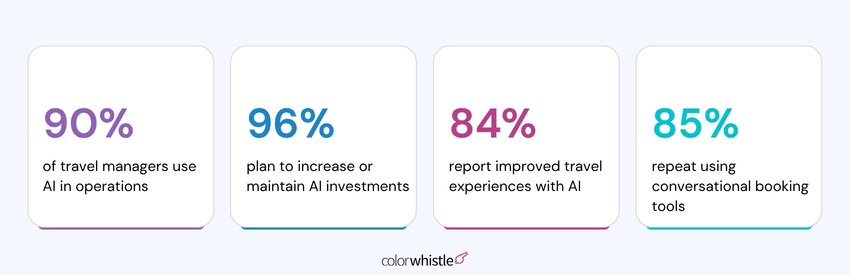
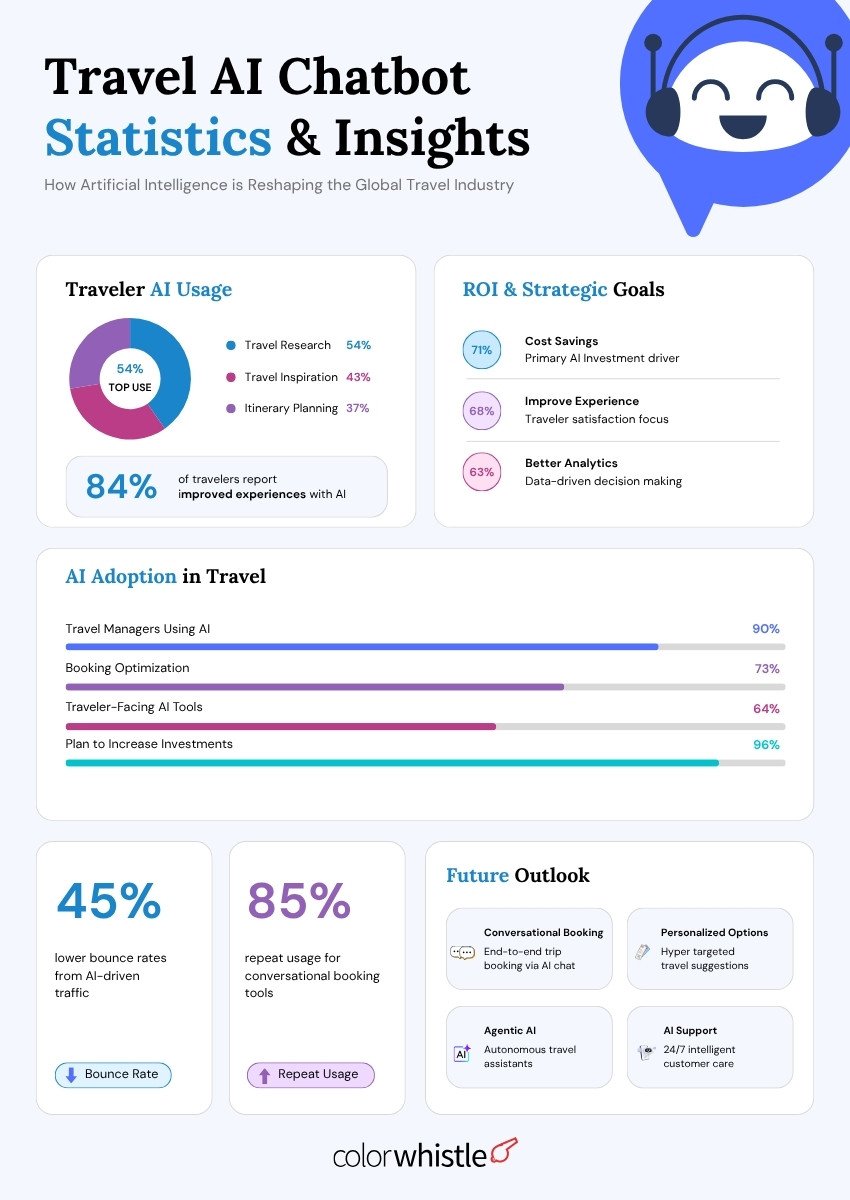
- 90% of travel managers report using AI or generative AI tools within their travel programs.
- 73% use AI to streamline booking processes.
- 70% use AI for pricing optimization.
- 64% use traveler-facing AI tools such as chatbots.
- 71% cite cost savings as a primary objective for AI adoption.
- 63% use AI to improve data analysis and decision-making.
- More than half of travel managers say AI has exceeded expectations.
Our industry is in a good position to go beyond the hype and find practical, valuable applications that deliver real impact.
— Andrew Revell, Serko Head of AI
Travel AI Chatbot Adoption Statistics
AI adoption is no longer limited to experimentation. Travel businesses are increasingly integrating AI into customer-facing and operational workflows.
Key Adoption Statistics
- 90% of travel managers use AI or generative AI tools.
- 52% of travel managers report AI exceeded expectations.
- 46% cite technical complexity as the biggest barrier to implementation.
- 41% of travel and airline organizations use AI tools daily or weekly.
- 96% of travel brands plan to maintain or increase AI investments.
- Only 35% currently use AI in guest-facing applications.
Did You Know?
68% implement AI to enhance traveler experience.
Customer Experience Statistics: How Travelers Use AI Chatbots
Travelers are increasingly comfortable using AI throughout trip planning and research.
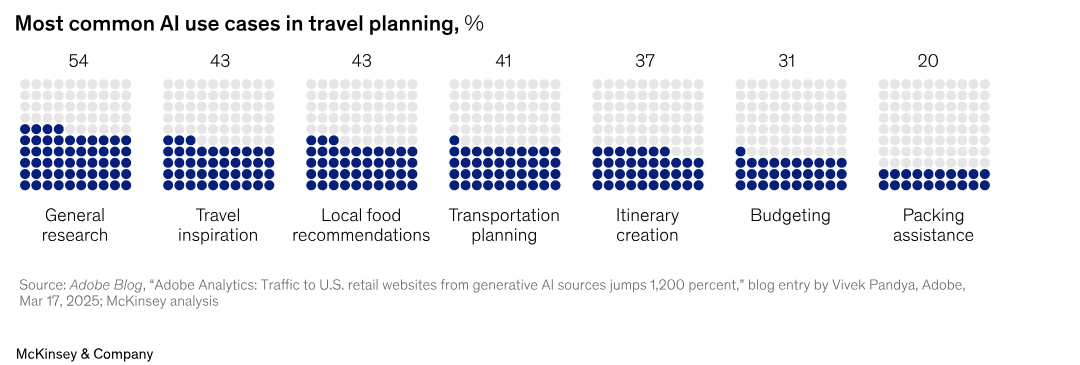
What Travelers Are Using AI For
- 54% use AI for travel research.
- 43% use AI for travel inspiration.
- 43% use AI for local food recommendations.
- 41% use AI for transportation planning.
- 37% use AI for itinerary creation.
- 31% use AI for budgeting assistance.
- 20% use AI for packing assistance.
Planning to launch or upgrade a travel platform in the US market? Explore our Travel Website Cost Guide for the USA to understand pricing, features, and development considerations.
Traveler Satisfaction
- 84% of travelers who used generative AI for travel-related tasks said it improved their experience.
- Less than one-third of travelers have used AI for travel planning so far, suggesting significant growth potential remains.
- AI usage for travel planning doubled year-over-year, according to industry reports.
Travelers increasingly expect immediate answers, personalized recommendations, and support that extend beyond traditional business hours. AI chatbots help travel brands meet those expectations without significantly increasing operational costs.
Also Read
Booking Behavior & Conversion Statistics
One of the strongest indicators of AI’s impact is how it influences travel planning and booking behavior.
Booking & Conversion Insights
- Travel websites receiving visitors from generative AI sources saw bounce rates 45% lower than other traffic sources.
- 95% of users rated their conversational booking experience positively in McKinsey’s SkyLink implementation.
- 85% became repeat users after trying the AI-powered booking assistant.
- 85% booked one of the first three options presented by the AI assistant.
- Nearly 70% of travelers still prefer completing bookings through trusted travel brands rather than AI chatbots alone.
Planning a travel website with AI-powered booking assistance? Features such as chatbot integrations, personalized recommendations, CRM connectivity, and automated customer support can significantly influence both user experience and development costs. Explore the Website Cost & Features Guide to understand what’s involved in building these capabilities.
Travel AI Chatbot ROI Statistics
For travel businesses, ROI remains one of the biggest drivers behind AI adoption.
Business Impact Statistics
- 71% of travel managers pursue AI initiatives to reduce costs.
- 63% focus on improving business intelligence and analytics.
- More than half report AI performance exceeding expectations.
- Travel advisors using AI report significant gains in productivity and response times.
- One agency cited a 40% increase in business growth after incorporating AI into daily workflows.
These findings reinforce a broader trend: AI chatbots are increasingly viewed as revenue-generating and efficiency-enhancing tools rather than optional website features.
AI Travel Trends Shaping the Future
Several emerging trends are expected to accelerate chatbot adoption across the travel sector.
Conversational Booking
Travelers increasingly expect natural-language interactions rather than complex booking workflows.
Personalized Recommendations
AI is becoming more effective at delivering recommendations based on preferences, budgets, location, and past travel behavior.
Agentic AI
The industry is moving toward AI assistants capable of helping travelers research, compare, and potentially complete bookings through connected ecosystems.
Trust Remains Critical
Despite rising AI adoption, travelers continue to place greater trust in established travel brands during the booking stage.
Wondering what it costs to build a travel agency website with features like AI chatbots, booking automation, and personalized customer experiences? Check out our detailed guide on Travel Agency Website Costs in India.
What This Means for Your Travel Business
These statistics carry a clear message for travel businesses: AI chatbots are becoming an expected part of the digital travel experience.
- Travelers increasingly use AI during trip research and planning.
- Personalization is becoming a competitive differentiator.
- Faster response times improve customer experiences.
- AI-powered support can help reduce operational costs.
- Direct booking experiences increasingly depend on intelligent automation.
Whether you’re building a travel agency website, tour booking platform, OTA, or destination portal, AI capabilities are becoming closely tied to conversion, customer engagement, and long-term scalability.
Explore what a travel website costs to build or review travel website design inspirations to see how leading travel brands are integrating AI-powered experiences into their platforms.
Need help building a travel website with AI chatbot capabilities? ColorWhistle helps travel businesses design and develop websites that combine booking functionality, personalization, and modern customer engagement tools.
FAQ’s
What percentage of travel managers use AI?
Approximately 90% of travel managers report using AI or generative AI tools in their travel programs.
How many travel companies use AI chatbots?
According to recent research, 64% of travel managers use traveler-facing AI tools such as chatbots, while 35% of travel and airline brands have deployed AI in guest-facing applications.
Do travelers like using AI for trip planning?
Yes. 84% of travelers who used generative AI for travel-related tasks reported that it improved their experience.
What are the most common uses of travel AI chatbots?
Travel research, itinerary planning, transportation planning, budgeting, travel inspiration, and local recommendations are among the most common use cases.
Are AI chatbots worth it for travel businesses?
Research shows travel businesses primarily invest in AI to reduce costs, improve customer experiences, and gain operational efficiencies.
 Luxury Travel Consumer Statistics 2026: Spend...