


Digitizing NABL Consulting Without Triggering Assessor Red Flags

With half a decade of experience in creating tech content for education, healthcare, hospitality, and real estate, Nandhini excels at turning complex insights into clear, credible, in-depth, research-backed, and engaging content that helps readers make informed decisions.

Our authors are proven experts in their fields, writing on topics where they have demonstrated expertise. Every piece of content undergoes peer review and validation by industry professionals.
AI Summary
Key Highlights of Digitizing NABL Consulting Without Red Flags
This post explores how NABL consultants can digitize their processes without triggering assessor red flags. The key insight: digitization should support expertise, not replace it, by automating administrative tasks while preserving document integrity and audit trails. It covers common pitfalls like identical templates, metadata errors, and weak CAPA records, and prescribes solutions such as configurable document scaffolds, client-specific workspaces, evidence-linked CAPA modules, and NABL-specific gap analysis tools. Designed for experienced NABL consultants, the article promotes customized digital systems that enhance compliance, reduce workload, and improve audit readiness, with practical guidelines to maintain accuracy and client training.
If you’ve been consulting for NABL-accredited or accreditation-seeking laboratories for any length of time, you know the balancing act. On one hand, labs are demanding faster turnaround, better documentation, and more structured audit readiness. On the other hand, the NABL assessment process is meticulous, and any sign of shortcuts, templated inconsistency, or poorly managed digital records can raise flags faster than a missing uncertainty budget.
The conversation around digitizing NABL consulting has been picking up speed. But most of what’s out there either talks in vague terms about ‘going digital’ or focuses entirely on lab management software, not on what consultants specifically need to do their jobs better without compromising the integrity of what they deliver.
This article is for you: the NABL consultant who is already doing the hard work and is wondering how digital tools can support that work, not replace the expertise behind it.
For consulting firms evaluating structured digital transformation, explore ColorWhistle’s customized web and software development solutions designed specifically for workflow-driven consulting environments:
TL;DR
This blog is for NABL consultants who want to digitize their practice without triggering assessor red flags. It breaks down the compliance risks of careless digitization, explains what NABL assessors actually scrutinize, and outlines how to design structured, audit-ready digital systems that improve efficiency without compromising ISO/IEC 17025 integrity.
This blog includes:
- The 5 red flags NABL assessors identify immediately
- Why copy-paste templates and generic QMS tools create compliance risk
- What proper digital document scaffolding should look like
- How to structure gap analysis, CAPA, and equipment tracking digitally
- Metadata, version control, and audit trail best practices
- Data security and multi-client architecture requirements
- A compliance-first framework for scaling NABL consulting safely
What ‘Red Flags’ Actually Look Like to NABL Assessors
Before talking about solutions, it’s worth being precise about the problem. What actually triggers scrutiny during assessments, and how can digital tools inadvertently make things worse?
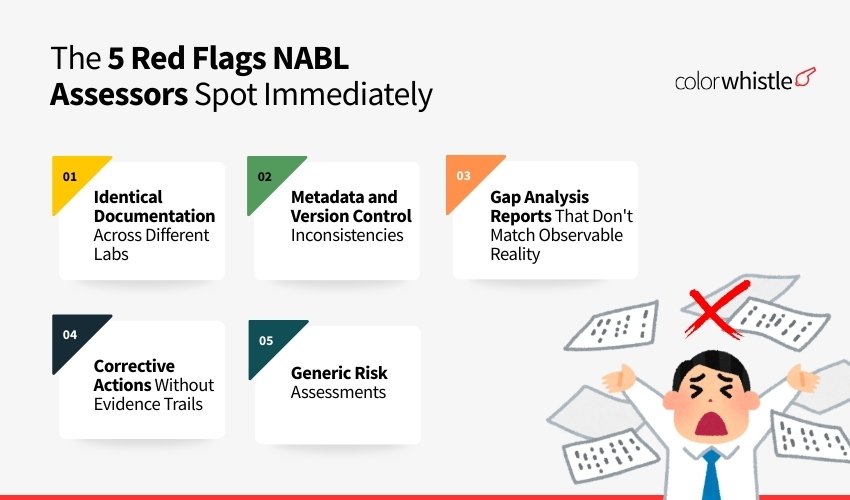
Identical Documentation Across Different Labs
This is the most common pitfall. If two labs under different scopes of accreditation submit quality manuals or SOPs that are word-for-word identical, down to the same examples, the same formatting quirks, the same field names, assessors notice. It signals that neither document genuinely reflects the lab’s actual operations.
The risk with digitization: using the same document templates and simply swapping out lab names without substantive customization replicates this problem at scale.
Metadata and Version Control Inconsistencies
NABL assessors review document histories, version logs, and approval records. If a document shows it was created and approved on the same day, or if version numbers don’t align with described changes, those are red flags. Digital tools that auto-date documents or don’t maintain proper version histories can inadvertently create these inconsistencies.
Gap Analysis Reports That Don’t Match Observable Reality
If your gap analysis identifies ‘minor non-conformances, but the assessment team finds significant deficiencies in the same areas, it damages credibility, both yours and the lab’s. This becomes a problem when consultants use standardized scoring rubrics that aren’t calibrated to the specific lab’s maturity.
Did you know?
The full ISO/IEC 17025 accreditation journey from gap analysis to certificate typically takes 6 to 12 months, depending on the lab’s starting readiness. Labs with no prior QMS can take more months.
Corrective Actions Without Evidence Trails
NABL is particularly attentive to CAPA (Corrective and Preventive Action) records. An assessor will want to see not just that a corrective action was planned, but that it was implemented, verified, and closed with evidence. Digital tools that allow consultants to mark CAPAs as ‘closed’ without linking supporting documents create exactly the kind of gap assessors are trained to find.
Generic Risk Assessments
ISO/IEC 17025 Clause 8.5 requires risk-based thinking. Labs and by extension, their consultants are expected to demonstrate that risks have been assessed in context. Generic risk matrices copy-pasted from templates without lab-specific data or rationale are easy to spot and easy to question.
What Digitization Should Actually Do for Consultants
The goal of digitizing a consulting practice isn’t to automate compliance; it’s to automate the administrative overhead so consultants can spend more time on the work that requires expertise. Here’s what that looks like in practice.
Structured, Configurable Document Templates (Not Static Ones)
There’s a difference between a template and a scaffold. A static template gives you pre-written text that needs to be edited. A configurable scaffold prompts you to answer specific questions about the lab, its scope, test methods, equipment, personnel structure, customer types, and builds a first draft of the document based on those inputs.
The latter approach means that two labs using the same underlying system will produce structurally similar but substantively different documents. That’s the right outcome. The document reflects the lab, not the tool.
Client Specific Workspaces with Controlled Access
Each client lab should have a completely isolated workspace. Document repositories, audit trails, communication logs, and CAPA records should never bleed across clients. This isn’t just good practice for confidentiality; it also protects you legally and operationally.
Version history should be maintained automatically, with timestamps and user attribution. If a document was reviewed by you on a certain date and approved by the lab’s QM on another, that trail should be clear and unalterable.
Gap Analysis Tools Tied to Specific NABL Criteria
Rather than a generic checklist, an effective digital gap analysis tool maps directly to the NABL specific requirements for the relevant accreditation scope, whether that’s NABL 112 for testing, NABL 106 for calibration, or the specific technical criteria for medical labs under NABL-NABH coordination.
Importantly, the scoring should require evidence inputs, not just yes/no checkboxes. ‘Documented procedure exists: Yes’ is weaker than ‘Documented procedure exists: [Link to SOP Rev 3, approved 12-Jan-2025].’ The latter is defensible. The former isn’t.
CAPA Modules with Evidence Linkage
Every corrective action should be linked to the non-conformance that triggered it, the root cause analysis methodology used, the action taken, the person responsible, the target date, and the evidence of closure. Assessors should be able to follow this chain clearly.
A digital CAPA tracker that enforces this structure that won’t let a record be closed without an attached evidence document is more than convenient. It’s a compliance safeguard.
Calibration and Equipment Management Tracking
One of the most frequently cited non-conformances in NABL assessments involves equipment calibration records missed calibration dates, missing traceability certificates, or gaps in maintenance logs. A system that tracks equipment by lab, with calibration due-date alerts and certificate storage, removes a significant manual burden from consultants while also reducing the risk of something slipping through.
Pre-Assessment Simulation Reporting
Some of the most effective consulting engagements include a structured pre-assessment simulation, a mock audit that mirrors what the actual NABL assessment team will do. Digitizing this process means you can generate a structured report with clause-by-clause findings, priority ratings, and linked evidence or gaps. Labs can act on this report systematically, and you have a clear record of the state of the lab before assessment.
Off-the-Shelf vs. Custom: What Most Consultants Miss
Standard QMS platforms handle document control reasonably well for a single organization. But they weren’t built for consultants managing 10-15 labs simultaneously, each with different scopes and accreditation stages. You end up either maintaining separate subscriptions per lab or forcing a single-org tool into a multi-client model; neither works cleanly.
A purpose-built solution designed around consulting workflows, multi-client architecture, NABL-specific criteria; client-ready reporting changes the equation. The time saved per engagement, combined with the ability to scale without proportionally increasing overhead, typically makes the investment worthwhile quickly.
Practical Guidelines: Digitizing Without Compromising Compliance
Whether you’re exploring an existing tool or considering a custom solution, here are principles that should guide how you approach digitization as a NABL consultant.
Customize Before You Digitize
Every document that goes to a client should reflect that client’s reality. Before you build templates or configure workflows, spend time documenting what’s genuinely different about each client, their scope, their personnel structure, their equipment, their risk profile. Build your digital system around those variables, not around generic quality clauses.
Preserve the Human Audit Trail
Digital tools should make the human decision-making more visible, not less. Every significant assessment, every gap rating, and every corrective action recommendation should be traceable to a reviewer with dates and context. Automated timestamps are fine. Automated decisions are not.
Keep Document Metadata Clean
When you create or revise a document in a digital system, the metadata should reflect actual dates, actual reviewers, and actual approval chains. Never back-date documents. Never mark a revision as minor when substantive changes are made. These are the details assessor’s check.
Separate Your Consulting Records from Lab Records
Your working notes, draft assessments, internal communications, and preliminary reports are your intellectual property and your working records. They’re distinct from the final documents that the lab adopts as its own. Your digital system should support this separation clearly.
Train Your Clients on the Digital System
If you’re sharing a client portal or digital workspace with lab personnel, invest time in training them on how to use it correctly. A lab QM who doesn’t understand how version control works and inadvertently creates conflicting document versions can create compliance problems that weren’t there before you introduced the digital tool.
To achieve this balance effectively, it’s essential to understand how to audit digital NABL processes thoroughly. This involves implementing robust measures that address identity, integrity, versioning, availability, and validation risks.
Data Security and Confidentiality
NABL-accredited labs deal with sensitive data, test results, client information, quality records. As a consultant, you’re often privy to this data in the course of your engagement. Any digital tool you use must meet reasonable standards for data security: encrypted storage, role-based access control, audit logs of who accessed what and when, and a clear data retention and deletion policy.
If you’re using a cloud-based system, understand where your data is hosted and whether that hosting arrangement is consistent with any data residency expectations your lab clients may have. This is particularly relevant for labs in sectors like defense, pharmaceuticals, or government testing where data governance requirements may be more stringent.
A well-designed custom solution can address these requirements by design rather than workaround.
Interested in a digital platform built specifically for NABL consulting workflows?
ColorWhistle builds customized web and software solutions for consulting practices like yours, designed around how you work, not around a generic QMS template. Reach out to explore what’s possible.
Wrap-Up
Digitizing your practice isn’t about finding shortcuts. It’s about removing friction from work that doesn’t require your expertise, so you can focus on the work that does. The assessors reviewing your clients’ labs aren’t evaluating your software. They’re evaluating whether the documentation reflects how the lab operates. The right digital infrastructure helps you ensure it does.
Scaling your NABL consulting practice?
Stop relying on generic tools. Start building infrastructure that protects compliance and accelerates delivery.
Schedule a Consultation with ColorWhistle
 How to Use AI to Assist NABL Documentation Wi...