


AI Agency Industry Statistics: Market Size, Growth & Adoption Trends

Anusha is a digital strategy expert with deep expertise in branding, UI/UX, and performance-focused content. She brings advanced insight into brands to scale intelligently, blending creativity with conversion-focused thinking.

Our authors are proven experts in their fields, writing on topics where they have demonstrated expertise. Every piece of content undergoes peer review and validation by industry professionals.
AI Summary
Key Highlights of AI Agency Industry Market Size Growth
This post explores the expanding AI agency industry, highlighting its shift from experimental technology to essential business capability. The key insight: AI agencies now address broad needs beyond model development, including integration, workflow automation, governance, and outcome measurement. It serves business leaders and AI service providers seeking to understand market size, growth, adoption trends, and emerging opportunities like generative and agentic AI. Supported by authoritative data from Gartner, McKinsey, and others, it outlines industry-specific adoption, talent shortages, and future forecasts. Readers will learn how AI agencies drive workflow transformation, industry specialization, and measurable ROI to meet evolving enterprise demands.
Artificial intelligence has moved from a largely experimental technology to a business capability that is being deployed across marketing, sales, customer service, software engineering, IT, operations, analytics and knowledge of work. For AI agencies, this shift creates a market that is broader than AI model development alone: businesses increasingly need help identifying use cases, preparing data, integrating AI into existing systems, automating workflows, deploying AI agents, governing AI use and measuring business outcomes.
There is an important measurement caveat. There is no single, universally accepted global statistic for the size of the “AI agency industry.” Public research typically measures adjacent categories such as total AI spending, generative-AI spending, AI services, AI consulting, enterprise adoption and AI software. This report therefore uses those measurable markets as indicators of the addressable opportunity for AI agencies and clearly labels what each statistic actually measures.
The statistics below prioritize primary or high-authority sources, including Stanford HAI, OECD, McKinsey, Gartner, Deloitte, IBM, Microsoft, PwC, and the World Economic Forum. The figures are intended to support a publishable ColorWhistle article while avoiding unsupported claims or false precision.
Executive Snapshot: The Numbers to Know
| Statistic / finding | Why it matters for AI agencies | Source |
|---|---|---|
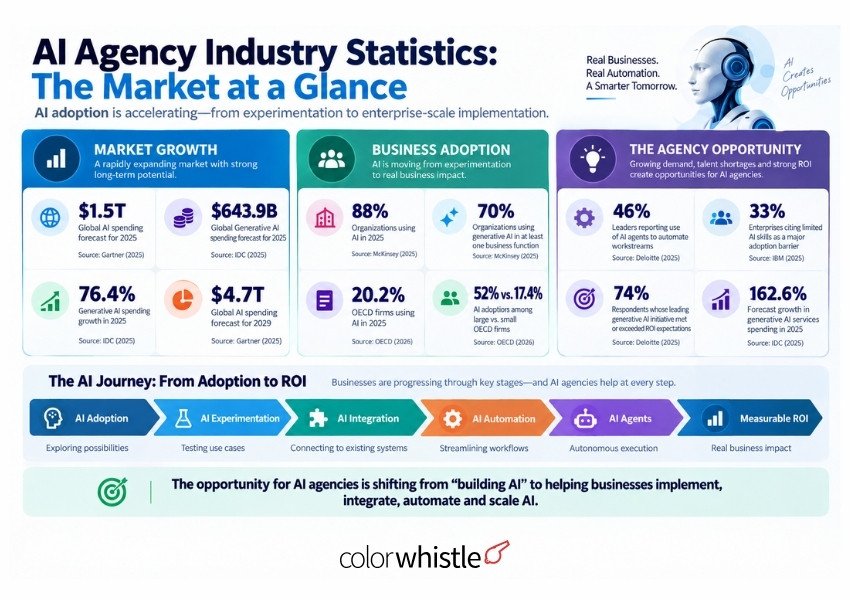
| 88% of surveyed organizations reported using AI in 2025; 70% reported using generative AI in at least one business function. | Shows that the addressable market is moving beyond early experimentation toward broad organizational adoption. | Stanford HAI, 2026 AI Index |
| 20.2% of OECD firms reported using AI in 2025, up from 14.2% in 2024 and 8.7% in 2023. | Confirms rapid firm-level adoption while showing that there is still a large implementation gap. | OECD, 2026 |
| Worldwide AI spending was forecast at nearly $1.5 trillion in 2025 and more than $2 trillion in 2026. | Demonstrates the scale of the broader AI ecosystem in which agencies operate. | Gartner, 2025 |
| Worldwide GenAI spending was forecast at $643.9 billion in 2025, up 76.4% from 2024. | Signals for rapid expansion of the GenAI technology and services ecosystem. | Gartner, 2025 |
| 71% of McKinsey survey respondents said their organizations regularly use GenAI in at least one business function. | Highlights strong demand for implementation, integration, and workflow redesign. | McKinsey, 2025 |
| 74% of Deloitte respondents said their most advanced GenAI initiative was meeting or exceeding ROI expectations; 20% reported ROI above 30%. | Supports an outcomes-led agency proposition, while emphasizing the need for measurement. | Deloitte, 2025 |
| 26% of Deloitte respondents were exploring autonomous agent development largely with another 42% exploring it to some extent. | Shows that agentic AI is an emerging agency service opportunity. | Deloitte, 2025 |
| Microsoft found that 46% of leaders said their organizations were using agents to fully automate workstreams or business processes. | Indicates growing demand for agent-enabled automation. | Microsoft Work Trend Index 2025 |
| PwC found that AI-exposed industries had 3x higher growth in revenue per employee than less AI-exposed industries. | Provides an economic case for AI investment and transformation. | PwC 2025 Global AI Jobs Barometer |
| WEF projects 170 million jobs created and 92 million displaced by global labor-market transformation by 2030. | Illustrates the scale of workforce redesign and the need for AI skills and implementation support. | World Economic Forum, Future of Jobs 2025 |
1. AI Agency Industry at a Glance
The AI agency category sits at the intersection of AI technology, consulting, software development, automation and digital transformation. Because public datasets rarely isolate “AI agencies” as a separate industry, a defensible statistics article should describe the agency’s opportunity using adjacent measurable indicators rather than claiming a single global agency-market number.
| Statistic / finding | Why it matters for AI agencies | Source |
|---|---|---|
| 88% of surveyed organizations reported using AI in 2025. | Broad adoption expands the pool of businesses that may need implementation and optimization support. | Stanford HAI, 2026 AI Index |
| 70% reported using generative AI in at least one business function in 2025. | GenAI has become a mainstream business capability rather than a niche experiment. | Stanford HAI, 2026 AI Index |
| 20.2% of OECD firms used AI in 2025, versus 8.7% in 2023. | Firm-level adoption is rising quickly, while a large share of businesses remains outside of active adoption, an implementation opportunity. | OECD, 2026 |
2. AI Agency Market Size Statistics
A key editorial point is to separate the “AI market” from the “AI agency market.” The figures below describe the larger spending pools that create demand for AI implementation, integration, consulting, and development services.
| Statistic / finding | Why it matters for AI agencies | Source |
|---|---|---|
| Global AI spending was forecast to reach nearly $1.5 trillion in 2025 and top $2 trillion in 2026. | Provides a top-down indicator of the total commercial AI economy. | Gartner, 17 Sep 2025 |
| Gartner forecast AI spending to reach $4.7 trillion by 2029, up from $1.8 trillion in 2025. | Indicates a transition from experimentation toward enterprise-scale AI spending. | Gartner, Forecast Analysis: AI Spending, 4Q25 |
| GenAI spending was forecast at $643.9 billion in 2025, up 76.4% from 2024. | Shows the rapid growth of the GenAI ecosystem relevant to AI agencies. | Gartner, 31 Mar 2025 |
| GenAI services spending was forecast at $27.76 billion in 2025, up 162.6% from 2024. | One of the closest public spending indicators for the services side of the GenAI ecosystem. | Gartner, 31 Mar 2025 |
3. AI Agency Industry Growth Statistics
Growth is visible across AI adoption, AI spending, and GenAI spending. For an agency article, the strongest narrative is not simply “AI is growing,” but that spending and adoption are moving toward implementation, integration and business-process change.
| Statistic / finding | Why it matters for AI agencies | Source |
|---|---|---|
| OECD firm AI adoption grew 42.4% in 2025. | Shows rapid year-over-year expansion in active business AI use. | OECD, 2026 |
| GenAI spending grew 76.4% globally in Gartner's 2025 forecast. | Shows the acceleration of the GenAI commercial ecosystem. | Gartner, 2025 |
| GenAI services spending was forecast to grow 162.6% in 2025. | Suggests particularly strong growth in service-related GenAI spending. | Gartner, 2025 |
4. Business AI Adoption Statistics
Business adoption is now one of the most important indicators of future agency demand. Adoption rates differ substantially by source because surveys use different definitions, samples and questions; the figures should therefore not be treated as directly interchangeable.
| Statistic / finding | Why it matters for AI agencies | Source |
|---|---|---|
| 78% of organizations reported using AI in 2024 in the Stanford HAI survey; the figure rose to 88% in 2025. | Shows rapid movement in organizational AI adoption. | Stanford HAI, AI Index 2025 & 2026 |
| 20.2% of OECD firms reported using AI in 2025, up from 14.2% in 2024. | Provides a firm-level statistical view and demonstrates that adoption remains far from universal. | OECD, 2026 |
| 42% of enterprises with more than 1,000 employees in IBM's 2023 survey had actively deployed AI; another 40% were exploring it. | Shows a large enterprise implementation pipeline. | IBM Global AI Adoption Index 2023 |
5. Generative AI Adoption Statistics
Generative AI is particularly important for agencies because many business use cases require more than access to a model: they require workflow design, integration, data preparation, governance, user experience and change management.
| Statistic / finding | Why it matters for AI agencies | Source |
|---|---|---|
| 71% of McKinsey respondents said their organizations regularly use GenAI in at least one business function in 2025. | Shows that GenAI use has moved into multiple operational functions. | McKinsey, State of AI 2025 |
| GenAI use was reported in marketing and sales, product and service development, service operations and software engineering among the leading functions. | These functions map closely to agency-led automation, integration, and application projects. | McKinsey, State of AI 2025 |
| Gartner forecast end-user spending on GenAI models at $14.2 billion in 2025. | Shows a growing direct spending category for enterprise GenAI model access. | Gartner, 10 Jul 2025 |
6. AI Agent / Agentic AI Adoption Statistics
Agentic AI is emerging as a distinct opportunity because agents can execute multi-step tasks and workflows rather than simply generate content. Public adoption data is still early, so the article should describe agentic AI as an emerging market rather than a mature category.
| Statistic / finding | Why it matters for AI agencies | Source |
|---|---|---|
| 26% of Deloitte respondents were largely exploring autonomous-agent development; another 42% were exploring it to some extent. | Shows significant experimentation with agentic AI. | Deloitte, State of GenAI in Enterprise Q4 2024 |
| 46% of Microsoft Work Trend Index 2025 leaders said their organization was using agents to fully automate workstreams or business processes. | Points to a shift from assistants toward workflow automation. | Microsoft Work Trend Index 2025 |
| Stanford's 2026 AI Index reports that AI agent deployment remained in the single digits across nearly all business functions. | Provides a useful counterbalance: agent deployment is promising but still early compared with general AI adoption. | Stanford HAI, 2026 AI Index |
7. AI Agency Services Statistics
There is no authoritative global dataset ranking “AI agency services” by demand. A robust article should instead connect documented business use cases to service categories. The most defensible service taxonomy includes AI strategy and consulting, AI integration, workflow automation, custom AI applications, GenAI implementation, AI agents, data readiness and governance.
| Statistic / finding | Why it matters for AI agencies | Source |
|---|---|---|
| McKinsey identifies marketing and sales, product and service development, service operations and software engineering among the most common GenAI business functions. | These are natural service areas for AI automation, integration, and custom application work. | McKinsey, State of AI 2025 |
| IBM identified IT automation, digital labor and customer care among enterprise AI use cases expected to produce impact quickly. | Supports demand for automation and customer service AI services. | IBM Global AI Adoption Index 2023 |
8. AI Adoption by Industry
Industry adoption varies significantly. This creates an opportunity for verticalized AI agencies that understand a sector’s workflows, data constraints, compliance needs and customer experience.
| Statistic / finding | Why it matters for AI agencies | Source |
|---|---|---|
| 57.3% of OECD ICT firms used AI in 2025, the highest share among industries measured. | Technology is a leading adoption market and may have more sophisticated AI requirements. | OECD, 2026 |
| 36.8% of OECD professional and scientific services firms used AI in 2025. | Professional services are another high-adoption segment with strong knowledge-work use cases. | OECD, 2026 |
| Year-over-year AI use grew 62.5% in accommodation and food services and 59.1% in construction in the OECD dataset. | Previously, lower-adoption sectors could be high-growth targets for practical automation services. | OECD, 2026 |
9. AI Adoption by Business Size
Company size is one of the clearest adoption divides. Large firms have more resources for AI teams and infrastructure, while smaller firms may have a stronger need for external specialists and packaged implementation services.
| Statistic / finding | Why it matters for AI agencies | Source |
|---|---|---|
| 52.0% of large OECD firms used AI in 2025 versus 17.4% of small firms. | The gap indicates substantial room for SMB adoption and implementation support. | OECD, 2026 |
| IBM found that 42% of surveyed enterprises with more than 1,000 employees had actively deployed AI, while 40% were exploring it. | Large organizations represent both mature implementation work and large transformation pipelines. | IBM Global AI Adoption Index 2023 |
10. Enterprise AI Spending Statistics
Enterprise spending is a stronger commercial indicator than consumer enthusiasm because it translates directly into budgets for software, infrastructure, services, and implementation.
| Statistic / finding | Why it matters for AI agencies | Source |
|---|---|---|
| Worldwide AI spending was forecast at nearly $1.5 trillion in 2025. | Demonstrates the size of enterprise and technology investment around AI. | Gartner, 2025 |
| AI spending was forecast to exceed $2 trillion in 2026. | Indicates continued investment as organizations move toward scaled adoption. | Gartner, 2025 |
| GenAI spending was forecast at $643.9 billion in 2025. | Shows the growing budget pool around GenAI products, infrastructure and services. | Gartner, 2025 |
11. AI Outsourcing & External Vendor Statistics
Public datasets do not provide a clean global “AI outsourcing rate.” However, multiple sources identify capability gaps, complexity, and organizational change as barriers—conditions that can increase demand for external implementation partners.
| Statistic / finding | Why it matters for AI agencies | Source |
|---|---|---|
| 33% of IBM's surveyed enterprises cited limited AI skills and expertise as a top barrier to deployment. | External specialists can help with close skills and implementation gaps. | IBM Global AI Adoption Index 2023 |
| 25% cited data complexity as a top barrier; 23% cited ethical concerns. | AI agencies can provide data-readiness, integration and responsible AI support alongside development. | IBM Global AI Adoption Index 2023 |
| McKinsey reports organizations are hiring new AI roles, retraining employees, and redesigning workflows. | Implementation increasingly requires organizational as well as technical capabilities. | McKinsey, State of AI 2025 |
12. AI Talent Shortage Statistics
AI adoption depends on people who can translate business problems into AI systems, integrate technology into existing environments, and manage risk. Skills shortages therefore support the case for specialist partners.
| Statistic / finding | Why it matters for AI agencies | Source |
|---|---|---|
| 33% of IBM's surveyed enterprises identified limited AI skills and expertise as a top barrier to deployment. | A direct indicator of the skills gap affecting implementation. | IBM Global AI Adoption Index 2023 |
| PwC found workers with AI skills commanded a 56% wage premium in 2025. | The premium indicates that AI skills are scarce and valuable. | PwC 2025 Global AI Jobs Barometer |
| WEF projects 78 million net additional jobs by 2030 after 170 million jobs are created and 92 million displaced. | Workforce transformation will increase demand for AI skills, training, and redesign. | World Economic Forum, Future of Jobs 2025 |
13. AI ROI Statistics
ROI data is increasingly important because AI buyers are moving from experimentation toward business cases. Agencies should therefore position services around measurable outcomes rather than tool deployment alone.
| Statistic / finding | Why it matters for AI agencies | Source |
|---|---|---|
| 74% of Deloitte respondents said their most advanced GenAI initiative was meeting or exceeding ROI expectations. | Shows that leading GenAI initiatives can deliver against expectations. | Deloitte, 2025 |
| 20% reported ROI above 30% for their most advanced GenAI initiative. | Provides a concrete high-end ROI benchmark from a survey of enterprise leaders. | Deloitte, 2025 |
| Stanford HAI reports that among organizations reporting AI financial impact, many estimates remain low; for example, 49% in service operations reported cost savings, with most savings below 10%. | Highlights the difference between adoption and material financial impact. | Stanford HAI, AI Index 2025 |
14. AI Automation Statistics
Automation is one of the clearest ways an AI agency can connect technology to operational value. The strongest statistics relate to workflow automation, service operations, IT and digital labor.
| Statistic / finding | Why it matters for AI agencies | Source |
|---|---|---|
| 46% of Microsoft Work Trend Index 2025 leaders said their organization was using agents to fully automate workstreams or business processes. | Signals growing acceptance of AI-driven workflow automation. | Microsoft Work Trend Index 2025 |
| IBM identified IT automation and digital labor among use cases where organizations expect AI to have a rapid impact. | Supports automation as a core agency service category. | IBM Global AI Adoption Index 2023 |
| McKinsey found service operations, marketing/sales, product/service development and software engineering among common GenAI use areas. | These functions contain many repeatable workflows suitable for automation. | McKinsey, State of AI 2025 |
15. AI Adoption by Geography
AI adoption varies significantly by geography because of differences in digital infrastructure, investment, talent, regulation, and enterprise maturity. The article can use global comparisons without implying that one survey is directly comparable with another.
| Statistic / finding | Why it matters for AI agencies | Source |
|---|---|---|
| IBM's 2023 enterprise survey reported active AI use of 59% in India, 58% in the UAE, 53% in Singapore and 50% in China among surveyed enterprise respondents. | Shows strong adoption signals in several major Asian and Middle Eastern markets. | IBM Global AI Adoption Index 2023 |
| OECD reports AI adoption above 35% in Denmark, Finland and Sweden in 2025. | Shows high adoption in leading OECD economies. | OECD, 2026 |
| Stanford HAI reports generative AI adoption reached 53% globally in three years; Singapore was at 61% and UAE at 64% in its country comparison. | Illustrates rapid diffusion and strong adoption in selected markets. | Stanford HAI, 2026 AI Index |
16. AI Agency Pricing & Revenue Statistics
There is no reliable, standardized global benchmark for AI agency pricing. Project cost varies by scope, data readiness, integration complexity, model choice, security requirements, geography, and ongoing support. A statistics article should not invent an “average AI agency project price.”
| Statistic / finding | Why it matters for AI agencies | Source |
|---|---|---|
| Gartner forecasts GenAI services spending of $27.76 billion in 2025. | Provides a market-level spending benchmark without pretending that it represents agency revenue alone. | Gartner, 2025 |
17. AI Agency Client Demand & Use Cases
The strongest evidence for agency demand comes from the business functions where organizations are already applying AI. These use cases can be translated into agency offerings.
| Statistic / finding | Why it matters for AI agencies | Source |
|---|---|---|
| McKinsey's leading GenAI functions include marketing and sales, product/service development, service operations, and software engineering. | Useful for defining client demand categories. | McKinsey, State of AI 2025 |
| IBM highlights IT automation, digital labor and customer care as prominent enterprise AI use cases. | Supports demand for AI automation and customer service solutions. | IBM Global AI Adoption Index 2023 |
| Microsoft identifies customer service, marketing, and product development among top AI investment priorities in its 2025 Work Trend Index. | Shows commercially important functions for AI agent implementation. | Microsoft Work Trend Index 2025 |
18. AI Agency Industry Trends
Several trends emerge consistently across the research: organizations are moving from pilots toward workflow redesign; GenAI is spreading across business functions; agentic AI is gaining attention but remains early; and domain-specific models and integrated AI capabilities are becoming more important.
| Statistic / finding | Why it matters for AI agencies | Source |
|---|---|---|
| Gartner predicts that more than half of GenAI models used by enterprises will be domain-specific by 2027, up from 1% in 2024. | Supports the rise of vertical and function-specific AI solutions. | Gartner, 10 Jul 2025 |
| McKinsey reports organizations are redesigning workflows and strengthening AI governance as they deploy GenAI. | Shows that successful AI adoption requires organizational change, not only software. | McKinsey, State of AI 2025 |
| Deloitte reports regulatory uncertainty and risk management remain barriers to agentic AI. | Responsible AI, governance, and risk management are potential agency service areas. | Deloitte, 2025 |
19. AI Agency Industry Forecast
The forecast should be framed as an addressable opportunity rather than a precise forecast of AI-agency revenue. The underlying AI and GenAI spending forecasts point to a much larger market for implementation and transformation services.
| Statistic / finding | Why it matters for AI agencies | Source |
|---|---|---|
| Gartner forecasts global AI spending at $1.8 trillion in 2025 and $4.7 trillion in 2029. | Indicates a rapidly expanding underlying AI economy. | Gartner, Forecast Analysis: AI Spending, 4Q25 |
| Gartner forecasts software GenAI spending to rise from $299 billion in 2025 to $895 billion in 2028. | Suggests significant enterprise software transformation around GenAI. | Gartner, Forecast Analysis: GenAI Spending in Software Markets |
| Gartner forecasts end-user spending on GenAI models at $14.2 billion in 2025 and specialized model spending at $1.1 billion. | Supports continued growth in enterprise model consumption and domain-specific AI. | Gartner, 10 Jul 2025 |
20. Future Trends & Predictions
- AI agencies will shift from chatbot development to AI-powered workflow transformation. Businesses are increasingly looking beyond individual AI tools toward redesigned, end-to-end workflows. McKinsey notes that fewer than 40% of companies currently report measurable gains despite widespread AI investment, suggesting that workflow redesign, not simply adding AI to existing tasks, will become increasingly important.
Source: McKinsey – AI: Work partnerships between people, agents, and robots - AI agents will become a major agency service category. Agentic AI is moving from experimentation toward business-process automation. Gartner expects agentic AI and domain-specific models to be among the technologies enabling GenAI to scale, while Deloitte expects agentic AI pilots to expand significantly.
Source: Gartner – Top Emerging Adoption Trends for Generative AI - Demand for industry-specific AI solutions will grow. Gartner predicts that more than 50% of GenAI models used by enterprises will be specific to an industry or business function by 2027, compared with about 1% in 2023. This points toward more verticalized AI agencies serving healthcare, finance, legal, real estate, manufacturing and other sectors.
Source: Gartner – 3 Bold and Actionable Predictions for the Future of GenAI - Smaller, task-specific AI models will create new implementation opportunities. Gartner predicts organizations will use small, task-specific AI models at least three times more frequently than general-purpose LLMs by 2027. Agencies may increasingly help businesses select, fine-tune, integrate and manage specialized models.
Source: Gartner – Small, Task-Specific AI Models Prediction - Multimodal AI will become a standard part of business applications. Gartner identifies multimodal capabilities alongside agentic AI and domain-specific models as technologies that will enable GenAI solutions to scale over the next two years. This could expand agency opportunities across voice, video, image, document and text-based workflows.
Source: Gartner – Top Emerging Adoption Trends for Generative AI - AI integration will become more valuable than standalone AI tools. As organizations move AI into production, agencies will increasingly be asked to connect AI with CRMs, ERPs, websites, databases, business applications and internal knowledge systems. Gartner’s current outlook emphasizes integration as a key requirement for scaling GenAI.
Source: Gartner – Top Emerging Adoption Trends for Generative AI - AI implementation and governance will become recurring services. As AI moves into customer-facing and operational workflows, businesses will need ongoing monitoring, security, evaluation, governance and optimization, not just one-time deployment. Deloitte identifies regulatory uncertainty and risk management as important barriers to agentic AI adoption.
Source: Deloitte – State of Generative AI in the Enterprise - The next competitive advantage will come from moving AI into production at a scale. Stanford reports that organizational AI adoption reached 88%, but AI-agent deployment remains in the single digits across nearly all business functions. This gap between AI adoption and deep operational deployment represents a major opportunity for agencies.
Source: Stanford HAI – 2026 AI Index, Economy
21. What These Statistics Mean for AI Agencies
The data points to a three-layer opportunity: first, a rapidly expanding technology and spending base; second, accelerating business adoption; and third, a persistent implementation gap caused by skills, data, governance and workflow complexity. AI agencies are positioned between those layers, helping organizations turn AI capabilities into operational systems and measurable outcomes.
| Statistic / finding | Why it matters for AI agencies | Source |
|---|---|---|
| 20.2% of OECD firms used AI in 2025, while 52% of large firms and 17.4% of small firms used AI. | Adoption is expanding but remains uneven, leaving substantial room for implementation partners. | OECD, 2026 |
| IBM found that 40% of surveyed enterprises were still exploring or experimenting with AI in 2023. | The pipeline from experimentation to deployment remains commercially important. | IBM Global AI Adoption Index 2023 |
| Deloitte found most respondents' expected value from leading GenAI initiatives, while scaling remained difficult. | The agency opportunity is increasingly about implementation quality, integration and change management. | Deloitte, 2025 |
Research Methodology & Editorial Notes
This document uses a source-first approach. Statistics are drawn primarily from official reports, research pages and press releases published by the organizations that conducted or commissioned the research. Where the phrase “AI agency market” cannot be directly measured from public data, the document uses adjacent categories, AI spending, GenAI spending, AI services, enterprise adoption and implementation barriers, and explicitly labels them.
Survey results should not be treated directly comparable unless their samples and definitions match. For example, Stanford’s organizational-adoption figures, OECD’s firm-level statistics, and IBM’s enterprise surveys use different populations and methodologies. The final blog should retain the source name, publication year, and the definition of the statistic wherever possible.
Pricing is especially fragmented. Public agency pricing is usually based on individual project scope rather than an industry-wide statistical standard. The recommended article should avoid unsupported claims such as “the average AI agency charges $X” unless a credible dataset specifically measures that metric.
Research Links
Stanford HAI — 2026 AI Index, Economy
https://hai.stanford.edu/ai-index/2026-ai-index-report/economy
Stanford HAI — 2025 AI Index Report
https://hai.stanford.edu/ai-index/2025-ai-index-report
Stanford HAI — State of AI in 10 Charts, 2025
https://hai.stanford.edu/news/ai-index-2025-state-of-ai-in-10-charts
OECD — AI use by individuals surges across the OECD as adoption by firms continues to expand
https://www.oecd.org/en/about/news/announcements/2026/01/ai-use-by-individuals-surges-across-the-oecd-as-adoption-by-firms-continues-to-expand.html
OECD — Artificial Intelligence topic/data
https://www.oecd.org/en/topics/artificial-intelligence.html
Gartner — Worldwide AI Spending, September 2025
https://www.gartner.com/en/newsroom/press-releases/2025-09-17-gartner-says-worldwide-ai-spending-will-total-1-point-5-trillion-in-2025
Gartner — Worldwide GenAI Spending, March 2025
https://www.gartner.com/en/newsroom/press-releases/2025-03-31-gartner-forecasts-worldwide-genai-spending-to-reach-644-billion-in-2025
Gartner — GenAI Models Spending, July 2025
https://www.gartner.com/en/newsroom/press-releases/2025-07-10-gartner-forecasts-worldwide-end-user-spending-on-generative-ai-models-to-total-us-dollars-14-billion-in-2025
Gartner — AI Spending Forecast Analysis, 4Q25
https://www.gartner.com/en/documents/7290730
Gartner — GenAI Spending in Software Markets
https://www.gartner.com/en/documents/6321447
McKinsey — The State of AI: How organizations are rewiring to capture value, 2025
https://www.mckinsey.com/capabilities/quantumblack/our-insights/the-state-of-ai-how-organizations-are-rewiring-to-capture-value
IBM — Global AI Adoption Index 2023
https://newsroom.ibm.com/2024-01-10-Data-Suggests-Growth-in-Enterprise-Adoption-of-AI-is-Due-to-Widespread-Deployment-by-Early-Adopters
Deloitte — State of Generative AI in the Enterprise Q4 / 2025
https://www2.deloitte.com/us/en/pages/about-deloitte/articles/press-releases/state-of-generative-ai.html
Microsoft — 2025 Work Trend Index
https://www.microsoft.com/en-us/worklab/work-trend-index/2025-the-year-the-frontier-firm-is-born
Microsoft — 2025 Work Trend Index official blog
https://blogs.microsoft.com/blog/2025/04/23/the-2025-annual-work-trend-index-the-frontier-firm-is-born/
PwC — 2025 Global AI Jobs Barometer
https://www.pwc.com/gx/en/issues/artificial-intelligence/job-barometer/2025/report.pdf
World Economic Forum — Future of Jobs Report 2025
https://www.weforum.org/press/2025/01/future-of-jobs-report-2025-78-million-new-job-opportunities-by-2030-but-urgent-upskilling-needed-to-prepare-workforces/
The evidence points to a rapidly expanding AI economy, accelerating business adoption and a large gap between having access to AI and implementing it successfully. Organizations are not only experimenting with generative AI; they are redesigning workflows, investing in automation, exploring AI agents, and looking for measurable business value. At the same time, skills shortages, data complexity, governance requirements, and the difficulty of scaling pilots continue to slow adoption.
For businesses, this means the question is increasingly not whether AI matters, but where it can create measurable value and how quickly it can be integrated into day-to-day operations. For AI agencies, the opportunity is to bridge that gap with strategy, implementation, custom AI applications, automation, integrations, AI agents, data readiness, and ongoing optimization.
If your business is evaluating AI opportunities, planning an automation project or looking to build and integrate AI into an existing product or workflow, contact ColorWhistle. ColorWhistle provides AI consulting, AI integration, automation, custom AI agent development and AI application development services designed around business goals and operational needs. The team can help assess your current workflows, identify practical AI opportunities, define a roadmap, and move from experimentation to implementation.
Explore ColorWhistle AI Consulting: https://colorwhistle.com/services/ai-consulting/
Contact ColorWhistle: https://colorwhistle.com/contact-us/
 EdTech Market Statistics in India & Globa...