


Cosmetic Surgery Consumer Behavior Statistics: Trends, Demographics & Digital Influence

Anusha is a digital strategy expert with deep expertise in branding, UI/UX, and performance-focused content. She brings advanced insight into brands to scale intelligently, blending creativity with conversion-focused thinking.

Our authors are proven experts in their fields, writing on topics where they have demonstrated expertise. Every piece of content undergoes peer review and validation by industry professionals.
AI Summary
Key Highlights of Cosmetic Surgery Consumer Behavior Trends
This post explores evolving consumer behavior in cosmetic surgery, emphasizing the digital journey's impact on patient decisions. The key insight: patients research extensively online before consultations, influenced by social media, reviews, and procedure trends. It serves cosmetic clinics and brands aiming to adapt marketing strategies. The article details demographic shifts, procedure demand, and social media's role, supported by global statistics from ISAPS, ASPS, and surveys. Clinics benefit by enhancing digital presence with authentic content and seamless booking. The post urges providers to combine credibility with digital engagement, preparing for future trends driven by informed, digitally savvy patients.
Cosmetic surgery decisions are increasingly influenced by a combination of procedure trends, age, gender, social media, online research, patient reviews, and changing expectations around appearance. For clinics and cosmetic surgery brands, understanding this behavior is important because the patient’s journey often starts well before the consultation.
The statistics below are structured differently from a traditional market-size article. Each section answers a practical question: Who is choosing cosmetic procedures? What are they choosing? What influences them? And what should clinics expect next?
What Are Consumers Choosing?
Procedure demand gives clinics a direct view of changing consumer preferences. The latest global data shows strong demand for both surgical and nonsurgical treatments, with body contouring, facial rejuvenation, injectables, and skin treatments remaining in important categories.
- 34.9 million aesthetic procedures were performed globally by plastic surgeons in 2023, including more than 15.8 million surgical and 19.1 million nonsurgical procedures. Source: ISAPS
- Global aesthetic procedure volume increased 40% over the four years through 2023, showing strong post-pandemic growth in consumer demand. Source: ISAPS
- In 2024, eyelid surgery was the world’s most common cosmetic surgical procedure, with approximately 2.12 million procedures. Source: ISAPS
- Liposuction accounted for approximately 2.09 million procedures globally in 2024, making it the second most common surgical procedure worldwide. Source: ISAPS
- Botulinum toxin was the most frequently performed nonsurgical aesthetic procedure in 2024, with approximately 7.89 million procedures. Source: ISAPS
- Nonsurgical skin tightening increased 38.9% globally in 2024, indicating growing consumer interest in less invasive aesthetic treatments. Source: ISAPS
What this suggests for the next 5 years
- Minimally invasive and nonsurgical treatments will continue competing strongly with surgery.
- Body contouring and facial rejuvenation will remain major consumer categories.
- Consumers are likely to increasingly seek natural-looking improvements rather than dramatic transformations.
Who Is Getting Cosmetic Procedures?
Cosmetic surgery is no longer defined by one demographic. Age and gender preferences are changing, while newer demand drivers such as weight loss medications are creating additional procedure categories.
- In 2024, cosmetic procedure volume among men increased 6.3%, while procedures among women declined 3.9%, according to ISAPS global data. Source: ISAPS
- Among men globally in 2024, eyelid surgery was the most common surgical procedure, with approximately 489,763 procedures. Source: ISAPS
- Gynecomastia surgery accounted for approximately 383,656 procedures among men globally in 2024, making it the second most common male surgical procedure. Source: ISAPS
- In 2025, the American Society of Plastic Surgeons reported a 24% increase in cosmetic procedures among adults aged 66 and older, the largest increase among the age groups reported. Source: ASPS
- 82% of ASPS member surgeons reported consultation requests related to GLP-1 medication use, particularly for procedures addressing excess skin following significant weight loss. Source: ASPS
- In 2025, facial fat grafting increased 39%, while breast augmentation increased 11% and breast lifts increased 8% in the ASPS statistics. Source: ASPS
What this suggests for the next 5 years
- Older consumers will become an increasingly important cosmetic surgery segment.
- Male aesthetic demand will continue expanding beyond traditional procedures.
- GLP-1-related weight loss is likely to create sustained demand for body contouring and reconstructive-style aesthetic procedures.
- Clinics will increasingly need age-specific and gender-specific patient journeys.
How Does Social Media Influence Cosmetic Surgery Decisions?
The cosmetic surgery consumer journey is increasingly digital. Patients can discover procedures, compare surgeons, watch recovery journeys, view before-and-after results, read reviews, and form expectations before contacting a clinic.
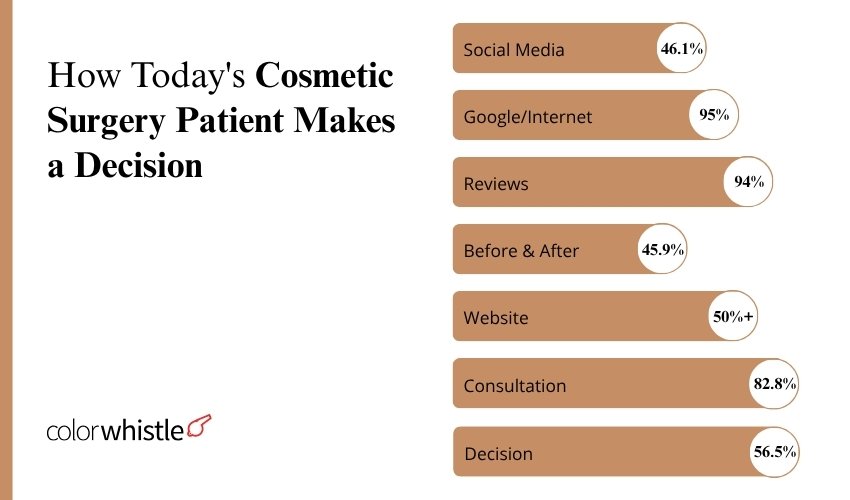
- 46.1% of people surveyed had intentionally viewed plastic surgery content on social media. Source: ScienceDirect
- Among people who intentionally viewed plastic surgery content, 71.1% used Instagram and 55.4% used Facebook. Source: ScienceDirect
- 45.9% of respondents said before-and-after results on social media were the most influential factor when selecting a plastic surgeon. Source: ScienceDirect
- Before-and-after results received the highest interest among the content types studied, followed by patient testimonials and recovery information. Source: ScienceDirect
- In a study of 146,108 cosmetic surgery patients in Japan, the internet motivated 53.7% of patients to visit a clinic, while Instagram motivated 17.3%. Source: PubMed
- The same study found that TikTok influence increased significantly during the study period, with an odds ratio of 24.9 between the opening and expansion periods. Source: PubMed
What this suggests for the next 5 years
- Short-form video will become an increasingly important patient acquisition channel.
- Before-and-after content will remain powerful, but educational and recovery-focused content will become more important for building trust.
- Clinics will need to manage the gap between social media expectations and realistic medical outcomes.
- AI-generated images and filters will make patient education and expectation management increasingly important.
What Makes a Patient Trust a Cosmetic Surgery Provider?
Digital visibility can attract patients, but trust determines whether they move forward. Consumers increasingly research providers across websites, social media, review platforms, and patient testimonials before booking a consultation.
- 70% of respondents in the 2025 ASDS Consumer Survey said they were considering a cosmetic procedure. Source: ASDS
- 94% of consumers surveyed by ASDS use rating and review websites when choosing a provider. Source: ASDS
- Nearly half of ASDS survey respondents said a provider’s social media presence affects their decision to schedule an appointment. Source: ASDS
- Dermatologists have remained the leading influencer of consumer decisions about cosmetic procedures and skincare in the ASDS consumer survey since 2018. Source: ASDS
- An earlier ASPS patient survey found that more than half of patients said a practice website influenced their choice of cosmetic surgery practice. Source: ASPS
What this suggests for the next 5 years
- Clinic websites will remain central to the patient decision journey, even as social platforms become more influential.
- Online reviews, credentials, treatment information, FAQs, consultations, and patient education will become increasingly important.
- Cosmetic surgery brands will need to create a consistent trust experience across Google, websites, social media, and review platforms.
The Consumer Decision Journey Is Becoming Digital
The modern cosmetic surgery journey is no longer simply “see an advertisement, visit a clinic, and book a procedure.” Patients can spend weeks or months researching options online before making contact.
- 53.7% of patients in a large Japanese cosmetic surgery dataset were motivated by the internet to visit a clinic. Source: PubMed
- 17.3% were motivated by Instagram, making social media a significant discovery channel. Source: PubMed
- 94% of ASDS survey respondents use ratings and review websites to select providers. Source: ASDS
- 45.9% in a social media study identified before-and-after results as the most influential social content when selecting a plastic surgeon. Source: ScienceDirect
What this suggests for the next 5 years
Cosmetic surgery businesses will increasingly compete on digital patient experience, not just surgical expertise.
One can expect more investment in:
- AI-powered patient FAQs
- Online consultation booking
- Virtual consultations
- Treatment comparison tools
- Before-and-after galleries
- Recovery timelines
- Patient education
- Online reviews and reputation management
- Personalized treatment journeys
- Mobile-first websites
- AI-assisted lead qualification
Next Five-Year Predictions: 2026 to 2030
Based on the consumer behavior data above, these are the strongest trends to watch:
1. AI will become part of the cosmetic surgery patient journey
AI will increasingly support procedure discovery, patient education, lead qualification, appointment scheduling, FAQs, and post-consultation communication.
2. Social proof will become even more important
Reviews, testimonials, verified patient stories, recovery experiences, and authentic before-and-after content will increasingly influence provider selection.
3. Clinics will compete on digital experience
A strong website will evolve from an information brochure into a patient conversion and education platform.
4. Personalization will become a major differentiator
Patients will increasingly expect content and recommendations tailored to their age, goals, procedure interests, recovery concerns, and previous interactions with the clinic.
5. Video will dominate cosmetic surgery discovery
Instagram, TikTok, YouTube, and short-form video will continue influencing how consumers discover procedures and evaluate providers.
6. Natural-looking outcomes will gain importance
The growing interest in facial rejuvenation, restoration, and proportionate results suggests that consumers will increasingly favor subtle, personalized outcomes over dramatic transformations.
7. GLP-1 medications will reshape body-contouring demand
As more people experience significant weight loss through GLP-1 medications, demand for procedures addressing excess skin and body contouring is likely to remain an important category.
8. Older consumers will become a larger target segment
The 24% increase among patients aged 66 and older in 2025 indicates that cosmetic surgery marketing will increasingly need to address healthy aging, restoration, and age-specific concerns.
The statistics point to an important shift: patients are becoming more informed before they contact a cosmetic surgery provider.
Consumers now have access to procedure information, surgeon reviews, patient experiences, social media content, recovery stories, and before-and-after results. However, digital content should support informed decision-making, not replace consultation with a qualified medical professional.
For patients, the most useful approach is to research the procedure, verify the provider’s credentials, understand potential risks and recovery, review realistic outcomes, and discuss individual suitability with a qualified surgeon.
Cosmetic surgery consumer behavior is changing rapidly. Patients are no longer relying on referrals or clinic visits to make decisions. They are researching procedures online, comparing providers, watching social media content, reading reviews, and looking for realistic patient outcomes before booking a consultation.
For cosmetic surgery clinics and aesthetic brands, this makes a strong digital presence more important than ever. A professional website, informative content, authentic patient stories, online consultation options, and a seamless booking experience can help turn digital research into meaningful patient engagement.
As AI, personalization, video content, and digital patient experiences continue to evolve, clinics that combine medical credibility with a trusted digital experience will be better positioned to attract and convert informed consumers.
Looking to strengthen your cosmetic surgery brand online? Contact ColorWhistle to explore healthcare website development, digital marketing, AI solutions, and patient-focused digital experiences designed to help your practice grow.
 AEO & SEO for eCommerce, SaaS, Marketplac...