



Telehealth & Online Consultation Statistics in India & USA: Growth & Adoption Trends

Phurvishaa specializes in crafting travel tech and marketing content, leveraging deep research, SEO expertise, and AI-driven insights. Her strategic approach ensures content that educates, engages and delivers knowledge.

Our authors are proven experts in their fields, writing on topics where they have demonstrated expertise. Every piece of content undergoes peer review and validation by industry professionals.
AI Summary
Key Highlights of Telehealth Growth and Adoption Trends
This post explores telehealth's evolution from pandemic response to a permanent healthcare fixture in India and the USA. The key insight: mental health dominates US telehealth usage, while India's government-led eSanjeevani platform drives massive consultation volumes. The blog serves healthcare providers and health tech businesses, offering data-driven market size, growth rates, and adoption trends for 2026. It highlights critical platform features like integrated workflows, mental health focus, rural accessibility, and AI support. Readers learn how these distinct models inform virtual care infrastructure investments to expand digital healthcare access and improve patient outcomes.
Telehealth has crossed from pandemic necessity to structural healthcare reality and the telehealth and online consultation statistics coming out of both India and the USA in 2026 make that unmistakably clear. In the US, mental health has emerged as the dominant use case with utilization of climbing quarter-on-quarter. In India, a government-led platform has quietly become one of the world’s largest telemedicine services by sheer consultation volume. Together, the two markets represent very different models of how digital healthcare access can scale, and both carry direct lessons for hospitals, clinics, and health tech businesses investing in virtual care infrastructure today.
Here’s a data-first look at how telehealth is growing, who’s using it, and what’s driving adoption in both markets in 2026.
TL; DR
This blog is for: hospital administrators, healthtech founders, healthcare marketers, telehealth platform builders, and web agencies building digital products for hospitals, clinics, and virtual care providers in India and the US.
- How the US and Indian telehealth markets compare in size, growth rate, and trajectory
- What’s driving telehealth utilization in the US and why mental health dominates by a wide margin
- How India’s government-led eSanjeevani platform has scaled to hundreds of millions of patients
- What the ABDM and digital health ID rollout mean for India’s broader virtual care ecosystem
- What a telehealth-ready digital platform needs to look like to serve patients in both markets
Global Telehealth Market: Size & Scale
Before zooming into each market, the global backdrop matters:
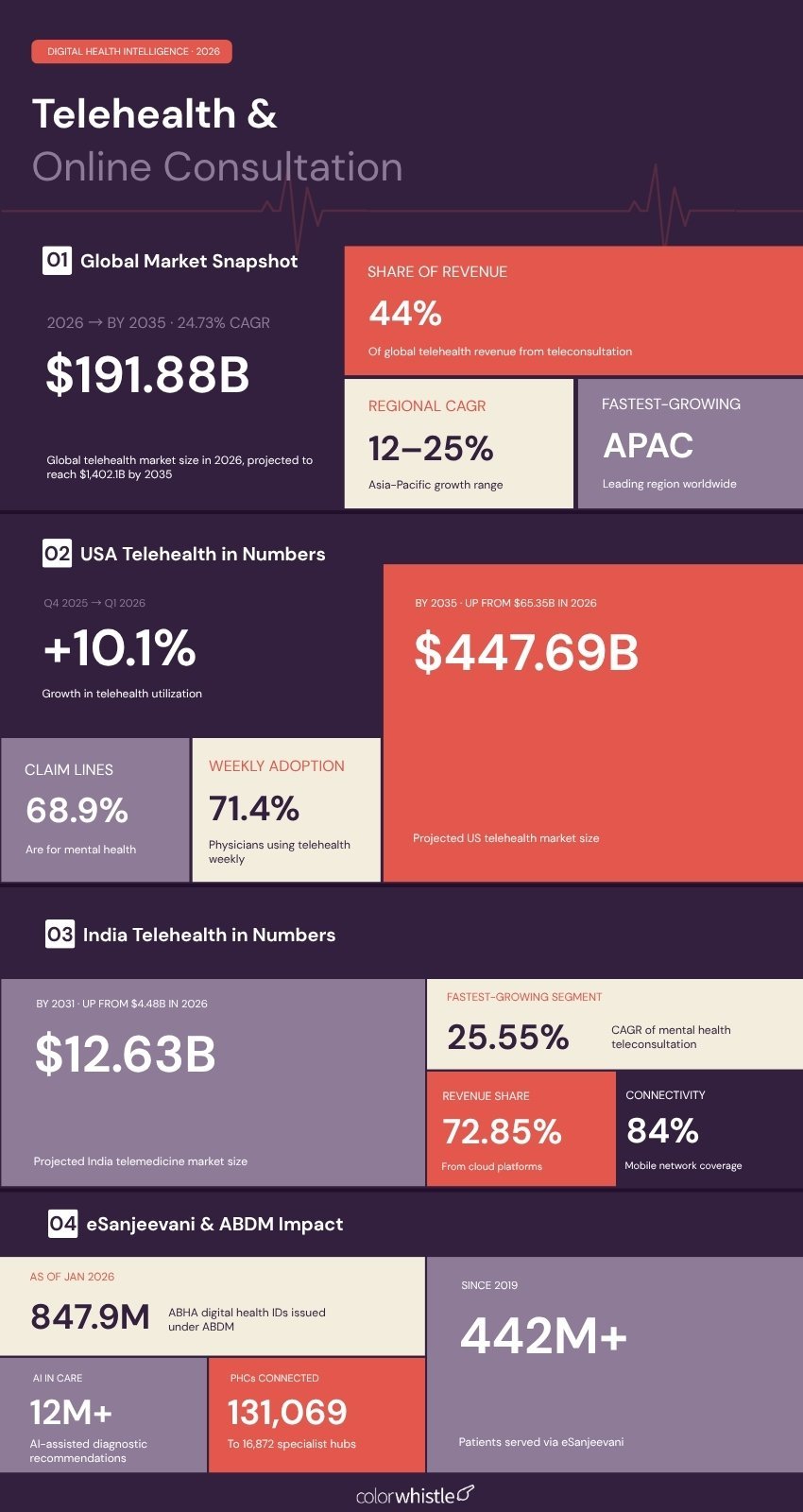
- The global telehealth market was valued at $191.88 billion in 2026 and is projected to reach $1,402.1 billion by 2035, growing at a CAGR of 24.73% one of the fastest growth rates across any healthcare technology segment. (Source: Towards Healthx2edcare)
- A parallel estimate from Fortune Business Insights places the 2026 global telehealth market at $219.31 billion, projected to reach $1,272.81 billion by 2034 at a CAGR of 24.60%. (Source: Fortune Business Insights)
- Teleconsultation contributed 44% of global telehealth revenue by application in 2026, while the services segment leads overall with a 52% market share. (Source: Towards Healthcare)
- Mental health and behavioral therapy is the fastest-growing application segment globally, forecast to maintain that status through 2035. (Source: Towards Healthcare)
- Asia-Pacific is the fastest-growing region, with projected CAGRs between 12% and 25% depending on the segment driven by expanding 5G infrastructure, rising smartphone penetration, and government-backed digital health mandates across India, China, and Southeast Asia. (Source: Fortune Business Insights, Towards Healthcare)
The global telehealth industry has moved well beyond the pandemic surge it is now a foundational layer of healthcare delivery, supporting not just consultations but long-term chronic care, personalized medicine, and operational efficiency.
– DrCare247, Top Telehealth Use Cases 2026
USA Telehealth: Market Size & Utilization
The US remains the world’s largest single telehealth market by revenue, with adoption entrenching itself into everyday care:
- The US telehealth market is projected at $65.35 billion in 2026, growing to $447.69 billion by 2035 at a CAGR of 24.73%. (Source: Towards Healthcare)
- A broader US telemedicine estimate from Precedence Research places the 2026 US market at approximately $46–52 billion, reaching $172.61 billion by 2035 at a CAGR of 18.25%. (Source: Precedence Research)
- Telehealth utilization increased 10.1% nationally from Q4 2026 to Q1 2026, with telehealth measured as a percentage of medical claim lines rising from 5.01% to 5.51%. (Source: Fair Health via Fierce Healthcare)
- The percentage of US patients with a telehealth claim rose from 17.3% in Q4 2026 to 18.4% in Q1 2026, a 6.3% rise nationally. (Source: Fair Health via Fierce Healthcare)
- 44% of US adults had a virtual visit in the past year. Usage is higher among women (33.8%) vs men (26.3%), and adults 65+ lead at 43.3%. (Source: Deloitte / CDC via Axis Intelligence)
- 78.6% of US hospitals have installed a telemedicine solution as of 2024, according to Definitive Healthcare. (Source: ScienceSoft)
- Telehealth is projected to account for 25–30% of all medical visits in the United States by end of 2026, supported by sustained regulatory support from Congress. (Source: ScienceSoft)
- Telehealth saves the US healthcare system an estimated $42 billion annually, while patients save an average of $235 per digital encounter. (Source: CTel / Axis Intelligence)
USA: Mental Health Dominates Telehealth Usage
Mental health has become the defining use case for telehealth in the US by an extraordinary margin:
- Mental health conditions account for 68.9% of all US telehealth claim lines 36 times higher than acute respiratory infections, the next-largest category at 1.9%. (Source: FAIR Health via Axis Intelligence)
- In Q1 2026, 52.1% of all US patients with a telehealth claim had a mental health condition. For children aged 0–9 it was 26.9%, and for adults 65+ it was 22%. (Source: Fair Health via Fierce Healthcare)
- Beyond psychiatry, the top telehealth specialties by utilization as of late 2025 are: mental health (28.2%), endocrinology (11.4%), obstetrics (9.4%), and urgent care (2.3% the lowest). (Source: Epic Research / American Hospital Association, March 2026)
- Telehealth utilization is roughly twice as high in urban areas (18.6% of patients) compared to rural areas (10.3%) though rural growth from Q4 2025 to Q1 2026 was faster at 7.8% vs 6.2% in urban areas, a promising sign of closing access gaps. (Source: Fair Health via Fierce Healthcare)
- US digital health startups raised $14.2 billion in venture capital in 2025, the highest since 2022 with AI-enabled companies capturing 54% of all funding. (Source: Axis Intelligence)
Also Read
India Telehealth: Market Size & Government Infrastructure
India’s telehealth story is fundamentally different from the US driven by public infrastructure at national scale rather than private-sector adoption:
- The India telemedicine market was valued at $4.48 billion in 2026 and is projected to reach $12.63 billion by 2031, growing at a CAGR of 23.05%. (Source: Mordor Intelligence)
- mHealth applications hold the largest segment share at 47.30%, while mental health use cases are projected to expand at a 25.55% CAGR through 2031 the fastest-growing application in the Indian market. (Source: Mordor Intelligence)
- Cloud platforms account for 72.85% of India’s telemedicine market revenue, driven by compliance features, elastic compute, and scalability for national-level health datasets. (Source: Mordor Intelligence)
- Mobile network coverage now reaches 84% of Indian citizens, with 5G subscriptions forecast to reach 1 billion by 2030 eliminating prior bandwidth constraints for video consultation at scale. (Source: Ministry of Communications via Mordor Intelligence)
- By 2026, India is expected to become the second-largest HealthTech startup hub in Asia, supported by government PPP programs and private investment from Microsoft, Google, Infosys, and AWS. (Source: Digital Health News)
eSanjeevani & ABDM: India’s Public Telehealth Backbone
No telehealth blog covering India is complete without eSanjeevani arguably the world’s most ambitious government-led telemedicine deployment:
- eSanjeevani has served over 442 million patients since its launch in 2019, operating through a hub-and-spoke model connecting 131,069 Ayushman Arogya Mandirs (primary health centers as spokes) to 16,872 specialist hubs. (Source: Digital Health News)
- Between April 2023 and November 2025 alone, eSanjeevani enabled 282 million telemedicine consultations, of which approximately 12 million were directly assisted by AI-enabled diagnostic recommendations. (Source: Organiser via IndiaAI Mission)
- More than 57% of eSanjeevani beneficiaries are women, and approximately 12% are senior citizens, demonstrating the platform’s reach into India’s most underserved demographic groups. (Source: IMPRI India / Ministry of Health)
- The eSanjeevani AB-HWC provider-to-provider model accounts for over 93% of all usage, making it primarily a healthcare worker-assisted tool rather than a direct-to-patient app a design choice that has enabled its rural reach. (Source: Oxford Open Digital Health / C-DAC)
- The Ayushman Bharat Digital Mission (ABDM) had issued over 84.79 crore (847.9 million) ABHA digital health IDs as of January 2026, with 82.69 crore health records linked the most expansive national digital health identity rollout in the world. (Source: Digital Health News World Health Day 2026)
- The ABDM was funded at ₹1,600 crore ($180.4 million) for the period 2021–2026, with the goal of connecting every citizen’s health record across public and private providers through a single interoperable digital identity. (Source: IBEF)
What a Telehealth-Ready Digital Platform Looks Like in Practice
The statistics tell the story of where telehealth is going. The practical question is what that means for the hospitals, clinics, and healthtech companies building the digital infrastructure behind it.
A telehealth-ready platform in 2026 shares several consistent characteristics whether it’s a private multi-specialty group in the US or a public health system in India:
- Frictionless scheduling for virtual visits patients should be able to book a teleconsultation in the same flow as an in-person appointment, with clear specialty selection and real-time availability
- Integrated prescription and follow-up workflows telehealth encounters that don’t connect to e-prescribing, lab ordering, or follow-up scheduling create care gaps that reduce retention and outcomes
- Mental health-specific UX given that mental health dominates telehealth usage in the US and is the fastest-growing segment in India, platforms that don’t surface mental health services prominently are already behind the primary demand curve
- Rural and low-bandwidth accessibility in both markets, a meaningful share of patients accesses telehealth through constrained connectivity. Lightweight interfaces and audio-only fallback options are infrastructure decisions, not design choices
- AI-assisted intake and triage from India’s AI-based Clinical Decision Support Systems on eSanjeevani to US-based platforms embedding AI symptom checkers at intake, this is quickly becoming a baseline expectation from both patients and providers
A healthcare website or patient portal that doesn’t support this end-to-end virtual care flow is increasingly positioned as an offline provider in an online-first market.
Also Read
What This Means for Healthcare Platforms & Hospital Websites
Both the US and Indian markets make one thing unmistakably clear: telehealth is no longer a feature it’s a care delivery model that patients, payers, and providers are organizing around.
With 25–30% of all US medical visits projected to be virtual by end of 2026, a hospital or clinic website that doesn’t support online consultation booking is already missing a significant share of patient intent
In India, the eSanjeevani model proves that government-led infrastructure can scale telemedicine to hundreds of millions but private providers who build their own digital patient-facing infrastructure will capture the urban, semi-urban, and premium-care segments that public platforms don’t serve
The US VC market $14.2 billion raised in digital health in 2025 signals sustained investment in the technology stack that powers virtual care
Whether you’re building a new hospital website, upgrading a patient portal, or launching a telehealth-native platform, the infrastructure decisions made now determine which patient segments you’re accessible to in 2026 and beyond. Explore what a healthcare website build involves, see how ColorWhistle approaches healthcare web design, and browse related healthcare statistics from our series.
Building a telehealth platform, hospital website, or patient consultation portal? Talk to ColorWhistle we build healthcare digital experiences designed for the way patients access care
FAQs
How big is the global telehealth market in 2026?
The global telehealth market was valued at $191.88 billion in 2026 and is projected to reach $1,402.1 billion by 2035 at a CAGR of 24.73% driven by rising chronic disease burden, AI integration, and expanding digital health reimbursement policies worldwide.
What is the size of the US telehealth market in 2026?
The US telehealth market is projected at $65.35 billion in 2026, growing to $447.69 billion by 2035 at a CAGR of 24.73% with telehealth utilization rising 10.1% between Q4 2025 and Q1 2026 alone, per Fair Health.
Why does mental health dominate US telehealth usage?
Mental health conditions account for 68.9% of all US telehealth claim lines 36 times higher than the next-largest category driven by reduced stigma, strong patient demand for flexible scheduling, and the sustained policy support for telepsychiatry that outlasted the pandemic.
 Dental Clinic Website Statistics & Patien...