



![Dental Clinic Website Statistics & Patient Booking Trends [2026]](https://colorwhistle.com/wp-content/uploads/2026/07/Dental-Clinic-Website-Statistics-Patient-Booking-Trends-ColorWhistle.jpg "Dental Clinic Website Statistics & Patient Booking Trends [2026]")
Dental Clinic Website Statistics & Patient Booking Trends [2026]

Phurvishaa specializes in crafting travel tech and marketing content, leveraging deep research, SEO expertise, and AI-driven insights. Her strategic approach ensures content that educates, engages and delivers knowledge.

Our authors are proven experts in their fields, writing on topics where they have demonstrated expertise. Every piece of content undergoes peer review and validation by industry professionals.
AI Summary
Dental Clinic Website Statistics & Patient Booking Trends [2026]
This post explores dental clinic website statistics and patient booking trends to guide practice owners, DSOs, and marketers in 2026. The key insight: a modern dental website with online booking, mobile-first design, real photography, transparent pricing, and embedded reviews drives higher appointment conversions. It analyzes the booming dental practice management software market, digital patient behavior, and regional deployment trends, showing fast growth in cloud-based and AI-driven tools. Readers will learn how to build or upgrade websites that capture after-hours interest and outperform competitors, ultimately boosting patient bookings and revenue in an increasingly digital dental economy.
The dental clinic website has quietly become the front door of modern dental practice. Patients no longer walk in off the street to ask about availability they search, compare, and book online before ever picking up the phone. For dental practice owners, DSOs, and healthcare marketers, understanding the latest dental clinic website statistics and patient booking trends is the clearest signal of where the industry is heading and where most practices are still falling behind.
Here’s a data-first look at the dental practice management software market, digital patient behavior, and what it takes to build a dental clinic website that converts in 2026.
TL; DR
A data-backed look at the dental practice management software market and digital patient trends in 2026 covering how the market is growing, how dental clinics are adopting digital tools, what the shift to cloud and SaaS means operationally, and what a high-converting dental clinic website actually looks like in practice.
This blog is for: dental practice owners, DSO administrators, healthcare marketers, and web agencies building digital products for dental clinics and multi-location practices.
- Where the global dental practice management software market stands in size and trajectory
- How cloud, SaaS, and AI-based tools are reshaping how dental clinics operate day-to-day
- Which regions are growing fastest and what’s driving their digital adoption
- What teledentistry growth means for how patients expect to access dental care
What separates a dental clinic website that converts from one that just exists
Dental Practice Management Software: Market Size & Growth
The technology layer behind every dental clinic’s digital operations is expanding fast:
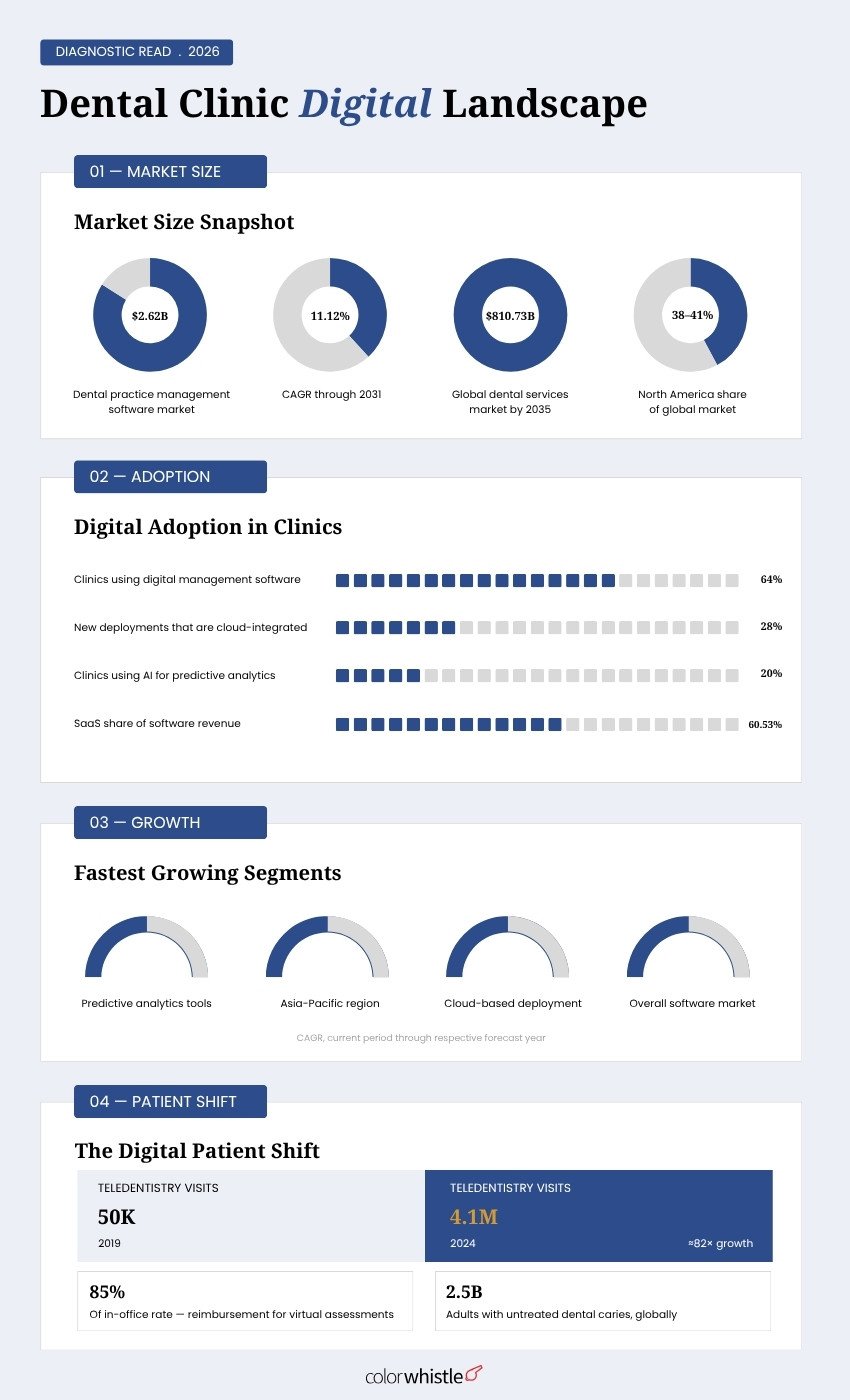
- The global dental practice management software market was valued at $2.62 billion in 2026 and is projected to reach $4.44 billion by 2031, growing at a CAGR of 11.12%. (Source: Mordor Intelligence)
- A parallel estimate from Towards Healthcare places the market at $1.97 billion in 2026, projected to reach $4.16 billion by 2035 at a CAGR of 8.64%. (Source: Towards Healthcare)
- North America dominates the dental practice management software market, holding approximately 38–41% of global share in 2026, driven by advanced healthcare IT infrastructure and high digitalization rates. (Source: Business Research Insights)
- The web-based deployment segment dominates with roughly 46–55% market share, while cloud-based deployment is the fastest-growing segment, projected to grow at 14.25% annually through 2031. (Source: Mordor Intelligence)
- Predictive analytics tools used for no-show reduction, chair utilization, and treatment acceptance forecasting are growing at a 16.17% CAGR through 2031, one of the fastest-growing application categories in the entire market. (Source: Mordor Intelligence)
“Rapid uptake reflects three converging forces: rising oral-disease prevalence that pushes clinics toward digital triage, tighter security and interoperability rules, and mature cloud infrastructure that removes capital barriers for small practices.”
– Mordor Intelligence, Dental Practice Management Software Market Report, January 2026
The Wider Dental Industry: Market Context
Dental clinic websites don’t operate in isolation they sit within a fast-growing broader dental economy:
- The global dental services market is projected to reach $810.73 billion by 2035, growing from $493 billion in 2025, at a CAGR of 5.1%. (Source: Precedence Research via GlobeNewswire)
- The global dental software market covering scheduling, imaging integration, and patient record systems is valued at approximately $2.07 billion in 2026, growing at a CAGR of 9.6% through 2033. (Source: Coherent Market Insights)
- Globally, untreated dental caries affects 2.5 billion adults, while periodontal disease impacts 1 billion people, yet only 23% of low- and middle-income countries integrate oral health into primary care highlighting a massive, underserved demand gap that digital access could help close. (Source: Mordor Intelligence)
How Patients Research & Choose a Dentist
The patient journey overwhelmingly starts online, well before any phone call is made:
- 64% of dental clinics have implemented digital management software, with 51% focused specifically on improving patient management efficiency. (Source: Business Research Insights)
- 28% of new dental software deployments are cloud-integrated, and 20% now use AI for predictive analytics signaling that even traditionally slower-moving small practices are adopting modern digital infrastructure. (Source: Business Research Insights)
- The top five dental software providers control 56% of the market, while smaller vendors are expanding their client base by 17%, reflecting healthy competition and increasing accessibility for independent practices to adopt digital tools. (Source: Business Research Insights)
- The United States had 202,304 practicing dentists in 2023, with the workforce projected to reach 67 dentists per 100,000 people by 2040 a growing supply that makes differentiation through digital presence increasingly important for individual practices. (Source: Grandviewresearch)
Also Read
What Makes a Dental Clinic Website Convert in 2026
Beyond the market data, there’s a clear pattern emerging in what separates dental clinic websites that consistently fill appointment books from those that don’t:
- Online booking front and center patients increasingly expect to choose a service, pick up a provider, and confirm a time slot without ever needing to call. A booking CTA should appear on every page, not just a dedicated “contact us” section
- Mobile-first, fast-loading design most dental searches happen on mobile, often during a commute, lunch break, or evening when the front desk is closed. A slow or clunky mobile experience pushes patients to the next practice in search results
- Real photography and transparent pricing, generic stock photography and hidden pricing erode trust quickly. Practices that show real clinic photos, staff, and clear treatment cost ranges build credibility faster
- Embedded reviews and trust signals surfacing real patient testimonials directly on the website, rather than only linking out to Google or Yelp, keeps trust-building happening on the practice’s own domain
- 24/7 capture for after-hours interest whether through a booking widget, chat tool, or simple contact form, capturing interest outside business hours prevents losing patients who research dental care in the evening or on weekends
A well-built dental clinic website isn’t a brochure; it functions as the practice’s most active member of the front desk team, working around the clock to convert visitors into booked appointments.
Regional & Deployment Trends Shaping the Market
Where and how dental practices are investing in digital infrastructure varies by region:
- Asia-Pacific is the fastest-growing region for dental practice management software, advancing at a CAGR of 15.52% through 2031, led by digitization initiatives in China and India. (Source: Mordor Intelligence)
- SaaS-based dental software captured 60.53% revenue share in 2025–2026 and is forecast to rise at a 13.85% CAGR, as practices increasingly favor predictable subscription pricing over large upfront license costs. (Source: Mordor Intelligence)
- A major industry vendor, Patterson Companies, reported 27% of subscription revenue growth in a recent fiscal year while perpetual license sales dropped 11%, prompting a broader industry pivot toward subscription-only software pricing models. (Source: Mordor Intelligence)
- India mandated all district hospitals adopt digital charting by March 2025, reflecting a broader government push toward digitized dental and healthcare record-keeping in emerging markets. (Source: Mordor Intelligence)
- For enterprise Dental Service Organizations (DSOs), volume-based software pricing unlocks an estimated 22% in software cost savings, while also centralizing patient data for cross-location benchmarking and performance analysis. (Source: Mordor Intelligence)
Also Read
What This Means for Dental Clinic Websites
Every data point in this blog reinforces the same operational reality: a dental practice website and booking infrastructure now directly determines its growth trajectory.
With nearly two-thirds of practices already running digital management software, a practice without a strong online booking and patient communication system is falling behind the market median, not ahead of it
The shift toward cloud and SaaS-based tools means modern, affordable digital infrastructure is more accessible to independent practices than ever before cost is no longer the barrier it once was
Predictive analytics for no-shows and treatment acceptance is among the fastest-growing software category, signaling where competitive practices are investing next
Whether you’re building a new dental clinic website from scratch or modernizing an outdated patient portal, the investment translates directly into more booked chairs and fewer missed opportunities. Explore what a professional healthcare website build actually costs, or see how ColorWhistle approaches healthcare and dental web design.
Ready to build a dental clinic website that turns visitors into booked appointments? Talk to ColorWhistle we build healthcare and dental websites designed around real patient behavior.
FAQ’s
How big is the dental practice management software market in 2026?
The global dental practice management software market was valued at $2.62 billion in 2026 and is projected to reach $4.44 billion by 2031, growing at a CAGR of 11.12% driven by cloud adoption, AI integration, and rising demand for efficient patient management tools.
How widely have dental clinics adopted digital management software?
64% of dental clinics have already implemented digital management software in 2026, with 51% focused specifically on improving patient management efficiency making digital tools the operational standard rather than the exception.
What is the fastest-growing technology segment within dental software?
Cloud-based deployment is growing at 14.25% annually through 2031, while predictive analytics tools for no-show reduction and chair utilization are growing even faster at 16.17% CAGR the highest-growth application category in the market.
 Podcast Industry Statistics 2026: Growth, Mon...