
The NABL Consultant’s Guide to Digital Scaling | Process First Approach

With half a decade of experience in creating tech content for education, healthcare, hospitality, and real estate, Nandhini excels at turning complex insights into clear, credible, in-depth, research-backed, and engaging content that helps readers make informed decisions.

Our authors are proven experts in their fields, writing on topics where they have demonstrated expertise. Every piece of content undergoes peer review and validation by industry professionals.
AI Summary
The NABL Consultant’s Guide to Digital Scaling | Process First Approach
This post explores why NABL consultants must adopt digital systems to overcome inefficiencies in manual project management and documentation. The key insight: a process-first digital system enhances compliance, scalability, and client service. It details core components like automated documentation, gap analysis tools, client portals, training modules, and audit trails. The methodology emphasizes mapping existing workflows before technology adoption, ensuring system alignment with consultancy processes. Benefits include time savings, increased client capacity, improved audit outcomes, and revenue growth. The guide targets NABL consultants aiming to modernize operations, reduce manual workload, and gain competitive advantage through tailored digital solutions.
If you’re a NABL consultant still managing client projects with Excel spreadsheets, Word documents scattered across folders, and WhatsApp messages for tracking progress, you’re not just working inefficiently, you’re leaving serious money on the table.
The laboratories you serve are digitizing. They’re implementing LIMS, electronic record systems, and automated workflows. Meanwhile, many consultants are stuck in the paper era, manually creating SOPs for the fifth time this month, spending hours on gap analysis that should take minutes, and losing clients to more tech-savvy competitors.
It’s time to talk about why digital systems aren’t just “nice to have”; they’re essential for scaling your consultancy, delivering superior client service, and dramatically increasing your revenue.
To understand how digital systems can streamline operations beyond documentation, read our guide on optimizing healthcare workflows for clinics and pharmacies.
TL;DR
This blog is for NABL consultancy firms looking to move beyond manual documentation workflows and implement structured, audit-proof digital systems aligned with ISO/IEC 17025 processes. It explains why generic tools fall short, outlines the core components of a purpose-built compliance platform, and presents a process first methodology for designing scalable, traceable, and revenue-enhancing consultancy systems.
This blog includes:
- Why manual NABL workflows limit scalability
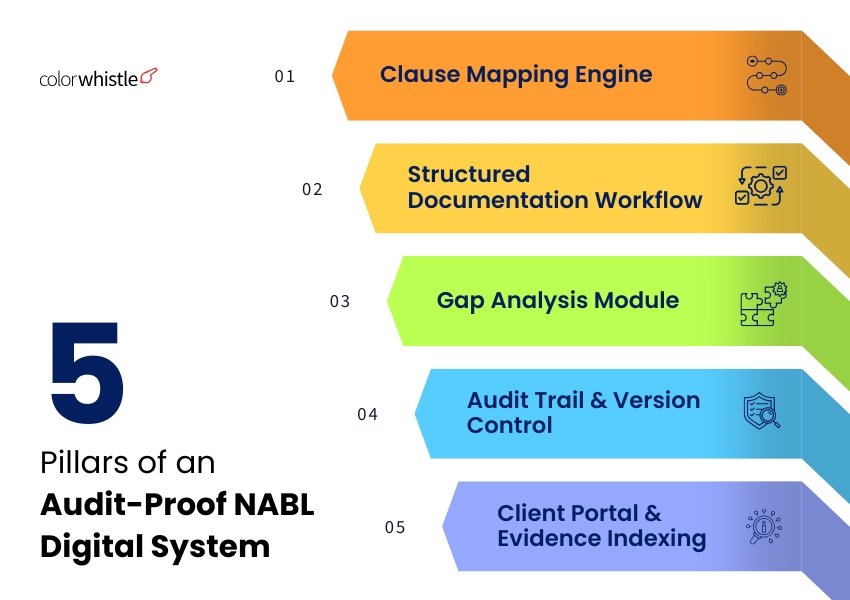
- Core components of an audit-proof system
- Process first implementation strategy
- Compliance safeguards and audit trails
- How custom platforms outperform generic tools
Why NABL Consultants Need Digital Systems?
Current Challenges in NABL Consulting
Manual processes create bottlenecks that limit consultant capacity:
- Documentation creation takes 15-20 hours per client
- Gap analysis requires 1-2 full days on-site
- Client communication scattered across email, phone, and messaging apps
- No centralized system for tracking project progress
- Repetitive work creating similar SOPs and quality manuals
- Limited ability to serve more than 6-8 clients simultaneously
Benefits of Digital Systems for NABL Consultants
Implementing purpose-built software provides measurable improvements:
- Time efficiency: Reduce documentation time by 60-70%
- Client capacity: Serve 2-3x more clients with same team size
- Consistency: Standardized templates ensure compliance across all clients
- Client satisfaction: Real-time progress tracking reduces status inquiries
- Audit success: Increase first-time pass rates from 75% to 90%+
- Revenue growth: Higher client capacity directly increases annual revenue
Core Digital System Components for NABL Consultants
Documentation Management System
Purpose: Automate creation of ISO 17025 compliant documentation.
Key Features:
- Pre-built SOP templates for common laboratory processes
- Quality manual generator aligned with NABL requirements
- Form templates (test reports, calibration certificates)
- Clause coverage verification
- Version control and change management
Expected Results: Documentation creation time reduced from 15-20 hours to 2-3 hours per client.
Gap Analysis and Assessment Tools
Purpose: Conduct systematic compliance assessments
Key Features:
- Digital checklists covering all ISO 17025 clauses
- Photo and evidence upload capability
- Risk scoring and prioritization
- Automated gap report generation
- Action item tracking with assignments
Expected Results: Gap analysis time reduced from 2 days to 4-6 hours, with more comprehensive documentation.
Also Read
Client Portal and Project Management
Purpose: Provide clients with visibility and self-service capabilities
Key Features:
- Project timeline with milestone tracking
- Document repository with version control
- Task assignment and notifications
- Progress dashboards
- Secure messaging
Expected Results: 50-60% reduction in status update calls and emails.
Training and Competency Management
Purpose: Deliver standardized training to client personnel
Key Features:
- Video modules on ISO 17025 requirements
- Role-specific learning paths
- Competency assessments and quizzes
- Certificate generation
- Training records for audit evidence
Expected Results: Reduced consultant time spent on repetitive training sessions, improved client team preparedness.
Audit Trail and Compliance Monitoring
Purpose: Maintain complete records of all system activities
Key Features:
- User action logging
- Document access tracking
- Modification history with before/after values
- Tamper-evident audit logs
- Compliance report generation
Expected Results: Complete audit readiness with automatically generated evidence.
Did you Know?
LIMS implementations yield 32% TAT reductions, 95% drops in manual errors, and $380K annual savings in one ISO 15189 case. Labs report up to 100x processing boosts and stronger audit trails for 21 CFR Part 11/ISO standards. Global LIMS market hit $2.5B in 2024, growing at 8% CAGR to $3.67B by 2029, driven by compliance needs.
Process First Implementation Methodology
Successful digital transformation starts with understanding your existing consultancy processes before choosing technology. The system should support your methodology, not disrupt it.
Begin by mapping your full client lifecycle from inquiry to accreditation. Identify deliverables, approvals, handoffs, timelines, and decision points. This clarifies inconsistencies and highlights areas for standardization.
Translate these process maps into clear system requirements. Define what the platform must achieve: template management, approval workflows, reporting formats, integrations, performance expectations, and security controls. Each requirement should include acceptance criteria.
Evaluate platforms designed for accreditation or quality management workflows rather than generic tools. Test them using real client scenarios. Conduct hands-on trials and speak with existing users to assess practical usability and long-term reliability.
Once selected, configure the platform to reflect your methodology. Upload standardized templates, define user roles, set up approval hierarchies, and establish integrations. Work iteratively to ensure the system matches documented requirements.
Validate the system through structured testing of real workflows, documentation creation, gap analysis, project tracking, and reporting. Record expected outcomes, actual results, and corrective actions where needed.
Train your consulting team thoroughly. Provide hands-on practice aligned with real engagements and document internal procedures for consistent system use.
Pilot Implementation Strategy
Start with one or two suitable clients before full rollout. Execute complete engagements using the new system and measure time efficiency, documentation quality, and usability.
Track metrics such as documentation turnaround time, gap analysis duration, client feedback, and audit trail completeness. Use these insights to refine workflows and templates before wider deployment.
Document lessons learned and update training materials to ensure smoother expansion.
Measuring Return on Investment
Digital systems reduce documentation preparation time significantly, allowing consultants to serve more clients without increasing team size. Improved efficiency directly increases annual client capacity and revenue potential.
Even after accounting for software costs, the return on investment is substantial due to time savings, increased engagement volume, and reduced rework.
Quality outcomes also improve. Standardized templates and structured workflows increase first-time audit pass rates and reduce corrective cycles. Client experience strengthens when project visibility improves through centralized tracking.
Maintaining System Compliance Over Time
Ongoing governance is essential. Review user access regularly, verify backups, and test data recovery procedures.
Conduct periodic system reviews to assess performance, audit trail integrity, and user feedback. Update validation records whenever major system changes are introduced.
Ensure templates and checklists remain aligned with evolving NABL and ISO/IEC 17025 requirements. A structured digital system makes consistent updates easier than managing separate document files.
Custom Digital Systems for NABL Consultancy Firms
ColorWhistle develops custom software solutions for structured compliance environments, including NABL consultancy operations.
Instead of offering generic document management tools, we design process driven platforms aligned with ISO/IEC 17025 consulting workflows. Our systems are built around your actual engagement lifecycle, from client onboarding and Quality Manual development to clause traceability, internal audit tracking, and surveillance updates.
For NABL consultancy firms, we build:
- Centralized documentation engines with structured version control
- Clause-linked SOP and Quality Manual management systems
- Integrated non-conformity and CAPA tracking modules
- Role-based approval workflows with audit logs
- Secure reporting dashboards for assessment readiness
- Multi-dimensional document management systems that consolidate offline files, cloud uploads, WhatsApp document sharing, and email forwards into a single controlled repository
Every platform is developed to reflect your methodology, ensuring scalability without compromising compliance traceability.
If your consultancy firm is looking to reduce manual documentation workload, improve internal control, and scale operations efficiently, ColorWhistle can design a customized digital system to support that growth.
Wrap-Up
For NABL consultancy firms, digital systems are not about adopting new tools; they are about strengthening delivery processes. As documentation volumes grow and compliance expectations become more structured, relying on manual workflows limits efficiency and scalability.
A process first digital system helps standardize documentation, improve traceability, and maintain controlled approvals across all client engagements. When designed correctly, it simplifies operations without compromising compliance integrity.
If you’re exploring how to digitize and streamline your NABL consultancy workflows, the team at ColorWhistle can help you design a system aligned with your process and compliance requirements.
Get in touch to discuss a customized digital solution for your NABL consultancy firm.
FAQs
Can generic document management software handle NABL consultancy workflows?
Generic document management platforms focus primarily on file storage and sharing. They typically do not include built-in clause mapping, compliance traceability, or integrated non-conformity workflows. NABL consultancy firms often require customized systems aligned with accreditation processes rather than standard file-sharing tools.
Is a custom-built digital platform better than ready-made software for NABL consultants?
For consultancy firms managing multiple laboratories, custom-built platforms are often more effective because they align directly with ISO/IEC 17025 documentation structures and internal consulting methodologies. Custom systems can integrate clause traceability, workflow automation, and multi-channel document management within a single controlled environment.
 Content Creation for Online Educators: Build ...