



EdTech Market Statistics in India & Global Markets: Growth & Investment Trends

Archana's passion for data analysis, statistics, and content creation makes her well-equipped to write insightful, data-driven blogs that transforms complex data into engaging content, helping readers gain deeper insights and take informed decisions.

Our authors are proven experts in their fields, writing on topics where they have demonstrated expertise. Every piece of content undergoes peer review and validation by industry professionals.
The global EdTech industry is moving into a more mature phase. The pandemic accelerated digital learning adoption, but the market is now being reshaped by AI, personalized learning, workforce upskilling, hybrid education, and stronger demand for measurable learning outcomes.
India is particularly important in this transformation. The country combines a large student population, expanding digital infrastructure, growing demand for professional skills, government-backed digital education initiatives, and increasing adoption of AI-powered learning.
At the same time, EdTech investment has become more selective. Investors are increasingly looking beyond user growth and focusing on sustainable business models, career outcomes, AI capabilities, institutional partnerships, and recurring revenue.
Here are the statistics that explain where the EdTech market stands today and where it could go next.
Global EdTech Market: How Big Is the Opportunity?
The first question for investors, education businesses, technology providers, and EdTech startups is simple: How large is the global opportunity?
The answer depends on how the market is defined. Some reports measure the broader EdTech and smart-classroom ecosystem, while others focus specifically on digital education or online learning. Together, the numbers point to a rapidly expanding technology layer within the global education economy.
Global EdTech and Smart Classrooms Market
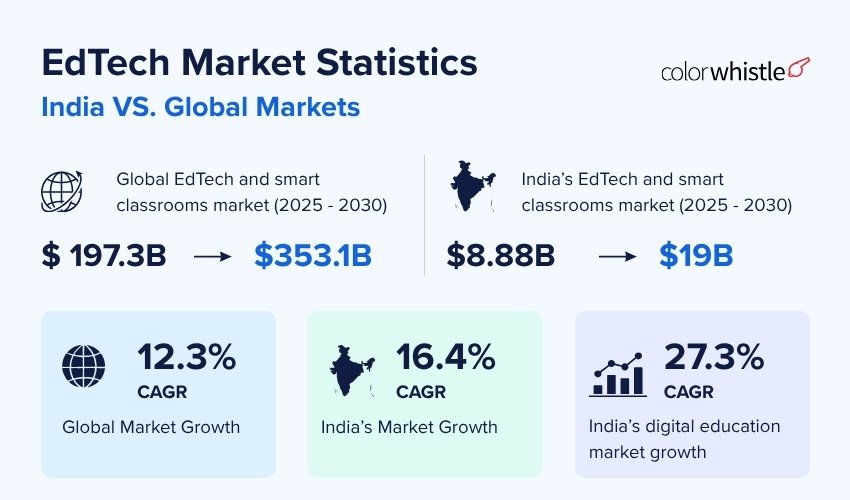
$197.3 billion – The global EdTech and smart classrooms market is estimated at $197.3 billion in 2025 and is projected to reach $353.1 billion by 2030, growing at a 12.3% CAGR.
Global EdTech Market Alternative Forecast
$199.74 billion → $456.41 billion – Another market estimate places the global EdTech market at $199.74 billion in 2025, with the market projected to reach $456.41 billion by 2030, representing a 17.9% CAGR.
Digital Education Is Growing Even Faster
The global digital education market is forecast to grow from $32.36 billion in 2025 to $95.70 billion by 2030, representing a 24.2% CAGR.
Global Digital Spending on Education
HolonIQ previously estimated global education digital spending would reach approximately $404 billion by 2025, up from $227 billion in 2020.
That means digital spending was expected to nearly double within five years, although it would still represent only a relatively small share of total education expenditure.
What This Means
The important signal is not simply that EdTech is growing. It is that different layers of the education technology ecosystem are growing at different speeds.
Digital education, adaptive learning, AI-powered tools, assessment platforms, smart classrooms, LMS platforms, and workforce learning are creating multiple technology markets inside education.
2026 to 2030 Prediction
EdTech will increasingly become infrastructure rather than an optional add-on.
Over the next five years, schools, universities, training organizations, and employers are likely to adopt technology across multiple parts of the learning journey, including:
- Enrollment
- Content delivery
- Assessment
- Personalized learning
- Student engagement
- Administration
- Career guidance
- Skills development
- Learning analytics
Decision takeaway: Businesses entering EdTech should avoid thinking only about “online courses.” The larger opportunity is the technology infrastructure surrounding learning.
India EdTech Market: Why Is India One of the Fastest-Growing Markets?
India has become one of the most important EdTech markets globally because of its combination of demographics, digital adoption, affordability requirements, and demand for education and employability.
India EdTech Market Could Reach $29 Billion
India’s EdTech market was valued at approximately $7.5 billion and is projected to reach $29 billion by 2030.
The projection comes from the Internet and Mobile Association of India and Grant Thornton Bharat.
India EdTech and Smart Classrooms Market
A more recent MarketsandMarkets estimate puts India’s EdTech and smart classrooms market at $8.88 billion in 2025.
It is projected to reach $19.0 billion by 2030, representing a 16.4% CAGR.
India Is Growing Faster Than the Global Average
The global EdTech and smart classrooms market is forecast to grow at approximately 12.3% CAGR, while India’s corresponding market is projected to grow at 16.4% CAGR.
That gives India a significantly faster growth trajectory than the global market.
India Online / Digital Education Market
India’s digital education market is forecast to increase from $2.03 billion in 2025 to $6.81 billion by 2030, representing a remarkable 27.3% CAGR.
The Indian online education market is expected to grow by $7.40 billion between 2025 and 2030, at a 23% CAGR.
India Online Education Market Prediction – 2026 to 2030
India’s EdTech growth will increasingly move beyond test preparation and K-12 tutoring.
The strongest opportunities are likely to emerge across:
- Higher education technology
- Professional certification
- Corporate learning
- AI-powered tutoring
- Vocational education
- Coding and technology skills
- Language learning
- Career-focused learning
- Learning management systems
- Digital assessment
Decision takeaway: Businesses targeting India should design for multiple learner segments instead of relying exclusively on the traditional K-12 online coaching model.
Who Is Driving EdTech Growth in India?
Market size alone does not tell the full story. The more useful question is:
Where is the demand actually coming from?
K-12 Remains a Major Segment
K-12 was the largest revenue-generating segment of India’s education technology market in 2024 according to Grand View Research.
At the same time, preschool is projected to be the fastest-growing segment during the forecast period.
Higher Education Technology Is Growing Rapidly
India’s higher education technology market was valued at approximately $1.20 billion in 2023 and is projected to reach $8.32 billion by 2030, representing a 31.8% CAGR.
This is particularly important because it indicates that India’s EdTech opportunity extends well beyond school education.
Online Learning Is Expanding Across User Groups
India’s online education ecosystem includes:
- Online university education
- Online learning platforms
- Professional certificates
- Skill development
- Corporate training
These categories increasingly overlap as learners look for education that directly connects to employment and career progression.
Government Platforms Have Massive Reach
India’s government-backed digital education ecosystem also demonstrates the scale of digital learning demand.
As of March 2026:
DIKSHA had more than 2 crore registered users.
As of January 2026:
SWAYAM had more than 5.80 crore registered enrolments.
India also operates 48 SWAYAM PrABHA DTH channels delivering educational content around the clock in multiple Indian languages.
Source: Government of India, PIB
2026 to 2030 Prediction
The next phase of Indian EdTech growth will be increasingly diversified.
Instead of one dominant consumer segment, growth should come from a combination of:
School + University + Professional + Corporate + Government
This creates opportunities for both B2C and B2B EdTech models.
Decision takeaway: If you are building an EdTech product for India, consider whether your platform can serve institutions, employers, or government programs in addition to individual learners.
EdTech Investment: Is Investor Interest Returning?
This is where the story becomes more interesting.
EdTech investment experienced an extraordinary boom during the pandemic. It then went through a major correction as investors began demanding stronger economics and sustainable growth.
Global EdTech VC Hit a Decade Low
Global EdTech VC funding reached approximately $2.4 billion in 2024, the lowest level in a decade according to HolonIQ.
HolonIQ reported that investment had fallen sharply from the pandemic-era peak.
Global Funding Started Stabilizing
By 2025, the market showed signs of stabilization.
In Q1 2025, global EdTech VC funding was approximately $410 million, down 35% year over year.
However, average deal size increased to approximately $7.8 million, indicating that investors were becoming more selective while making larger bets on promising companies.
AI Is Attracting Capital
In April 2025, global EdTech VC funding reached approximately $241 million, nearly double the amount recorded in April 2024.
AI-powered instruction and post-secondary education were among the areas attracting significant investor attention.
India EdTech Funding Fell in 2025
India experienced another difficult funding year.
Indian EdTech startups raised approximately $249 million in 2025, down 56% from $572 million in 2024.
The number of deals also declined from 48 in 2024 to 31 in 2025.
But 2026 Has Started Differently
India’s EdTech funding showed signs of recovery in the first half of 2026.
Indian EdTech companies raised approximately $178 million in H1 2026, compared with $73.3 million during the same period in 2025.
The H1 2026 figure was also higher than the $155 million raised during the whole of 2025.
2026 to 2030 Prediction
EdTech funding is likely to become smaller in volume but stronger in quality.
Investors are likely to favor companies that demonstrate:
- Sustainable unit economics
- Strong retention
- Measurable learning outcomes
- AI differentiation
- B2B or institutional revenue
- Workforce relevance
- International scalability
- Lower customer acquisition costs
Decision takeaway: The era of raising capital primarily on user numbers is fading. EdTech companies will increasingly need to prove that technology produces measurable educational or career outcomes.
AI in Education: The Biggest Shift in the EdTech Market
AI is no longer simply another EdTech feature.
It is changing how educational content is created, delivered, personalized, assessed, and consumed.
86% of Students Use AI for Their Studies
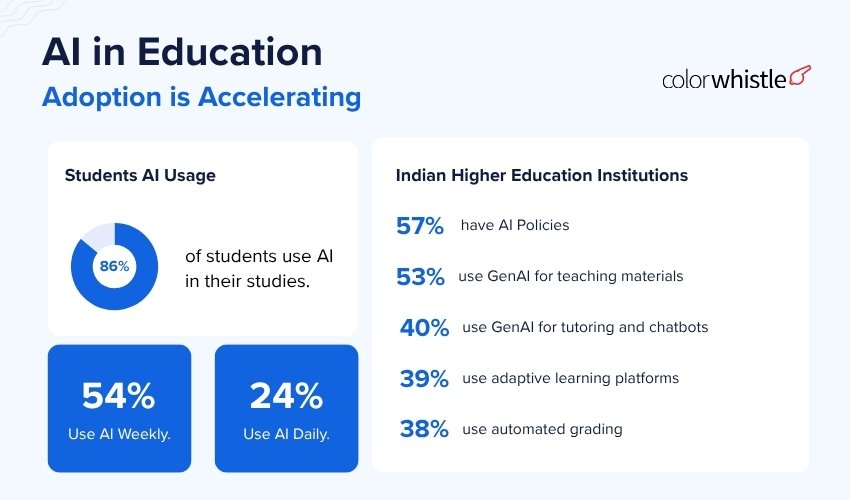
A Digital Education Council survey cited by EY found that 86% of students use AI in their studies.
Among them:
- 54% use AI weekly
- 24% use AI daily
57% of Indian Higher Education Institutions Have AI Policies
The 2025 FICCI-EY-P AI Adoption Survey found that approximately 57% of Indian higher education institutions already have an AI policy.
Another 40% were developing one.
How Indian Universities Are Using Generative AI
Among the academic applications reported in the survey:
- 53% use GenAI for teaching materials
- 40% use it for tutoring and chatbots
- 39% use adaptive learning platforms
- 38% use automated grading
AI Adoption Is Also Growing Among Teachers and Children
The Bharat Survey for EdTech 2025 found that among EdTech-using teachers:
51% already use GenAI.
Among EdTech-using children:
35% use GenAI for learning, and 69% of those users do so daily.
But AI Literacy Is a Problem
High usage does not necessarily mean high understanding.
The Bharat Survey found that many children and teachers have misconceptions about how AI works, highlighting the need for AI literacy alongside AI adoption.
Source: Central Square Foundation
2026 to 2030 Prediction
AI tutors, adaptive learning systems, automated assessment, AI teaching assistants, and personalized learning engines will become standard EdTech capabilities.
But the competitive advantage will shift from simply saying “AI-powered” to demonstrating:
Better learning outcomes + responsible AI + personalization + measurable progress.
Decision takeaway: EdTech companies should treat AI literacy, governance, transparency, and human oversight as product features rather than compliance afterthoughts.
What Are Investors Likely to Fund Next?
The investment numbers reveal an important change.
EdTech is moving away from the idea that more users automatically mean more value.
The market is increasingly rewarding technology that solves expensive, measurable problems.
AI and Workforce Learning Are Attracting Attention
HolonIQ’s 2026 outlook highlights growing investment interest in AI-enabled platforms and workforce training.
In its Q1 2026 update, HolonIQ reported $512 million in EdTech investment, with capital continuing to favor AI-enabled and career-aligned platforms.
Career Alignment Is Becoming More Important
The rise of professional certifications, online degrees, technical training, and corporate learning reflects a broader shift toward outcome-driven education.
This is particularly relevant as employers increasingly prioritize skills over traditional credentials in some areas.
Personalized Learning Is Becoming a Core Product Category
Adaptive and personalized learning is specifically included among the major solution categories tracked in the global EdTech market.
2026 to 2030 Prediction
The most attractive EdTech opportunities are likely to sit at the intersection of:
AI + Skills + Personalization + Measurable Outcomes
This could create strong demand for:
- AI tutors
- AI assessment
- Skills intelligence platforms
- Corporate learning platforms
- Adaptive learning
- Career navigation
- AI-powered LMS platforms
- Student success platforms
- Workforce reskilling
- Education analytics
Five-Year EdTech Market Predictions: 2026 to 2030
Based on the market growth, funding, adoption, and AI statistics above, these are the trends businesses should watch.
India will remain one of the fastest-growing EdTech markets
India’s EdTech and smart classrooms market is projected to grow at 16.4% CAGR through 2030, compared with 12.3% globally.
Prediction: India will remain a priority market for EdTech startups, investors, global education companies, and technology providers.
AI tutors will become mainstream
With 86% of students already using AI for studies, AI-assisted learning is moving rapidly from experimentation toward everyday use.
Prediction: AI tutors will increasingly supplement teachers rather than simply replace traditional content platforms.
EdTech investment will prioritize sustainable businesses
India’s 2025 funding decline and the 2026 recovery indicate that investors are becoming selective rather than abandoning the sector.
Prediction: Revenue quality, retention, margins, learning outcomes, and institutional contracts will matter more than headline user numbers.
Prediction: Revenue quality, retention, margins, learning outcomes, and institutional contracts will matter more than headline user numbers.
Workforce learning will become a major EdTech growth engine
AI is changing job requirements, creating continuous demand for reskilling and upskilling.
Prediction: Corporate learning, professional certification, technical skills, and career transition platforms will attract increasing investment through 2030.
Hybrid learning will become the default model
The market is moving away from a simple online-versus-offline debate.
Prediction: The strongest education platforms will combine physical teaching, digital content, AI assistance, live instruction, assessment, and analytics.
Personalized learning will become a competitive requirement
As AI makes content personalization cheaper and more scalable, learners will increasingly expect education platforms to adapt to their pace, level, interests, and goals.
Prediction: Personalization will move from a premium feature to an expected part of the EdTech experience.
Government-backed digital education will continue expanding
DIKSHA already has more than 2 crore registered users, while SWAYAM has recorded more than 5.80 crore enrolments.
Source: Government of India, PIB
Prediction: Public digital education infrastructure will increasingly coexist with private EdTech platforms, creating opportunities for integrations, content, analytics, accessibility, and technology services.
Learning outcomes will become more important than engagement metrics
The sector’s funding correction has exposed the limitations of measuring success through downloads, registrations, and screen time alone.
Prediction: Investors and institutions will increasingly ask:
- Did students learn?
- Did they complete the course?
- Did skills improve?
- Did exam performance improve?
- Did learners get jobs?
- Did employers see productivity gains?
What These Statistics Mean for EdTech Businesses
The numbers point to a market that is growing, but becoming more disciplined.
| Market Signal | What It Means |
|---|---|
| Global EdTech market growing | Large long-term technology opportunity |
| India growing faster than global average | Strong opportunity for India-focused platforms |
| Digital education growing rapidly | Mobile and online learning remain important |
| Funding became more selective | Sustainable economics matter |
| AI adoption is widespread | AI capability is becoming essential |
| Higher education technology growing rapidly | Opportunity beyond K-12 |
| Government platforms have massive reach | Public digital education is a major ecosystem |
| Workforce learning is gaining attention | B2B and professional learning offer strong opportunities |
| Personalized learning is expanding | Adaptive technology can become a key differentiator |
| Learning outcomes matter more | EdTech products need measurable value |
The EdTech market is entering a new phase. Growth is still strong, but the definition of a successful EdTech company is changing.
The pandemic proved that education can move online. The next five years will determine which technologies can make digital education more personalized, measurable, affordable, and outcome-driven.
For India, the opportunity is particularly significant. With the Indian EdTech and smart classrooms market projected to reach $19 billion by 2030, digital education projected to grow at 27.3% CAGR, and AI already being used extensively by students and educators, the market is moving toward a much deeper integration of technology into education.
For EdTech businesses, the opportunity is no longer simply to put courses online. It is to build better learning experiences, stronger technology infrastructure, personalized journeys, and measurable outcomes.
Looking to build or scale your EdTech platform? Partner with ColorWhistle for innovative EdTech website development, AI-powered solutions, and digital experiences designed to drive learner engagement and business growth.
 Cosmetic Surgery Consumer Behavior Statistics...