


Website Modernization vs Revamp: Cost, ROI & Best Choice Guide

With half a decade of experience in creating tech content for education, healthcare, hospitality, and real estate, Nandhini excels at turning complex insights into clear, credible, in-depth, research-backed, and engaging content that helps readers make informed decisions.

Our authors are proven experts in their fields, writing on topics where they have demonstrated expertise. Every piece of content undergoes peer review and validation by industry professionals.
AI Summary
Website Modernization vs Revamp: Cost, ROI & Best Choice Guide
This post explores key differences between website modernization and revamp to help businesses make informed investment decisions. The key insight: modernization upgrades technology and performance quickly for faster ROI, while revamps rebuild the entire site for long-term strategic value but require more time and budget. It targets mid-market B2B leaders facing rising bounce rates, slow load times, or scaling challenges. The analysis covers cost comparisons, ROI timelines, and the impact of AI and the attention economy on digital experience expectations. Readers gain a decision matrix and checklist to align website investments with business goals and maximize ROI.
You’ve been getting signals. Bounce rates creeping up. Sales team complaining the site doesn’t reflect what you actually sell. Load times that would embarrass a 2012 blog. Or maybe investors are asking why your digital presence doesn’t match your ambitions.
Before you write a check or approve a six-month agency engagement, you need to understand what you’re actually buying. Because website modernization and website revamp are fundamentally different interventions, with different cost profiles, different timelines, and very different ROI curves.
Let’s untangle them.
What is Website Modernization?
Website modernization is the process of upgrading the underlying technology, architecture, and performance of an existing site without necessarily changing the visual identity. Think of it as replacing the engine, transmission, and electronics of a high-performing vehicle while keeping the chassis.
Migrating from a slow CMS to a faster platform (e.g., Webflow, headless CMS)
Improving Core Web Vitals and page speed scores
Adding integrations: CRM, marketing automation, chat
Accessibility (WCAG) compliance updates
Responsive/mobile optimization of existing pages
Security patches, SSL, dependency upgrades
What Is a Website Revamp?
A full website revamp, often referred to as a website redesign, involves rebuilding the website from the ground up.
This is not simply changing colors, layouts, or imagery. A revamp typically means rethinking the entire digital experience from information architecture and messaging strategy to design systems, backend technology, integrations, and infrastructure.
A full revamp often happens when the existing website has become fundamentally incapable of supporting the company’s business goals.
Perhaps the platform no longer scales with increasing traffic. Perhaps the brand has evolved significantly and the website no longer reflects its market position. Or perhaps years of patchwork updates have created technical debt so severe that continuing to improve the current site becomes inefficient.
In those scenarios, incremental fixes stop being cost-effective. A complete rebuild becomes the smarter long-term investment.
Planning a full revamp? Use our website redesign checklist to ensure a smooth, strategic transformation.
The Hidden Cost of Doing Nothing
Before comparing costs of action, understand the cost of inaction. An outdated website isn’t just an aesthetic problem, it’s a leaky revenue pipe.
For mid-market B2B companies, an underperforming website directly impacts: sales cycle length, inbound lead quality, cost-per-acquisition, and sales team productivity (time spent compensating for a poor digital first impression).
88%
of online consumers are less likely to return after a bad experience
Cost Comparison: Modernization vs. Revamp
Budgeting for these initiatives requires looking beyond the initial quote.
| Feature | Website Modernization | Full Website Revamp |
|---|---|---|
| Primary Cost Drivers | API integrations, backend refactoring, security patches. | UX research, UI design, content migration, SEO redirection. |
| Typical Investment | Mid-range (Lower upfront, higher technical talent). | High upfront (Heavy design and strategy hours). |
| Deployment Timeline | Phased/Incremental (Agile). | Big Bang (Waterfall). |
Modernization: Technical debt discovery. If the original code is “spaghetti code,” refactoring can occasionally rival the cost of a new build.
Revamp: SEO equity loss. A full revamp carries a high risk of temporary ranking drops if 301 redirects and URL structures are not managed with surgical precision. According to the Search Engine Journal, improper migrations can lead to a 20-30% drop in organic traffic.
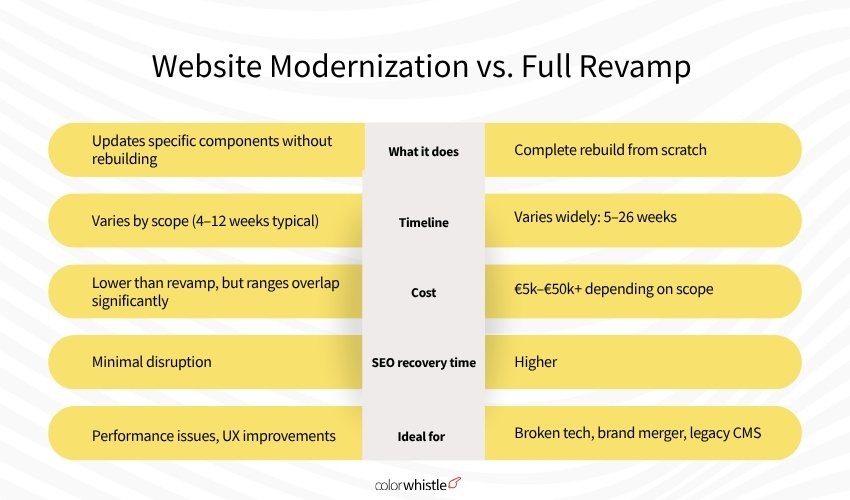
ROI of Modernization
Website modernization often produces faster ROI because it targets immediate business bottlenecks.
If your website is underperforming due to speed issues, poor mobile usability, outdated CTAs, or inefficient landing page experiences, incremental improvements can deliver measurable gains quickly. Faster loading times, improved UX, and better conversion optimization can impact lead generation within weeks.
This shorter ROI window makes modernization especially attractive for businesses operating under tighter budgets or quarterly performance pressures.
ROI of a Revamp
A full revamp, by contrast, tends to generate slower but broader ROI.
While redesigning your entire platform can unlock transformational benefits, better scalability, stronger branding, improved infrastructure, it typically takes longer to implement and longer to produce measurable returns. Full redesigns often require months of planning, execution, migration, testing, and optimization before the investment begins paying off.
So while redesign may generate larger long-term strategic value, modernization often wins in terms of short-term efficiency.
The 2026 Economic Factor: AI and the Attention Economy
Website decisions in 2026 are no longer based only on design or development costs. They are increasingly influenced by AI adoption and the growing pressure of the attention economy.
Why the Attention Economy Matters
The attention economy refers to the reality that consumer attention is limited, but digital competition is endless. Every business today is competing for the same few seconds of user focus across:
- Search engines
- Social media platforms
- Paid advertising channels
- Email campaigns
- Content platforms
As a result, the cost of acquiring traffic has risen significantly, making every website visit more valuable than ever.
Why This Impacts Website Investment
When businesses spend heavily to bring users to their website, poor digital experiences become expensive mistakes. If visitors leave because your site is outdated, slow, or confusing, the business loses both:
Customer attention
Marketing investment
Where AI Fits In
AI is amplifying this pressure by raising customer expectations. Users now expect experiences such as:
Personalized recommendations
Predictive search
AI-powered chat support
Dynamic content experiences
According to McKinsey, 65% of organizations now use generative AI in at least one business function.
Takeaway
In 2026, website budgeting is no longer just about fixing what is broken. Businesses must ask:
- Can the website hold user attention quickly?
- Can it support AI-driven experiences?
- Can it maximize ROI from rising traffic acquisition costs?
Want to future-proof your website for the AI era? Explore how modern businesses are building smarter digital experiences with advanced AI website capabilities.
The Decision Matrix: When to Choose What
Use this checklist before presenting the proposal to the board.
Choose Modernization if you answer “Yes” to these:
Platform Health: Your CMS is supported, but your code is bloated (e.g., slow load times, poor Core Web Vitals)
Traffic is Good, Conversions are Not: You have volume, but the UI/UX isn’t converting. (Solution: CRO-focused modernization)
Budget Constraints: You have less than $30k to spend immediately
AI Readiness: You lack structured data/schema, but the content is strong
When a Full Revamp is Unavoidable (The 20% Scenario)
Schedule a full rebuild immediately if:
- Your site runs on an unsupported PHP version or a proprietary CMS from 2015 (security risk)
- Your mobile UX is broken (non-responsive) in an era where 68% of traffic is mobile
- You have acquired a company and need to merge two distinct domains and brand identities
- Your current architecture cannot handle peak load (e.g., Black Friday crashes)
Ready to modernize or revamp? Let’s talk.
You know your numbers. You have the checklist. Now you need a partner who executes without surprises.
At ColorWhistle, we deliver:
Honest diagnosis (we’ll tell you if modernization is enough)
Risk-free revamps (zero SEO loss guaranteed)
Transparent pricing (no hidden scaling taxes)
Book a free 20-minute technical audit: Talk to a strategist
Wrap-Up
There’s no universal right answer between modernization and a full revamp, but there is a wrong approach: making the decision based on gut feeling, vendor pitches, or “everyone else is doing it.”
Make it a business decision. Quantify the cost of your current site’s underperformance. Map your strategic priorities for the next 18–24 months. Then choose the intervention that delivers the highest ROI in alignment with your actual timeline and budget constraints.
Most businesses are surprised to find they needed less than they thought or significantly more. The diagnostic process itself is valuable.
 AI Chatbots for Consulting Firm Tools & Ideas...