



Project Overview
ColorWhistle client (Goodwill Recovery), a judgment and asset recovery firm, came to us with a detailed blueprint for a 10-day AI-driven outreach campaign. They had already mapped out the campaign structure, personas, communication flow, and engagement logic. Before working with us, the client had attempted to implement this system through multiple teams, but the project had never reached completion. This left their environment in a mixed state, with some modules functional and others partially built or broken.
When we stepped in, our first task was to thoroughly analyze the existing setup so we could understand what was working and what needed attention. Since several developers had contributed to different stages, there was no clear continuity in the system.
To move forward with clarity, we proposed a proof of concept to study the entire environment in depth, review completed modules, identify gaps, and validate the technical feasibility of the original blueprint. After completing this assessment, we shared our findings with the client. It became clear that starting development from scratch would deliver a far more stable and scalable result, because the earlier work had too many inconsistencies to build upon.
With this direction agreed upon, we translated the client’s campaign blueprint into a fully functional AI Lead Recovery Automation System. We designed and built a scalable, multi-channel automation framework that connected CRM workflows, AI calling, messaging, and engagement tracking into one streamlined ecosystem.
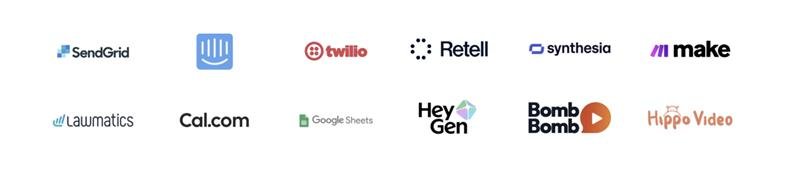
Technology Stack
- Make.com (Automation Orchestration)
- Intercom (CRM & Lifecycle Management)
- Intercom Email (Email Delivery)
- Retell AI (AI Voice Calling)
- Twilio (SMS Automation)
- Hippo Video (Video Engagement Integration & Webhooks)
- Google Sheets (Lead Source Monitoring)
- Make.com Datastores (Scheduling and State Management)
- Intercom Developer Apps (Webhook Routing)
- Cal.com (Appointment Booking Integration)
- HTTP APIs & Custom Webhooks
Client Overview
Our client operates in the legal and financial recovery sector, specializing in judgment enforcement, asset recovery, and debt collection services. The organization manages high-value leads that require timely engagement, structured follow-ups, and personalized communication to maximize recovery opportunities within time-sensitive legal windows.
Given the urgency-driven nature of their services, the client required a robust automation ecosystem capable of executing their predefined outreach campaign with precision, consistency, and scalability.
Client Requirements & Implementation Blueprint
The client came in with a very detailed campaign blueprint for a structured 10-day outreach lifecycle. Their main goal was to maximize engagement in the first 48 hours, using coordinated AI personas and multi-channel messaging to reach high-priority creditor leads quickly and consistently.
Key requirements defined by the client included:
- Immediate AI voice outreach as soon as new leads were imported
- A dual-persona communication model, with Monica handling AI voice calls and Laura managing SMS, email, and video outreach
- Personalized video messages that could convey urgency based on judgment details
- Consistent multi-channel engagement through calls, SMS, email, and CRM-driven interactions
- Automated qualification data collection and routing to consultations
- Dynamic AI video generation for every judgment using the specific case information
- Video engagement tracking so that hot leads could be prioritized
- Enforcement deadline tracking within a 10-day window
- Centralized CRM orchestration to manage lifecycle stages and automation logic
The blueprint also specified coordinated outreach within the initial hours, along with engagement-based routing and behavioral prioritization so the system could respond to lead actions in real time.
Business Challenges
Although the client had a strong campaign strategy on paper, they needed a technically reliable system that could bring the entire blueprint to life at scale. Several challenges had to be addressed before the automation could work smoothly in a real-world environment.
- Converting a complex outreach blueprint into automation workflows that actually execute as intended
- Coordinating multiple communication channels inside one connected system
- Keeping AI calls, CRM actions, and messaging platforms in sync in real time
- Building logic that could react to different lead behaviors and route them accordingly
- Managing follow-up scheduling within strict operational time windows
- Maintaining consistent data flow across all integrated platforms
- Evaluating the tools chosen by the client, such as Retell AI, Twilio, Intercom, HeyGen, and Lawmatics, to confirm whether they could support the required workflows and work together without breaking the experience
These challenges required an advanced automation architecture rather than simple workflow automation.
Requirement Analysis & Technical Approach by ColorWhistle
Rather than redefining the campaign strategy, we focused on understanding the client’s blueprint in depth. Our goal was to translate their vision into a clean, modular, and event-driven automation system that could operate reliably at scale.
We began by breaking down the entire outreach lifecycle into scenarios, triggers, and decision points. This helped us map every part of the blueprint to a clear technical action, condition, or workflow.
To execute this structure, we built a scenario-based automation framework on Make.com. Each scenario was designed to represent a specific campaign stage, engagement event, or lifecycle condition described in the client documentation. This approach ensured that every workflow followed the client’s original outreach logic, while still giving us the flexibility to maintain scalability, debugging clarity, and operational stability.
Solution Architecture
Lead Intake & CRM Orchestration
Structured Intake Flow
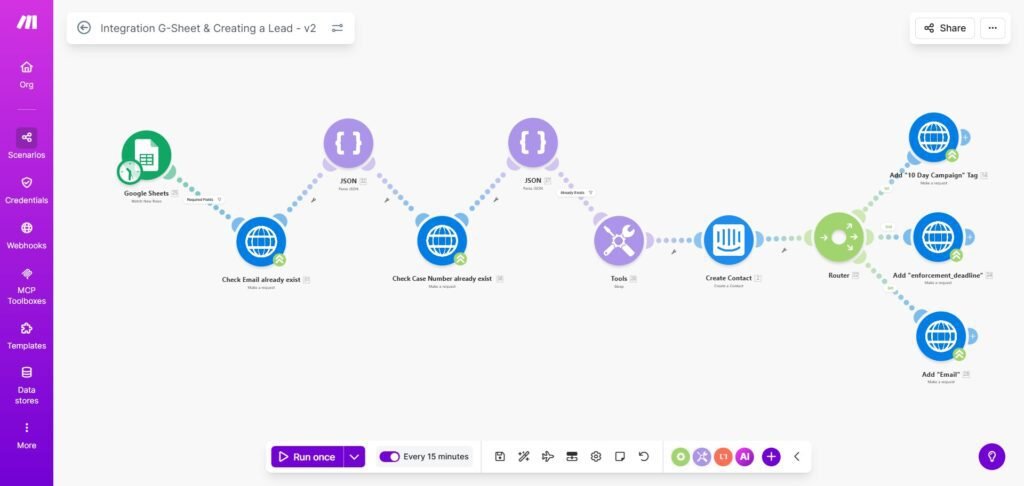
In Phase 1, we built an intake system designed to capture new judgments smoothly, validate them, and route them into a structured 10-day outreach campaign without any manual work.
We set up a monitored Google Sheet as the client’s entry point for new judgments.
The system checks for new rows during business hours and pulls in all case details needed for the outreach campaign.
Each incoming record includes:
- Creditors contact information
- Email and phone number
- Judgment and case details
- Debtor information
- Enforcement deadline
This keeps the intake source simple on the client side while giving us everything we need to initialize the campaign.
Multi-Layer Duplicate Prevention
Before creating a contact, the system runs two API checks inside Intercom:
- Email check to see if the creditor already exists
- Case-number check to detect if a judgment was previously added
If either check returns a match, the workflow stops.
This protects data quality and prevents duplicate campaigns from being triggered.
Creating a Clean, Validated Lead in Intercom
When a record passes both checks, the automation:
- Pauses briefly to avoid API rate limits
- Creates a new Intercom contact with all mapped fields
- Stores judgment details and custom attributes
- Initializes campaign fields such as call count and campaign day
From this point forward, Intercom becomes the single source of truth for the entire lifecycle of the lead.
Automatic Campaign Attribute Generation
As part of intake, the system automatically calculates:
- Enforcement deadline
- Campaign start date
- Campaign duration
- Initial monica_call_count
- Operational flags for follow-ups
These values allow the 10-day engagement sequence to run without any manual setup.
Campaign Tagging & Workflow Initiation
Finally, each lead is enriched with a campaign tag that signals the next set of automation scenarios to begin. This tag triggers:
- AI calls
- SMS and email sequences
- Follow-up scheduling
- Webhook-driven event handling
This keeps the entire engagement process synchronized and fully automated from the moment the lead enters the system.
AI Persona-Based Communication Implementation
Bringing the Dual-Persona Blueprint to Life
The communication plan for Phase 1 was built around two personas, each responsible for a different part of the outreach journey. To implement this exactly as the client envisioned, we connected multiple platforms together and ensured every message was generated with the right tone and context.
The two personas used throughout Phase 1:
- Monica, the AI voice agent making outbound calls
- Laura, the written communication persona managing SMS and email follow-ups
Both were powered by real-time data coming from Intercom, which functioned as the central source of truth throughout the project.
Monica – AI Voice Agent Powered by Retell AI
Monica handled all automated outbound calls, and her workflow relied heavily on Retell AI for voice calls and Make.com for orchestration.
Key parts of implementation:
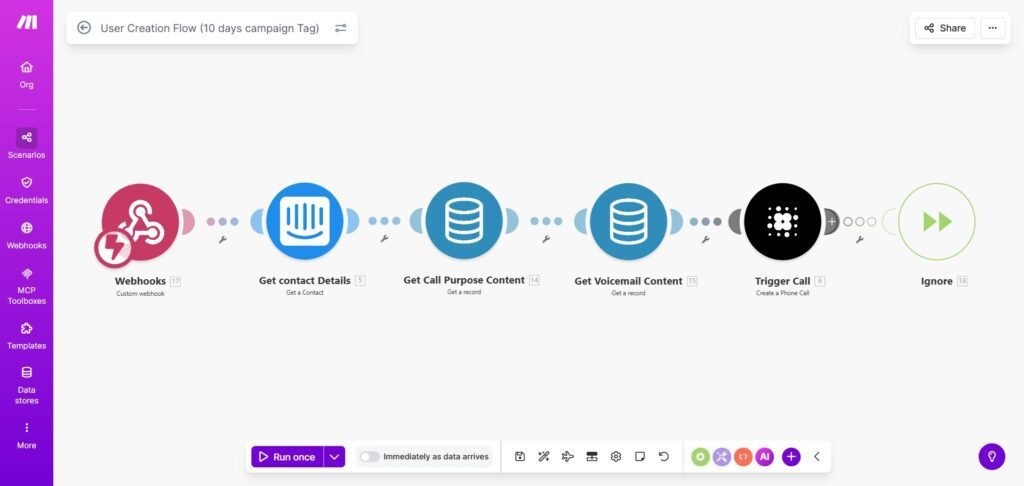
- Calls are triggered instantly when a new contact is created in Intercom
- Retell AI supplied the calling infrastructure, voice engine, and call flow logic
- Personalized scripts and voicemail messages stored in Make.com Datastores
- Dynamic variables injected using Intercom data, such as judgment amount, debtor name, and enforcement deadlines
- Call outcomes, recordings, and transcripts are sent back through Retell AI Webhooks
- All results were written into Intercom custom attributes for downstream use
Monica’s responses directly shaped Laura’s follow-up messages and determined how the lead moved through the 10-day campaign.
Laura – SMS & Email Persona Using Twilio + Intercom Email
Laura managed every written follow-up, driven by two primary systems:
- Twilio SMS for outbound and inbound text messages
- Intercom Email for structured email communication
Her automation layer included:
- Personalized SMS messages triggered by call outcomes and time-of-day logic
- Message variants based on Retell AI call results stored in Intercom
- Email delivery handled through Intercom’s native email system
- Automatic replies are routed back into the system for follow-up scheduling
- Inbound SMS webhooks through Twilio, which were parsed inside Make.com
Laura’s messages always reflected the latest state of the lead because she depended entirely on Intercom’s live attributes and tags.
Dynamic Personalization Controlled by Intercom & Make.com
To keep both personas consistent, personalization was centralized:
- Intercom stored the current campaign day, call count, video engagement, appointment status, and urgency-related data
- Make.com Datastores held the dynamic script content for calls, voicemail, SMS, and email
- Every message Laura or Monica delivered was assembled using values stored in Intercom
- Updates flowed back into Intercom immediately through webhooks, keeping both personas in sync
This avoided manual editing, removed messaging inconsistencies, and kept all communications aligned with the client’s urgency-driven model.
A Unified Multi-Channel Persona Experience
Several systems were involved in delivering the outreach sequence. Retell AI handled calls, Twilio managed SMS, Intercom delivered emails, and Make.com coordinated the logic.
Even with multiple platforms working together, the experience for the creditor felt unified and consistent.
Monica handled voice-driven urgency.
Laura guided the conversation through SMS and email.
Both personas used the same real-time data inside Intercom, which ensured the right message was delivered at the right time.
Event-Driven Workflow Implementation
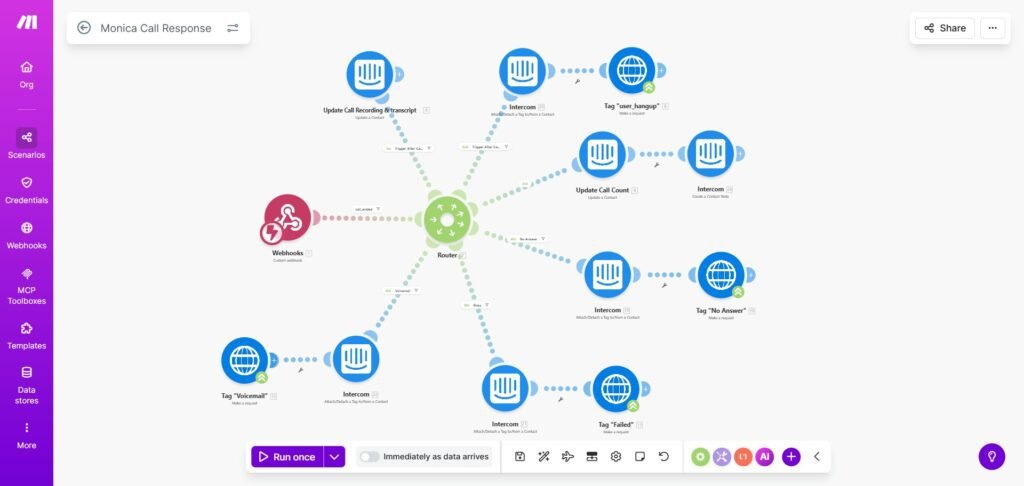
A System That Reacts to Real-Time Activity
Key lifecycle: The Phase 1 automation was built to respond instantly to what each lead did. Instead of running a fixed sequence, the workflows adjusted themselves based on call outcomes, SMS replies, video engagement, and campaign timing.
Fifteen Purpose-Built Make.com Scenarios
We organized the entire system into fifteen focused scenarios. Each one handled a specific event such as:
- Lead creation and campaign tagging
- Triggering Monica’s call through Retell AI
- Processing call outcomes, recordings, and transcripts
- Routing tags like No Answer, Failed, Voicemail, and Hang-up
- Scheduling SMS and email follow-ups
- Daily campaign progression
- Callback scheduling from inbound SMS
- Updating video engagement through Hippo Video webhooks
This modular structure kept the system stable and easy to manage.
Webhook-Driven Updates
Real-time webhooks from Retell AI, Twilio, Intercom, and Hippo Video kept Intercom updated with the latest activity.
Every update immediately triggered the next appropriate step, keeping the outreach flow aligned with the client’s urgency model.
A Campaign That Adapts Automatically
Because of this event-driven design, the system always knew what to do next.
For example:
- A No Answer call triggered a retry
- A “call me” SMS created a callback task
- High video engagement bumped lead priority
- A booked appointment stopped all other follow-ups
Smart Follow-Up & Lifecycle Scheduling
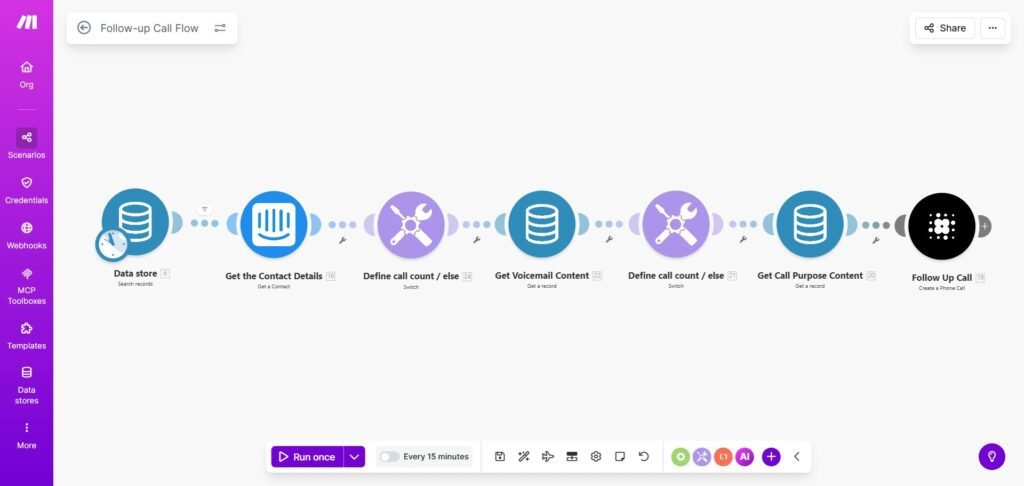
Automated Follow-Ups with Accurate Timing
To support the 10-day campaign, we built a scheduling system that calculated the next step for every lead based on outcome and time-of-day rules. All follow-ups were sent only during approved business hours.
Datastore-Based Timing Control
Make.com Datastores are used to track upcoming calls, SMS, and email actions.
The system stored the next scheduled time and triggered the action as soon as that window arrived. This kept every lead moving through the sequence without manual work.
Outcome-Driven Logic
Each call result had its own path, including:
- No Answer
- Failed Call
- Voicemail
- User Hang-Up
- Appointment Booked
Every outcome updated Intercom and recalculated the next touch automatically.
A Campaign That Adjusts Itself
After each event, the system always knew what to do next and when to do it. This kept the entire 10-day journey consistent, timely, and fully automated.
Video Engagement Strategy, Platform Transition & Lead Prioritization
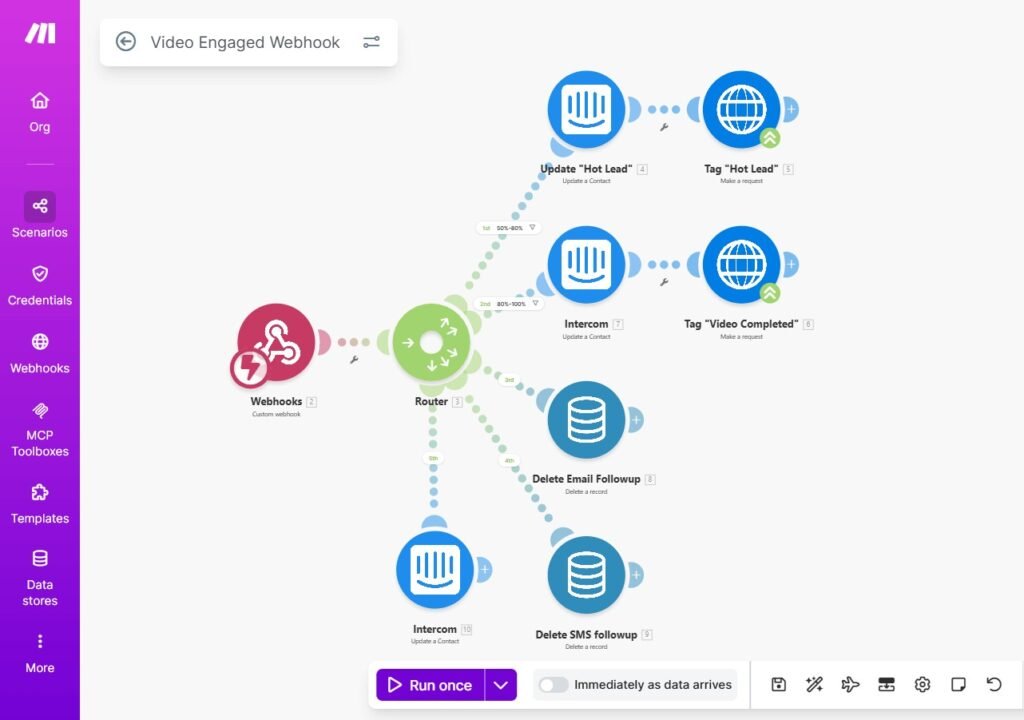
One of the key parts of the client’s outreach blueprint was video-based urgency communication for every judgment. To implement this, we explored several AI video generation platforms and went through multiple rounds of testing, experimentation, and vendor discussions.
We began with HeyGen, since it seemed like a strong fit for dynamic video generation. After several test iterations and direct communication with their team, the client was still not satisfied with the video quality and consistency, so we decided to look for alternatives.
Our next step was Synthesia. The generation’s quality was noticeably better, and the platform offered a wider range of AI avatars. They also gave us the option to create a custom avatar by uploading a video of someone reading a script, which would have been ideal for long-term personalization.
However, we ran into a major limitation. Synthesia informed us that their prebuilt AI avatars could not be used for finance-related content. Since the campaign messaging was linked to judgments and creditor recovery, they required us to use our own custom avatar instead. Because the project timelines were extremely tight, creating and training a custom avatar was not feasible.
After this restriction, we evaluated several other video platforms, including BombBomb. Ultimately, we found the best balance of flexibility and reliability with Hippo Video.
Given the restrictions and time constraints around AI avatar generation, we simplified the approach to use prerecorded videos combined with dynamic overlays, personalized descriptions, and unique video links for each judgment. We also collaborated directly with the Hippo Video development team and requested API enhancements to support this level of personalization at scale.
Even though Phase 1 used prerecorded videos, engagement tracking still played a critical role. The system captured real-time viewer activity through webhook integrations. This included metrics such as watch percentage, video completion, and interaction events.
These engagement signals were then used to:
- Identify high-intent leads
- Trigger priority callbacks
- Adjust the follow-up intensity
- Update CRM engagement attributes for better routing
This helped us move away from generic follow-up cycles and shift toward intelligent, behavior-based prioritization that aligned with the client’s urgency-driven campaign model.
Multi-Channel Automation Ecosystem
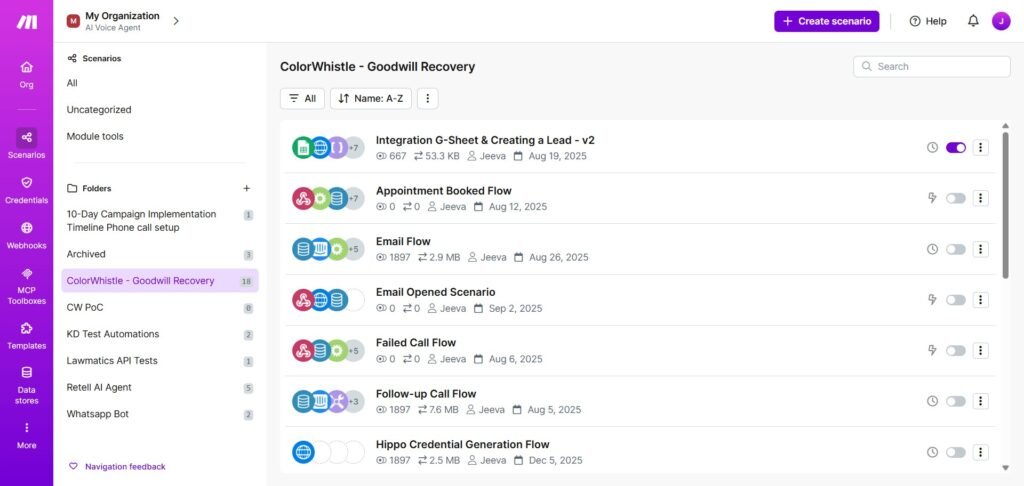
To bring the client’s outreach blueprint to life, we connected all communication channels into one coordinated automation system. Each channel was handled by a dedicated platform, and all activity flowed back into Intercom, which acted as the single source of truth.
Voice Calls
Retell AI powered the Monica persona.
Calls were triggered automatically from Intercom, used dynamic scripts from Make.com Datastores, and returned call results, recordings, and transcripts through webhooks.
SMS
Twilio SMS supported Laura’s written follow-ups.
Messages were personalized using Intercom attributes, and all inbound replies were routed back through Make.com for callback scheduling and next steps.
All email communications came through Intercom Email.
Emails were triggered by campaign activity, enriched with dynamic placeholders, and tracked for open-rate and engagement.
Video Engagement
Hippo Video supported personalized video delivery and real-time engagement tracking.
Webhook events such as watch percentage were used to identify high-intent leads and adjust follow-ups.
Make.com as the Automation Engine
Make.com connected everything together. It triggered calls, scheduled SMS and emails, processed webhooks, and coordinated the 10-day campaign logic across all channels.
Key Features Delivered
A Complete 10-Day Outreach Automation System
We translated the client’s campaign blueprint into a fully automated outreach engine that runs without manual involvement. The system manages intake, communication, scheduling, and follow-ups with precision across the entire 10-day window.
AI Persona-Based Engagement
Both communication personas were implemented exactly as defined.
Monica handled voice outreach through Retell AI, while Laura managed SMS and email through Twilio and Intercom. All messages were personalized using live CRM data.
Coordinated Multi-Channel Communication
Voice calls, SMS, email, and video engagement worked together as one unified experience. Every action was tied back to Intercom as the single source of truth.
Event-Driven Lifecycle Automation
The system operated on real-time triggers from Retell AI, Twilio, Hippo Video, and Intercom. Each event updated the CRM and initiated the next step in the campaign flow.
Behavior-Based Lead Prioritization
Video watch activity, SMS replies, and call outcomes directly shaped the next action. High-intent leads were identified and moved into faster or more focused follow-ups.
Automated Follow-Up Scheduling
A datastore-driven scheduling engine ensured calls, messages, and emails were delivered at the right time and within approved business hours.
Stable CRM Synchronization
All attributes, tags, and engagement data were synced into Intercom, which kept every module and persona aligned throughout the campaign.
Webhook-Driven Reliability
Real-time webhook integrations allowed the system to adapt instantly to lead behavior and maintain the correct campaign sequence.
Technical Challenges & Resolutions
As we built the automation, we encountered several platform-level limitations that required careful engineering. Some webhook events conflicted with one another; Intercom had restrictions around custom attribute behavior, and certain triggers did not fire immediately after contact creation.
To keep the system stable, we introduced:
- Improved webhook routing with separate Intercom apps
- Delayed execution logic to avoid API race conditions
- Clean data parsing and retrieval paths inside Make.com
- Defensive logic to prevent scenario deactivation during errors
These adjustments strengthened the workflow and ensured the 10-day campaign could run continuously without breakdowns or inconsistent states.
Business Impact
By turning the client’s outreach strategy into a fully automated system, our client gained a reliable, scalable, and consistent communication framework. Manual follow-up tasks were eliminated, timing errors were removed, and every lead received coordinated outreach within the critical enforcement window.
The team also gained full visibility inside Intercom, including call activity, SMS and email engagement, video watch behavior, and campaign progression. This allowed them to prioritize leads more effectively and focus on their time where it mattered most.
Final Thoughts
Phase 1 demonstrates how our team at ColorWhistle can take a complex outreach model and convert it into a practical, high-performing automation system. The AI Lead Recovery Automation combines AI calling, CRM orchestration, multi-channel messaging, and real-time workflows to deliver a structured communication experience that supports legal and financial recovery.
Most importantly, the system respects the client’s original strategy while giving them a stable foundation they can scale and expand in future phases.
 Implementing CI/CD for a Laravel Application ...