


Category: Software Architecture • HealthTech • SaaS Engineering
Across Mexico and many parts of Latin America, dental laboratories still rely heavily on paper-based workflows to manage daily operations. Work orders are handwritten, technician progress is tracked manually, and communication between clinics and laboratories often depends on phone calls or messaging apps.
While this process has worked for years, it becomes increasingly difficult to manage as laboratories grow. Delayed deliveries, misplaced trays, inconsistent communication, and limited operational visibility reduce productivity and impact customer satisfaction.
To solve these challenges, we designed and built a cloud-based Multi-Tenant Dental Laboratory Management Platform that digitizes the complete work-order lifecycle from order creation to final delivery.
This article explores the business problem, our architecture, workflow, technology choices, and the roadmap behind the platform.
Goal
To digitize dental laboratory operations by replacing manual, paper-based workflows with a scalable SaaS platform that improves efficiency, traceability, and real-time collaboration across clinics and labs.
Approach
We designed a multi-tenant cloud architecture using React, NestJS, PostgreSQL, Redis, and Socket.IO to centralize work orders, automate workflows, and enable real-time production tracking across multiple dental laboratories.
Solution
A fully cloud-based Dental Lab Management System that digitizes the entire work-order lifecycle, provides QR-based tracking, role-based access control, and real-time dashboards for technicians, administrators, and clinic partners.
The Problem with Traditional Dental Laboratory Operations
A typical dental laboratory receives physical impressions from multiple clinics every day.
The journey of each case usually looks like this:
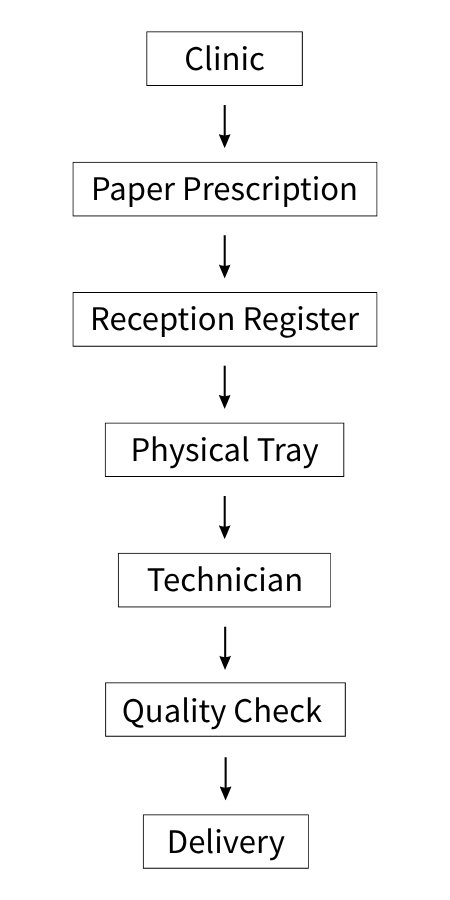
Although simple, this workflow creates several operational challenges.
Common Pain Points
- Difficult to locate work orders during production
- No real-time visibility into technician progress
- Manual status updates
- Frequent phone calls from clinics asking for updates
- Lost or misplaced physical trays
- No performance analytics
- Limited accountability across production stages
As laboratories scale, these issues multiply.
Our Digital Transformation Strategy
Instead of simply replacing paper with software, our goal was to build a complete operating system for dental laboratories.
The platform focuses on five key principles:
- Complete work-order traceability
- Multi-tenant SaaS architecture
- Real-time production monitoring
- QR-code driven workflow
- Role-based access control
This enables administrators, technicians, delivery staff, and clinic users to work from the same source of truth.
High-Level System Architecture
The application follows a modern layered architecture that separates presentation, business logic, messaging, and persistence.
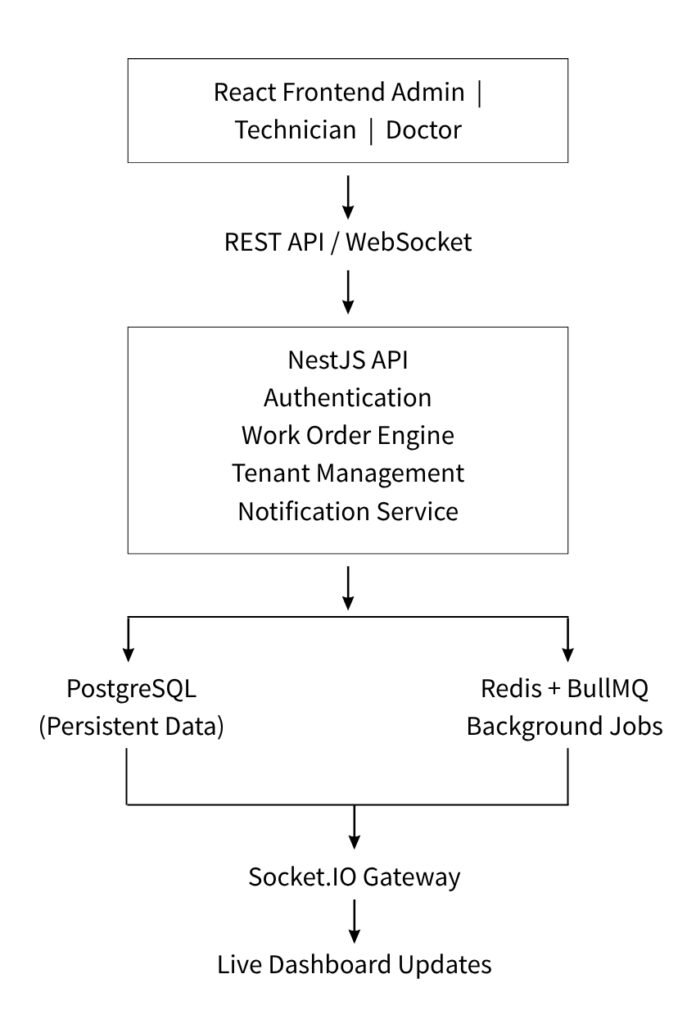
This architecture provides:
- Modular services
- Scalable APIs
- Real-time synchronization
- Background processing
- Easy horizontal scaling
Work Order Lifecycle
Every work order passes through a predefined production workflow.
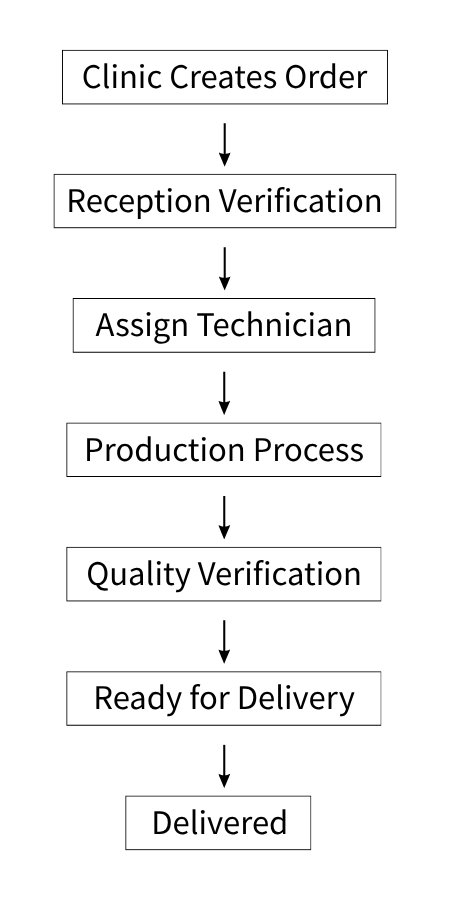
Every transition is validated by the backend, ensuring users cannot skip mandatory production stages.
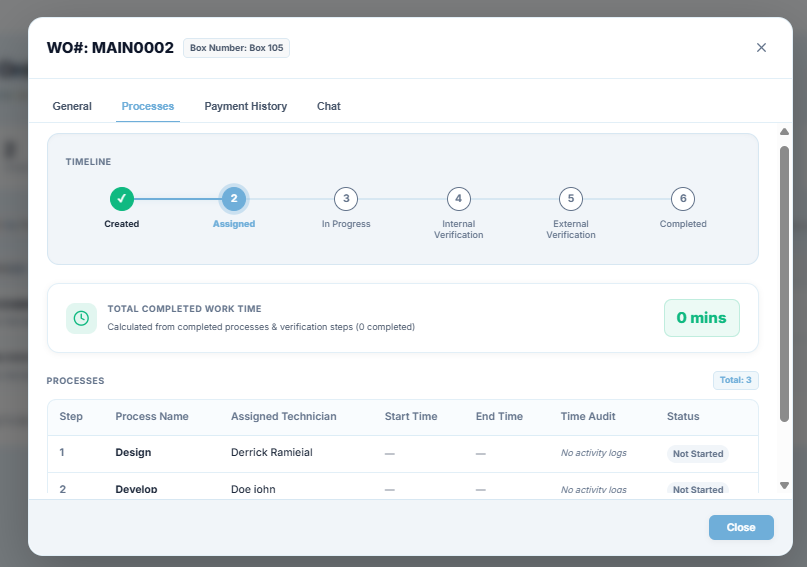
Whenever a technician completes a step:
- Database is updated
- Notifications are generated
- Dashboard refreshes instantly
- Next technician receives the task
This is achieved through WebSocket events powered by Socket.IO.
QR-Code Enabled Production Tracking
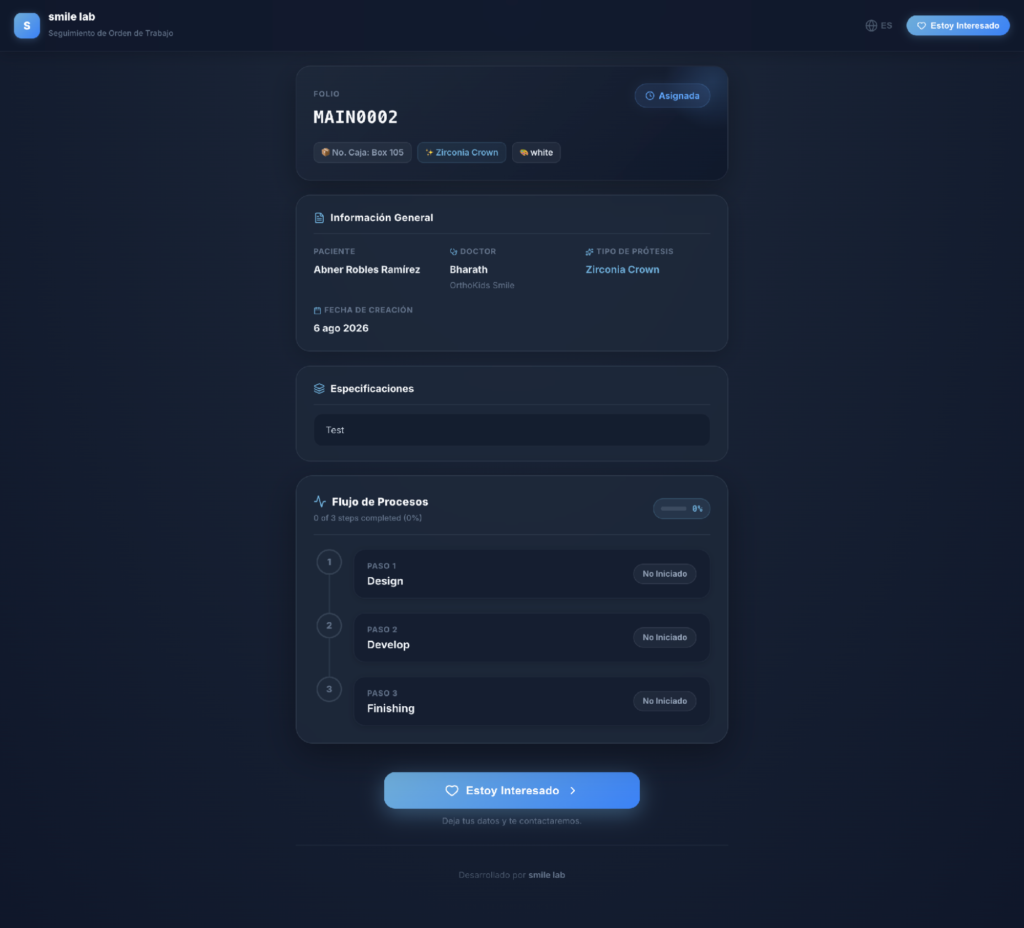
Each work order generates a unique QR code attached to the physical tray.
Instead of searching paperwork, technicians simply scan the tray using a mobile device.
Scanning the QR code allows them to:
- View work-order details
- Start production
- Complete assigned processes
- Update work status instantly
This removes manual paperwork while maintaining traceability throughout production.
Technology Stack
The platform is built using a modern TypeScript ecosystem.
Layer
- Frontend
- Backend
- Database
- ORM
- Authentication
- Queue System
- Cache
- Real-Time
- API Documentation
- Deployment
Technology
- React + TypeScript + Vite
- NestJS
- PostgreSQL
- Prisma
- JWT + RBAC
- BullMQ
- Redis
- Socket.IO
- Swagger
- Docker + Nginx + PM2
Why This Stack?
React provides a responsive user interface.
NestJS offers a modular architecture suitable for enterprise applications.
PostgreSQL ensures reliable relational data storage.
Prisma simplifies schema evolution and database migrations.
Redis and BullMQ handle asynchronous operations such as notifications, reminders, and reporting.
Socket.IO delivers real-time updates across all connected users.
Phase 1 Achievements
The first phase establishes the digital foundation of the platform.
Key deliverables include:
- Multi-tenant architecture
- Multi-branch management
- Work-order lifecycle automation
- Technician workflow management
- QR-code tracking
- Real-time dashboards
- Role-based permissions
- Dual-language support (Spanish and English)
- Financial reporting
- Operational analytics
This phase successfully replaces the traditional paper-based workflow with a fully digital production system.
Future Roadmap
The platform has been designed for long-term scalability.
Phase 2
- Doctor Portal
- Online work-order submission
- Digital scan uploads
Phase 4
- Delivery mobile application
- GPS tracking
- Digital proof of delivery
Conclusion
Digital transformation in dental laboratories is no longer optional—it is becoming a competitive necessity.
By replacing paper-based operations with a cloud-native SaaS platform, laboratories gain complete operational visibility, real-time collaboration, and measurable productivity improvements.
Our multi-tenant architecture, built using React, NestJS, PostgreSQL, Redis, BullMQ, and Socket.IO, provides a scalable foundation for future innovations such as AI-assisted production planning, CAD/CAM integrations, and intelligent logistics.
Phase 1 has successfully demonstrated how modern software architecture can transform traditional dental laboratory operations into a connected, efficient, and data-driven ecosystem.
WO Lifecycle:
QR-Code Enabled Production Tracking (mobile):
 Dynamic llms.txt Generator – WordPress Plug...